GAMETOGENESIS, FERTILIZATION AND EMBRYONIC 
DEVELOPMENT IN HUMAN 
NEELAM DEVPURA 
(M.Sc., NET, GATE) 
Ph.D. Scholar 1
CONTENT 
Gametogenesis 
a. spermatogenesis 
b. oogenesis 
Hormonal control of spermatogenesis and 
oogenesis 
Fertilization 
Cleavage 
Gastrulation 
Embryo development 
2
GAMETOGENESIS 
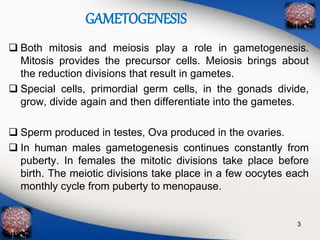
 Both mitosis and meiosis play a role in gametogenesis. 
Mitosis provides the precursor cells. Meiosis brings about 
the reduction divisions that result in gametes. 
 Special cells, primordial germ cells, in the gonads divide, 
grow, divide again and then differentiate into the gametes. 
 Sperm produced in testes, Ova produced in the ovaries. 
 In human males gametogenesis continues constantly from 
puberty. In females the mitotic divisions take place before 
birth. The meiotic divisions take place in a few oocytes each 
monthly cycle from puberty to menopause. 
3
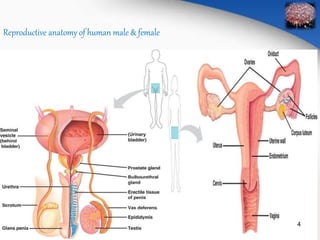
Reproductive anatomy of human male & female 
4
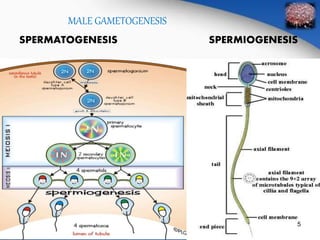
MALE GAMETOGENESIS 
SPERMATOGENESIS SPERMIOGENESIS 
5
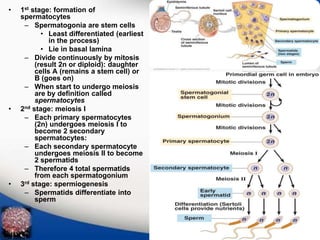
• 1st stage: formation of 
spermatocytes 
– Spermatogonia are stem cells 
• Least differentiated (earliest 
in the process) 
• Lie in basal lamina 
– Divide continuously by mitosis 
(result 2n or diploid): daughter 
cells A (remains a stem cell) or 
B (goes on) 
– When start to undergo meiosis 
are by definition called 
spermatocytes 
• 2nd stage: meiosis I 
– Each primary spermatocytes 
(2n) undergoes meiosis I to 
become 2 secondary 
spermatocytes: 
– Each secondary spermatocyte 
undergoes meiosis II to become 
2 spermatids 
– Therefore 4 total spermatids 
from each spermatogonium 
• 3rd stage: spermiogenesis 
– Spermatids differentiate into 
sperm 
6
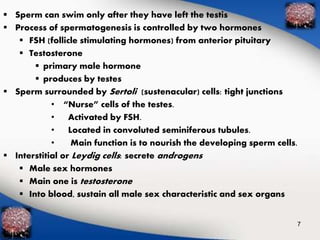
 Sperm can swim only after they have left the testis 
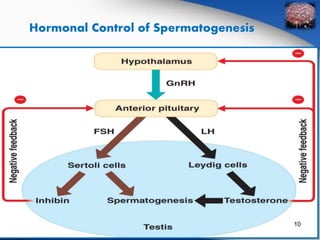
 Process of spermatogenesis is controlled by two hormones 
 FSH (follicle stimulating hormones) from anterior pituitary 
 Testosterone 
 primary male hormone 
 produces by testes 
 Sperm surrounded by Sertoli (sustenacular) cells: tight junctions 
• “Nurse” cells of the testes. 
• Activated by FSH. 
• Located in convoluted seminiferous tubules. 
• Main function is to nourish the developing sperm cells. 
 Interstitial or Leydig cells: secrete androgens 
 Male sex hormones 
 Main one is testosterone 
 Into blood, sustain all male sex characteristic and sex organs 
7
8
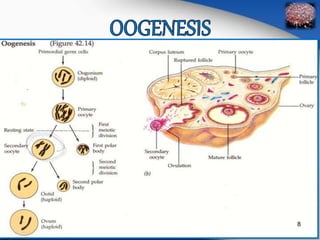
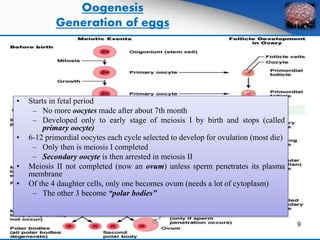
Oogenesis 
Generation of eggs 
• Starts in fetal period 
– No more oocytes made after about 7th month 
– Developed only to early stage of meiosis I by birth and stops (called 
primary oocyte) 
• 6-12 primordial oocytes each cycle selected to develop for ovulation (most die) 
– Only then is meiosis I completed 
– Secondary oocyte is then arrested in meiosis II 
• Meiosis II not completed (now an ovum) unless sperm penetrates its plasma 
membrane 
• Of the 4 daughter cells, only one becomes ovum (needs a lot of cytoplasm) 
– The other 3 become “polar bodies” 
9
Hormonal Control of Spermatogenesis 
10
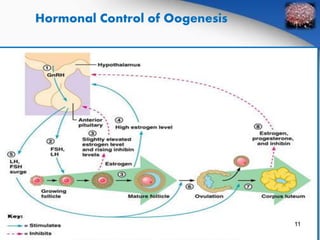
Hormonal Control of Oogenesis 
11
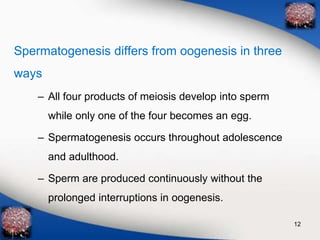
Spermatogenesis differs from oogenesis in three 
ways 
– All four products of meiosis develop into sperm 
while only one of the four becomes an egg. 
– Spermatogenesis occurs throughout adolescence 
and adulthood. 
– Sperm are produced continuously without the 
prolonged interruptions in oogenesis. 
12
13
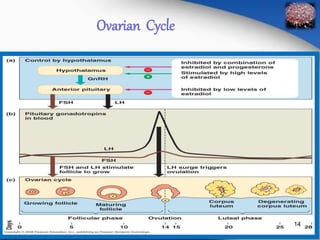
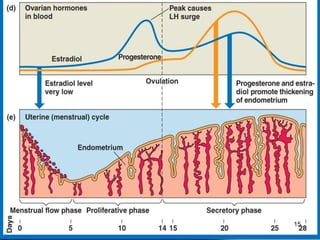
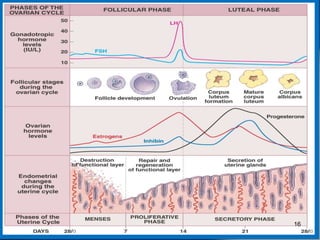
Ovarian Cycle 
14
15
16
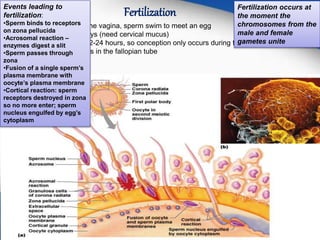
Fertilization 
 After ejaculation into the vagina, sperm swim to meet an egg 
 Sperm live 5-7 days (need cervical mucus) 
 Eggs live about 12-24 hours, so conception only occurs during this short window 
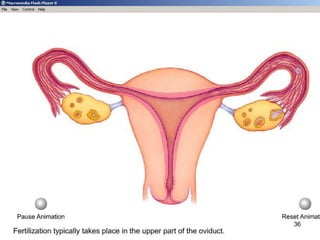
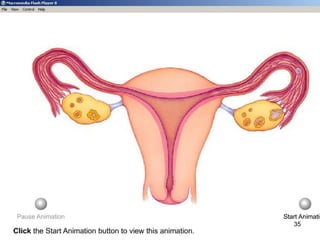
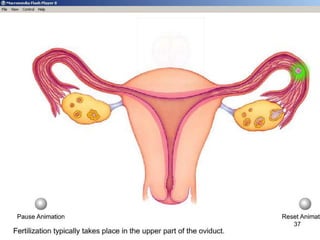
 Fertilization occurs in the fallopian tube 
17 
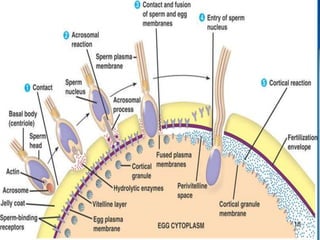
Events leading to 
fertilization: 
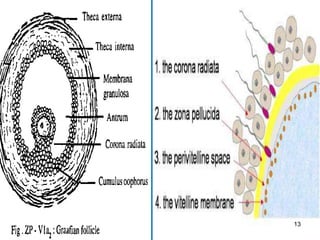
•Sperm binds to receptors 
on zona pellucida 
•Acrosomal reaction – 
enzymes digest a slit 
•Sperm passes through 
zona 
•Fusion of a single sperm’s 
plasma membrane with 
oocyte’s plasma membrane 
•Cortical reaction: sperm 
receptors destroyed in zona 
so no more enter; sperm 
nucleus engulfed by egg’s 
cytoplasm 
Fertilization occurs at 
the moment the 
chromosomes from the 
male and female 
gametes unite
18
19
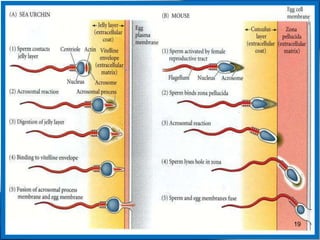
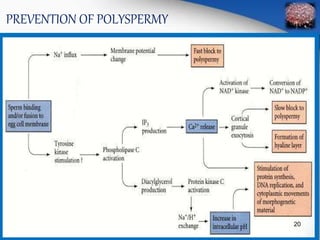
PREVENTION OF POLYSPERMY 
20
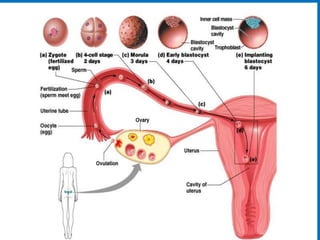
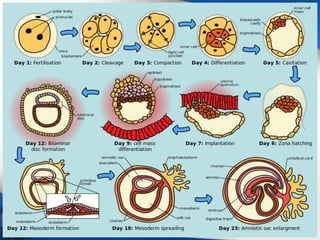
Initial days 
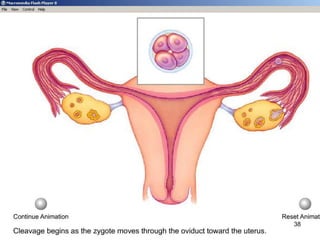
• Cleavage (cell division) 
• Blastocyst stage by day 4: now in uterus 
21
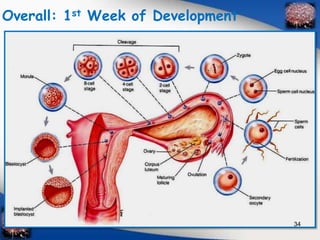
 Conception, fertilization of an egg by a sperm, occurs in 
the oviduct. 
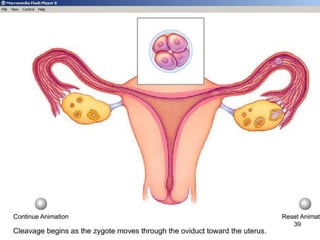
 The resulting zygote begins to divide by mitosis in a 
process called cleavage. 
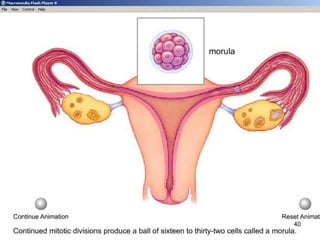
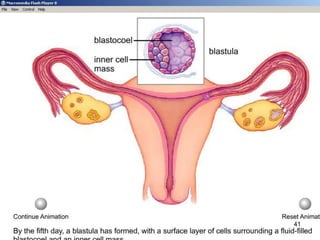
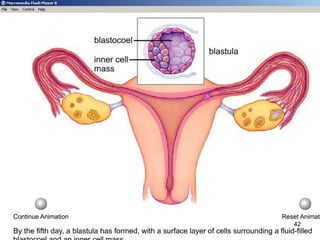
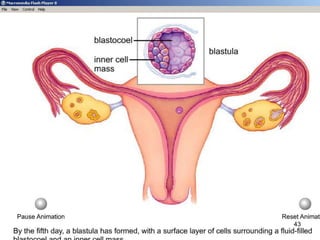
 Division of cells gives rise to a blastocyst, a ball of cells 
with a central cavity. 
 After blastocyst formation, the embryo implants into the 
endometrium 
 The embryo releases human chorionic gonadotropin 
(hCG), which prevents menstruation 
 Pregnancy, or gestation, is the condition of carrying one 
or more embryos in the uterus 
22
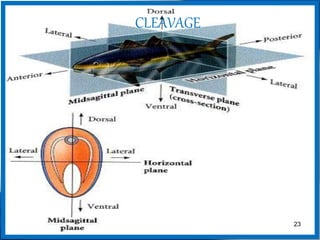
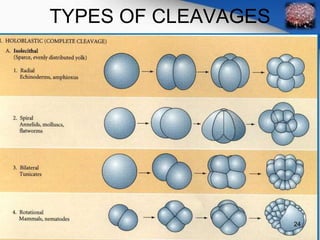
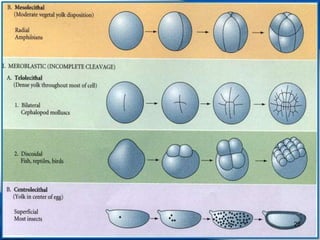
CLEAVAGE 
• Cleavage produces a ball of cells from the zygote 
– Cleavage 
•Rapid succession of cell divisions that produces a 
ball of cells – a multicellular embryo – from the 
zygote 
•PLANES OF CLEAVAGE: 
23
TYPES OF CLEAVAGES 
24
25
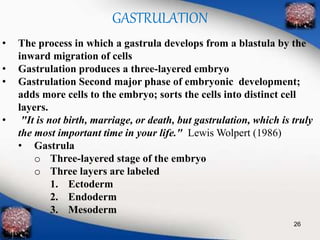
GASTRULATION 
• The process in which a gastrula develops from a blastula by the 
inward migration of cells 
• Gastrulation produces a three-layered embryo 
• Gastrulation Second major phase of embryonic development; 
adds more cells to the embryo; sorts the cells into distinct cell 
layers. 
• "It is not birth, marriage, or death, but gastrulation, which is truly 
the most important time in your life." Lewis Wolpert (1986) 
• Gastrula 
o Three-layered stage of the embryo 
o Three layers are labeled 
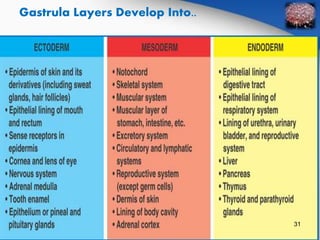
1. Ectoderm 
2. Endoderm 
3. Mesoderm 
26
27
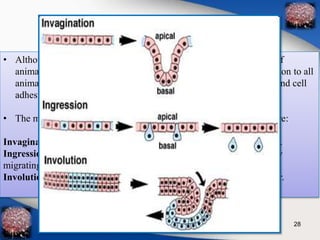
• Although the details of gastrulation differ between various groups of 
animals, the cellular mechanisms involved in gastrulation are common to all 
animals. Gastrulation involves changes in cell motility, cell shape, and cell 
adhesion. 
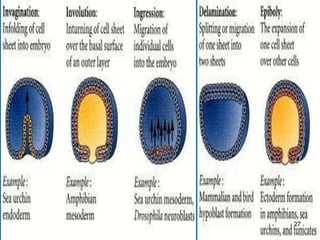
• The major types of cell movements that occur during gastrulation are: 
Invagination: a sheet of cells (called an epithelial sheet) bends inward. 
Ingression: individual cells leave an epithelial sheet and become freely 
migrating mesenchyme cells. 
Involution: an epithelial sheet rolls inward to form an underlying layer. 
28
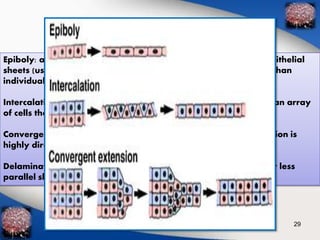
Epiboly: a sheet of cells spreads by thinning. The movement of epithelial 
sheets (usually of ectodermal cells) that spread as a unit, rather than 
individually, to enclose the deeper layers of the embryo. 
Intercalation: rows of cells move between one another, creating an array 
of cells that is longer (in one or more dimensions) but thinner. 
Convergent Extension: rows of cells intercalate, but the intercalation is 
highly directional. 
Delamination. The splitting of one cellular sheet into two more or less 
parallel sheets 
29
30
Gastrula Layers Develop Into.. 
31
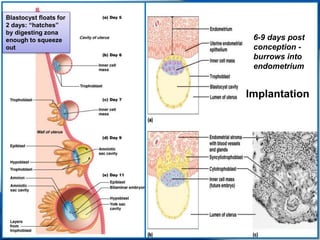
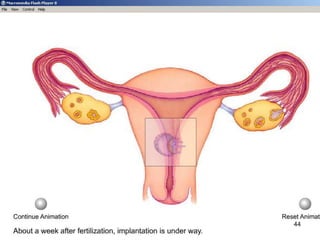
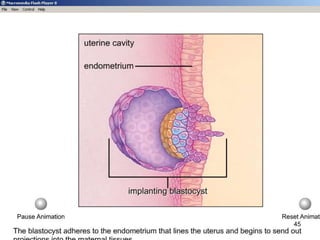
Implantation 
32 
Blastocyst floats for 
2 days: “hatches” 
by digesting zona 
enough to squeeze 
out 
6-9 days post 
conception - 
burrows into 
endometrium
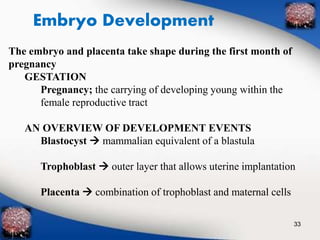
Embryo Development 
The embryo and placenta take shape during the first month of 
pregnancy 
GESTATION 
Pregnancy; the carrying of developing young within the 
female reproductive tract 
AN OVERVIEW OF DEVELOPMENT EVENTS 
Blastocyst  mammalian equivalent of a blastula 
Trophoblast  outer layer that allows uterine implantation 
Placenta  combination of trophoblast and maternal cells 
33
Overall: 1st Week of Development 
34
35
36
37
38
39
40
41
42
43
44
45
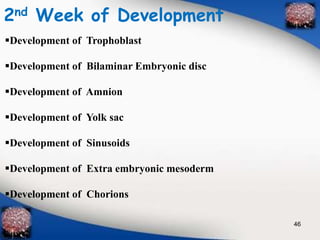
2nd Week of Development 
Development of Trophoblast 
Development of Bilaminar Embryonic disc 
Development of Amnion 
Development of Yolk sac 
Development of Sinusoids 
Development of Extra embryonic mesoderm 
Development of Chorions 
46
47
3rd Week of Development 
Gastrulation 
Primitive Stalk formation, Primitive Node formation 
Trilaminar Disk formation 
Notochordal process, Notochord, Archentron 
Oropharangeal & Cloacal membrane 
Neurulation 
Development of Chorionic Villi 
Development of Placenta 
48
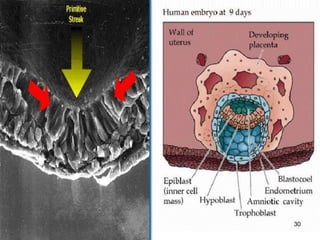
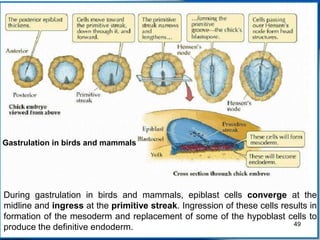
Gastrulation in birds and mammals 
During gastrulation in birds and mammals, epiblast cells converge at the 
midline and ingress at the primitive streak. Ingression of these cells results in 
formation of the mesoderm and replacement of some of the hypoblast cells to 
produce the definitive endoderm. 49
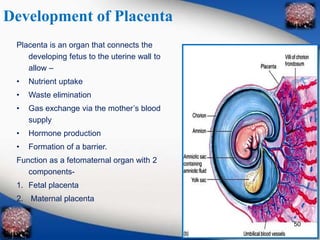
Development of Placenta 
Placenta is an organ that connects the 
developing fetus to the uterine wall to 
allow – 
• Nutrient uptake 
• Waste elimination 
• Gas exchange via the mother’s blood 
supply 
• Hormone production 
• Formation of a barrier. 
Function as a fetomaternal organ with 2 
components- 
1. Fetal placenta 
2. Maternal placenta 
50
The “Placental Barrier” 
• Sugars, fats and oxygen diffuse from mother’s blood to fetus 
• Urea and CO2 diffuse from fetus to mother 
• Maternal antibodies actively transported across placenta 
• Some resistance to disease (passive immunity) 
• Most bacteria are blocked 
• Many viruses can pass including rubella, chickenpox, mono, sometimes HIV 
• Many drugs and toxins pass including alcohol, heroin, mercury 
• Placental secretion of hormones 
• Progesterone and HCG (human chorionic gonadotropin, the hormone tested 
for pregnancy): maintain the uterus 
• Estrogens and CRH (corticotropin releasing hormone): promote labor 
51
Extra embryonic membranes 
• Amnion  protective fluid 
• Yolk sac  no yolk in humans, but same name; 
nourishment for non- placentals. 
• Chorion  become embryos part of placenta 
 Releases human chorionic gonadotropin (hcg) 
 Causes corpus luteum to stay; prevents menstruation 
• Allantois  functions in waste disposal; will 
become the umbilical cord 
52

Human developmental Biology

  • 1.
    GAMETOGENESIS, FERTILIZATION ANDEMBRYONIC DEVELOPMENT IN HUMAN NEELAM DEVPURA (M.Sc., NET, GATE) Ph.D. Scholar 1
  • 2.
    CONTENT Gametogenesis a.spermatogenesis b. oogenesis Hormonal control of spermatogenesis and oogenesis Fertilization Cleavage Gastrulation Embryo development 2
  • 3.
    GAMETOGENESIS  Bothmitosis and meiosis play a role in gametogenesis. Mitosis provides the precursor cells. Meiosis brings about the reduction divisions that result in gametes.  Special cells, primordial germ cells, in the gonads divide, grow, divide again and then differentiate into the gametes.  Sperm produced in testes, Ova produced in the ovaries.  In human males gametogenesis continues constantly from puberty. In females the mitotic divisions take place before birth. The meiotic divisions take place in a few oocytes each monthly cycle from puberty to menopause. 3
  • 4.
    Reproductive anatomy ofhuman male & female 4
  • 5.
  • 6.
    • 1st stage:formation of spermatocytes – Spermatogonia are stem cells • Least differentiated (earliest in the process) • Lie in basal lamina – Divide continuously by mitosis (result 2n or diploid): daughter cells A (remains a stem cell) or B (goes on) – When start to undergo meiosis are by definition called spermatocytes • 2nd stage: meiosis I – Each primary spermatocytes (2n) undergoes meiosis I to become 2 secondary spermatocytes: – Each secondary spermatocyte undergoes meiosis II to become 2 spermatids – Therefore 4 total spermatids from each spermatogonium • 3rd stage: spermiogenesis – Spermatids differentiate into sperm 6
  • 7.
     Sperm canswim only after they have left the testis  Process of spermatogenesis is controlled by two hormones  FSH (follicle stimulating hormones) from anterior pituitary  Testosterone  primary male hormone  produces by testes  Sperm surrounded by Sertoli (sustenacular) cells: tight junctions • “Nurse” cells of the testes. • Activated by FSH. • Located in convoluted seminiferous tubules. • Main function is to nourish the developing sperm cells.  Interstitial or Leydig cells: secrete androgens  Male sex hormones  Main one is testosterone  Into blood, sustain all male sex characteristic and sex organs 7
  • 8.
  • 9.
    Oogenesis Generation ofeggs • Starts in fetal period – No more oocytes made after about 7th month – Developed only to early stage of meiosis I by birth and stops (called primary oocyte) • 6-12 primordial oocytes each cycle selected to develop for ovulation (most die) – Only then is meiosis I completed – Secondary oocyte is then arrested in meiosis II • Meiosis II not completed (now an ovum) unless sperm penetrates its plasma membrane • Of the 4 daughter cells, only one becomes ovum (needs a lot of cytoplasm) – The other 3 become “polar bodies” 9
  • 10.
    Hormonal Control ofSpermatogenesis 10
  • 11.
    Hormonal Control ofOogenesis 11
  • 12.
    Spermatogenesis differs fromoogenesis in three ways – All four products of meiosis develop into sperm while only one of the four becomes an egg. – Spermatogenesis occurs throughout adolescence and adulthood. – Sperm are produced continuously without the prolonged interruptions in oogenesis. 12
  • 13.
  • 14.
  • 15.
  • 16.
  • 17.
    Fertilization  Afterejaculation into the vagina, sperm swim to meet an egg  Sperm live 5-7 days (need cervical mucus)  Eggs live about 12-24 hours, so conception only occurs during this short window  Fertilization occurs in the fallopian tube 17 Events leading to fertilization: •Sperm binds to receptors on zona pellucida •Acrosomal reaction – enzymes digest a slit •Sperm passes through zona •Fusion of a single sperm’s plasma membrane with oocyte’s plasma membrane •Cortical reaction: sperm receptors destroyed in zona so no more enter; sperm nucleus engulfed by egg’s cytoplasm Fertilization occurs at the moment the chromosomes from the male and female gametes unite
  • 18.
  • 19.
  • 20.
  • 21.
    Initial days •Cleavage (cell division) • Blastocyst stage by day 4: now in uterus 21
  • 22.
     Conception, fertilizationof an egg by a sperm, occurs in the oviduct.  The resulting zygote begins to divide by mitosis in a process called cleavage.  Division of cells gives rise to a blastocyst, a ball of cells with a central cavity.  After blastocyst formation, the embryo implants into the endometrium  The embryo releases human chorionic gonadotropin (hCG), which prevents menstruation  Pregnancy, or gestation, is the condition of carrying one or more embryos in the uterus 22
  • 23.
    CLEAVAGE • Cleavageproduces a ball of cells from the zygote – Cleavage •Rapid succession of cell divisions that produces a ball of cells – a multicellular embryo – from the zygote •PLANES OF CLEAVAGE: 23
  • 24.
  • 25.
  • 26.
    GASTRULATION • Theprocess in which a gastrula develops from a blastula by the inward migration of cells • Gastrulation produces a three-layered embryo • Gastrulation Second major phase of embryonic development; adds more cells to the embryo; sorts the cells into distinct cell layers. • "It is not birth, marriage, or death, but gastrulation, which is truly the most important time in your life." Lewis Wolpert (1986) • Gastrula o Three-layered stage of the embryo o Three layers are labeled 1. Ectoderm 2. Endoderm 3. Mesoderm 26
  • 27.
  • 28.
    • Although thedetails of gastrulation differ between various groups of animals, the cellular mechanisms involved in gastrulation are common to all animals. Gastrulation involves changes in cell motility, cell shape, and cell adhesion. • The major types of cell movements that occur during gastrulation are: Invagination: a sheet of cells (called an epithelial sheet) bends inward. Ingression: individual cells leave an epithelial sheet and become freely migrating mesenchyme cells. Involution: an epithelial sheet rolls inward to form an underlying layer. 28
  • 29.
    Epiboly: a sheetof cells spreads by thinning. The movement of epithelial sheets (usually of ectodermal cells) that spread as a unit, rather than individually, to enclose the deeper layers of the embryo. Intercalation: rows of cells move between one another, creating an array of cells that is longer (in one or more dimensions) but thinner. Convergent Extension: rows of cells intercalate, but the intercalation is highly directional. Delamination. The splitting of one cellular sheet into two more or less parallel sheets 29
  • 30.
  • 31.
  • 32.
    Implantation 32 Blastocystfloats for 2 days: “hatches” by digesting zona enough to squeeze out 6-9 days post conception - burrows into endometrium
  • 33.
    Embryo Development Theembryo and placenta take shape during the first month of pregnancy GESTATION Pregnancy; the carrying of developing young within the female reproductive tract AN OVERVIEW OF DEVELOPMENT EVENTS Blastocyst  mammalian equivalent of a blastula Trophoblast  outer layer that allows uterine implantation Placenta  combination of trophoblast and maternal cells 33
  • 34.
    Overall: 1st Weekof Development 34
  • 35.
  • 36.
  • 37.
  • 38.
  • 39.
  • 40.
  • 41.
  • 42.
  • 43.
  • 44.
  • 45.
  • 46.
    2nd Week ofDevelopment Development of Trophoblast Development of Bilaminar Embryonic disc Development of Amnion Development of Yolk sac Development of Sinusoids Development of Extra embryonic mesoderm Development of Chorions 46
  • 47.
  • 48.
    3rd Week ofDevelopment Gastrulation Primitive Stalk formation, Primitive Node formation Trilaminar Disk formation Notochordal process, Notochord, Archentron Oropharangeal & Cloacal membrane Neurulation Development of Chorionic Villi Development of Placenta 48
  • 49.
    Gastrulation in birdsand mammals During gastrulation in birds and mammals, epiblast cells converge at the midline and ingress at the primitive streak. Ingression of these cells results in formation of the mesoderm and replacement of some of the hypoblast cells to produce the definitive endoderm. 49
  • 50.
    Development of Placenta Placenta is an organ that connects the developing fetus to the uterine wall to allow – • Nutrient uptake • Waste elimination • Gas exchange via the mother’s blood supply • Hormone production • Formation of a barrier. Function as a fetomaternal organ with 2 components- 1. Fetal placenta 2. Maternal placenta 50
  • 51.
    The “Placental Barrier” • Sugars, fats and oxygen diffuse from mother’s blood to fetus • Urea and CO2 diffuse from fetus to mother • Maternal antibodies actively transported across placenta • Some resistance to disease (passive immunity) • Most bacteria are blocked • Many viruses can pass including rubella, chickenpox, mono, sometimes HIV • Many drugs and toxins pass including alcohol, heroin, mercury • Placental secretion of hormones • Progesterone and HCG (human chorionic gonadotropin, the hormone tested for pregnancy): maintain the uterus • Estrogens and CRH (corticotropin releasing hormone): promote labor 51
  • 52.
    Extra embryonic membranes • Amnion  protective fluid • Yolk sac  no yolk in humans, but same name; nourishment for non- placentals. • Chorion  become embryos part of placenta  Releases human chorionic gonadotropin (hcg)  Causes corpus luteum to stay; prevents menstruation • Allantois  functions in waste disposal; will become the umbilical cord 52