By Madeeha Anjum
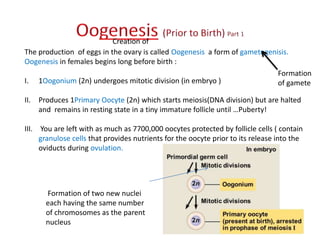
The production of eggs in the ovary is called Oogenesis a form of gametogenisis.
Oogenesis in females begins long before birth :
I. 1Oogonium (2n) undergoes mitotic division (in embryo )
II. Produces 1Primary Oocyte (2n) which starts meiosis(DNA division) but are halted
and remains in resting state in a tiny immature follicle until …Puberty!
III. You are left with as much as 7700,000 oocytes protected by follicle cells ( contain
granulose cells that provides nutrients for the oocyte prior to its release into the
oviducts during ovulation.
Formation of two new nuclei
each having the same number
of chromosomes as the parent
nucleus
Formation
of gamete
Creation of
Menstrual Cycle
Maturation of the primary oocyte(2n)begins the menstrual cycle
One puberty is reached multiple primary oocyte(2n) inside the follicle in one of the
female ovaries , starts to mature. One primary oocyte(2n) outgrows the rest eventually
resuming meiosis. The other cells degenerate .
Resuming meiosis the primary oocyte(2n) divides to form a secondary oocyte(n) and a
smaller cell called the polar body (n)
Meiotic division results in four
daughter cells each with half the
number of chromosomes of the
parent cell
Oogenesis (Post Birth) Part 2
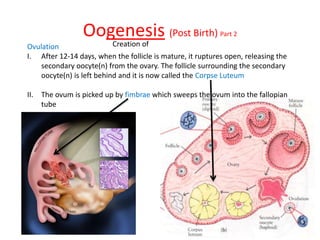
Ovulation
I. After 12-14 days, when the follicle is mature, it ruptures open, releasing the
secondary oocyte(n) from the ovary. The follicle surrounding the secondary
oocyte(n) is left behind and it is now called the Corpse Luteum
II. The ovum is picked up by fimbrae which sweeps the ovum into the fallopian
tube
Creation of
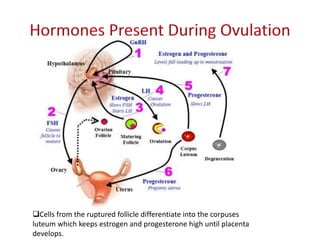
Cells from the ruptured follicle differentiate into the corpuses
luteum which keeps estrogen and progesterone high until placenta
develops.
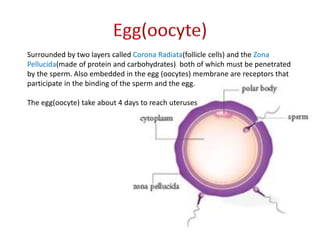
Surrounded by two layers called Corona Radiata(follicle cells) and the Zona
Pellucida(made of protein and carbohydrates) both of which must be penetrated
by the sperm. Also embedded in the egg (oocytes) membrane are receptors that
participate in the binding of the sperm and the egg.
The egg(oocyte) take about 4 days to reach uteruses
Creation of
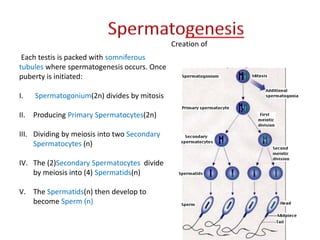
Each testis is packed with somniferous
tubules where spermatogenesis occurs. Once
puberty is initiated:
I. Spermatogonium(2n) divides by mitosis
II. Producing Primary Spermatocytes(2n)
III. Dividing by meiosis into two Secondary
Spermatocytes (n)
IV. The (2)Secondary Spermatocytes divide
by meiosis into (4) Spermatids(n)
V. The Spermatids(n) then develop to
become Sperm (n)
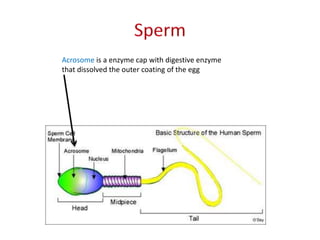
Acrosome is a enzyme cap with digestive enzyme
that dissolved the outer coating of the egg
Upon ejaculation 150-300 million sperm are released exiting the male
urethra . Once they enter the females vagina they must make there way to
the cervix , then through the uterus and finally through the oviduct/ fallopian
tube
Most do not survive this journey . Many are destroyed by the natural acidic
environment of the vagina or go the wrong direction. Only 100 will make it
close to the egg.
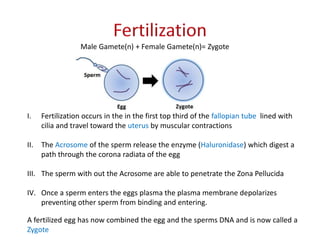
Male Gamete(n) + Female Gamete(n)= Zygote
I. Fertilization occurs in the in the first top third of the fallopian tube lined with
cilia and travel toward the uterus by muscular contractions
II. The Acrosome of the sperm release the enzyme (Haluronidase) which digest a
path through the corona radiata of the egg
III. The sperm with out the Acrosome are able to penetrate the Zona Pellucida
IV. Once a sperm enters the eggs plasma the plasma membrane depolarizes
preventing other sperm from binding and entering.
A fertilized egg has now combined the egg and the sperms DNA and is now called a
Zygote
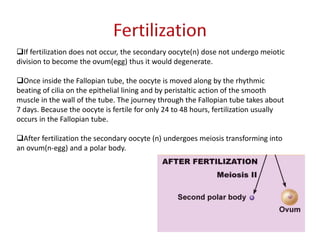
If fertilization does not occur, the secondary oocyte(n) dose not undergo meiotic
division to become the ovum(egg) thus it would degenerate.
Once inside the Fallopian tube, the oocyte is moved along by the rhythmic
beating of cilia on the epithelial lining and by peristaltic action of the smooth
muscle in the wall of the tube. The journey through the Fallopian tube takes about
7 days. Because the oocyte is fertile for only 24 to 48 hours, fertilization usually
occurs in the Fallopian tube.
After fertilization the secondary oocyte (n) undergoes meiosis transforming into
an ovum(n-egg) and a polar body.
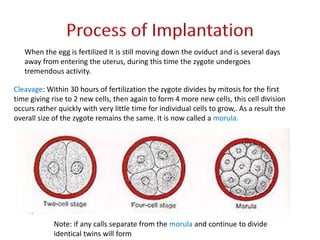
When the egg is fertilized it is still moving down the oviduct and is several days
away from entering the uterus, during this time the zygote undergoes
tremendous activity.
Cleavage: Within 30 hours of fertilization the zygote divides by mitosis for the first
time giving rise to 2 new cells, then again to form 4 more new cells, this cell division
occurs rather quickly with very little time for individual cells to grow,. As a result the
overall size of the zygote remains the same. It is now called a morula.
Note: if any calls separate from the morula and continue to divide
identical twins will form
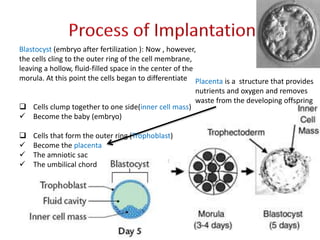
Blastocyst (embryo after fertilization ): Now , however,
the cells cling to the outer ring of the cell membrane,
leaving a hollow, fluid-filled space in the center of the
morula. At this point the cells began to differentiate
 Cells clump together to one side(inner cell mass)
 Become the baby (embryo)
 Cells that form the outer ring (Trophoblast)
 Become the placenta
 The amniotic sac
 The umbilical chord
Placenta is a structure that provides
nutrients and oxygen and removes
waste from the developing offspring
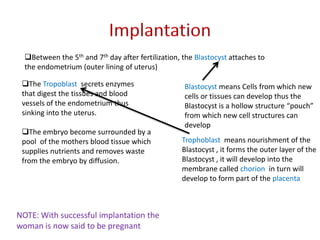
The embryo become surrounded by a
pool of the mothers blood tissue which
supplies nutrients and removes waste
from the embryo by diffusion.
Trophoblast means nourishment of the
Blastocyst , it forms the outer layer of the
Blastocyst , it will develop into the
membrane called chorion in turn will
develop to form part of the placenta
Blastocyst means Cells from which new
cells or tissues can develop thus the
Blastocyst is a hollow structure “pouch”
from which new cell structures can
develop
Between the 5th and 7th day after fertilization, the Blastocyst attaches to
the endometrium (outer lining of uterus)
The Tropoblast secrets enzymes
that digest the tissues and blood
vessels of the endometrium thus
sinking into the uterus.
NOTE: With successful implantation the
woman is now said to be pregnant
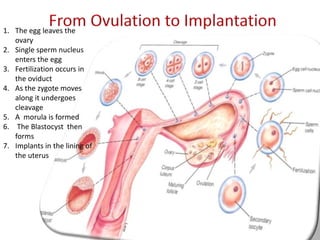
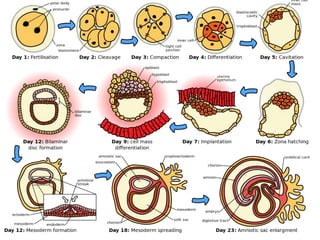
1. The egg leaves the
ovary
2. Single sperm nucleus
enters the egg
3. Fertilization occurs in
the oviduct
4. As the zygote moves
along it undergoes
cleavage
5. A morula is formed
6. The Blastocyst then
forms
7. Implants in the lining of
the uterus
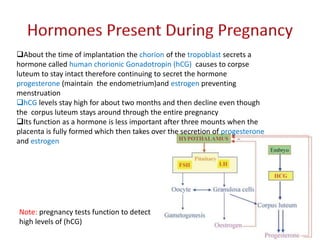
About the time of implantation the chorion of the tropoblast secrets a
hormone called human chorionic Gonadotropin (hCG) causes to corpse
luteum to stay intact therefore continuing to secret the hormone
progesterone (maintain the endometrium)and estrogen preventing
menstruation
hCG levels stay high for about two months and then decline even though
the corpus luteum stays around through the entire pregnancy
Its function as a hormone is less important after three mounts when the
placenta is fully formed which then takes over the secretion of progesterone
and estrogen
Note: pregnancy tests function to detect
high levels of (hCG)
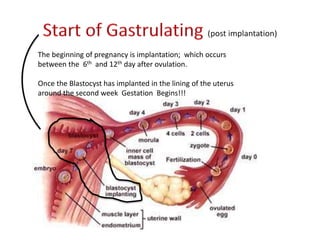
The beginning of pregnancy is implantation; which occurs
between the 6th and 12th day after ovulation.
Once the Blastocyst has implanted in the lining of the uterus
around the second week Gestation Begins!!!
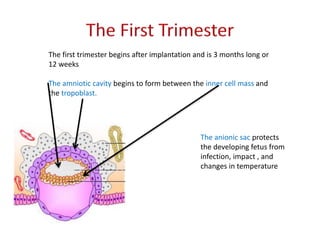
The first trimester begins after implantation and is 3 months long or
12 weeks
The amniotic cavity begins to form between the inner cell mass and
the tropoblast.
The anionic sac protects
the developing fetus from
infection, impact , and
changes in temperature
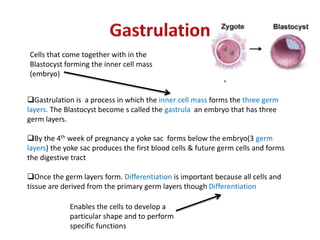
Gastrulation is a process in which the inner cell mass forms the three germ
layers. The Blastocyst become s called the gastrula an embryo that has three
germ layers.
By the 4th week of pregnancy a yoke sac forms below the embryo(3 germ
layers) the yoke sac produces the first blood cells & future germ cells and forms
the digestive tract
Once the germ layers form. Differentiation is important because all cells and
tissue are derived from the primary germ layers though Differentiation
Enables the cells to develop a
particular shape and to perform
specific functions
Cells that come together with in the
Blastocyst forming the inner cell mass
(embryo)
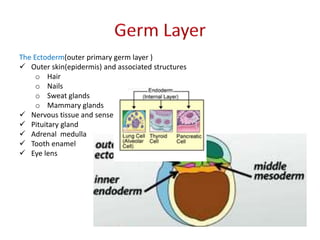
The Ectoderm(outer primary germ layer )
 Outer skin(epidermis) and associated structures
o Hair
o Nails
o Sweat glands
o Mammary glands
 Nervous tissue and sense organs
 Pituitary gland
 Adrenal medulla
 Tooth enamel
 Eye lens
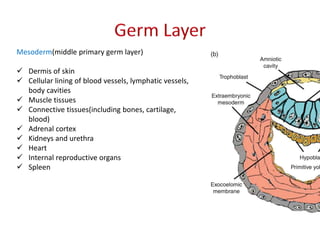
Mesoderm(middle primary germ layer)
 Dermis of skin
 Cellular lining of blood vessels, lymphatic vessels,
body cavities
 Muscle tissues
 Connective tissues(including bones, cartilage,
blood)
 Adrenal cortex
 Kidneys and urethra
 Heart
 Internal reproductive organs
 Spleen
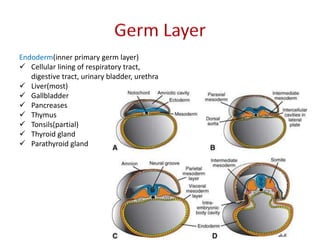
Endoderm(inner primary germ layer)
 Cellular lining of respiratory tract,
digestive tract, urinary bladder, urethra
 Liver(most)
 Gallbladder
 Pancreases
 Thymus
 Tonsils(partial)
 Thyroid gland
 Parathyroid gland
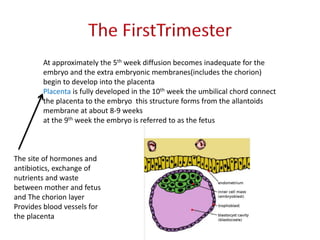
At approximately the 5th week diffusion becomes inadequate for the
embryo and the extra embryonic membranes(includes the chorion)
begin to develop into the placenta
Placenta is fully developed in the 10th week the umbilical chord connect
the placenta to the embryo this structure forms from the allantoids
membrane at about 8-9 weeks
at the 9th week the embryo is referred to as the fetus
The site of hormones and
antibiotics, exchange of
nutrients and waste
between mother and fetus
and The chorion layer
Provides blood vessels for
the placenta
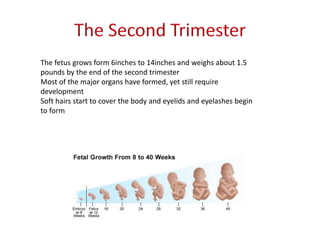
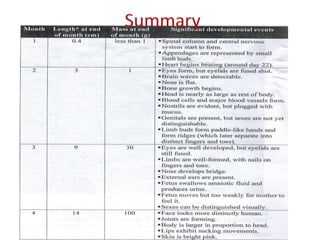
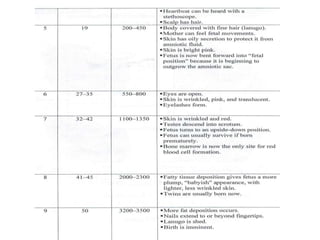
The fetus grows form 6inches to 14inches and weighs about 1.5
pounds by the end of the second trimester
Most of the major organs have formed, yet still require
development
Soft hairs start to cover the body and eyelids and eyelashes begin
to form
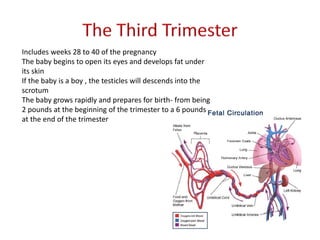
Includes weeks 28 to 40 of the pregnancy
The baby begins to open its eyes and develops fat under
its skin
If the baby is a boy , the testicles will descends into the
scrotum
The baby grows rapidly and prepares for birth- from being
2 pounds at the beginning of the trimester to a 6 pounds
at the end of the trimester
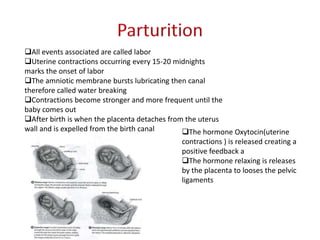
All events associated are called labor
Uterine contractions occurring every 15-20 midnights
marks the onset of labor
The amniotic membrane bursts lubricating then canal
therefore called water breaking
Contractions become stronger and more frequent until the
baby comes out
After birth is when the placenta detaches from the uterus
wall and is expelled from the birth canal The hormone Oxytocin(uterine
contractions ) is released creating a
positive feedback a
The hormone relaxing is releases
by the placenta to looses the pelvic
ligaments
http://legacy.owensboro.kctcs.edu/gcaplan/anat
2/notes/APIINotes2%20female%20reproduction.
htm
http://www.ck12.org/book/CK-12-Biology-
Concepts/section/13.63/
http://study.com/academy/lesson/oogenesis-
how-the-female-reproductive-system-produces-
eggs.html
Biology textbook

Pregnancy

  • 1.
  • 2.
    The production ofeggs in the ovary is called Oogenesis a form of gametogenisis. Oogenesis in females begins long before birth : I. 1Oogonium (2n) undergoes mitotic division (in embryo ) II. Produces 1Primary Oocyte (2n) which starts meiosis(DNA division) but are halted and remains in resting state in a tiny immature follicle until …Puberty! III. You are left with as much as 7700,000 oocytes protected by follicle cells ( contain granulose cells that provides nutrients for the oocyte prior to its release into the oviducts during ovulation. Formation of two new nuclei each having the same number of chromosomes as the parent nucleus Formation of gamete Creation of
  • 3.
    Menstrual Cycle Maturation ofthe primary oocyte(2n)begins the menstrual cycle One puberty is reached multiple primary oocyte(2n) inside the follicle in one of the female ovaries , starts to mature. One primary oocyte(2n) outgrows the rest eventually resuming meiosis. The other cells degenerate . Resuming meiosis the primary oocyte(2n) divides to form a secondary oocyte(n) and a smaller cell called the polar body (n) Meiotic division results in four daughter cells each with half the number of chromosomes of the parent cell
  • 4.
    Oogenesis (Post Birth)Part 2 Ovulation I. After 12-14 days, when the follicle is mature, it ruptures open, releasing the secondary oocyte(n) from the ovary. The follicle surrounding the secondary oocyte(n) is left behind and it is now called the Corpse Luteum II. The ovum is picked up by fimbrae which sweeps the ovum into the fallopian tube Creation of
  • 5.
    Cells from theruptured follicle differentiate into the corpuses luteum which keeps estrogen and progesterone high until placenta develops.
  • 6.
    Surrounded by twolayers called Corona Radiata(follicle cells) and the Zona Pellucida(made of protein and carbohydrates) both of which must be penetrated by the sperm. Also embedded in the egg (oocytes) membrane are receptors that participate in the binding of the sperm and the egg. The egg(oocyte) take about 4 days to reach uteruses
  • 7.
    Creation of Each testisis packed with somniferous tubules where spermatogenesis occurs. Once puberty is initiated: I. Spermatogonium(2n) divides by mitosis II. Producing Primary Spermatocytes(2n) III. Dividing by meiosis into two Secondary Spermatocytes (n) IV. The (2)Secondary Spermatocytes divide by meiosis into (4) Spermatids(n) V. The Spermatids(n) then develop to become Sperm (n)
  • 9.
    Acrosome is aenzyme cap with digestive enzyme that dissolved the outer coating of the egg
  • 10.
    Upon ejaculation 150-300million sperm are released exiting the male urethra . Once they enter the females vagina they must make there way to the cervix , then through the uterus and finally through the oviduct/ fallopian tube Most do not survive this journey . Many are destroyed by the natural acidic environment of the vagina or go the wrong direction. Only 100 will make it close to the egg.
  • 11.
    Male Gamete(n) +Female Gamete(n)= Zygote I. Fertilization occurs in the in the first top third of the fallopian tube lined with cilia and travel toward the uterus by muscular contractions II. The Acrosome of the sperm release the enzyme (Haluronidase) which digest a path through the corona radiata of the egg III. The sperm with out the Acrosome are able to penetrate the Zona Pellucida IV. Once a sperm enters the eggs plasma the plasma membrane depolarizes preventing other sperm from binding and entering. A fertilized egg has now combined the egg and the sperms DNA and is now called a Zygote
  • 12.
    If fertilization doesnot occur, the secondary oocyte(n) dose not undergo meiotic division to become the ovum(egg) thus it would degenerate. Once inside the Fallopian tube, the oocyte is moved along by the rhythmic beating of cilia on the epithelial lining and by peristaltic action of the smooth muscle in the wall of the tube. The journey through the Fallopian tube takes about 7 days. Because the oocyte is fertile for only 24 to 48 hours, fertilization usually occurs in the Fallopian tube. After fertilization the secondary oocyte (n) undergoes meiosis transforming into an ovum(n-egg) and a polar body.
  • 13.
    When the eggis fertilized it is still moving down the oviduct and is several days away from entering the uterus, during this time the zygote undergoes tremendous activity. Cleavage: Within 30 hours of fertilization the zygote divides by mitosis for the first time giving rise to 2 new cells, then again to form 4 more new cells, this cell division occurs rather quickly with very little time for individual cells to grow,. As a result the overall size of the zygote remains the same. It is now called a morula. Note: if any calls separate from the morula and continue to divide identical twins will form
  • 14.
    Blastocyst (embryo afterfertilization ): Now , however, the cells cling to the outer ring of the cell membrane, leaving a hollow, fluid-filled space in the center of the morula. At this point the cells began to differentiate  Cells clump together to one side(inner cell mass)  Become the baby (embryo)  Cells that form the outer ring (Trophoblast)  Become the placenta  The amniotic sac  The umbilical chord Placenta is a structure that provides nutrients and oxygen and removes waste from the developing offspring
  • 15.
    The embryo becomesurrounded by a pool of the mothers blood tissue which supplies nutrients and removes waste from the embryo by diffusion. Trophoblast means nourishment of the Blastocyst , it forms the outer layer of the Blastocyst , it will develop into the membrane called chorion in turn will develop to form part of the placenta Blastocyst means Cells from which new cells or tissues can develop thus the Blastocyst is a hollow structure “pouch” from which new cell structures can develop Between the 5th and 7th day after fertilization, the Blastocyst attaches to the endometrium (outer lining of uterus) The Tropoblast secrets enzymes that digest the tissues and blood vessels of the endometrium thus sinking into the uterus. NOTE: With successful implantation the woman is now said to be pregnant
  • 16.
    1. The eggleaves the ovary 2. Single sperm nucleus enters the egg 3. Fertilization occurs in the oviduct 4. As the zygote moves along it undergoes cleavage 5. A morula is formed 6. The Blastocyst then forms 7. Implants in the lining of the uterus
  • 17.
    About the timeof implantation the chorion of the tropoblast secrets a hormone called human chorionic Gonadotropin (hCG) causes to corpse luteum to stay intact therefore continuing to secret the hormone progesterone (maintain the endometrium)and estrogen preventing menstruation hCG levels stay high for about two months and then decline even though the corpus luteum stays around through the entire pregnancy Its function as a hormone is less important after three mounts when the placenta is fully formed which then takes over the secretion of progesterone and estrogen Note: pregnancy tests function to detect high levels of (hCG)
  • 18.
    The beginning ofpregnancy is implantation; which occurs between the 6th and 12th day after ovulation. Once the Blastocyst has implanted in the lining of the uterus around the second week Gestation Begins!!!
  • 19.
    The first trimesterbegins after implantation and is 3 months long or 12 weeks The amniotic cavity begins to form between the inner cell mass and the tropoblast. The anionic sac protects the developing fetus from infection, impact , and changes in temperature
  • 20.
    Gastrulation is aprocess in which the inner cell mass forms the three germ layers. The Blastocyst become s called the gastrula an embryo that has three germ layers. By the 4th week of pregnancy a yoke sac forms below the embryo(3 germ layers) the yoke sac produces the first blood cells & future germ cells and forms the digestive tract Once the germ layers form. Differentiation is important because all cells and tissue are derived from the primary germ layers though Differentiation Enables the cells to develop a particular shape and to perform specific functions Cells that come together with in the Blastocyst forming the inner cell mass (embryo)
  • 21.
    The Ectoderm(outer primarygerm layer )  Outer skin(epidermis) and associated structures o Hair o Nails o Sweat glands o Mammary glands  Nervous tissue and sense organs  Pituitary gland  Adrenal medulla  Tooth enamel  Eye lens
  • 22.
    Mesoderm(middle primary germlayer)  Dermis of skin  Cellular lining of blood vessels, lymphatic vessels, body cavities  Muscle tissues  Connective tissues(including bones, cartilage, blood)  Adrenal cortex  Kidneys and urethra  Heart  Internal reproductive organs  Spleen
  • 23.
    Endoderm(inner primary germlayer)  Cellular lining of respiratory tract, digestive tract, urinary bladder, urethra  Liver(most)  Gallbladder  Pancreases  Thymus  Tonsils(partial)  Thyroid gland  Parathyroid gland
  • 25.
    At approximately the5th week diffusion becomes inadequate for the embryo and the extra embryonic membranes(includes the chorion) begin to develop into the placenta Placenta is fully developed in the 10th week the umbilical chord connect the placenta to the embryo this structure forms from the allantoids membrane at about 8-9 weeks at the 9th week the embryo is referred to as the fetus The site of hormones and antibiotics, exchange of nutrients and waste between mother and fetus and The chorion layer Provides blood vessels for the placenta
  • 26.
    The fetus growsform 6inches to 14inches and weighs about 1.5 pounds by the end of the second trimester Most of the major organs have formed, yet still require development Soft hairs start to cover the body and eyelids and eyelashes begin to form
  • 27.
    Includes weeks 28to 40 of the pregnancy The baby begins to open its eyes and develops fat under its skin If the baby is a boy , the testicles will descends into the scrotum The baby grows rapidly and prepares for birth- from being 2 pounds at the beginning of the trimester to a 6 pounds at the end of the trimester
  • 30.
    All events associatedare called labor Uterine contractions occurring every 15-20 midnights marks the onset of labor The amniotic membrane bursts lubricating then canal therefore called water breaking Contractions become stronger and more frequent until the baby comes out After birth is when the placenta detaches from the uterus wall and is expelled from the birth canal The hormone Oxytocin(uterine contractions ) is released creating a positive feedback a The hormone relaxing is releases by the placenta to looses the pelvic ligaments
  • 31.

Editor's Notes

  • #26 The inner cell mass(ectoderm) begins to form the amniotic cavity The embryonic disk begins to form between the inner cell masses(ectoderm endoderm ) The mesoderm layer begins to form between the ectoderm and the endoderm The mesoderm layer begins to attach the ectoderm layer to the endoderm layer and to the tropoblast The endoderm form the yoke sac