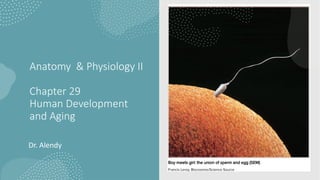
Anatomy & Physiology II
Chapter 29
Human Development
and Aging
Dr. Alendy
Resources
• Anatomy and physiology. The unity of FORM and FUNCTION by
SALADIN 9th Edition
• First Aid 2022
• Anatomy and Physiology OpenStax
Objectives
• Section 29.1
a. describe the process of sperm migration and fertilization;
b. explain how an egg prevents fertilization by more than
one sperm;
c. describe the major events that transform a fertilized egg
into an embryo; and
d. describe the implantation of the preembryo in the uterine
wall.
• Section 29.2
a. describe the formation and functions of the placenta;
b. explain how the conceptus is nourished before the
placenta takes over this function;
c. describe the embryonic membranes and their functions;
d. identify the major tissues derived from the primary germ
layers;
e. describe the major events of fetal development; and
f. describe the fetal circulatory system
• Section 29.3
a. describe how and why the circulatory system
changes at birth;
b. explain why the first breaths of air are relatively
difficult for a neonate;
c. describe the major physiological problems of a
premature infant; and
d. discuss some common causes of birth defects.
• Section 29.4
a. define senescence and distinguish it from aging;
b. describe some major changes that occur with
aging in each organ system;
c. summarize some current theories of senescence;
and
d. be able to explain how exercise and other factors
can slow the rate of senescence.
•
Introduction
• It is miraculous that a one-celled, fertilized egg transforms into an independent, fully developed
individual
• Embryology—the study of prenatal development
• Developmental biology—examines changes in form and function from fertilized egg through old
age
• Embryo—term has varied meanings
• Some authorities assert that: the fertilized egg or the two-cell stage is an embryo
• Other authorities (including this textbook) assert that an individual becomes an embryo when: it
is 16 days old and consists of three primary germ layers: Ectoderm, mesoderm, and ectoderm
• Embryogenesis—events leading up to this stage
• Preembryonic stage is the first 16 days after fertilization
Sperm Migration
• Egg must be fertilized within 12 to 24 hours of ovulation, if it is to survive
• Sperm must encounter the egg in the uterine tube
• Vast majority of sperm do not make it to egg
• Destroyed by vaginal acid or drain out of vagina
• Fail to penetrate the mucus of the cervical canal
• Destroyed by leukocytes in the uterus
• Half go up wrong uterine tube
• Of the 300 million that were ejaculated, about 200 spermatozoa reach the vicinity of the egg
• Sperm move by lashing of tail as they crawl along the female mucosa
• May be assisted by female physiology
• Strands of cervical mucus guide them through the cervical canal
• Uterine contractions that suck semen from vagina and spread it throughout the uterus
• Chemical attractant molecules released by egg may attract sperm from a short distance
Sperm Capacitation
• Spermatozoa reach distal uterine tube in half an hour or less but
cannot fertilize the egg for 10 hours
• Capacitation: process that migrating sperm must undergo to make it possible
to penetrate an egg
• Membrane of fresh sperm is toughened by cholesterol which prevents premature
release of acrosomal enzymes (which could damage sperm ducts)
• Female fluids leach cholesterol from the sperm plasma membrane and dilute inhibitory
factors in semen
• Sperm membrane becomes fragile and permeable to Ca2+
which diffuses into sperm
causing more powerful lashing of the tail
Fertilization
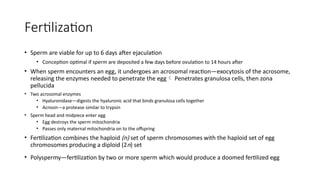
• Sperm are viable for up to 6 days after ejaculation
• Conception optimal if sperm are deposited a few days before ovulation to 14 hours after
• When sperm encounters an egg, it undergoes an acrosomal reaction—exocytosis of the acrosome,
releasing the enzymes needed to penetrate the egg Penetrates granulosa cells, then zona
pellucida
• Two acrosomal enzymes
• Hyaluronidase—digests the hyaluronic acid that binds granulosa cells together
• Acrosin—a protease similar to trypsin
• Sperm head and midpiece enter egg
• Egg destroys the sperm mitochondria
• Passes only maternal mitochondria on to the offspring
• Fertilization combines the haploid (n) set of sperm chromosomes with the haploid set of egg
chromosomes producing a diploid (2n) set
• Polyspermy—fertilization by two or more sperm which would produce a doomed fertilized egg
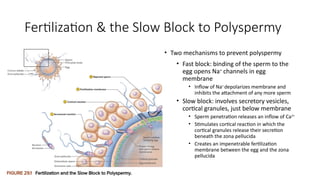
Fertilization & the Slow Block to Polyspermy
• Two mechanisms to prevent polyspermy
• Fast block: binding of the sperm to the
egg opens Na+
channels in egg
membrane
• Inflow of Na+
depolarizes membrane and
inhibits the attachment of any more sperm
• Slow block: involves secretory vesicles,
cortical granules, just below membrane
• Sperm penetration releases an inflow of Ca2+
• Stimulates cortical reaction in which the
cortical granules release their secretion
beneath the zona pellucida
• Creates an impenetrable fertilization
membrane between the egg and the zona
pellucida
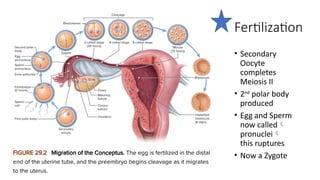
Fertilization
• Secondary
Oocyte
completes
Meiosis II
• 2nd
polar body
produced
• Egg and Sperm
now called
pronuclei
this ruptures
• Now a Zygote
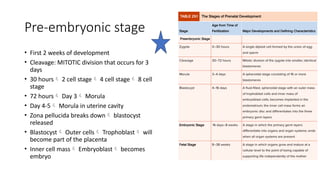
Pre-embryonic stage
• First 2 weeks of development
• Cleavage: MITOTIC division that occurs for 3
days
• 30 hours 2 cell stage 4 cell stage 8 cell
stage
• 72 hours Day 3 Morula
• Day 4-5 Morula in uterine cavity
• Zona pellucida breaks down blastocyst
released
• Blastocyst Outer cells Trophoblast will
become part of the placenta
• Inner cell mass Embryoblast becomes
embryo
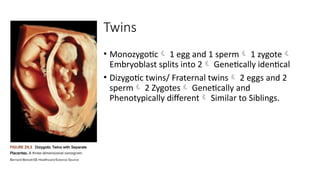
Twins
• Monozygotic 1 egg and 1 sperm 1 zygote
Embryoblast splits into 2 Genetically identical
• Dizygotic twins/ Fraternal twins 2 eggs and 2
sperm 2 Zygotes Genetically and
Phenotypically different Similar to Siblings.
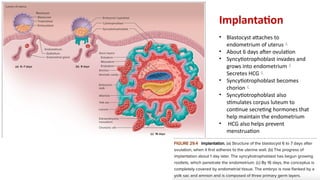
Implantation
• Blastocyst attaches to
endometrium of uterus
• About 6 days after ovulation
• Syncytiotrophoblast invades and
grows into endometrium
Secretes HCG
• Syncytiotrophoblast becomes
chorion
• Syncytiotrophoblast also
stimulates corpus luteum to
continue secreting hormones that
help maintain the endometrium
• HCG also helps prevent
menstruation
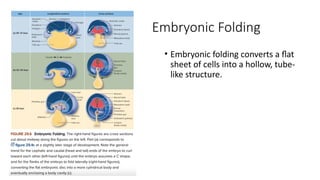
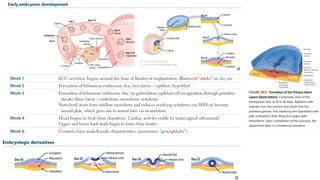
Embryonic Folding
• Embryonic folding converts a flat
sheet of cells into a hollow, tube-
like structure.
Embryogenesis
• Embryoblast flattens/ disklike
endoderm and ectoderm
• Primitive streak develops cells
sink into this groove form
mesoderm Gelatinous tissue/
Mesenchyme
• Blastomere 3 germ layers
Ectoderm, Mesoderm, Endoderm
• Also development of amniotic
cavity between embryoblast and
cytotrophoblast
• Week 2 to 9= Embryonic stage
• 3 germ layers
• Embryo begins receiving nutrients from
placenta
• Germ layer differentiation organs and
organ systems develop initiates fetal
stage
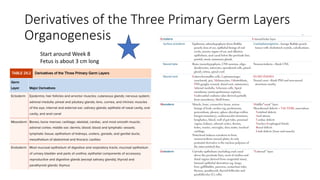
• Organogenesis: Formation of organs and
organ systems from primary germ
layers at 8 weeks, all organs are
present in 3cm long fetus. Heart is
beating and muscles exhibit contracts.
Derivatives of the Three Primary Germ Layers
Organogenesis
Start around Week 8
Fetus is about 3 cm long
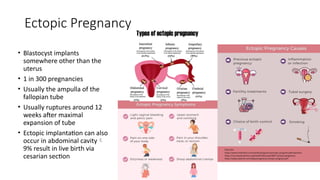
Ectopic Pregnancy
• Blastocyst implants
somewhere other than the
uterus
• 1 in 300 pregnancies
• Usually the ampulla of the
fallopian tube
• Usually ruptures around 12
weeks after maximal
expansion of tube
• Ectopic implantation can also
occur in abdominal cavity
9% result in live birth via
cesarian section
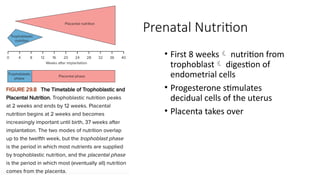
Prenatal Nutrition
• First 8 weeks nutrition from
trophoblast digestion of
endometrial cells
• Progesterone stimulates
decidual cells of the uterus
• Placenta takes over
Placentation
• Placenta formation occurs from
Day 11 through 12 weeks
• Chorionic villi
• Extensions of
syncytiotrophoblast into
endometrium by digestion and
growth of roots of tissue
• Mesenchyme extends into
chorionic villi to form embryonic
blood vessels
• Placental Sinus
• Pools of maternal blood that
merge and surround villi
• Blood stimulates rapid growth of
chorionic villi
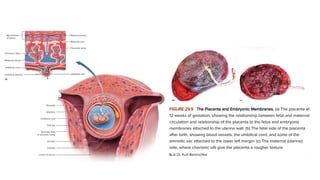
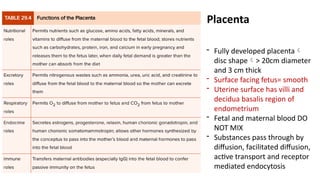
- Fully developed placenta
disc shape> 20cm diameter
and 3 cm thick
- Surface facing fetus= smooth
- Uterine surface has villi and
decidua basalis region of
endometrium
- Fetal and maternal blood DO
NOT MIX
- Substances pass through by
diffusion, facilitated diffusion,
active transport and receptor
mediated endocytosis
Placenta
Embryonic Membranes
• Amnion
• Transparent sac filled with fluid
• Protects embryo from trauma,
temperature changes, adhesions
and provides freedom of
movement
• Forms from maternal plasma
filtrate and fetal urine
• At term, amnion contains 700 to
1000 mL
• Yolk Sac
• Hangs from ventral side of embryo
• Contributes to GI tract, blood cells and
germ cells
• Allantois
• Foundation of umbilical cord and
urinary bladder
• Chorion
• Outermost membrane
• Chorionic villi from fetal portion of the
placenta.
Blood Circulation in
Fetus and Newborn
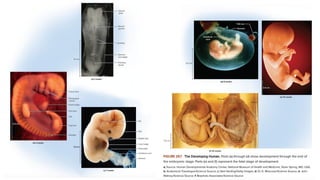
• Fetus= from 8 weeks until birth
• Organs mature to support external life
• Spaces in mesoderm become lined with
endothelium and merge into blood vessels and
lymphatic vessels
• Side by side endothelial tubes fuse to form heart
• Fetal Circulation
• Umbilical-placental circuit via umbilical cord
• Circulatory shunts
• Ductus venosus connects to IVC
• Foramen Ovale connects right and left atria
• Ductus arteriosus connects pulmonary trunk to
aorta
The Neonate or Newborn
• Transitional period
• First 6-8 hours heart and respiratory rate
increase and body temp falls
• Periods of sleeping and gagging on mucus
and debris
• Feed every 3. to 4 hours during 6 week
neonatal period
• Respiratory adaptations of newborn
• Onset of breathing due to CO2
accumulation
• Great effort to inflate lungs for first few
breaths
• Immunological adaptations
• Maternal antibody IgG, diffuses
across placenta
• Provides 6 month of protection
from most infections diseases
while fetal production increases
• IgA in breast milk can prevent
newborn from gastroenteritis
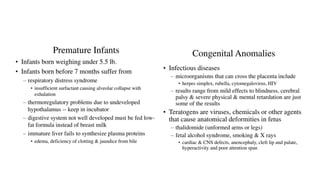
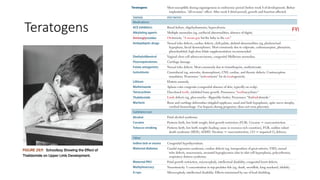
Teratogens FYI
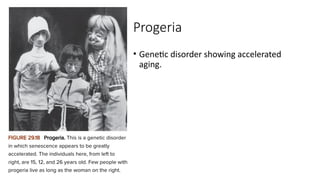
Progeria
• Genetic disorder showing accelerated
aging.
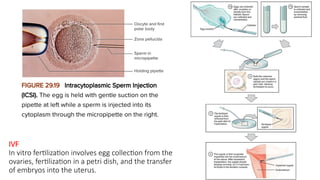
IVF
In vitro fertilization involves egg collection from the
ovaries, fertilization in a petri dish, and the transfer
of embryos into the uterus.
Because learning changes everything.®
www.mheducation.com
End of Main Content
© 2021 McGraw Hill. All rights reserved. Authorized only for instructor use in the classroom.
No reproduction or further distribution permitted without the prior written consent of McGraw Hill.

2086 Chapter 29 Human Development and Aging (1).pptx

  • 1.
    Anatomy & PhysiologyII Chapter 29 Human Development and Aging Dr. Alendy
  • 2.
    Resources • Anatomy andphysiology. The unity of FORM and FUNCTION by SALADIN 9th Edition • First Aid 2022 • Anatomy and Physiology OpenStax
  • 3.
    Objectives • Section 29.1 a.describe the process of sperm migration and fertilization; b. explain how an egg prevents fertilization by more than one sperm; c. describe the major events that transform a fertilized egg into an embryo; and d. describe the implantation of the preembryo in the uterine wall. • Section 29.2 a. describe the formation and functions of the placenta; b. explain how the conceptus is nourished before the placenta takes over this function; c. describe the embryonic membranes and their functions; d. identify the major tissues derived from the primary germ layers; e. describe the major events of fetal development; and f. describe the fetal circulatory system • Section 29.3 a. describe how and why the circulatory system changes at birth; b. explain why the first breaths of air are relatively difficult for a neonate; c. describe the major physiological problems of a premature infant; and d. discuss some common causes of birth defects. • Section 29.4 a. define senescence and distinguish it from aging; b. describe some major changes that occur with aging in each organ system; c. summarize some current theories of senescence; and d. be able to explain how exercise and other factors can slow the rate of senescence. •
  • 4.
    Introduction • It ismiraculous that a one-celled, fertilized egg transforms into an independent, fully developed individual • Embryology—the study of prenatal development • Developmental biology—examines changes in form and function from fertilized egg through old age • Embryo—term has varied meanings • Some authorities assert that: the fertilized egg or the two-cell stage is an embryo • Other authorities (including this textbook) assert that an individual becomes an embryo when: it is 16 days old and consists of three primary germ layers: Ectoderm, mesoderm, and ectoderm • Embryogenesis—events leading up to this stage • Preembryonic stage is the first 16 days after fertilization
  • 5.
    Sperm Migration • Eggmust be fertilized within 12 to 24 hours of ovulation, if it is to survive • Sperm must encounter the egg in the uterine tube • Vast majority of sperm do not make it to egg • Destroyed by vaginal acid or drain out of vagina • Fail to penetrate the mucus of the cervical canal • Destroyed by leukocytes in the uterus • Half go up wrong uterine tube • Of the 300 million that were ejaculated, about 200 spermatozoa reach the vicinity of the egg • Sperm move by lashing of tail as they crawl along the female mucosa • May be assisted by female physiology • Strands of cervical mucus guide them through the cervical canal • Uterine contractions that suck semen from vagina and spread it throughout the uterus • Chemical attractant molecules released by egg may attract sperm from a short distance
  • 6.
    Sperm Capacitation • Spermatozoareach distal uterine tube in half an hour or less but cannot fertilize the egg for 10 hours • Capacitation: process that migrating sperm must undergo to make it possible to penetrate an egg • Membrane of fresh sperm is toughened by cholesterol which prevents premature release of acrosomal enzymes (which could damage sperm ducts) • Female fluids leach cholesterol from the sperm plasma membrane and dilute inhibitory factors in semen • Sperm membrane becomes fragile and permeable to Ca2+ which diffuses into sperm causing more powerful lashing of the tail
  • 7.
    Fertilization • Sperm areviable for up to 6 days after ejaculation • Conception optimal if sperm are deposited a few days before ovulation to 14 hours after • When sperm encounters an egg, it undergoes an acrosomal reaction—exocytosis of the acrosome, releasing the enzymes needed to penetrate the egg Penetrates granulosa cells, then zona pellucida • Two acrosomal enzymes • Hyaluronidase—digests the hyaluronic acid that binds granulosa cells together • Acrosin—a protease similar to trypsin • Sperm head and midpiece enter egg • Egg destroys the sperm mitochondria • Passes only maternal mitochondria on to the offspring • Fertilization combines the haploid (n) set of sperm chromosomes with the haploid set of egg chromosomes producing a diploid (2n) set • Polyspermy—fertilization by two or more sperm which would produce a doomed fertilized egg
  • 8.
    Fertilization & theSlow Block to Polyspermy • Two mechanisms to prevent polyspermy • Fast block: binding of the sperm to the egg opens Na+ channels in egg membrane • Inflow of Na+ depolarizes membrane and inhibits the attachment of any more sperm • Slow block: involves secretory vesicles, cortical granules, just below membrane • Sperm penetration releases an inflow of Ca2+ • Stimulates cortical reaction in which the cortical granules release their secretion beneath the zona pellucida • Creates an impenetrable fertilization membrane between the egg and the zona pellucida
  • 9.
    Fertilization • Secondary Oocyte completes Meiosis II •2nd polar body produced • Egg and Sperm now called pronuclei this ruptures • Now a Zygote
  • 10.
    Pre-embryonic stage • First2 weeks of development • Cleavage: MITOTIC division that occurs for 3 days • 30 hours 2 cell stage 4 cell stage 8 cell stage • 72 hours Day 3 Morula • Day 4-5 Morula in uterine cavity • Zona pellucida breaks down blastocyst released • Blastocyst Outer cells Trophoblast will become part of the placenta • Inner cell mass Embryoblast becomes embryo
  • 11.
    Twins • Monozygotic 1egg and 1 sperm 1 zygote Embryoblast splits into 2 Genetically identical • Dizygotic twins/ Fraternal twins 2 eggs and 2 sperm 2 Zygotes Genetically and Phenotypically different Similar to Siblings.
  • 12.
    Implantation • Blastocyst attachesto endometrium of uterus • About 6 days after ovulation • Syncytiotrophoblast invades and grows into endometrium Secretes HCG • Syncytiotrophoblast becomes chorion • Syncytiotrophoblast also stimulates corpus luteum to continue secreting hormones that help maintain the endometrium • HCG also helps prevent menstruation
  • 13.
    Embryonic Folding • Embryonicfolding converts a flat sheet of cells into a hollow, tube- like structure.
  • 14.
    Embryogenesis • Embryoblast flattens/disklike endoderm and ectoderm • Primitive streak develops cells sink into this groove form mesoderm Gelatinous tissue/ Mesenchyme • Blastomere 3 germ layers Ectoderm, Mesoderm, Endoderm • Also development of amniotic cavity between embryoblast and cytotrophoblast • Week 2 to 9= Embryonic stage • 3 germ layers • Embryo begins receiving nutrients from placenta • Germ layer differentiation organs and organ systems develop initiates fetal stage • Organogenesis: Formation of organs and organ systems from primary germ layers at 8 weeks, all organs are present in 3cm long fetus. Heart is beating and muscles exhibit contracts.
  • 16.
    Derivatives of theThree Primary Germ Layers Organogenesis Start around Week 8 Fetus is about 3 cm long
  • 17.
    Ectopic Pregnancy • Blastocystimplants somewhere other than the uterus • 1 in 300 pregnancies • Usually the ampulla of the fallopian tube • Usually ruptures around 12 weeks after maximal expansion of tube • Ectopic implantation can also occur in abdominal cavity 9% result in live birth via cesarian section
  • 19.
    Prenatal Nutrition • First8 weeks nutrition from trophoblast digestion of endometrial cells • Progesterone stimulates decidual cells of the uterus • Placenta takes over
  • 20.
    Placentation • Placenta formationoccurs from Day 11 through 12 weeks • Chorionic villi • Extensions of syncytiotrophoblast into endometrium by digestion and growth of roots of tissue • Mesenchyme extends into chorionic villi to form embryonic blood vessels • Placental Sinus • Pools of maternal blood that merge and surround villi • Blood stimulates rapid growth of chorionic villi
  • 22.
    - Fully developedplacenta disc shape> 20cm diameter and 3 cm thick - Surface facing fetus= smooth - Uterine surface has villi and decidua basalis region of endometrium - Fetal and maternal blood DO NOT MIX - Substances pass through by diffusion, facilitated diffusion, active transport and receptor mediated endocytosis Placenta
  • 23.
    Embryonic Membranes • Amnion •Transparent sac filled with fluid • Protects embryo from trauma, temperature changes, adhesions and provides freedom of movement • Forms from maternal plasma filtrate and fetal urine • At term, amnion contains 700 to 1000 mL • Yolk Sac • Hangs from ventral side of embryo • Contributes to GI tract, blood cells and germ cells • Allantois • Foundation of umbilical cord and urinary bladder • Chorion • Outermost membrane • Chorionic villi from fetal portion of the placenta.
  • 24.
    Blood Circulation in Fetusand Newborn • Fetus= from 8 weeks until birth • Organs mature to support external life • Spaces in mesoderm become lined with endothelium and merge into blood vessels and lymphatic vessels • Side by side endothelial tubes fuse to form heart • Fetal Circulation • Umbilical-placental circuit via umbilical cord • Circulatory shunts • Ductus venosus connects to IVC • Foramen Ovale connects right and left atria • Ductus arteriosus connects pulmonary trunk to aorta
  • 25.
    The Neonate orNewborn • Transitional period • First 6-8 hours heart and respiratory rate increase and body temp falls • Periods of sleeping and gagging on mucus and debris • Feed every 3. to 4 hours during 6 week neonatal period • Respiratory adaptations of newborn • Onset of breathing due to CO2 accumulation • Great effort to inflate lungs for first few breaths • Immunological adaptations • Maternal antibody IgG, diffuses across placenta • Provides 6 month of protection from most infections diseases while fetal production increases • IgA in breast milk can prevent newborn from gastroenteritis
  • 32.
  • 44.
    Progeria • Genetic disordershowing accelerated aging.
  • 45.
    IVF In vitro fertilizationinvolves egg collection from the ovaries, fertilization in a petri dish, and the transfer of embryos into the uterus.
  • 46.
    Because learning changeseverything.® www.mheducation.com End of Main Content © 2021 McGraw Hill. All rights reserved. Authorized only for instructor use in the classroom. No reproduction or further distribution permitted without the prior written consent of McGraw Hill.

Editor's Notes

  • #26 https://www.online-sciences.com/the-living-organisms/what-is-the-stages-of-embryo-fetus-development/
  • #27 https://www.online-sciences.com/the-living-organisms/what-is-the-stages-of-embryo-fetus-development/
  • #28 https://www.online-sciences.com/the-living-organisms/what-is-the-stages-of-embryo-fetus-development/
  • #29 https://www.online-sciences.com/the-living-organisms/what-is-the-stages-of-embryo-fetus-development/