Conception and Fertilization
By:
Haider Mohammed



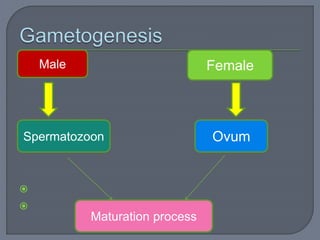
FemaleMale
OvumSpermatozoon
Maturation process
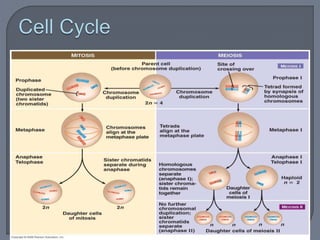
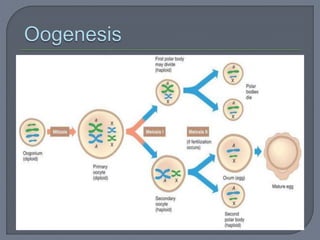
Both mitosis and meiosis play a role in
gametogensis.
Mitosis provide the precursor cells.
Meiosis bring about the reduction division
that result in gametes.
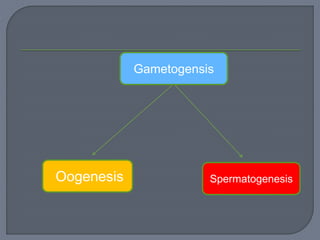
Gametogensis
SpermatogenesisOogenesis
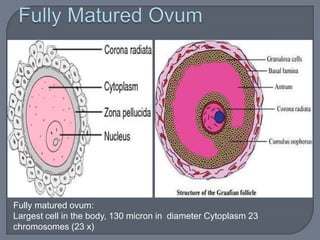
Fully matured ovum:
Largest cell in the body, 130 micron in diameter Cytoplasm 23
chromosomes (23 x)
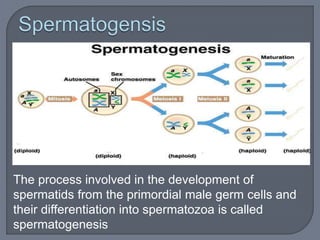
The process involved in the development of
spermatids from the primordial male germ cells and
their differentiation into spermatozoa is called
spermatogenesis
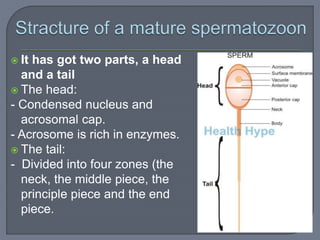
 It has got two parts, a head
and a tail
 The head:
- Condensed nucleus and
acrosomal cap.
- Acrosome is rich in enzymes.
 The tail:
- Divided into four zones (the
neck, the middle piece, the
principle piece and the end
piece.
Spermatogensis differ from oogensis in
three ways:
1- All four product of meiosis develop into
sperm while only one of the four become
an egg.
2- spermatogensis occur throughout
adolescence and adulthood.
3- sperm are produce continuously without
the prolonged interruption like in
oogenesis.
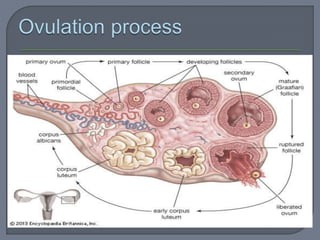
Ovulation is a process where by a
secondary oocyte is released from ovary
following of a mature graafian follicle and
become available for conception.
In each ovarian cycle, only one secondary
oocyte is likely to rupture.
It starts at puberty and end menopause.
Preovulatory enlargement of the graafian
follicle due to accumulation of follicular fluid.
Measure about 20 mm in diameter.
The cumulus oophorus sprates from rest of
granulosa cells.
The follicular wall near the ovarian surface
becomes thinner.
Significant changes occur just prior to
ovulation (few hours).
Cytoplasmic volume is increased.
Completion of the arrested first meiotic
division occur with extrusion of first polar
body, each containing haploid number of
chromosomes (23 X).
Endocrinal (LH surge, FSH rise)
Stretching factors (a passive stretching
process of granulosa cells).
Contraction of the micromuscles in the
theca externa and ovarian stroma due to
increase prostaglandin secretion.
 LH surge: sustained peak level of estrogen for 24 to 36 hours
in the late follicular phase.
 LH surge occurs from the anterior pituitary.
 Ovulation approximately occurs 16-24 hours after the LH
surge.
 LH peak persist for about 24 hours.
 The LH surge stimulates completion of reduction division of
the oocyte and intiate luteinization of the granulosa cells,
synthesis of progesterone and prostaglandins.
 FSH rise: preovulatery rise of progesterone facilitate the
positive feed back action of estrogen to induce FSH surge
lead to increase plasminogen activator. Plasminogen help
lysis of the wall of the follicle.
The follicle is changed into corpus luteum.
The ovum is peaked up into the fallopian
tube and undergoes either degeneration or
further maturation, if fertilization is to occur.
Menstruation is unrelated with ovulation.
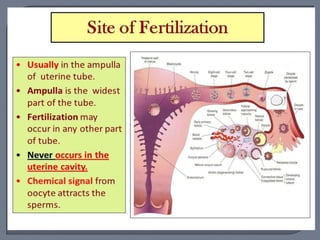
Fertilization is a process of fusion of the
spermatozoon with the mature ovum.
It begins with sperm egg collision and ends
with production of mononucleated single cell
called the zygot.
Objectives:
1- To initiate the embryonic development of the
egg.
2- To restore the chromosome number of the
species.
Fertilizable life span of oocyte is 12 to 24
hours and sperm is 48 to 72 hours.
Out of the hundreds in the vagina at single
ejaculation, only thousands capacitated
spermatozoa enter the uterine tube while only
300-500 reach the ovum.
Tubal transport is facilitated by muscular
contraction and aspiration action of the
uterine tube.
It take only few minutes for sperm to reach
the fallopian tube.
Capacitation
Acrosomal reaction
Cortical reaction
Development of Zygote
The process of undertaking in the sperm
when inside the female genital tract
influenced by the secretion of the uterine tube
is know as capacitation.
Sperm must be in the female genital tract
4-6 hours before they can fertilize an ovum.
The sperm undergoes changes in the removal
of the glycoprotein coat.
The acrosomal layer of the sperm becom
reactive and release the enzyme
hyaluronidase known as the acrosome
reaction.
It disperses the corona radiate (outer layer
of ovum) allowing access to the zona
pellucida.
The first sperm that reaches the zona
pellucida penetrates it.
Penetration of the zona pellucida occur with
the aid of several enzymes processed by the
sperm which break down the proteins of the
zona layer.
Upon penetration a chemical reaction know
as the cortical reaction occur which makes it
impermeable to other sperms.
The plasma membrane of the sperm and
oocyte fuse.
The ocyte at this stage compelet and
second meiotic division and becomes
mature, the pronuclei has 23 haploid
chromosomes.
Male and female pronuclei fuses to form a
new nucleus that is a combination of the
genetic material from both the sperm and
the oocyte diploid cell
 The male and female gametes each contribute
half the complement of the chromosomes to
make a total of 46. the new cell is called zygote.
 The zygote, thus formed, contain both the
paternal and maternal genetic materials.
 Sex of the child is determined by the pattern of
the sex chromosome supplied by the
spermatozoon
 If the spermatozoon contain X chromosome, a
female embryo (46,XX) is formed, if it contain a
Y chromosome , a male emberyo (46, XX) is
formed.
Pre-embryonic period: first two
weeks after fertilization.
Embryonic period: 2 – 8 weeks.
Fetal period: 8 Weeks to birth
 This period include the implantation of the
zygote into the endometrium.
 The embryo takes about 3 days to travel
through the fallopian tube to reach the uterus.
 It takes another 3 days to get implanted,
usually in the dorsal wall of the uterus.
 Thus embryo is about 1 week old when it gets
implanted.
 Zygote undergo mitotic division and cellular
replication known as cleavage which result in
the formation of smaller cells known as
blastomers.
 During this period a strong membrane of
glycoprotein called zona pellucida surrounds
the zygote
 The zygote mainly gets nourishment
(glycogen)from the goblet cells of the uterine
tubes and later the secretory cells of the
uterus.
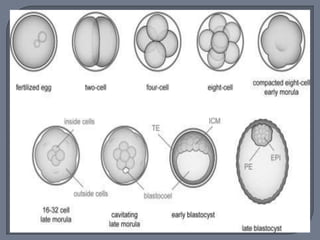
 The zygote divided in to :
 2 cells at day 1,or 30 hours
 4 at 2 days,8 by 2.5 days,16 by 3 days and
called as morula resembling a mulberry 16 to
64 cell stage
Cell bind tightly together in a process
known as compactation.
Next cavitation occur where by the
outermost cells secrete fluid into the
morula and a fluid filled cavity or blastocele
appears.
This result in the formation of the blaster or
blastocyst comprising 58 cells.
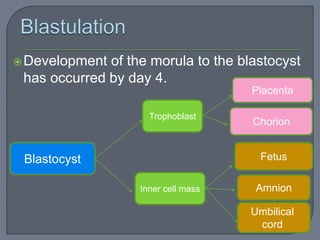
Development of the morula to the blastocyst
has occurred by day 4.
Blastocyst
Trophoblast
Placenta
Chorion
Inner cell mass
Fetus
Amnion
Umbilical
cord
Embedding of the embryo to the wall of
uterus.
Also called as Nidation.
Occurs in the endometrium of the anterior
or posterior wall of the body near the
fundus on the 6th day which corresponds to
the 20th day of regular menstrual cycle.
Implantation occur through four stages
apposition, adhesion, penetration and
invasion.
Occurs through pinopod formation.
Pinopods are long finger like projections
(microvilli) from the endometrial cell
surface..
This pinopods absorb the endometrial fluid
which is secreted by the endometrial gland
cells. This fluid, rich in glycogen and mucin
provides nutrition to blastocyst intially.
Unless this fluid is absorbed, adhesion
phase cannot occur.
Adhesion of blastocyst to the endometrium
occurs through the adhesion molecules like
integrin, selectin and cadherin
(glycoproteins).
Occur through the stromal cells in between
the gland and is facilitated by the histolytic
action of the blastocyst.
With increasing lysis of the stormal cells,
the blastocyst is burrowed more and more
inside the stratum compactum of the
decidua.
Endometrium during pregnancy is know as
the decidua.
Three layer are found.
1- the basal layer: lie immediately above the
myometrium. Remain unchanged in itself but
regenerates the new endomertium during the
puerperium
2- the functional layer: consist of tortuous
glands which are rich in secretions.
It provide a secure anchorage for the
placenta and allows it access to nutrition and
oxygen, but as soon as the baby is born
separation can occur.
3- The compact layer: this layer form the
surface of the decidua and is composed of
closely packed stroma cells and the neck of
the glands.
Three layer include:
1- The ectoderm: skin and nervous system
2- The mesoderm: bones, muscles, heart,
blood vessels and some visceral organs.
3- The endoderm: mucous membrane and
glands.
Two cavities appear on either side of
embryonic plate (amniotic cavity and yolk
sac)
 By the end of 2nd month, trophoblast is
character by great no. of secondary and
tertiary villi.
 By four month cytotrophblastic cells and
connective tissue disappear, only syncytium
and endothelial vessel remain (tertiary villi).
 In early stage, villi covers the entire surface of
chorion.
 As the pregnancy advances, villi on
embryonic pole continues to grow and
expand – chorion frondosum (bushy chorion).
 Villi on an embryonic pole degenerate- chorion
leave. The fusion of amnion and chorion occurs to
form aminochorionic membrane.
 Placenta is an organ that connects the developing
fetus to the uterine wall to allow.
 Nutrient uptake.
 Waste elimination.
 Gas exchange by the mother blood supply.
 Hormone production.
 Formation of a barrier.
 Function as a fetomaternal organ with 2
components (fetal placenta and maternal placenta).
Sugar, fats and oxygen diffuse from mothers
blood to fetus.
Urea and CO2 diffuse from fetus to mother.
Maternal antibodies actively transported
across placenta. Some resistance to disease
(passive immunity).
Most bacteria are blocked.
Many viruses can pass including rubella,
chickenpox, sometime HIV.
Many drugs and toxins pass including
alcohol, heroin and mercury.
Progesterone and HCG (human choroinic
gondatropin, the hormone tested for
pregnancy): maintain the uterus.
Estrogen and CRH (corticotropin releasing
hormone): promote labor.
Conception and fertilization

Conception and fertilization

  • 1.
  • 2.
  • 3.
    Both mitosis andmeiosis play a role in gametogensis. Mitosis provide the precursor cells. Meiosis bring about the reduction division that result in gametes.
  • 5.
  • 7.
    Fully matured ovum: Largestcell in the body, 130 micron in diameter Cytoplasm 23 chromosomes (23 x)
  • 8.
    The process involvedin the development of spermatids from the primordial male germ cells and their differentiation into spermatozoa is called spermatogenesis
  • 9.
     It hasgot two parts, a head and a tail  The head: - Condensed nucleus and acrosomal cap. - Acrosome is rich in enzymes.  The tail: - Divided into four zones (the neck, the middle piece, the principle piece and the end piece.
  • 10.
    Spermatogensis differ fromoogensis in three ways: 1- All four product of meiosis develop into sperm while only one of the four become an egg. 2- spermatogensis occur throughout adolescence and adulthood. 3- sperm are produce continuously without the prolonged interruption like in oogenesis.
  • 11.
    Ovulation is aprocess where by a secondary oocyte is released from ovary following of a mature graafian follicle and become available for conception. In each ovarian cycle, only one secondary oocyte is likely to rupture. It starts at puberty and end menopause.
  • 13.
    Preovulatory enlargement ofthe graafian follicle due to accumulation of follicular fluid. Measure about 20 mm in diameter. The cumulus oophorus sprates from rest of granulosa cells. The follicular wall near the ovarian surface becomes thinner.
  • 14.
    Significant changes occurjust prior to ovulation (few hours). Cytoplasmic volume is increased. Completion of the arrested first meiotic division occur with extrusion of first polar body, each containing haploid number of chromosomes (23 X).
  • 15.
    Endocrinal (LH surge,FSH rise) Stretching factors (a passive stretching process of granulosa cells). Contraction of the micromuscles in the theca externa and ovarian stroma due to increase prostaglandin secretion.
  • 16.
     LH surge:sustained peak level of estrogen for 24 to 36 hours in the late follicular phase.  LH surge occurs from the anterior pituitary.  Ovulation approximately occurs 16-24 hours after the LH surge.  LH peak persist for about 24 hours.  The LH surge stimulates completion of reduction division of the oocyte and intiate luteinization of the granulosa cells, synthesis of progesterone and prostaglandins.  FSH rise: preovulatery rise of progesterone facilitate the positive feed back action of estrogen to induce FSH surge lead to increase plasminogen activator. Plasminogen help lysis of the wall of the follicle.
  • 17.
    The follicle ischanged into corpus luteum. The ovum is peaked up into the fallopian tube and undergoes either degeneration or further maturation, if fertilization is to occur. Menstruation is unrelated with ovulation.
  • 18.
    Fertilization is aprocess of fusion of the spermatozoon with the mature ovum. It begins with sperm egg collision and ends with production of mononucleated single cell called the zygot. Objectives: 1- To initiate the embryonic development of the egg. 2- To restore the chromosome number of the species.
  • 20.
    Fertilizable life spanof oocyte is 12 to 24 hours and sperm is 48 to 72 hours. Out of the hundreds in the vagina at single ejaculation, only thousands capacitated spermatozoa enter the uterine tube while only 300-500 reach the ovum. Tubal transport is facilitated by muscular contraction and aspiration action of the uterine tube. It take only few minutes for sperm to reach the fallopian tube.
  • 21.
  • 22.
    The process ofundertaking in the sperm when inside the female genital tract influenced by the secretion of the uterine tube is know as capacitation. Sperm must be in the female genital tract 4-6 hours before they can fertilize an ovum. The sperm undergoes changes in the removal of the glycoprotein coat.
  • 23.
    The acrosomal layerof the sperm becom reactive and release the enzyme hyaluronidase known as the acrosome reaction. It disperses the corona radiate (outer layer of ovum) allowing access to the zona pellucida.
  • 24.
    The first spermthat reaches the zona pellucida penetrates it. Penetration of the zona pellucida occur with the aid of several enzymes processed by the sperm which break down the proteins of the zona layer. Upon penetration a chemical reaction know as the cortical reaction occur which makes it impermeable to other sperms.
  • 25.
    The plasma membraneof the sperm and oocyte fuse. The ocyte at this stage compelet and second meiotic division and becomes mature, the pronuclei has 23 haploid chromosomes. Male and female pronuclei fuses to form a new nucleus that is a combination of the genetic material from both the sperm and the oocyte diploid cell
  • 26.
     The maleand female gametes each contribute half the complement of the chromosomes to make a total of 46. the new cell is called zygote.  The zygote, thus formed, contain both the paternal and maternal genetic materials.  Sex of the child is determined by the pattern of the sex chromosome supplied by the spermatozoon  If the spermatozoon contain X chromosome, a female embryo (46,XX) is formed, if it contain a Y chromosome , a male emberyo (46, XX) is formed.
  • 27.
    Pre-embryonic period: firsttwo weeks after fertilization. Embryonic period: 2 – 8 weeks. Fetal period: 8 Weeks to birth
  • 28.
     This periodinclude the implantation of the zygote into the endometrium.  The embryo takes about 3 days to travel through the fallopian tube to reach the uterus.  It takes another 3 days to get implanted, usually in the dorsal wall of the uterus.  Thus embryo is about 1 week old when it gets implanted.  Zygote undergo mitotic division and cellular replication known as cleavage which result in the formation of smaller cells known as blastomers.
  • 29.
     During thisperiod a strong membrane of glycoprotein called zona pellucida surrounds the zygote  The zygote mainly gets nourishment (glycogen)from the goblet cells of the uterine tubes and later the secretory cells of the uterus.  The zygote divided in to :  2 cells at day 1,or 30 hours  4 at 2 days,8 by 2.5 days,16 by 3 days and called as morula resembling a mulberry 16 to 64 cell stage
  • 31.
    Cell bind tightlytogether in a process known as compactation. Next cavitation occur where by the outermost cells secrete fluid into the morula and a fluid filled cavity or blastocele appears. This result in the formation of the blaster or blastocyst comprising 58 cells.
  • 32.
    Development of themorula to the blastocyst has occurred by day 4. Blastocyst Trophoblast Placenta Chorion Inner cell mass Fetus Amnion Umbilical cord
  • 33.
    Embedding of theembryo to the wall of uterus. Also called as Nidation. Occurs in the endometrium of the anterior or posterior wall of the body near the fundus on the 6th day which corresponds to the 20th day of regular menstrual cycle. Implantation occur through four stages apposition, adhesion, penetration and invasion.
  • 34.
    Occurs through pinopodformation. Pinopods are long finger like projections (microvilli) from the endometrial cell surface.. This pinopods absorb the endometrial fluid which is secreted by the endometrial gland cells. This fluid, rich in glycogen and mucin provides nutrition to blastocyst intially.
  • 35.
    Unless this fluidis absorbed, adhesion phase cannot occur. Adhesion of blastocyst to the endometrium occurs through the adhesion molecules like integrin, selectin and cadherin (glycoproteins).
  • 36.
    Occur through thestromal cells in between the gland and is facilitated by the histolytic action of the blastocyst. With increasing lysis of the stormal cells, the blastocyst is burrowed more and more inside the stratum compactum of the decidua.
  • 37.
    Endometrium during pregnancyis know as the decidua. Three layer are found. 1- the basal layer: lie immediately above the myometrium. Remain unchanged in itself but regenerates the new endomertium during the puerperium 2- the functional layer: consist of tortuous glands which are rich in secretions.
  • 38.
    It provide asecure anchorage for the placenta and allows it access to nutrition and oxygen, but as soon as the baby is born separation can occur. 3- The compact layer: this layer form the surface of the decidua and is composed of closely packed stroma cells and the neck of the glands.
  • 39.
    Three layer include: 1-The ectoderm: skin and nervous system 2- The mesoderm: bones, muscles, heart, blood vessels and some visceral organs. 3- The endoderm: mucous membrane and glands. Two cavities appear on either side of embryonic plate (amniotic cavity and yolk sac)
  • 40.
     By theend of 2nd month, trophoblast is character by great no. of secondary and tertiary villi.  By four month cytotrophblastic cells and connective tissue disappear, only syncytium and endothelial vessel remain (tertiary villi).  In early stage, villi covers the entire surface of chorion.  As the pregnancy advances, villi on embryonic pole continues to grow and expand – chorion frondosum (bushy chorion).
  • 41.
     Villi onan embryonic pole degenerate- chorion leave. The fusion of amnion and chorion occurs to form aminochorionic membrane.  Placenta is an organ that connects the developing fetus to the uterine wall to allow.  Nutrient uptake.  Waste elimination.  Gas exchange by the mother blood supply.  Hormone production.  Formation of a barrier.  Function as a fetomaternal organ with 2 components (fetal placenta and maternal placenta).
  • 42.
    Sugar, fats andoxygen diffuse from mothers blood to fetus. Urea and CO2 diffuse from fetus to mother. Maternal antibodies actively transported across placenta. Some resistance to disease (passive immunity). Most bacteria are blocked. Many viruses can pass including rubella, chickenpox, sometime HIV. Many drugs and toxins pass including alcohol, heroin and mercury.
  • 43.
    Progesterone and HCG(human choroinic gondatropin, the hormone tested for pregnancy): maintain the uterus. Estrogen and CRH (corticotropin releasing hormone): promote labor.