Professor (Dr.) Namrata Chhabra 
Biochemistry for Medics- Lecture notes 
www.namrata.co 
11/05/14 Biochemistry for medics- Lecture notes 1
• The ability to utilize carbohydrates can be 
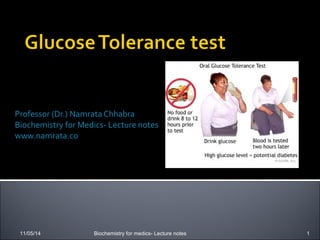
determined by Glucose tolerance test. 
• Initially fasting blood glucose is estimated 
• A loading dose of glucose is given. 
• The blood glucose levels are estimated at 
regular intervals after the glucose load 
• In conditions of insulin deficiency, blood 
glucose levels get elevated due to impaired 
utilization of glucose. 
11/05/14 Biochemistry for medics- Lecture notes 2
A) Decreased Glucose tolerance 
Decreased carbohydrate tolerance (non-utilization 
of carbohydrate load) is observed 
in conditions causing hyperglycemia, for 
example: 
 Diabetes mellitus 
 Hyperactivity of anterior pituitary and 
adrenal cortex 
 Hyperthyroidism 
 Stress 
11/05/14 Biochemistry for medics- Lecture notes 3
B) Increased Glucose Tolerance 
Increased carbohydrate tolerance is observed 
in all conditions that cause hypoglycemia-i) 
Hypopituitarism 
ii) Hyperinsulinism 
iii) Hypothyroidism 
iv) Adrenal cortical hypofunction 
v) Decreased gastro intestinal absorption like 
sprue, celiac disease. 
11/05/14 Biochemistry for medics- Lecture notes 4
i) In asymptomatic persons with sustained or 
transient glycosuria 
ii) In persons with symptoms of diabetes but no 
glycosuria or hyperglycemia 
iii) Persons with family history but no 
symptoms or positive blood findings 
11/05/14 Biochemistry for medics- Lecture notes 5
iv)In persons with or without symptoms of 
diabetes mellitus showing one abnormal 
blood finding 
v) In patients with neuropathies or 
retinopathies of unknown origin 
vi) In women with H/o having delivered large 
babies. 
11/05/14 Biochemistry for medics- Lecture notes 6
a) In proven cases of diabetes mellitus the test 
is not required. 
b) GTT is required only in doubtful cases, it is 
not recommended for follow up of patient. 
c) The test should not be carried out in acutely 
ill patients 
11/05/14 Biochemistry for medics- Lecture notes 7
a) The patient is instructed to have good 
carbohydrate diet for 3 days prior to the test. 
Further , diet containing about 30-50 G of 
carbohydrate should be taken on the evening 
prior to the test. 
b) The patient should avoid drugs likely to 
influence the blood glucose levels, for at 
least, 2 days prior to the test 
11/05/14 Biochemistry for medics- Lecture notes 8
c) Patient should abstain from smoking during 
the test. 
d) Strenuous exercise on the previous day is to 
be avoided. 
e) The exercise is also to be avoided on the 
same day prior to the test 
11/05/14 Biochemistry for medics- Lecture notes 9
Standard Oral glucose tolerance test 
I/V Glucose tolerance test 
Mini Glucose tolerance test 
11/05/14 Biochemistry for medics- Lecture notes 10
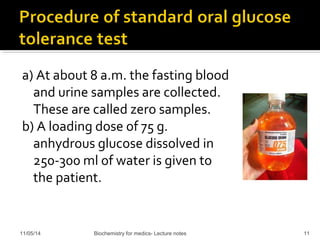
a) At about 8 a.m. the fasting blood 
and urine samples are collected. 
These are called zero samples. 
b) A loading dose of 75 g. 
anhydrous glucose dissolved in 
250-300 ml of water is given to 
the patient. 
11/05/14 Biochemistry for medics- Lecture notes 11
• In children 1.75 g of glucose /kg body weight 
is given. 
• In the classical procedures, the blood and 
urine samples are collected at half hourly 
interval of the next two and a half hour or 
three hours. 
• Glucose is estimated in all the blood 
samples. 
• Urine is analyzed for the presence of 
glucose. 
11/05/14 Biochemistry for medics- Lecture notes 12
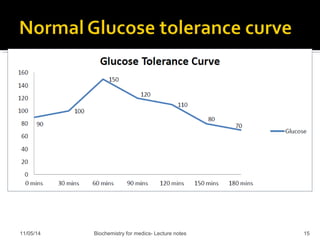
A curve is plotted with the blood glucose 
levels on the vertical axis against the time of 
collection on the horizontal axis. 
The curve so obtained is called glucose 
tolerance curve. 
11/05/14 Biochemistry for medics- Lecture notes 13
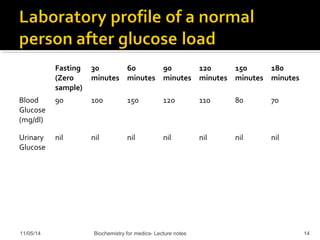
Fasting 
(Zero 
sample) 
30 
minutes 
60 
minutes 
90 
minutes 
120 
minutes 
150 
minutes 
180 
minutes 
Blood 
Glucose 
(mg/dl) 
90 100 150 120 110 80 70 
Urinary 
Glucose 
nil nil nil nil nil nil nil 
11/05/14 Biochemistry for medics- Lecture notes 14
11/05/14 Biochemistry for medics- Lecture notes 15
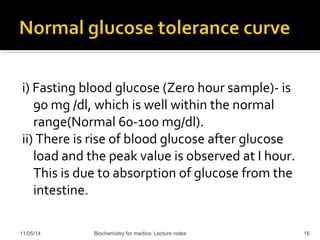
i) Fasting blood glucose (Zero hour sample)- is 
90 mg /dl, which is well within the normal 
range(Normal 60-100 mg/dl). 
ii) There is rise of blood glucose after glucose 
load and the peak value is observed at I hour. 
This is due to absorption of glucose from the 
intestine. 
11/05/14 Biochemistry for medics- Lecture notes 16
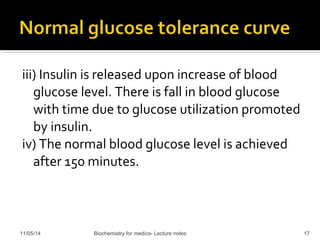
iii) Insulin is released upon increase of blood 
glucose level. There is fall in blood glucose 
with time due to glucose utilization promoted 
by insulin. 
iv) The normal blood glucose level is achieved 
after 150 minutes. 
11/05/14 Biochemistry for medics- Lecture notes 17
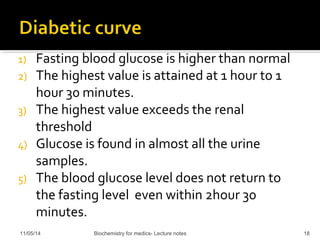
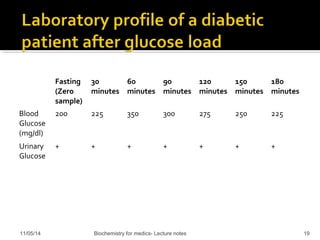
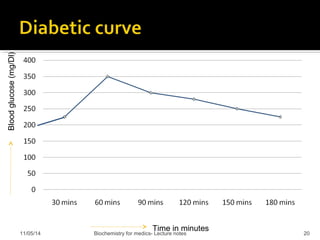
1) Fasting blood glucose is higher than normal 
2) The highest value is attained at 1 hour to 1 
hour 30 minutes. 
3) The highest value exceeds the renal 
threshold 
4) Glucose is found in almost all the urine 
samples. 
5) The blood glucose level does not return to 
the fasting level even within 2hour 30 
minutes. 
11/05/14 Biochemistry for medics- Lecture notes 18
Fasting 
(Zero 
sample) 
30 
minutes 
60 
minutes 
90 
minutes 
120 
minutes 
150 
minutes 
180 
minutes 
Blood 
Glucose 
(mg/dl) 
200 225 350 300 275 250 225 
Urinary 
Glucose 
+ + + + + + + 
11/05/14 Biochemistry for medics- Lecture notes 19
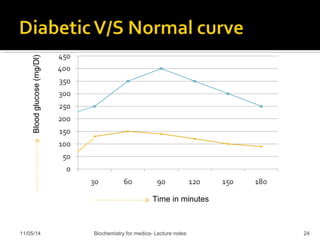
Time in minutes Blood glucose (mg/Dl) 11/05/14 20 Biochemistry for medics- Lecture notes
Blood glucose levels are within the normal 
limits. 
Glucose tolerance curve is normal. 
There is lowering of renal threshold. 
Thus glucose is found in some of the samples 
depending upon the renal threshold. 
11/05/14 Biochemistry for medics- Lecture notes 21
Early diabetes mellitus, 
Pregnancy, 
Renal disease, 
Heavy metal poisoning 
Deficiency of carrier protein (SGLT-2). 
Renal glycosuria can also be observed in 
children of diabetic parents. 
11/05/14 Biochemistry for medics- Lecture notes 22
Fasting 
(Zero 
sample) 
30 
minutes 
60 
minutes 
90 
minutes 
120 
minutes 
150 
minutes 
180 
minutes 
Blood 
Glucose 
(mg/dl) 
90 130 150 140 120 100 90 
Urinary 
Glucose 
nil + + + + ± nil 
11/05/14 Biochemistry for medics- Lecture notes 23
Time in minutes Blood glucose (mg/Dl) 
11/05/14 Biochemistry for medics- Lecture notes 24
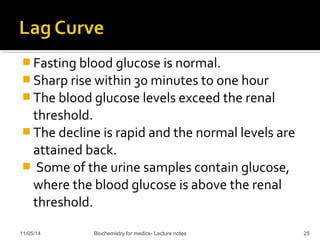
Fasting blood glucose is normal. 
Sharp rise within 30 minutes to one hour 
The blood glucose levels exceed the renal 
threshold. 
The decline is rapid and the normal levels are 
attained back. 
 Some of the urine samples contain glucose, 
where the blood glucose is above the renal 
threshold. 
11/05/14 Biochemistry for medics- Lecture notes 25
Hyperthyroidism 
Pregnancy 
After gastro-enterostomy 
Early diabetes mellitus 
11/05/14 Biochemistry for medics- Lecture notes 26
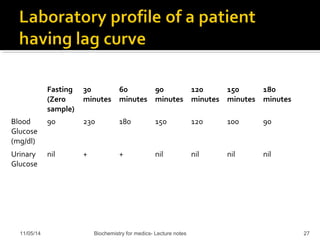
Fasting 
(Zero 
sample) 
30 
minutes 
60 
minutes 
90 
minutes 
120 
minutes 
150 
minutes 
180 
minutes 
Blood 
Glucose 
(mg/dl) 
90 230 180 150 120 100 90 
Urinary 
Glucose 
nil + + nil nil nil nil 
11/05/14 Biochemistry for medics- Lecture notes 27
•This test is undertaken for patients with 
malabsorption (Celiac disease or 
enteropathies), 
•Under these conditions oral glucose load is not 
well absorbed and 
• the results of oral glucose tolerance test 
become inconclusive. 
11/05/14 Biochemistry for medics- Lecture notes 28
• I/V glucose tolerance test is carried out by 
giving 25 g of glucose dissolved in 100 ml 
distilled water as intravenous injection within 
5 minutes. 
• Completion of infusion is taken as 0 time. 
• Blood samples are taken at 10 minutes 
interval for the next hour. 
• The peak value is reached within a few 
minutes and the value touches to near 
normal in 45-60 minutes. 
11/05/14 Biochemistry for medics- Lecture notes 29
Interpretation 
• In normal individuals, blood glucose level 
returns to normal within 60 minutes 
• In diabetes mellitus, decline is slow 
• The initial values are attained in 120 minutes. 
11/05/14 Biochemistry for medics- Lecture notes 30
a) Acute infections- Cortisol is secreted, the 
curve is elevated and prolonged 
b) Liver diseases- The curve is elevated and 
prolonged. 
c) Hyperthyroidism- There is steep rise in curve. 
11/05/14 Biochemistry for medics- Lecture notes 31
d) Hypothyroidism-A flat curve is obtained in 
hypothyroidism. Thyroid hormone increases 
the absorption of glucose from the gut. 
e) Starvation- There is rise of counter 
regulatory hormones, which show increased 
glucose tolerance 
11/05/14 Biochemistry for medics- Lecture notes 32
As per current WHO recommendations, in 
the mini or modern glucose tolerance test, 
only two samples are collected, 
 Fasting (zero hour) and 2 hour post glucose 
load. 
Urine samples are also collected during the 
same time. 
The diagnosis is made from the variations 
observed in these results. 
11/05/14 Biochemistry for medics- Lecture notes 33
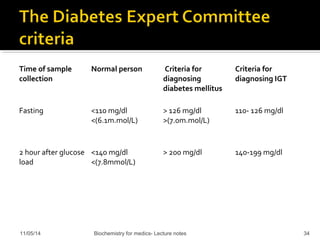
Time of sample 
collection 
Normal person Criteria for 
diagnosing 
diabetes mellitus 
Criteria for 
diagnosing IGT 
Fasting 
<110 mg/dl 
<(6.1m.mol/L) 
> 126 mg/dl 
>(7.0m.mol/L) 
110- 126 mg/dl 
2 hour after glucose 
load 
<140 mg/dl 
<(7.8mmol/L) 
> 200 mg/dl 
140-199 mg/dl 
11/05/14 Biochemistry for medics- Lecture notes 34
For proper evaluation of the test, the subjects 
should be normally active and free from 
acute illness. 
 Medications that may impair glucose 
tolerance include diuretics, contraceptive 
drugs, glucocorticoids, niacin, and phenytoin 
should be avoided on that day. 
11/05/14 Biochemistry for medics- Lecture notes 35
Cortisone stress test- used for detecting pre 
diabetes or Latent diabetes 
Extended GTT- To diagnose the cause of 
hypoglycemia especially 2-3 hours after 
meals. 
11/05/14 Biochemistry for medics- Lecture notes 36
If the fasting plasma glucose level is 126 
mg/dL or higher on more than one occasion, 
further evaluation of the patient with a 
glucose challenge is unnecessary. However, 
when fasting plasma glucose is less than 126 
mg/dL in suspected cases, a standardized oral 
glucose tolerance test may be done . 
11/05/14 Biochemistry for medics- Lecture notes 37
A random plasma glucose concentration 
>11.1 mmol/L (200 mg/dL) accompanied by 
classic symptoms of DM (polyuria, polydipsia, 
weight loss) is sufficient for the diagnosis of 
DM. 
11/05/14 Biochemistry for medics- Lecture notes 38

Glucose Tolerance Test

  • 1.
    Professor (Dr.) NamrataChhabra Biochemistry for Medics- Lecture notes www.namrata.co 11/05/14 Biochemistry for medics- Lecture notes 1
  • 2.
    • The abilityto utilize carbohydrates can be determined by Glucose tolerance test. • Initially fasting blood glucose is estimated • A loading dose of glucose is given. • The blood glucose levels are estimated at regular intervals after the glucose load • In conditions of insulin deficiency, blood glucose levels get elevated due to impaired utilization of glucose. 11/05/14 Biochemistry for medics- Lecture notes 2
  • 3.
    A) Decreased Glucosetolerance Decreased carbohydrate tolerance (non-utilization of carbohydrate load) is observed in conditions causing hyperglycemia, for example:  Diabetes mellitus  Hyperactivity of anterior pituitary and adrenal cortex  Hyperthyroidism  Stress 11/05/14 Biochemistry for medics- Lecture notes 3
  • 4.
    B) Increased GlucoseTolerance Increased carbohydrate tolerance is observed in all conditions that cause hypoglycemia-i) Hypopituitarism ii) Hyperinsulinism iii) Hypothyroidism iv) Adrenal cortical hypofunction v) Decreased gastro intestinal absorption like sprue, celiac disease. 11/05/14 Biochemistry for medics- Lecture notes 4
  • 5.
    i) In asymptomaticpersons with sustained or transient glycosuria ii) In persons with symptoms of diabetes but no glycosuria or hyperglycemia iii) Persons with family history but no symptoms or positive blood findings 11/05/14 Biochemistry for medics- Lecture notes 5
  • 6.
    iv)In persons withor without symptoms of diabetes mellitus showing one abnormal blood finding v) In patients with neuropathies or retinopathies of unknown origin vi) In women with H/o having delivered large babies. 11/05/14 Biochemistry for medics- Lecture notes 6
  • 7.
    a) In provencases of diabetes mellitus the test is not required. b) GTT is required only in doubtful cases, it is not recommended for follow up of patient. c) The test should not be carried out in acutely ill patients 11/05/14 Biochemistry for medics- Lecture notes 7
  • 8.
    a) The patientis instructed to have good carbohydrate diet for 3 days prior to the test. Further , diet containing about 30-50 G of carbohydrate should be taken on the evening prior to the test. b) The patient should avoid drugs likely to influence the blood glucose levels, for at least, 2 days prior to the test 11/05/14 Biochemistry for medics- Lecture notes 8
  • 9.
    c) Patient shouldabstain from smoking during the test. d) Strenuous exercise on the previous day is to be avoided. e) The exercise is also to be avoided on the same day prior to the test 11/05/14 Biochemistry for medics- Lecture notes 9
  • 10.
    Standard Oral glucosetolerance test I/V Glucose tolerance test Mini Glucose tolerance test 11/05/14 Biochemistry for medics- Lecture notes 10
  • 11.
    a) At about8 a.m. the fasting blood and urine samples are collected. These are called zero samples. b) A loading dose of 75 g. anhydrous glucose dissolved in 250-300 ml of water is given to the patient. 11/05/14 Biochemistry for medics- Lecture notes 11
  • 12.
    • In children1.75 g of glucose /kg body weight is given. • In the classical procedures, the blood and urine samples are collected at half hourly interval of the next two and a half hour or three hours. • Glucose is estimated in all the blood samples. • Urine is analyzed for the presence of glucose. 11/05/14 Biochemistry for medics- Lecture notes 12
  • 13.
    A curve isplotted with the blood glucose levels on the vertical axis against the time of collection on the horizontal axis. The curve so obtained is called glucose tolerance curve. 11/05/14 Biochemistry for medics- Lecture notes 13
  • 14.
    Fasting (Zero sample) 30 minutes 60 minutes 90 minutes 120 minutes 150 minutes 180 minutes Blood Glucose (mg/dl) 90 100 150 120 110 80 70 Urinary Glucose nil nil nil nil nil nil nil 11/05/14 Biochemistry for medics- Lecture notes 14
  • 15.
    11/05/14 Biochemistry formedics- Lecture notes 15
  • 16.
    i) Fasting bloodglucose (Zero hour sample)- is 90 mg /dl, which is well within the normal range(Normal 60-100 mg/dl). ii) There is rise of blood glucose after glucose load and the peak value is observed at I hour. This is due to absorption of glucose from the intestine. 11/05/14 Biochemistry for medics- Lecture notes 16
  • 17.
    iii) Insulin isreleased upon increase of blood glucose level. There is fall in blood glucose with time due to glucose utilization promoted by insulin. iv) The normal blood glucose level is achieved after 150 minutes. 11/05/14 Biochemistry for medics- Lecture notes 17
  • 18.
    1) Fasting bloodglucose is higher than normal 2) The highest value is attained at 1 hour to 1 hour 30 minutes. 3) The highest value exceeds the renal threshold 4) Glucose is found in almost all the urine samples. 5) The blood glucose level does not return to the fasting level even within 2hour 30 minutes. 11/05/14 Biochemistry for medics- Lecture notes 18
  • 19.
    Fasting (Zero sample) 30 minutes 60 minutes 90 minutes 120 minutes 150 minutes 180 minutes Blood Glucose (mg/dl) 200 225 350 300 275 250 225 Urinary Glucose + + + + + + + 11/05/14 Biochemistry for medics- Lecture notes 19
  • 20.
    Time in minutesBlood glucose (mg/Dl) 11/05/14 20 Biochemistry for medics- Lecture notes
  • 21.
    Blood glucose levelsare within the normal limits. Glucose tolerance curve is normal. There is lowering of renal threshold. Thus glucose is found in some of the samples depending upon the renal threshold. 11/05/14 Biochemistry for medics- Lecture notes 21
  • 22.
    Early diabetes mellitus, Pregnancy, Renal disease, Heavy metal poisoning Deficiency of carrier protein (SGLT-2). Renal glycosuria can also be observed in children of diabetic parents. 11/05/14 Biochemistry for medics- Lecture notes 22
  • 23.
    Fasting (Zero sample) 30 minutes 60 minutes 90 minutes 120 minutes 150 minutes 180 minutes Blood Glucose (mg/dl) 90 130 150 140 120 100 90 Urinary Glucose nil + + + + ± nil 11/05/14 Biochemistry for medics- Lecture notes 23
  • 24.
    Time in minutesBlood glucose (mg/Dl) 11/05/14 Biochemistry for medics- Lecture notes 24
  • 25.
    Fasting blood glucoseis normal. Sharp rise within 30 minutes to one hour The blood glucose levels exceed the renal threshold. The decline is rapid and the normal levels are attained back.  Some of the urine samples contain glucose, where the blood glucose is above the renal threshold. 11/05/14 Biochemistry for medics- Lecture notes 25
  • 26.
    Hyperthyroidism Pregnancy Aftergastro-enterostomy Early diabetes mellitus 11/05/14 Biochemistry for medics- Lecture notes 26
  • 27.
    Fasting (Zero sample) 30 minutes 60 minutes 90 minutes 120 minutes 150 minutes 180 minutes Blood Glucose (mg/dl) 90 230 180 150 120 100 90 Urinary Glucose nil + + nil nil nil nil 11/05/14 Biochemistry for medics- Lecture notes 27
  • 28.
    •This test isundertaken for patients with malabsorption (Celiac disease or enteropathies), •Under these conditions oral glucose load is not well absorbed and • the results of oral glucose tolerance test become inconclusive. 11/05/14 Biochemistry for medics- Lecture notes 28
  • 29.
    • I/V glucosetolerance test is carried out by giving 25 g of glucose dissolved in 100 ml distilled water as intravenous injection within 5 minutes. • Completion of infusion is taken as 0 time. • Blood samples are taken at 10 minutes interval for the next hour. • The peak value is reached within a few minutes and the value touches to near normal in 45-60 minutes. 11/05/14 Biochemistry for medics- Lecture notes 29
  • 30.
    Interpretation • Innormal individuals, blood glucose level returns to normal within 60 minutes • In diabetes mellitus, decline is slow • The initial values are attained in 120 minutes. 11/05/14 Biochemistry for medics- Lecture notes 30
  • 31.
    a) Acute infections-Cortisol is secreted, the curve is elevated and prolonged b) Liver diseases- The curve is elevated and prolonged. c) Hyperthyroidism- There is steep rise in curve. 11/05/14 Biochemistry for medics- Lecture notes 31
  • 32.
    d) Hypothyroidism-A flatcurve is obtained in hypothyroidism. Thyroid hormone increases the absorption of glucose from the gut. e) Starvation- There is rise of counter regulatory hormones, which show increased glucose tolerance 11/05/14 Biochemistry for medics- Lecture notes 32
  • 33.
    As per currentWHO recommendations, in the mini or modern glucose tolerance test, only two samples are collected,  Fasting (zero hour) and 2 hour post glucose load. Urine samples are also collected during the same time. The diagnosis is made from the variations observed in these results. 11/05/14 Biochemistry for medics- Lecture notes 33
  • 34.
    Time of sample collection Normal person Criteria for diagnosing diabetes mellitus Criteria for diagnosing IGT Fasting <110 mg/dl <(6.1m.mol/L) > 126 mg/dl >(7.0m.mol/L) 110- 126 mg/dl 2 hour after glucose load <140 mg/dl <(7.8mmol/L) > 200 mg/dl 140-199 mg/dl 11/05/14 Biochemistry for medics- Lecture notes 34
  • 35.
    For proper evaluationof the test, the subjects should be normally active and free from acute illness.  Medications that may impair glucose tolerance include diuretics, contraceptive drugs, glucocorticoids, niacin, and phenytoin should be avoided on that day. 11/05/14 Biochemistry for medics- Lecture notes 35
  • 36.
    Cortisone stress test-used for detecting pre diabetes or Latent diabetes Extended GTT- To diagnose the cause of hypoglycemia especially 2-3 hours after meals. 11/05/14 Biochemistry for medics- Lecture notes 36
  • 37.
    If the fastingplasma glucose level is 126 mg/dL or higher on more than one occasion, further evaluation of the patient with a glucose challenge is unnecessary. However, when fasting plasma glucose is less than 126 mg/dL in suspected cases, a standardized oral glucose tolerance test may be done . 11/05/14 Biochemistry for medics- Lecture notes 37
  • 38.
    A random plasmaglucose concentration >11.1 mmol/L (200 mg/dL) accompanied by classic symptoms of DM (polyuria, polydipsia, weight loss) is sufficient for the diagnosis of DM. 11/05/14 Biochemistry for medics- Lecture notes 38