DEFINITION & GENERAL
PRINCIPLE OF PROSTHESIS
Dr Ratul Das
2nd year post graduate student,Dept.of PMR,
SMS medical college,jaipur
PG training class
Definition :
A prosthesis is an artificial replacement for any or all parts of the lower or
upper extremities.
It is a device that is designed to replace, as much as possible, the function
or appearance of a missing limb or body part.
Purpose
• A prosthesis is used to provide an individual who has an
amputated limb with the opportunity to perform functional tasks,
particularly ambulation (walking) which may not be possible
without the limb.
• The type of prosthesis is determined by the extent of an
amputation.
Most Common Causes of Limb Amputations
1.Trauma
2. Cancer/tumors
3. Vascular complications of diseases
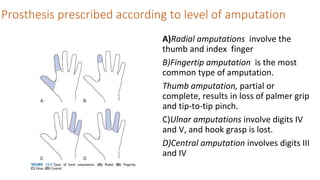
Prosthesis prescribed according to level of amputation
A)Radial amputations involve the
thumb and index finger
B)Fingertip amputation is the most
common type of amputation.
Thumb amputation, partial or
complete, results in loss of palmer grip
and tip-to-tip pinch.
C)Ulnar amputations involve digits IV
and V, and hook grasp is lost.
D)Central amputation involves digits III
and IV
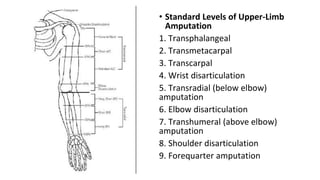
• Standard Levels of Upper-Limb
Amputation
1. Transphalangeal
2. Transmetacarpal
3. Transcarpal
4. Wrist disarticulation
5. Transradial (below elbow)
amputation
6. Elbow disarticulation
7. Transhumeral (above elbow)
amputation
8. Shoulder disarticulation
9. Forequarter amputation
• Transphalangeal amputation : amputation through distal interphalangeal joint
/proximal interphalangeal joint or metacarpophalangeal joint
• Transradial amputation: amputation through radius and ulna.devided into
three level :
1. Long: residual limb length of 55–90%
2. Short: residual limb length of 35–55%
3 Very short: residual limb length of less than 35%
The long below-elbow residual limb retains 60–120° degrees of supination and
pronation and the short below-elbow residual limb retains less than 60°
supination and pronation with prosthesis. A very short transradial amputation is
results in difficult prosthetic suspension and the additional loss of full range of
motion (ROM) at the elbow
• The long forearm residual limb is preferred for optimal prosthetic restoration
goal.
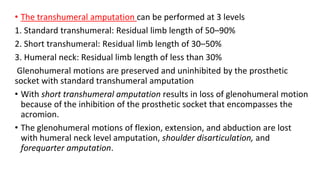
• The transhumeral amputation can be performed at 3 levels
1. Standard transhumeral: Residual limb length of 50–90%
2. Short transhumeral: Residual limb length of 30–50%
3. Humeral neck: Residual limb length of less than 30%
Glenohumeral motions are preserved and uninhibited by the prosthetic
socket with standard transhumeral amputation
• With short transhumeral amputation results in loss of glenohumeral motion
because of the inhibition of the prosthetic socket that encompasses the
acromion.
• The glenohumeral motions of flexion, extension, and abduction are lost
with humeral neck level amputation, shoulder disarticulation, and
forequarter amputation.
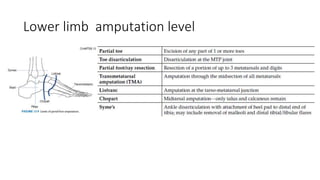
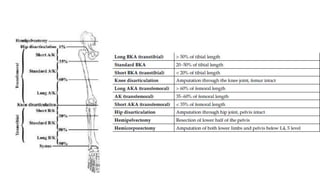
Lower limb amputation level
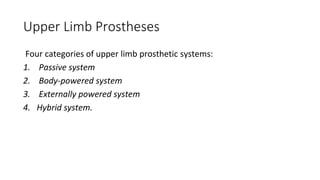
Upper Limb Prostheses
Four categories of upper limb prosthetic systems:
1. Passive system
2. Body-powered system
3. Externally powered system
4. Hybrid system.
• A passive system is primarily cosmetic but also functions a stabilizer.
A passive system is fabricated if the patient does not have enough
strength or movement to control a prosthesis, or wears a prosthesis
only for cosmoses.
• A body-powered system prosthesis uses the patient’s own residual
limb or body strength and ROM to control the prosthesis. This
includes powering the basic functions of terminal device opening and
closing by elbow and shoulder joint mobilization.
• An externally powered system uses an outside power source such as a
battery to operate the prosthesis.
• A hybrid system uses the patient’s own muscle strength and joint
movement, as well as an external supply for power. An example of a
hybrid system is one in which there is a body powered elbow joint but
an externally powered terminal device.
Components of prosthesis
1. Socket
2. Body of prosthesis
3. Harness /suspension system
4. Control system
5. Terminal device
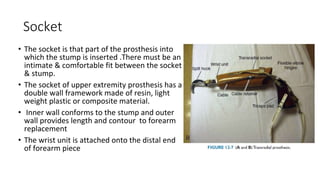
Socket
• The socket is that part of the prosthesis into
which the stump is inserted .There must be an
intimate & comfortable fit between the socket
& stump.
• The socket of upper extremity prosthesis has a
double wall framework made of resin, light
weight plastic or composite material.
• Inner wall conforms to the stump and outer
wall provides length and contour to forearm
replacement
• The wrist unit is attached onto the distal end
of forearm piece
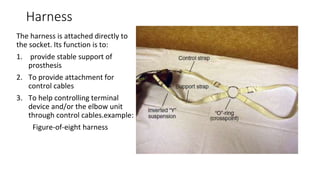
Harness
The harness is attached directly to
the socket. Its function is to:
1. provide stable support of
prosthesis
2. To provide attachment for
control cables
3. To help controlling terminal
device and/or the elbow unit
through control cables.example:
Figure-of-eight harness
Power:
Body-powered prostheses:
Cable controlled
Externally powered prostheses:
Electrically powered Myoelectric prostheses
Switch-controlled prostheses
Body-powered prostheses
• Body powered prostheses use forces generated by body movements
transmitted through cables to operate joints and terminal devices.
• Forward flexing the shoulder to provide tension on the control
cable(Bowden cable) of the prosthesis resulting in opening the
terminal device. Relaxing the shoulder forward flexion results in
return of the terminal device to the static closed position.
• Body-powered prostheses are more durable and are less expensive
and lighter than myoelectric prostheses
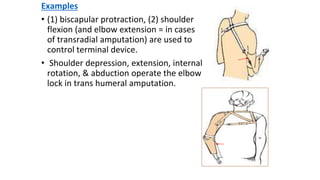
Examples
• (1) biscapular protraction, (2) shoulder
flexion (and elbow extension = in cases
of transradial amputation) are used to
control terminal device.
• Shoulder depression, extension, internal
rotation, & abduction operate the elbow
lock in trans humeral amputation.
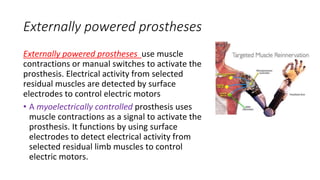
Externally powered prostheses
Externally powered prostheses use muscle
contractions or manual switches to activate the
prosthesis. Electrical activity from selected
residual muscles are detected by surface
electrodes to control electric motors
• A myoelectrically controlled prosthesis uses
muscle contractions as a signal to activate the
prosthesis. It functions by using surface
electrodes to detect electrical activity from
selected residual limb muscles to control
electric motors.
• Switch-controlled, externally powered prostheses use small switches
to operate the electric motors. These switches typically are enclosed
inside the socket or incorporated into the suspension harness of the
prosthesis
Terminal Devices and Wrist Units
• The terminal device is connected to forearm socket by wrist unit.
prosthetic wrist allows passive pronation and supination.
• Terminal devices are divided into two categories:
(1) Passive terminal device
(2) Active terminal device
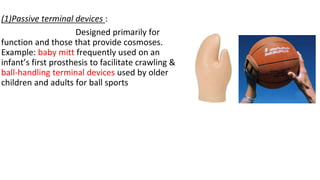
(1)Passive terminal devices :
Designed primarily for
function and those that provide cosmoses.
Example: baby mitt frequently used on an
infant’s first prosthesis to facilitate crawling &
ball-handling terminal devices used by older
children and adults for ball sports
Active terminal devices :
Two main categories
(1)Hooks including prehensors (which are devices that have a thumb-like
component and a finger component)
(2) Artificial hands
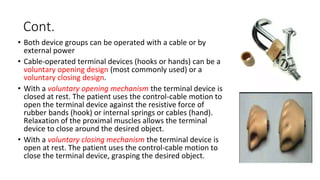
Cont.
• Both device groups can be operated with a cable or by
external power
• Cable-operated terminal devices (hooks or hands) can be a
voluntary opening design (most commonly used) or a
voluntary closing design.
• With a voluntary opening mechanism the terminal device is
closed at rest. The patient uses the control-cable motion to
open the terminal device against the resistive force of
rubber bands (hook) or internal springs or cables (hand).
Relaxation of the proximal muscles allows the terminal
device to close around the desired object.
• With a voluntary closing mechanism the terminal device is
open at rest. The patient uses the control-cable motion to
close the terminal device, grasping the desired object.
LOWER LIMB PROSTHESIS
1.Preparatory (Temporary) Prosthesis
2. Definitive (Permanent) Prosthesis
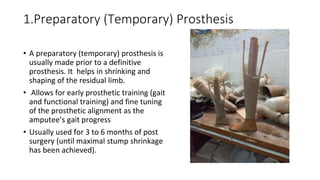
1.Preparatory (Temporary) Prosthesis
• A preparatory (temporary) prosthesis is
usually made prior to a definitive
prosthesis. It helps in shrinking and
shaping of the residual limb.
• Allows for early prosthetic training (gait
and functional training) and fine tuning
of the prosthetic alignment as the
amputee’s gait progress
• Usually used for 3 to 6 months of post
surgery (until maximal stump shrinkage
has been achieved).
Definitive (Permanent) Prosthesis:
• When shaping and shrinking process has ended and residual limb
volume has stabilized, a definitive or permanent prosthesis is made.
• It can be applied after 3-9 months of postoperative.
• Life span of 3-5 years.
• Changes are needed when there is residual limb atrophy, weight gain
or loss and excessive wear after prosthesis.
Lower limb prosthesis
Socket:
• The socket is typically custom-made for the user. The socket is constructed using a
cast of the residual limb. The residual limb shape can also be recorded via manual
measurements or by digital measurements that track the outer shape of the limb.
This shape is then used to create the socket interface.
• In most sockets, the goal is to achieve total contact with the residual limb. Total
contact does not necessarily imply equal pressure distribution.
• Pressure-tolerant areas can receive higher pressures and pressure sensitive areas
can receive lower pressures. Total contact helps decrease edema, increase
proprioception and increase the overall weight-bearing surface
Cont.
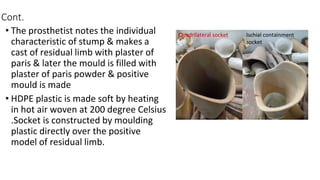
• The prosthetist notes the individual
characteristic of stump & makes a
cast of residual limb with plaster of
paris & later the mould is filled with
plaster of paris powder & positive
mould is made
• HDPE plastic is made soft by heating
in hot air woven at 200 degree Celsius
.Socket is constructed by moulding
plastic directly over the positive
model of residual limb.
Quadrilateral socket Ischial containment
socket
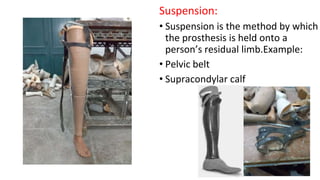
Suspension:
• Suspension is the method by which
the prosthesis is held onto a
person’s residual limb.Example:
• Pelvic belt
• Supracondylar calf
Body:
The prosthetic socket is connected to the remaining components in two
ways:
(1) Exoskeletal construction
(2) Endoskeletal construction
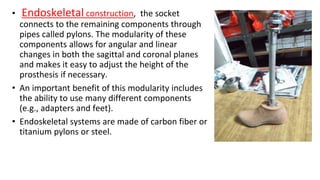
• Endoskeletal construction, the socket
connects to the remaining components through
pipes called pylons. The modularity of these
components allows for angular and linear
changes in both the sagittal and coronal planes
and makes it easy to adjust the height of the
prosthesis if necessary.
• An important benefit of this modularity includes
the ability to use many different components
(e.g., adapters and feet).
• Endoskeletal systems are made of carbon fiber or
titanium pylons or steel.
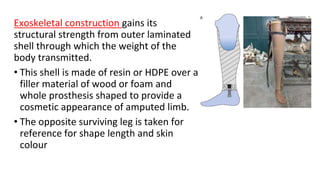
Exoskeletal construction gains its
structural strength from outer laminated
shell through which the weight of the
body transmitted.
• This shell is made of resin or HDPE over a
filler material of wood or foam and
whole prosthesis shaped to provide a
cosmetic appearance of amputed limb.
• The opposite surviving leg is taken for
reference for shape length and skin
colour
Prosthetic feet
prosthetic feet are made out of many different materials including
wood, plastic, foam, and carbon fiber. Example:
(1)SACH (solid ankle cushion-heel)
(2)Jaipur foot
Solid-Ankle Cushion-Heel Feet
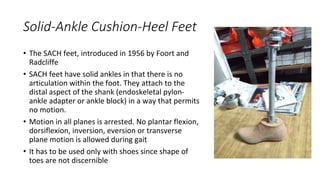
• The SACH feet, introduced in 1956 by Foort and
Radcliffe
• SACH feet have solid ankles in that there is no
articulation within the foot. They attach to the
distal aspect of the shank (endoskeletal pylon-
ankle adapter or ankle block) in a way that permits
no motion.
• Motion in all planes is arrested. No plantar flexion,
dorsiflexion, inversion, eversion or transverse
plane motion is allowed during gait
• It has to be used only with shoes since shape of
toes are not discernible
Jaipur foot
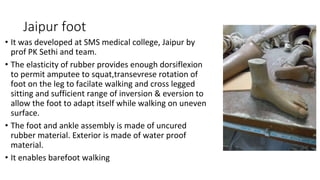
• It was developed at SMS medical college, Jaipur by
prof PK Sethi and team.
• The elasticity of rubber provides enough dorsiflexion
to permit amputee to squat,transevrese rotation of
foot on the leg to facilate walking and cross legged
sitting and sufficient range of inversion & eversion to
allow the foot to adapt itself while walking on uneven
surface.
• The foot and ankle assembly is made of uncured
rubber material. Exterior is made of water proof
material.
• It enables barefoot walking
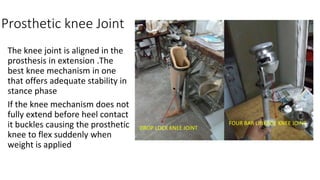
Prosthetic knee Joint
The knee joint is aligned in the
prosthesis in extension .The
best knee mechanism in one
that offers adequate stability in
stance phase
If the knee mechanism does not
fully extend before heel contact
it buckles causing the prosthetic
knee to flex suddenly when
weight is applied
DROP LOCK KNEE JOINT
FOUR BAR LINKAGE KNEE JOINT
References
• Atlas of orthosis by AAOS
• Physical medicine and rehabilitation by Braddom
• Physical medicine and rehabilitation by board review
THANK YOU

Prosthetics

  • 1.
    DEFINITION & GENERAL PRINCIPLEOF PROSTHESIS Dr Ratul Das 2nd year post graduate student,Dept.of PMR, SMS medical college,jaipur PG training class
  • 2.
    Definition : A prosthesisis an artificial replacement for any or all parts of the lower or upper extremities. It is a device that is designed to replace, as much as possible, the function or appearance of a missing limb or body part.
  • 3.
    Purpose • A prosthesisis used to provide an individual who has an amputated limb with the opportunity to perform functional tasks, particularly ambulation (walking) which may not be possible without the limb. • The type of prosthesis is determined by the extent of an amputation.
  • 4.
    Most Common Causesof Limb Amputations 1.Trauma 2. Cancer/tumors 3. Vascular complications of diseases
  • 5.
    Prosthesis prescribed accordingto level of amputation A)Radial amputations involve the thumb and index finger B)Fingertip amputation is the most common type of amputation. Thumb amputation, partial or complete, results in loss of palmer grip and tip-to-tip pinch. C)Ulnar amputations involve digits IV and V, and hook grasp is lost. D)Central amputation involves digits III and IV
  • 6.
    • Standard Levelsof Upper-Limb Amputation 1. Transphalangeal 2. Transmetacarpal 3. Transcarpal 4. Wrist disarticulation 5. Transradial (below elbow) amputation 6. Elbow disarticulation 7. Transhumeral (above elbow) amputation 8. Shoulder disarticulation 9. Forequarter amputation
  • 7.
    • Transphalangeal amputation: amputation through distal interphalangeal joint /proximal interphalangeal joint or metacarpophalangeal joint • Transradial amputation: amputation through radius and ulna.devided into three level : 1. Long: residual limb length of 55–90% 2. Short: residual limb length of 35–55% 3 Very short: residual limb length of less than 35% The long below-elbow residual limb retains 60–120° degrees of supination and pronation and the short below-elbow residual limb retains less than 60° supination and pronation with prosthesis. A very short transradial amputation is results in difficult prosthetic suspension and the additional loss of full range of motion (ROM) at the elbow • The long forearm residual limb is preferred for optimal prosthetic restoration goal.
  • 8.
    • The transhumeralamputation can be performed at 3 levels 1. Standard transhumeral: Residual limb length of 50–90% 2. Short transhumeral: Residual limb length of 30–50% 3. Humeral neck: Residual limb length of less than 30% Glenohumeral motions are preserved and uninhibited by the prosthetic socket with standard transhumeral amputation • With short transhumeral amputation results in loss of glenohumeral motion because of the inhibition of the prosthetic socket that encompasses the acromion. • The glenohumeral motions of flexion, extension, and abduction are lost with humeral neck level amputation, shoulder disarticulation, and forequarter amputation.
  • 9.
  • 11.
    Upper Limb Prostheses Fourcategories of upper limb prosthetic systems: 1. Passive system 2. Body-powered system 3. Externally powered system 4. Hybrid system.
  • 12.
    • A passivesystem is primarily cosmetic but also functions a stabilizer. A passive system is fabricated if the patient does not have enough strength or movement to control a prosthesis, or wears a prosthesis only for cosmoses. • A body-powered system prosthesis uses the patient’s own residual limb or body strength and ROM to control the prosthesis. This includes powering the basic functions of terminal device opening and closing by elbow and shoulder joint mobilization.
  • 13.
    • An externallypowered system uses an outside power source such as a battery to operate the prosthesis. • A hybrid system uses the patient’s own muscle strength and joint movement, as well as an external supply for power. An example of a hybrid system is one in which there is a body powered elbow joint but an externally powered terminal device.
  • 14.
    Components of prosthesis 1.Socket 2. Body of prosthesis 3. Harness /suspension system 4. Control system 5. Terminal device
  • 15.
    Socket • The socketis that part of the prosthesis into which the stump is inserted .There must be an intimate & comfortable fit between the socket & stump. • The socket of upper extremity prosthesis has a double wall framework made of resin, light weight plastic or composite material. • Inner wall conforms to the stump and outer wall provides length and contour to forearm replacement • The wrist unit is attached onto the distal end of forearm piece
  • 16.
    Harness The harness isattached directly to the socket. Its function is to: 1. provide stable support of prosthesis 2. To provide attachment for control cables 3. To help controlling terminal device and/or the elbow unit through control cables.example: Figure-of-eight harness
  • 17.
    Power: Body-powered prostheses: Cable controlled Externallypowered prostheses: Electrically powered Myoelectric prostheses Switch-controlled prostheses
  • 18.
    Body-powered prostheses • Bodypowered prostheses use forces generated by body movements transmitted through cables to operate joints and terminal devices. • Forward flexing the shoulder to provide tension on the control cable(Bowden cable) of the prosthesis resulting in opening the terminal device. Relaxing the shoulder forward flexion results in return of the terminal device to the static closed position. • Body-powered prostheses are more durable and are less expensive and lighter than myoelectric prostheses
  • 19.
    Examples • (1) biscapularprotraction, (2) shoulder flexion (and elbow extension = in cases of transradial amputation) are used to control terminal device. • Shoulder depression, extension, internal rotation, & abduction operate the elbow lock in trans humeral amputation.
  • 20.
    Externally powered prostheses Externallypowered prostheses use muscle contractions or manual switches to activate the prosthesis. Electrical activity from selected residual muscles are detected by surface electrodes to control electric motors • A myoelectrically controlled prosthesis uses muscle contractions as a signal to activate the prosthesis. It functions by using surface electrodes to detect electrical activity from selected residual limb muscles to control electric motors.
  • 21.
    • Switch-controlled, externallypowered prostheses use small switches to operate the electric motors. These switches typically are enclosed inside the socket or incorporated into the suspension harness of the prosthesis
  • 22.
    Terminal Devices andWrist Units • The terminal device is connected to forearm socket by wrist unit. prosthetic wrist allows passive pronation and supination. • Terminal devices are divided into two categories: (1) Passive terminal device (2) Active terminal device
  • 23.
    (1)Passive terminal devices: Designed primarily for function and those that provide cosmoses. Example: baby mitt frequently used on an infant’s first prosthesis to facilitate crawling & ball-handling terminal devices used by older children and adults for ball sports
  • 24.
    Active terminal devices: Two main categories (1)Hooks including prehensors (which are devices that have a thumb-like component and a finger component) (2) Artificial hands
  • 25.
    Cont. • Both devicegroups can be operated with a cable or by external power • Cable-operated terminal devices (hooks or hands) can be a voluntary opening design (most commonly used) or a voluntary closing design. • With a voluntary opening mechanism the terminal device is closed at rest. The patient uses the control-cable motion to open the terminal device against the resistive force of rubber bands (hook) or internal springs or cables (hand). Relaxation of the proximal muscles allows the terminal device to close around the desired object. • With a voluntary closing mechanism the terminal device is open at rest. The patient uses the control-cable motion to close the terminal device, grasping the desired object.
  • 26.
    LOWER LIMB PROSTHESIS 1.Preparatory(Temporary) Prosthesis 2. Definitive (Permanent) Prosthesis
  • 27.
    1.Preparatory (Temporary) Prosthesis •A preparatory (temporary) prosthesis is usually made prior to a definitive prosthesis. It helps in shrinking and shaping of the residual limb. • Allows for early prosthetic training (gait and functional training) and fine tuning of the prosthetic alignment as the amputee’s gait progress • Usually used for 3 to 6 months of post surgery (until maximal stump shrinkage has been achieved).
  • 28.
    Definitive (Permanent) Prosthesis: •When shaping and shrinking process has ended and residual limb volume has stabilized, a definitive or permanent prosthesis is made. • It can be applied after 3-9 months of postoperative. • Life span of 3-5 years. • Changes are needed when there is residual limb atrophy, weight gain or loss and excessive wear after prosthesis.
  • 29.
    Lower limb prosthesis Socket: •The socket is typically custom-made for the user. The socket is constructed using a cast of the residual limb. The residual limb shape can also be recorded via manual measurements or by digital measurements that track the outer shape of the limb. This shape is then used to create the socket interface. • In most sockets, the goal is to achieve total contact with the residual limb. Total contact does not necessarily imply equal pressure distribution. • Pressure-tolerant areas can receive higher pressures and pressure sensitive areas can receive lower pressures. Total contact helps decrease edema, increase proprioception and increase the overall weight-bearing surface
  • 30.
    Cont. • The prosthetistnotes the individual characteristic of stump & makes a cast of residual limb with plaster of paris & later the mould is filled with plaster of paris powder & positive mould is made • HDPE plastic is made soft by heating in hot air woven at 200 degree Celsius .Socket is constructed by moulding plastic directly over the positive model of residual limb. Quadrilateral socket Ischial containment socket
  • 31.
    Suspension: • Suspension isthe method by which the prosthesis is held onto a person’s residual limb.Example: • Pelvic belt • Supracondylar calf
  • 32.
    Body: The prosthetic socketis connected to the remaining components in two ways: (1) Exoskeletal construction (2) Endoskeletal construction
  • 33.
    • Endoskeletal construction,the socket connects to the remaining components through pipes called pylons. The modularity of these components allows for angular and linear changes in both the sagittal and coronal planes and makes it easy to adjust the height of the prosthesis if necessary. • An important benefit of this modularity includes the ability to use many different components (e.g., adapters and feet). • Endoskeletal systems are made of carbon fiber or titanium pylons or steel.
  • 34.
    Exoskeletal construction gainsits structural strength from outer laminated shell through which the weight of the body transmitted. • This shell is made of resin or HDPE over a filler material of wood or foam and whole prosthesis shaped to provide a cosmetic appearance of amputed limb. • The opposite surviving leg is taken for reference for shape length and skin colour
  • 35.
    Prosthetic feet prosthetic feetare made out of many different materials including wood, plastic, foam, and carbon fiber. Example: (1)SACH (solid ankle cushion-heel) (2)Jaipur foot
  • 36.
    Solid-Ankle Cushion-Heel Feet •The SACH feet, introduced in 1956 by Foort and Radcliffe • SACH feet have solid ankles in that there is no articulation within the foot. They attach to the distal aspect of the shank (endoskeletal pylon- ankle adapter or ankle block) in a way that permits no motion. • Motion in all planes is arrested. No plantar flexion, dorsiflexion, inversion, eversion or transverse plane motion is allowed during gait • It has to be used only with shoes since shape of toes are not discernible
  • 37.
    Jaipur foot • Itwas developed at SMS medical college, Jaipur by prof PK Sethi and team. • The elasticity of rubber provides enough dorsiflexion to permit amputee to squat,transevrese rotation of foot on the leg to facilate walking and cross legged sitting and sufficient range of inversion & eversion to allow the foot to adapt itself while walking on uneven surface. • The foot and ankle assembly is made of uncured rubber material. Exterior is made of water proof material. • It enables barefoot walking
  • 38.
    Prosthetic knee Joint Theknee joint is aligned in the prosthesis in extension .The best knee mechanism in one that offers adequate stability in stance phase If the knee mechanism does not fully extend before heel contact it buckles causing the prosthetic knee to flex suddenly when weight is applied DROP LOCK KNEE JOINT FOUR BAR LINKAGE KNEE JOINT
  • 39.
    References • Atlas oforthosis by AAOS • Physical medicine and rehabilitation by Braddom • Physical medicine and rehabilitation by board review
  • 40.