TOTAL HIP REPLACEMENT(THR)
PREPARED BY-KAUSHAL SHAH
CONTENTS
 Anatomy of hip
 Causes
 Types of surgery
 Materials used in Surgery
 Characteristics of Materials
 procedure
 Complications
 Advantages and Disadvantages
 Precautions to prevent Implant failure
 Regulations
WHAT IS TOTAL HIP REPLACEMENT
 This is an operation where your arthritic or damaged hip joint is removed and
replaced with an artificial joint (prosthesis). The replacement is usually made of
high grade metals, plastics and / or ceramics. Total hip joint replacement
involves replacing the hip socket (acetabulum which resembles a cup-shaped
bone in the pelvis) and the head of the thigh bone (femur).
ANATOMY OF HIP
ANATOMY OF HIP
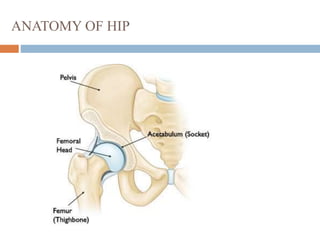
 The hip is one of the body’s largest joints. It is ball-and-socket joint. The socket
is formed by the acetabulum, which is part of the large pelvis bone. The ball is
the femoral head, which is the upper end of the femur (thighbone).
 The bone surfaces of the ball and socket are covered with articular cartilage, a
smooth tissue that cushions the ends of the bones and enables them to move
easily.
 A thin tissue called synovial membrane surrounds the hip joint. In a healthy hip,
this membrane makes a small amount of fluid that lubricates the cartilage and
eliminates almost all friction during hip movement.
 Bands of tissue called ligaments (the hip capsule) connect the ball to the socket
and provide stability to the joint.
CAUSES
 Osteoarthritis:- This is an age-related “wear and tear” type of arthritis. It
usually occurs in people 50 years of age and older and often in individuals with
a family history of arthritis. The cartilage cushioning the bones of the hip wears
away. The bones then rub against each other, causing hip pain and stiffness.
Osteoarthritis may also be caused or accelerated by subtle irregularities in how
the hip developed in childhood.
 Rheumatoid arthritis:- This is an autoimmune disease in which the synovial
membrane becomes inflamed and thickened. This chronic inflammation can
damage the cartilage, leading to pain and stiffness. Rheumatoid arthritis is the
most common type of a group of disorders termed “inflammatory arthritis.”
CAUSES
 Post-traumatic arthritis:-This can follow a serious hip injury or fracture. The
cartilage may become damaged and lead to hip pain and stiffness over time.
 Avascular necrosis:- An injury to the hip, such as a dislocation or fracture,
may limit the blood supply to the femoral head. This is called avascular necrosis
(also commonly referred to as “osteonecrosis”). The lack of blood may cause
the surface of the bone to collapse, and arthritis will result. Some diseases can
also cause avascular necrosis.
 Childhood hip disease:- Some infants and children have hip problems. Even
though the problems are successfully treated during childhood, they may still
cause arthritis later on in life. This happens because the hip may not grow
normally, and the joint surfaces are affected.
TYPES OF SURGURY
1.Cemented fixation technique
 Cemented fixation uses an acrylic polymer (PMMA).
 Both the bone and the cement must lock together in order to make the insertion
last.
 Bone cement is not glue and it doesn’t stick to anything.
 Cement simply acts as a filler between the bone and the implant.
2.cementless fixation technique
 Stems are rough (titanium, cobalt-chromium alloy).
 Cups are made from metal alloy with rough outer part.
 Cementless implants are covered with porous or hydroxyapatite covering the
maximum bone ingrowth capability is obtained with the pore size 100–200 µm.
MATERIALS USED IN SURGURY
 There are a large number of hip implant devices on the market. Each
manufacturer has different models but each style falls into one of four basic
material categories:
 metal on plastic (polyethylene or UHMWPE)
 metal on metal (MoM)
 ceramic on plastic (UHMWPE)
 ceramic on ceramic (CoC)
CHERECTERISTICS OF MATERIALS USED IN
SURGURY
 Metal-on-Plastic
Metal-on-plastic (polyethylene) is the longest tried and tested bearing. The
convex femoral stem is constructed of metal (usually a cobalt chrome alloy) and
the concave cup liner is made of a plastic called polyethylene.
 Metal-on-Metal (MoM)
Metal-on-Metal hip implants have been used even longer than metal-on-plastic
implants. MoM bearings are made of cobalt chromium alloy, titanium alloy or
sometimes stainless steel. . They offer the potential for greatly reduced wear,
with less inflammation and less bone loss. Some device recalls have brought
negative attention to MoM.
CHERECTERISTICS OF MATERIALS USED IN
SURGURY
 Ceramic-on-Ceramic (CoC)
If you are a very active individual or a relatively young patient your surgeon
may prescribe an all-ceramic hip joint. Ceramic-on-Ceramic is a good
combination with longevity and reliability. In these hip joints, the traditional
metal ball and polyethylene liner are replaced by a high-strength ceramic
bearing that has the reputation for ultra low wear performance.
 Ceramic-on-Plastic (or UHMWPE)
Ceramic-on-UHMWPE (Ultra High Molecular Weight PolyEthylene) is a good
combination of two very reliable materials. Ceramic heads are harder than metal
and are the most scratch-resistant implant material. The hard, ultra-smooth
surface can greatly reduce the wear rate on the polyethylene bearing. The
potential wear rate for this type of implant is less than Metal-on-Polyethylene.
PROCEDURE
 You will not feel any pain during surgery because you will have one of two types
of anesthesia:
 General anesthesia. This means you will be asleep and unable to feel pain.
 Regional (spinal or epidural anesthesia). Medicine is put into your back to make
you numb below your waist. You will also get medicine to make you sleepy. And
you may get medicine that will make you forget about the procedure, even though
you will not be fully asleep.
 After you receive anesthesia, your surgeon will make a surgical cut to open up
your hip joint. Often this cut is over the buttocks. Then your surgeon will
PROCEDURE
1) Cut and remove the head of your thigh bone.
2) Clean out your hip socket and remove the rest of the cartilage and damaged or
arthritic bone.
3) Put the new hip socket in place, then insert the metal stem into your thigh bone.
4) Place the correct-sized ball for the new joint.
5) Secure all of the new parts in place, sometimes with a special cement.
6) Repair the muscles and tendons around the new joint.
7) Close the surgical cut.
8) This surgery usually takes 2 to 4 hours.
COMPLICATIONS
 Risks for any anesthesia are:
 Allergic reactions to medicines.
 Breathing problems.
 Risks for any surgery :
 Bleeding. surgery.
 Infection, including in the lungs, urinary tract,
 Blood clots in the legs that may travel to the lungs.
 Heart attack or stroke during and chest.
ADVANTAGES AND DISADVANTAGES
 Advantages
 Low damage to major muscles
 Less post operative pain
 Faster recovery
 Decrease risk of dislocation
 Better range of movement
 Disadvantages
 There is potential risk of nerve injury
 There may be wound healing issues
 Blood loss
 Longer duration of surgery
PRECAUSTIONS TO PREVENT FAILURE
 Wound Care
You may have stitches or staples running along your wound or a suture beneath
your skin. Avoid getting the wound wet until it has thoroughly sealed and dried.
You may continue to bandage the wound to prevent irritation from clothing.
 Diet
Some loss of appetite is common for several weeks after surgery. A balanced
diet, often with an iron supplement, is important to promote proper tissue
healing and restore muscle strength. Be sure to drink plenty of fluids.
 Activity
Exercise is a critical component of home care, particularly during the first few
weeks after surgery.
 Avoiding Falls
A fall during the first few weeks after surgery can damage your new hip and
may result in a need for more surgery. Stairs are a particular hazard until your
hip is strong and mobile. You should use a cane, crutches, a walker, or handrails.
PRECAUSTIONS TO PREVENT FAILURE
 Preventing Infection
 Warning signs of infection
 Persistent fever (higher than 100°F orally)
 Shaking chills
 Increasing redness, tenderness, or swelling of the hip wound
 Drainage from the hip wound
 Increasing hip pain with both activity and rest
 Recognizing the Signs of a Blood Clot
 Pain in your calf and leg that is unrelated to your incision
 Tenderness or redness of your calf
 New or increasing swelling of your thigh, calf, ankle, or foot.
PRECAUSTIONS TO PREVENT FAILURE
 Other Precautions
To assure proper recovery and prevent dislocation of the prosthesis, you may be
asked to take special precautions when sitting, bending, or sleeping — usually
for the first 6 weeks after surgery. These precautions will vary from patient to
patient, depending on the surgical approach your surgeon used to perform your
hip replacement.
REGULATIONS
 In India medical devices are governed by CDSCO(Central Drugs Standard
Control Organization) which is regulated by Directorate General of Health
Services , Ministry of Health and Family Welfare , Government of India.
 Materials like bone cement, prosthetic replacement are regulated under the
DRUG AND COOSMETIC ACT (DCA).
 Following are the IMRDA (Indian Medical Device Regulatory Act) essential
principles:
1. Should not compromise health and safety.
2. Design and manufacture of devices must conform with safety principles.
3. Long term safety should be ensured.
4. Benefits of the devices must outweigh any side effects.
5. Medical devices should be useful for the intended purpose.
THANK YOU

Total hip replacement(thr)

  • 1.
  • 2.
    CONTENTS  Anatomy ofhip  Causes  Types of surgery  Materials used in Surgery  Characteristics of Materials  procedure  Complications  Advantages and Disadvantages  Precautions to prevent Implant failure  Regulations
  • 3.
    WHAT IS TOTALHIP REPLACEMENT  This is an operation where your arthritic or damaged hip joint is removed and replaced with an artificial joint (prosthesis). The replacement is usually made of high grade metals, plastics and / or ceramics. Total hip joint replacement involves replacing the hip socket (acetabulum which resembles a cup-shaped bone in the pelvis) and the head of the thigh bone (femur).
  • 4.
  • 5.
    ANATOMY OF HIP The hip is one of the body’s largest joints. It is ball-and-socket joint. The socket is formed by the acetabulum, which is part of the large pelvis bone. The ball is the femoral head, which is the upper end of the femur (thighbone).  The bone surfaces of the ball and socket are covered with articular cartilage, a smooth tissue that cushions the ends of the bones and enables them to move easily.  A thin tissue called synovial membrane surrounds the hip joint. In a healthy hip, this membrane makes a small amount of fluid that lubricates the cartilage and eliminates almost all friction during hip movement.  Bands of tissue called ligaments (the hip capsule) connect the ball to the socket and provide stability to the joint.
  • 6.
    CAUSES  Osteoarthritis:- Thisis an age-related “wear and tear” type of arthritis. It usually occurs in people 50 years of age and older and often in individuals with a family history of arthritis. The cartilage cushioning the bones of the hip wears away. The bones then rub against each other, causing hip pain and stiffness. Osteoarthritis may also be caused or accelerated by subtle irregularities in how the hip developed in childhood.  Rheumatoid arthritis:- This is an autoimmune disease in which the synovial membrane becomes inflamed and thickened. This chronic inflammation can damage the cartilage, leading to pain and stiffness. Rheumatoid arthritis is the most common type of a group of disorders termed “inflammatory arthritis.”
  • 7.
    CAUSES  Post-traumatic arthritis:-Thiscan follow a serious hip injury or fracture. The cartilage may become damaged and lead to hip pain and stiffness over time.  Avascular necrosis:- An injury to the hip, such as a dislocation or fracture, may limit the blood supply to the femoral head. This is called avascular necrosis (also commonly referred to as “osteonecrosis”). The lack of blood may cause the surface of the bone to collapse, and arthritis will result. Some diseases can also cause avascular necrosis.  Childhood hip disease:- Some infants and children have hip problems. Even though the problems are successfully treated during childhood, they may still cause arthritis later on in life. This happens because the hip may not grow normally, and the joint surfaces are affected.
  • 8.
    TYPES OF SURGURY 1.Cementedfixation technique  Cemented fixation uses an acrylic polymer (PMMA).  Both the bone and the cement must lock together in order to make the insertion last.  Bone cement is not glue and it doesn’t stick to anything.  Cement simply acts as a filler between the bone and the implant. 2.cementless fixation technique  Stems are rough (titanium, cobalt-chromium alloy).  Cups are made from metal alloy with rough outer part.  Cementless implants are covered with porous or hydroxyapatite covering the maximum bone ingrowth capability is obtained with the pore size 100–200 µm.
  • 9.
    MATERIALS USED INSURGURY  There are a large number of hip implant devices on the market. Each manufacturer has different models but each style falls into one of four basic material categories:  metal on plastic (polyethylene or UHMWPE)  metal on metal (MoM)  ceramic on plastic (UHMWPE)  ceramic on ceramic (CoC)
  • 10.
    CHERECTERISTICS OF MATERIALSUSED IN SURGURY  Metal-on-Plastic Metal-on-plastic (polyethylene) is the longest tried and tested bearing. The convex femoral stem is constructed of metal (usually a cobalt chrome alloy) and the concave cup liner is made of a plastic called polyethylene.  Metal-on-Metal (MoM) Metal-on-Metal hip implants have been used even longer than metal-on-plastic implants. MoM bearings are made of cobalt chromium alloy, titanium alloy or sometimes stainless steel. . They offer the potential for greatly reduced wear, with less inflammation and less bone loss. Some device recalls have brought negative attention to MoM.
  • 11.
    CHERECTERISTICS OF MATERIALSUSED IN SURGURY  Ceramic-on-Ceramic (CoC) If you are a very active individual or a relatively young patient your surgeon may prescribe an all-ceramic hip joint. Ceramic-on-Ceramic is a good combination with longevity and reliability. In these hip joints, the traditional metal ball and polyethylene liner are replaced by a high-strength ceramic bearing that has the reputation for ultra low wear performance.  Ceramic-on-Plastic (or UHMWPE) Ceramic-on-UHMWPE (Ultra High Molecular Weight PolyEthylene) is a good combination of two very reliable materials. Ceramic heads are harder than metal and are the most scratch-resistant implant material. The hard, ultra-smooth surface can greatly reduce the wear rate on the polyethylene bearing. The potential wear rate for this type of implant is less than Metal-on-Polyethylene.
  • 12.
    PROCEDURE  You willnot feel any pain during surgery because you will have one of two types of anesthesia:  General anesthesia. This means you will be asleep and unable to feel pain.  Regional (spinal or epidural anesthesia). Medicine is put into your back to make you numb below your waist. You will also get medicine to make you sleepy. And you may get medicine that will make you forget about the procedure, even though you will not be fully asleep.  After you receive anesthesia, your surgeon will make a surgical cut to open up your hip joint. Often this cut is over the buttocks. Then your surgeon will
  • 13.
    PROCEDURE 1) Cut andremove the head of your thigh bone. 2) Clean out your hip socket and remove the rest of the cartilage and damaged or arthritic bone. 3) Put the new hip socket in place, then insert the metal stem into your thigh bone. 4) Place the correct-sized ball for the new joint. 5) Secure all of the new parts in place, sometimes with a special cement. 6) Repair the muscles and tendons around the new joint. 7) Close the surgical cut. 8) This surgery usually takes 2 to 4 hours.
  • 14.
    COMPLICATIONS  Risks forany anesthesia are:  Allergic reactions to medicines.  Breathing problems.  Risks for any surgery :  Bleeding. surgery.  Infection, including in the lungs, urinary tract,  Blood clots in the legs that may travel to the lungs.  Heart attack or stroke during and chest.
  • 15.
    ADVANTAGES AND DISADVANTAGES Advantages  Low damage to major muscles  Less post operative pain  Faster recovery  Decrease risk of dislocation  Better range of movement  Disadvantages  There is potential risk of nerve injury  There may be wound healing issues  Blood loss  Longer duration of surgery
  • 16.
    PRECAUSTIONS TO PREVENTFAILURE  Wound Care You may have stitches or staples running along your wound or a suture beneath your skin. Avoid getting the wound wet until it has thoroughly sealed and dried. You may continue to bandage the wound to prevent irritation from clothing.  Diet Some loss of appetite is common for several weeks after surgery. A balanced diet, often with an iron supplement, is important to promote proper tissue healing and restore muscle strength. Be sure to drink plenty of fluids.  Activity Exercise is a critical component of home care, particularly during the first few weeks after surgery.  Avoiding Falls A fall during the first few weeks after surgery can damage your new hip and may result in a need for more surgery. Stairs are a particular hazard until your hip is strong and mobile. You should use a cane, crutches, a walker, or handrails.
  • 17.
    PRECAUSTIONS TO PREVENTFAILURE  Preventing Infection  Warning signs of infection  Persistent fever (higher than 100°F orally)  Shaking chills  Increasing redness, tenderness, or swelling of the hip wound  Drainage from the hip wound  Increasing hip pain with both activity and rest  Recognizing the Signs of a Blood Clot  Pain in your calf and leg that is unrelated to your incision  Tenderness or redness of your calf  New or increasing swelling of your thigh, calf, ankle, or foot.
  • 18.
    PRECAUSTIONS TO PREVENTFAILURE  Other Precautions To assure proper recovery and prevent dislocation of the prosthesis, you may be asked to take special precautions when sitting, bending, or sleeping — usually for the first 6 weeks after surgery. These precautions will vary from patient to patient, depending on the surgical approach your surgeon used to perform your hip replacement.
  • 19.
    REGULATIONS  In Indiamedical devices are governed by CDSCO(Central Drugs Standard Control Organization) which is regulated by Directorate General of Health Services , Ministry of Health and Family Welfare , Government of India.  Materials like bone cement, prosthetic replacement are regulated under the DRUG AND COOSMETIC ACT (DCA).  Following are the IMRDA (Indian Medical Device Regulatory Act) essential principles: 1. Should not compromise health and safety. 2. Design and manufacture of devices must conform with safety principles. 3. Long term safety should be ensured. 4. Benefits of the devices must outweigh any side effects. 5. Medical devices should be useful for the intended purpose.
  • 20.