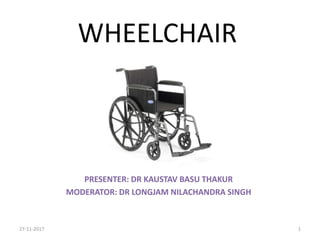

WHEELCHAIR
PRESENTER: DR KAUSTAV BASU THAKUR
MODERATOR: DR LONGJAM NILACHANDRA SINGH
27-11-2017 1
INTRODUCTION
• Any chair on wheels that can
be propelled either manually
or by power
• A properly prescribed
wheelchair-useful in
reintegrating a person with a
disability into the community
27-11-2017 2
HISTORY
• The first folding manual WC - US by Herbert Everest and
Harry Jennings in 1933
• In late 1970s and early 1980s, Marilyn Hamilton led way
in development of manual WC with custom fitting
• Today a plethora of powered and manual WC technology
• Challenge is matching client need to specific WC
technologies and components
27-11-2017 3
GOALS OF PRESCRIBING WC
• Maximize functional independence with ADL
• Minimize risk of secondary injuries
• Accommodate or correct skeletal deformities
• Ensure proper comfort
• Promote positive and unobtrusive self image
27-11-2017 4
INDICATIONS
• INADVISABILITY OF AMBULATION
Contraindications to weight-bearing
Interference with wound healing
Prior to ambulation
Inadequate safety in walking
Deficiency of the patient’s judgment
**In all of these conditions, the restriction against walking may be
temporary
27-11-2017 5
INDICATIONS contd
• IMPOSSIBLE FOR AMBULATION
 Congenital or traumatic LL amputees
 Paralysis
 Deformity
 Pain on weight bearing
 Incoordination
**In all of these conditions, the use of wheel chair may be permanent
27-11-2017 6
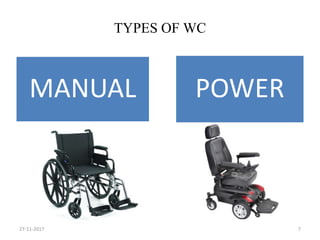
TYPES OF WC
MANUAL POWER
27-11-2017 7
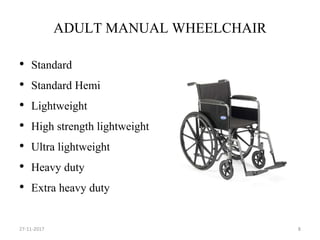
ADULT MANUAL WHEELCHAIR
• Standard
• Standard Hemi
• Lightweight
• High strength lightweight
• Ultra lightweight
• Heavy duty
• Extra heavy duty
27-11-2017 8
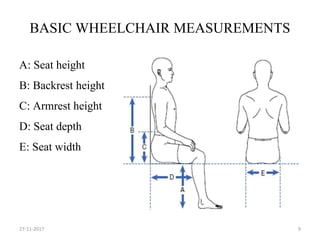
BASIC WHEELCHAIR MEASUREMENTS
A: Seat height
B: Backrest height
C: Armrest height
D: Seat depth
E: Seat width
27-11-2017 9
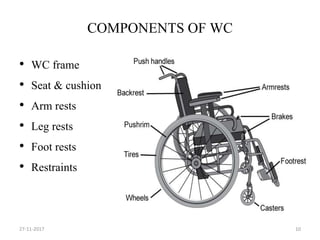
COMPONENTS OF WC
• WC frame
• Seat & cushion
• Arm rests
• Leg rests
• Foot rests
• Restraints
27-11-2017 10
MANUAL WC ACCESSORIES
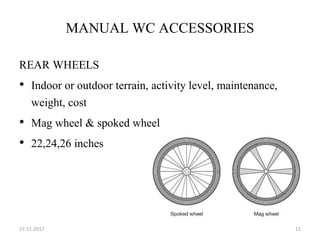
REAR WHEELS
• Indoor or outdoor terrain, activity level, maintenance,
weight, cost
• Mag wheel & spoked wheel
• 22,24,26 inches
27-11-2017 11
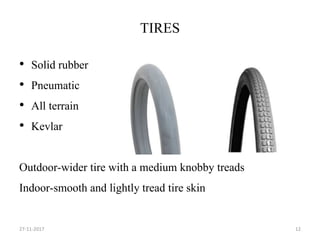
TIRES
• Solid rubber
• Pneumatic
• All terrain
• Kevlar
Outdoor-wider tire with a medium knobby treads
Indoor-smooth and lightly tread tire skin
27-11-2017 12
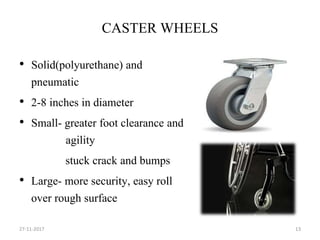
CASTER WHEELS
• Solid(polyurethane) and
pneumatic
• 2-8 inches in diameter
• Small- greater foot clearance and
agility
stuck crack and bumps
• Large- more security, easy roll
over rough surface
27-11-2017 13
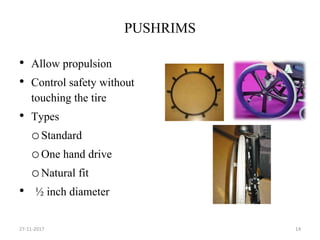
PUSHRIMS
• Allow propulsion
• Control safety without
touching the tire
• Types
oStandard
oOne hand drive
oNatural fit
• ½ inch diameter
27-11-2017 14
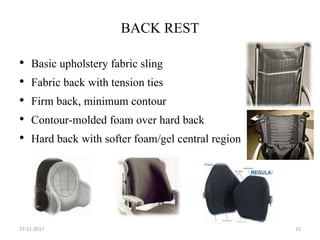
BACK REST
• Basic upholstery fabric sling
• Fabric back with tension ties
• Firm back, minimum contour
• Contour-molded foam over hard back
• Hard back with softer foam/gel central region
27-11-2017 15
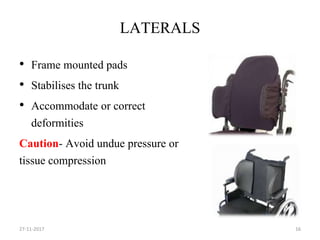
LATERALS
• Frame mounted pads
• Stabilises the trunk
• Accommodate or correct
deformities
Caution- Avoid undue pressure or
tissue compression
27-11-2017 16
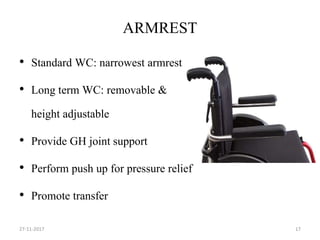
ARMREST
• Standard WC: narrowest armrest
• Long term WC: removable &
height adjustable
• Provide GH joint support
• Perform push up for pressure relief
• Promote transfer
27-11-2017 17
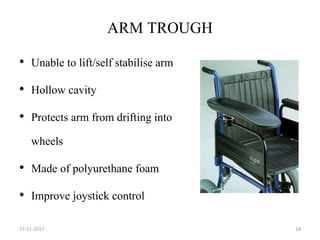
ARM TROUGH
• Unable to lift/self stabilise arm
• Hollow cavity
• Protects arm from drifting into
wheels
• Made of polyurethane foam
• Improve joystick control
27-11-2017 18
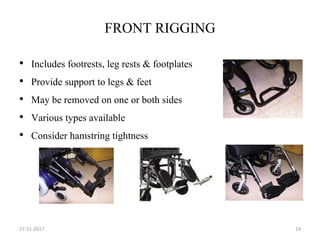
FRONT RIGGING
• Includes footrests, leg rests & footplates
• Provide support to legs & feet
• May be removed on one or both sides
• Various types available
• Consider hamstring tightness
27-11-2017 19
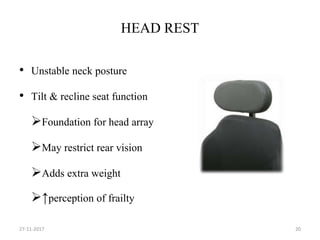
HEAD REST
• Unstable neck posture
• Tilt & recline seat function
Foundation for head array
May restrict rear vision
Adds extra weight
↑perception of frailty
27-11-2017 20
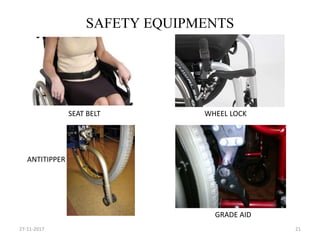
SAFETY EQUIPMENTS
27-11-2017 21
SEAT BELT WHEEL LOCK
ANTITIPPER
GRADE AID
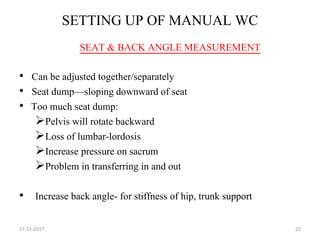
SETTING UP OF MANUAL WC
• Can be adjusted together/separately
• Seat dump—sloping downward of seat
• Too much seat dump:
Pelvis will rotate backward
Loss of lumbar-lordosis
Increase pressure on sacrum
Problem in transferring in and out
• Increase back angle- for stiffness of hip, trunk support
27-11-2017 22
SEAT & BACK ANGLE MEASUREMENT
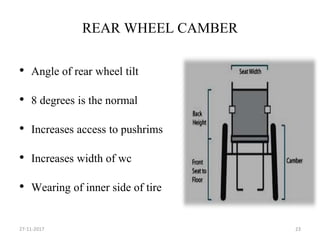
REAR WHEEL CAMBER
• Angle of rear wheel tilt
• 8 degrees is the normal
• Increases access to pushrims
• Increases width of wc
• Wearing of inner side of tire
27-11-2017 23
HORIZONTAL AXLE POSITION
• Moving the axle forward moves the seat back
• Shift of COG over or slightly behind rear axles
• Forward axle position
- requires less muscle effort
- facilitates “popping a wheelie”
• Make WC more “tippy” and difficult push up ramp
• Delivered with the axle in the most rearward position
• Needs to be changed
27-11-2017 24
VERTICAL AXLE POSITION
• Raising the axle has the effect of lowering the seat, while
lowering the axle raises the seat
oBetter propulsion biomechanics by lowering the seat
height
oGreater stability in low position
oToo low - lead to shoulder impingement syndrome
oIdeal position - elbow angle 100- 120⁰
27-11-2017 25
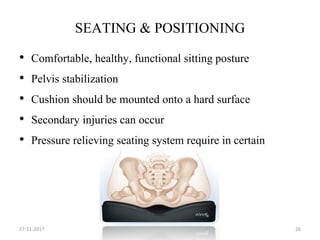
SEATING & POSITIONING
• Comfortable, healthy, functional sitting posture
• Pelvis stabilization
• Cushion should be mounted onto a hard surface
• Secondary injuries can occur
• Pressure relieving seating system require in certain
27-11-2017 26
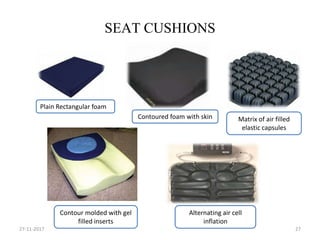
SEAT CUSHIONS
27-11-2017 27
Plain Rectangular foam
Contoured foam with skin Matrix of air filled
elastic capsules
Alternating air cell
inflation
Contour molded with gel
filled inserts
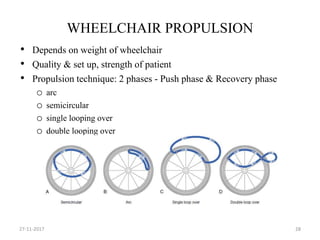
WHEELCHAIR PROPULSION
• Depends on weight of wheelchair
• Quality & set up, strength of patient
• Propulsion technique: 2 phases - Push phase & Recovery phase
o arc
o semicircular
o single looping over
o double looping over
27-11-2017 28
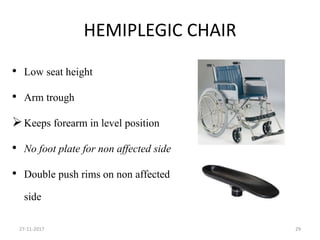
HEMIPLEGIC CHAIR
• Low seat height
• Arm trough
Keeps forearm in level position
• No foot plate for non affected side
• Double push rims on non affected
side
27-11-2017 29
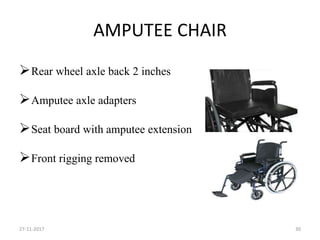
AMPUTEE CHAIR
Rear wheel axle back 2 inches
Amputee axle adapters
Seat board with amputee extension
Front rigging removed
27-11-2017 30
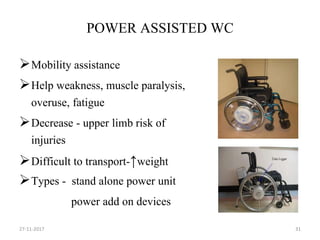
POWER ASSISTED WC
Mobility assistance
Help weakness, muscle paralysis,
overuse, fatigue
Decrease - upper limb risk of
injuries
Difficult to transport-↑weight
Types - stand alone power unit
power add on devices
27-11-2017 31
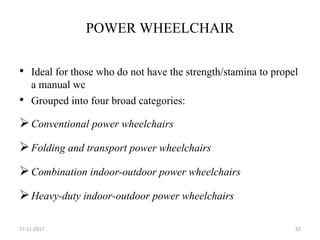
POWER WHEELCHAIR
• Ideal for those who do not have the strength/stamina to propel
a manual wc
• Grouped into four broad categories:
Conventional power wheelchairs
Folding and transport power wheelchairs
Combination indoor-outdoor power wheelchairs
Heavy-duty indoor-outdoor power wheelchairs
27-11-2017 32
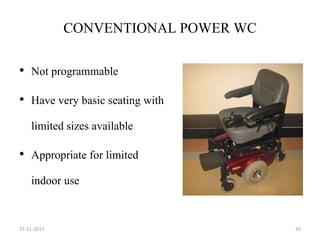
CONVENTIONAL POWER WC
• Not programmable
• Have very basic seating with
limited sizes available
• Appropriate for limited
indoor use
27-11-2017 33
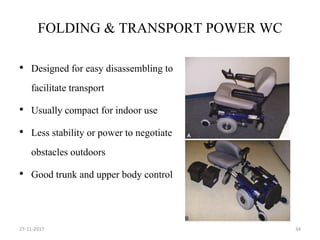
FOLDING & TRANSPORT POWER WC
• Designed for easy disassembling to
facilitate transport
• Usually compact for indoor use
• Less stability or power to negotiate
obstacles outdoors
• Good trunk and upper body control
27-11-2017 34
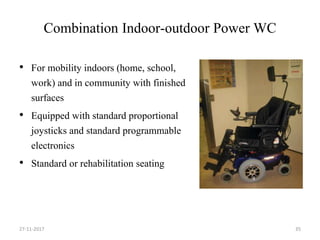
Combination Indoor-outdoor Power WC
• For mobility indoors (home, school,
work) and in community with finished
surfaces
• Equipped with standard proportional
joysticks and standard programmable
electronics
• Standard or rehabilitation seating
27-11-2017 35
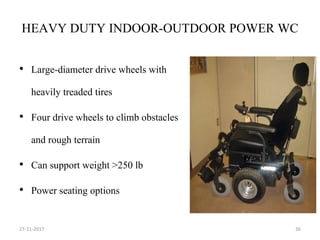
HEAVY DUTY INDOOR-OUTDOOR POWER WC
• Large-diameter drive wheels with
heavily treaded tires
• Four drive wheels to climb obstacles
and rough terrain
• Can support weight >250 lb
• Power seating options
27-11-2017 36
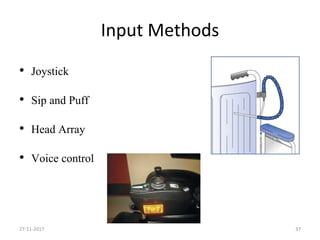
Input Methods
• Joystick
• Sip and Puff
• Head Array
• Voice control
27-11-2017 37
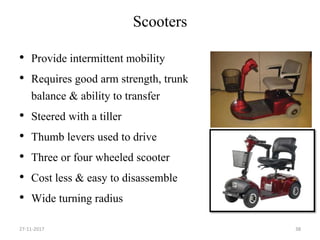
Scooters
• Provide intermittent mobility
• Requires good arm strength, trunk
balance & ability to transfer
• Steered with a tiller
• Thumb levers used to drive
• Three or four wheeled scooter
• Cost less & easy to disassemble
• Wide turning radius
27-11-2017 38
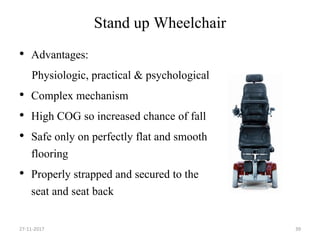
Stand up Wheelchair
• Advantages:
Physiologic, practical & psychological
• Complex mechanism
• High COG so increased chance of fall
• Safe only on perfectly flat and smooth
flooring
• Properly strapped and secured to the
seat and seat back
27-11-2017 39
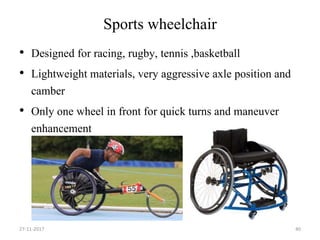
Sports wheelchair
• Designed for racing, rugby, tennis ,basketball
• Lightweight materials, very aggressive axle position and
camber
• Only one wheel in front for quick turns and maneuver
enhancement
27-11-2017 40
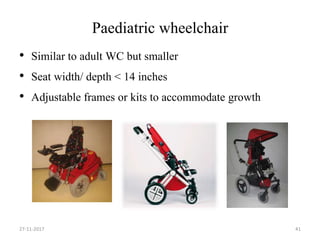
Paediatric wheelchair
• Similar to adult WC but smaller
• Seat width/ depth < 14 inches
• Adjustable frames or kits to accommodate growth
27-11-2017 41
Prerequisites
Good upper limb strength
Able to lift buttock 2” from bed surface
Stable trunk balance
Hand eye coordination
Good cognition
27-11-2017 42
Factors in wheelchair selection
 Age & weight
 Disability & prognosis
 Functional skills
 Indoor / outdoor use
 Portability / accessibility
 Reliability / durability
 Cosmetic features
 Options available
 Service
 Cost
 Level of acceptance
27-11-2017 43
Wheelchair prescription
• Particulars of patients
• Size : adult, intermediate,
small
• Types: fixed back, semi
reclining
• Brakes: lever, toggle
• Foot rest: detachable, non
detachable
• Foot plates: regular, large
• Heel loops: right, left
• Armrest: padded, removable
• Wheels size: 22-26 “, spokes,
mag-wheel
• Tires: regular, pneumatic
• Axle: regular, heavy duty
• Hand rims: regular, vertical
• Front caster: 2-8 ” regular,
pneumatic
• Cushion
• Back rest
• Color
27-11-2017 44
COMPLICATIONS
• Pressure ulcer
• Nerve compression at wrist
• Overuse injury to muscles , tendons and ligaments
• Shoulder impingement syndrome
27-11-2017 45
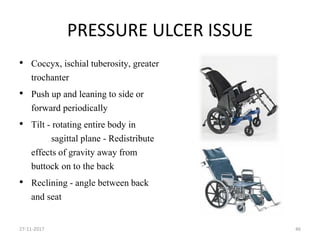
PRESSURE ULCER ISSUE
• Coccyx, ischial tuberosity, greater
trochanter
• Push up and leaning to side or
forward periodically
• Tilt - rotating entire body in
sagittal plane - Redistribute
effects of gravity away from
buttock on to the back
• Reclining - angle between back
and seat
27-11-2017 46
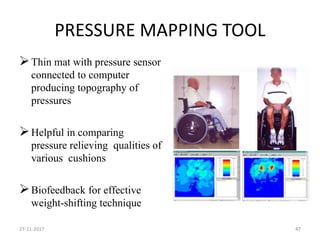
PRESSURE MAPPING TOOL
Thin mat with pressure sensor
connected to computer
producing topography of
pressures
Helpful in comparing
pressure relieving qualities of
various cushions
Biofeedback for effective
weight-shifting technique
27-11-2017 47
THANK YOU
27-11-2017 48

Wheelchair

  • 1.
    WHEELCHAIR PRESENTER: DR KAUSTAVBASU THAKUR MODERATOR: DR LONGJAM NILACHANDRA SINGH 27-11-2017 1
  • 2.
    INTRODUCTION • Any chairon wheels that can be propelled either manually or by power • A properly prescribed wheelchair-useful in reintegrating a person with a disability into the community 27-11-2017 2
  • 3.
    HISTORY • The firstfolding manual WC - US by Herbert Everest and Harry Jennings in 1933 • In late 1970s and early 1980s, Marilyn Hamilton led way in development of manual WC with custom fitting • Today a plethora of powered and manual WC technology • Challenge is matching client need to specific WC technologies and components 27-11-2017 3
  • 4.
    GOALS OF PRESCRIBINGWC • Maximize functional independence with ADL • Minimize risk of secondary injuries • Accommodate or correct skeletal deformities • Ensure proper comfort • Promote positive and unobtrusive self image 27-11-2017 4
  • 5.
    INDICATIONS • INADVISABILITY OFAMBULATION Contraindications to weight-bearing Interference with wound healing Prior to ambulation Inadequate safety in walking Deficiency of the patient’s judgment **In all of these conditions, the restriction against walking may be temporary 27-11-2017 5
  • 6.
    INDICATIONS contd • IMPOSSIBLEFOR AMBULATION  Congenital or traumatic LL amputees  Paralysis  Deformity  Pain on weight bearing  Incoordination **In all of these conditions, the use of wheel chair may be permanent 27-11-2017 6
  • 7.
    TYPES OF WC MANUALPOWER 27-11-2017 7
  • 8.
    ADULT MANUAL WHEELCHAIR •Standard • Standard Hemi • Lightweight • High strength lightweight • Ultra lightweight • Heavy duty • Extra heavy duty 27-11-2017 8
  • 9.
    BASIC WHEELCHAIR MEASUREMENTS A:Seat height B: Backrest height C: Armrest height D: Seat depth E: Seat width 27-11-2017 9
  • 10.
    COMPONENTS OF WC •WC frame • Seat & cushion • Arm rests • Leg rests • Foot rests • Restraints 27-11-2017 10
  • 11.
    MANUAL WC ACCESSORIES REARWHEELS • Indoor or outdoor terrain, activity level, maintenance, weight, cost • Mag wheel & spoked wheel • 22,24,26 inches 27-11-2017 11
  • 12.
    TIRES • Solid rubber •Pneumatic • All terrain • Kevlar Outdoor-wider tire with a medium knobby treads Indoor-smooth and lightly tread tire skin 27-11-2017 12
  • 13.
    CASTER WHEELS • Solid(polyurethane)and pneumatic • 2-8 inches in diameter • Small- greater foot clearance and agility stuck crack and bumps • Large- more security, easy roll over rough surface 27-11-2017 13
  • 14.
    PUSHRIMS • Allow propulsion •Control safety without touching the tire • Types oStandard oOne hand drive oNatural fit • ½ inch diameter 27-11-2017 14
  • 15.
    BACK REST • Basicupholstery fabric sling • Fabric back with tension ties • Firm back, minimum contour • Contour-molded foam over hard back • Hard back with softer foam/gel central region 27-11-2017 15
  • 16.
    LATERALS • Frame mountedpads • Stabilises the trunk • Accommodate or correct deformities Caution- Avoid undue pressure or tissue compression 27-11-2017 16
  • 17.
    ARMREST • Standard WC:narrowest armrest • Long term WC: removable & height adjustable • Provide GH joint support • Perform push up for pressure relief • Promote transfer 27-11-2017 17
  • 18.
    ARM TROUGH • Unableto lift/self stabilise arm • Hollow cavity • Protects arm from drifting into wheels • Made of polyurethane foam • Improve joystick control 27-11-2017 18
  • 19.
    FRONT RIGGING • Includesfootrests, leg rests & footplates • Provide support to legs & feet • May be removed on one or both sides • Various types available • Consider hamstring tightness 27-11-2017 19
  • 20.
    HEAD REST • Unstableneck posture • Tilt & recline seat function Foundation for head array May restrict rear vision Adds extra weight ↑perception of frailty 27-11-2017 20
  • 21.
    SAFETY EQUIPMENTS 27-11-2017 21 SEATBELT WHEEL LOCK ANTITIPPER GRADE AID
  • 22.
    SETTING UP OFMANUAL WC • Can be adjusted together/separately • Seat dump—sloping downward of seat • Too much seat dump: Pelvis will rotate backward Loss of lumbar-lordosis Increase pressure on sacrum Problem in transferring in and out • Increase back angle- for stiffness of hip, trunk support 27-11-2017 22 SEAT & BACK ANGLE MEASUREMENT
  • 23.
    REAR WHEEL CAMBER •Angle of rear wheel tilt • 8 degrees is the normal • Increases access to pushrims • Increases width of wc • Wearing of inner side of tire 27-11-2017 23
  • 24.
    HORIZONTAL AXLE POSITION •Moving the axle forward moves the seat back • Shift of COG over or slightly behind rear axles • Forward axle position - requires less muscle effort - facilitates “popping a wheelie” • Make WC more “tippy” and difficult push up ramp • Delivered with the axle in the most rearward position • Needs to be changed 27-11-2017 24
  • 25.
    VERTICAL AXLE POSITION •Raising the axle has the effect of lowering the seat, while lowering the axle raises the seat oBetter propulsion biomechanics by lowering the seat height oGreater stability in low position oToo low - lead to shoulder impingement syndrome oIdeal position - elbow angle 100- 120⁰ 27-11-2017 25
  • 26.
    SEATING & POSITIONING •Comfortable, healthy, functional sitting posture • Pelvis stabilization • Cushion should be mounted onto a hard surface • Secondary injuries can occur • Pressure relieving seating system require in certain 27-11-2017 26
  • 27.
    SEAT CUSHIONS 27-11-2017 27 PlainRectangular foam Contoured foam with skin Matrix of air filled elastic capsules Alternating air cell inflation Contour molded with gel filled inserts
  • 28.
    WHEELCHAIR PROPULSION • Dependson weight of wheelchair • Quality & set up, strength of patient • Propulsion technique: 2 phases - Push phase & Recovery phase o arc o semicircular o single looping over o double looping over 27-11-2017 28
  • 29.
    HEMIPLEGIC CHAIR • Lowseat height • Arm trough Keeps forearm in level position • No foot plate for non affected side • Double push rims on non affected side 27-11-2017 29
  • 30.
    AMPUTEE CHAIR Rear wheelaxle back 2 inches Amputee axle adapters Seat board with amputee extension Front rigging removed 27-11-2017 30
  • 31.
    POWER ASSISTED WC Mobilityassistance Help weakness, muscle paralysis, overuse, fatigue Decrease - upper limb risk of injuries Difficult to transport-↑weight Types - stand alone power unit power add on devices 27-11-2017 31
  • 32.
    POWER WHEELCHAIR • Idealfor those who do not have the strength/stamina to propel a manual wc • Grouped into four broad categories: Conventional power wheelchairs Folding and transport power wheelchairs Combination indoor-outdoor power wheelchairs Heavy-duty indoor-outdoor power wheelchairs 27-11-2017 32
  • 33.
    CONVENTIONAL POWER WC •Not programmable • Have very basic seating with limited sizes available • Appropriate for limited indoor use 27-11-2017 33
  • 34.
    FOLDING & TRANSPORTPOWER WC • Designed for easy disassembling to facilitate transport • Usually compact for indoor use • Less stability or power to negotiate obstacles outdoors • Good trunk and upper body control 27-11-2017 34
  • 35.
    Combination Indoor-outdoor PowerWC • For mobility indoors (home, school, work) and in community with finished surfaces • Equipped with standard proportional joysticks and standard programmable electronics • Standard or rehabilitation seating 27-11-2017 35
  • 36.
    HEAVY DUTY INDOOR-OUTDOORPOWER WC • Large-diameter drive wheels with heavily treaded tires • Four drive wheels to climb obstacles and rough terrain • Can support weight >250 lb • Power seating options 27-11-2017 36
  • 37.
    Input Methods • Joystick •Sip and Puff • Head Array • Voice control 27-11-2017 37
  • 38.
    Scooters • Provide intermittentmobility • Requires good arm strength, trunk balance & ability to transfer • Steered with a tiller • Thumb levers used to drive • Three or four wheeled scooter • Cost less & easy to disassemble • Wide turning radius 27-11-2017 38
  • 39.
    Stand up Wheelchair •Advantages: Physiologic, practical & psychological • Complex mechanism • High COG so increased chance of fall • Safe only on perfectly flat and smooth flooring • Properly strapped and secured to the seat and seat back 27-11-2017 39
  • 40.
    Sports wheelchair • Designedfor racing, rugby, tennis ,basketball • Lightweight materials, very aggressive axle position and camber • Only one wheel in front for quick turns and maneuver enhancement 27-11-2017 40
  • 41.
    Paediatric wheelchair • Similarto adult WC but smaller • Seat width/ depth < 14 inches • Adjustable frames or kits to accommodate growth 27-11-2017 41
  • 42.
    Prerequisites Good upper limbstrength Able to lift buttock 2” from bed surface Stable trunk balance Hand eye coordination Good cognition 27-11-2017 42
  • 43.
    Factors in wheelchairselection  Age & weight  Disability & prognosis  Functional skills  Indoor / outdoor use  Portability / accessibility  Reliability / durability  Cosmetic features  Options available  Service  Cost  Level of acceptance 27-11-2017 43
  • 44.
    Wheelchair prescription • Particularsof patients • Size : adult, intermediate, small • Types: fixed back, semi reclining • Brakes: lever, toggle • Foot rest: detachable, non detachable • Foot plates: regular, large • Heel loops: right, left • Armrest: padded, removable • Wheels size: 22-26 “, spokes, mag-wheel • Tires: regular, pneumatic • Axle: regular, heavy duty • Hand rims: regular, vertical • Front caster: 2-8 ” regular, pneumatic • Cushion • Back rest • Color 27-11-2017 44
  • 45.
    COMPLICATIONS • Pressure ulcer •Nerve compression at wrist • Overuse injury to muscles , tendons and ligaments • Shoulder impingement syndrome 27-11-2017 45
  • 46.
    PRESSURE ULCER ISSUE •Coccyx, ischial tuberosity, greater trochanter • Push up and leaning to side or forward periodically • Tilt - rotating entire body in sagittal plane - Redistribute effects of gravity away from buttock on to the back • Reclining - angle between back and seat 27-11-2017 46
  • 47.
    PRESSURE MAPPING TOOL Thinmat with pressure sensor connected to computer producing topography of pressures Helpful in comparing pressure relieving qualities of various cushions Biofeedback for effective weight-shifting technique 27-11-2017 47
  • 48.