Dr. Sujit Kumar Singh
PG- Orthopedics
PGIMS, Rohtak
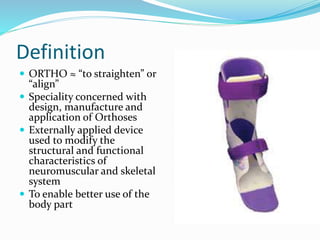
Definition
 ORTHO ≈ “to straighten” or
“align”
 Speciality concerned with
design, manufacture and
application of Orthoses
 Externally applied device
used to modify the
structural and functional
characteristics of
neuromuscular and skeletal
system
 To enable better use of the
body part
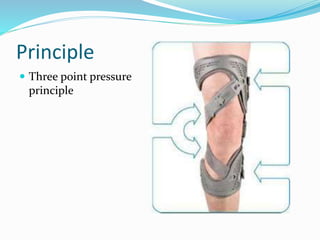
Principle
 Three point pressure
principle
Functions
 Prevent deformity
 Provide stability
 Overcoming weakness
 Relieving pain
 Assist in function
 Maintain alignment
 Allows maximal functional independence
Indications
 Post Polio paralysis
 Nerve injuries
 Stroke and trauma brain injury
 Spinal cord inury
 Deformities
 Burns
 Sports Injuries
 and many more…
Prescription
 Technical analysis form
 Nomenclature
Nomenclature
Spinal Orthoses
 2 groups- Supportive and
Corrective
 Mechanical deficiencies are
present eg. Taylor brace, short
spinal brace
 Inspite of deficiencies, patients
obtain symptomatic relief-
psycological, abdominal
compression, support of
pendulous abdomen, decrease
in lumbar lordosis,decrease in
movement,activity, support of SI
joint and ilio-lumbar ligaments
Supportive Spinal Orthoses
 Fabric Spinal orthoses(jean, coutil,canvas, duck,rayon,nylon,airtex)
 SacroIliac Orthosis (SIO)
 LumboSacral Orthosis (LSO)
 ThoracoLumbar/ThoracolumbarSacral Orthosis (TLSO)
 Immediate Lumbar Orthoses
 Rigid Spinal Orthoses
 Taylor Spinal Brace (TLSO)
 Fisher Spinal Brace (TLSO)
 Thomas/Jones Spinal Brace (TLSO)
 Anterior Spinal Hyperextension Brace (ASH) (TLSO)
 Moulded Spinal Orthoses
SacroIliac Orthosis
LumboSacral/Knights Orthosis
ThoracoLumbar/ThoracoLumbarSacral Orthosis
Immediate Lumbar Orthoses
 Cheap and instant
 Tubigrip body
bandage used
 Rolled from nipples
to upper thighs
 POP is rolled over it
Rigid Spinal Orthosis
 All are constructed on the basis of a metal frame which
takes firm support from pelvis(except anterior
hyperextension orthosis)
 Pelvic band/ Moulded pelvic corset
 Metallic uprights are present over the base and
connected by crossbars
 Abdominal plate
 Padded shoulder or clavicular straps
Taylor Spinal Brace
 1863, by CF Taylor
 Used in treatment of TB
Spine
 Limits forward flexion,
extension, lateral flexion
and to some extent
rotation of the lumbar
and lower thoracic
regions of spine
 Increases movements at
LumboSacral junction
Fisher Spinal Brace
Jones Spinal Brace
Anterior Spinal Hyperextension brace
Jewett type Cruciform type
Corrective Spinal Orthoses
 Milwaukee brace
 Boston brace
Milwaukee Brace
 CTLSO
 Ambulant treatment of
scoliosis
 Worn for a number of
years
 23hrs/ day
 S/E-Meralgia
Paraesthetica
Boston Spinal Brace
Orthoses for Cervical Spine
 Head is balanced on Cx Spine by action of neck
muscles
 Considerable range of movement in all directions
 Inflammatory conditions or mechanical derangements
require immobilisation + support of head to relieve
pressure upn vertebrae, discs, joints and Cranial
nerves
 External support must fit the contours
 Forehead must also be included in lesions of upper Cx
spine
Soft Cervical Collar
 Extends from base of
bandible, superior nuchal
line to manubrium and C7
spine inferiorly
 Mild soft tissue strain,
sprain, spasm
 Kinesthetic reminder
 Heat retention
 Motion Control
 Flexion- 26%
 Extension- 20%
 Lateral bending- 8%
 Rotation- 17%
Hard Cervical / Thomas Collar
 Hugh Owen Thomas
 Originally made from
metal sheet covered with
felt
 made from hard
polyethylene
 Some more restriction of
movement
 Indications- same as Soft
collar
Moulded Cervical Orthoses
 Philadelphia Collar
 Made of Plastazone/
Polyethylene foam
 2 separate pieces
 Motion control
 Flexion- 70%
 Extension-60%
 Lateral flexion- 35%
 Rotation- 60%
 Most effective in injury above
C3
SOMI Brace
 Sterno- Occipito-
Mandibular- Immobilizer
 Indications- stable spinal
fracture dislocations and
moderate to severe soft
tissue damage
 Motion control
 Flexion- 95%
 Extension-40%
 Lateral flexion- 35%
 Rotation- 70%
Four-Poster Cervical Brace
 Similar to SOMI brace
 Except Posterior post and
extra axillary straps
 Motion control
 Flexion- 90%
 Extension-80%
 Lateral flexion- 55%
 Rotation- 70%
 Modification- chest and
back plates extend further
down
 more effective in controlling
flexion and rotation
Cervical Halo Orthosis
 Rigid Invasive bracing system
 Maximum motion control, but
less used due to its invasive
nature
 Indication- unstable fracture
dislocation of spine
 Motion control
 Flexion- 95%
 Extension-95%
 Lateral flexion- 95%
 Rotation- 99%
 Ability to provide distracting
forces
Cervicothoracic Orthoses
 Minerva Jacket
 Rigid frame, custom
made, total contact
 Covers entire skull except
face, extending upto
inferior costal margin
 Indications- Traumatic
and Pott’s spine
 Maximum motion control
at lower cervival and
cervicothoracic juntion
Cervicothoracolumbosacral Orthosis
 Halo Pelvic brace
 Rigid, invasive brace
 Historical importance only
 Four spring loaded
distraction bars
 Indication- Immobilisation
in Pott’s spine and deformity
correction of spine
 Functions- limits all spinal
movements
Upper Limb Orthoses
Classification
 Static
 Serial Static
 Serial motion blocking
 Static progressive
 Dynamic
 Motion Blocking
 Traction
 Tenodesis
 Continuous Passive Motion Orthoses
 Adaptive Orthoses
Hand Orthoses
 Finger Cot
 Long finger
extension splint
 Mallet finger splint
 Ring and figure 8 splint
 Capner’s spring coil splint
Wrist Hand Orthoses
 Wrist hand stabilizer
Cock up Splint
 Static
 Dynamic
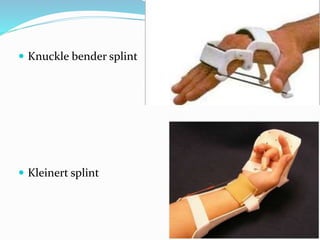
 Knuckle bender splint
 Kleinert splint
Elbow Orthoses
 Elbow ROM
 Elbow Extension
orthosis
Shoulder Orthoses
 Air-Plane splint
 Figure of 8 brace
 Sling and Swathe Immobilizer
(Universal Shoulder Immobiliser)
Turn-Buckle Splint
 Produce gradual
stretching over a
contracted joint. Eg-stiff
elbow, VIC
 Corrects contracture
very fast
 Decreases rehabilitation
time’
 Excellent patient
compliance
Lower Limb Orthoses
 Foot orthosis
 Purpose of shoe modification
 Restoration of normal gait
 Proper distribution of wt
 Balancing while standing
 Component of calliper
Hallux Valgus correcting brace
Ankle Foot Orthoses
 Support ankle and foot
 Maintains ankle stability
 Prevent equinus contracture
 Heel stop is attached to limit
excessive dorsi/plantar flexion
 Weak plantar flexors-
front/calcaneous stop
 Weak dorsiflexors-
back/equinous stop
Disadvantage- Axis of movement of
appliance dosnot correspont with
that of ankle, thereby stress is
imposed on heel and shoes
Toe raising devices
AFO Dorsi A
Foot Drop Splint
 AFO Plantar R- Ankle foot orthosis plantarflexion resist
T straps
 T-strap is cut from leather.
 Vertical limb is attached at the
junction of the upper with the sole
 The strap encircles both the ankle
and the side bar
 The t-strap may be attached either
inside or outside of the shoe
 Weak TA and TP->foot valgus-
>Outside iron and inner T-Strap
 Weak Peroneal muscles-> foot varus-
>inside iron and outside T-strap
Knee Orthoses
 Knee Immobiliser
 From mid thigh to mid leg
 Maintains knee in extension
 Indications
 Post-operative knee
 Sprains and strains
 Knee ROM brace
 Provides protected and controlled
knee motion
 Used in cases of Periarticular
fracture fixation, ligamentous
reconstruction
 Valgum Varus brace
 Gaining popularity
 Corrects deformity around knee
 Mermaid splint
 Nonarticular orthosis
 Keeps both knee solidly in
the night
 Used when disease is in
active phase and
deformity is mild
 Knee Gaiter
 Maintains knee in
extension
 Used in spastic conditions
like CP
Knee joints in lower limb orthoses
 Single axis knee
joint
 Restriction in
hyperextension
 Drop lock
 Variant- Posterior
offset type
 Stance control
knee joint
 No flexion during
weight bearing
 Polycentric knee
joint
 Closer to anatomic
knee joint
 Lock-in variable
flexion type knee
joint
 Removable hold in
sagital plane which
functions in full
extension and can be
released for flexion
Knee Ankle Foot Orthoses
 Conventional
 Prevent buckling of knee and
facilitate ambulation, eg PPRP
 Maintain stability of knee, eg
neuropathic joint
 To relieve weight on bone and joint
Total contact KAFO
 Made up of thermoplastics attached
with the knee joint
 Variant- ischial weight bearing type
PTB type
Hip Knee Ankle Foot Orthoses
 Maintain standing
posture and ensure
mobility
 Maintain stability of hip
jouint
 Variant- Reciprocating
gain Orthosis
 Used in Spina Bifida and
spinal cord injury
 Combines flexion of one
hip with extension of
opposite hip
Thank You

Orthotics

  • 1.
    Dr. Sujit KumarSingh PG- Orthopedics PGIMS, Rohtak
  • 2.
    Definition  ORTHO ≈“to straighten” or “align”  Speciality concerned with design, manufacture and application of Orthoses  Externally applied device used to modify the structural and functional characteristics of neuromuscular and skeletal system  To enable better use of the body part
  • 3.
    Principle  Three pointpressure principle
  • 4.
    Functions  Prevent deformity Provide stability  Overcoming weakness  Relieving pain  Assist in function  Maintain alignment  Allows maximal functional independence
  • 5.
    Indications  Post Polioparalysis  Nerve injuries  Stroke and trauma brain injury  Spinal cord inury  Deformities  Burns  Sports Injuries  and many more…
  • 6.
  • 12.
  • 13.
    Spinal Orthoses  2groups- Supportive and Corrective  Mechanical deficiencies are present eg. Taylor brace, short spinal brace  Inspite of deficiencies, patients obtain symptomatic relief- psycological, abdominal compression, support of pendulous abdomen, decrease in lumbar lordosis,decrease in movement,activity, support of SI joint and ilio-lumbar ligaments
  • 14.
    Supportive Spinal Orthoses Fabric Spinal orthoses(jean, coutil,canvas, duck,rayon,nylon,airtex)  SacroIliac Orthosis (SIO)  LumboSacral Orthosis (LSO)  ThoracoLumbar/ThoracolumbarSacral Orthosis (TLSO)  Immediate Lumbar Orthoses  Rigid Spinal Orthoses  Taylor Spinal Brace (TLSO)  Fisher Spinal Brace (TLSO)  Thomas/Jones Spinal Brace (TLSO)  Anterior Spinal Hyperextension Brace (ASH) (TLSO)  Moulded Spinal Orthoses
  • 15.
  • 16.
  • 17.
  • 18.
    Immediate Lumbar Orthoses Cheap and instant  Tubigrip body bandage used  Rolled from nipples to upper thighs  POP is rolled over it
  • 19.
    Rigid Spinal Orthosis All are constructed on the basis of a metal frame which takes firm support from pelvis(except anterior hyperextension orthosis)  Pelvic band/ Moulded pelvic corset  Metallic uprights are present over the base and connected by crossbars  Abdominal plate  Padded shoulder or clavicular straps
  • 20.
    Taylor Spinal Brace 1863, by CF Taylor  Used in treatment of TB Spine  Limits forward flexion, extension, lateral flexion and to some extent rotation of the lumbar and lower thoracic regions of spine  Increases movements at LumboSacral junction
  • 21.
  • 22.
  • 23.
  • 24.
  • 25.
    Corrective Spinal Orthoses Milwaukee brace  Boston brace
  • 26.
    Milwaukee Brace  CTLSO Ambulant treatment of scoliosis  Worn for a number of years  23hrs/ day  S/E-Meralgia Paraesthetica
  • 27.
  • 28.
    Orthoses for CervicalSpine  Head is balanced on Cx Spine by action of neck muscles  Considerable range of movement in all directions  Inflammatory conditions or mechanical derangements require immobilisation + support of head to relieve pressure upn vertebrae, discs, joints and Cranial nerves  External support must fit the contours  Forehead must also be included in lesions of upper Cx spine
  • 29.
    Soft Cervical Collar Extends from base of bandible, superior nuchal line to manubrium and C7 spine inferiorly  Mild soft tissue strain, sprain, spasm  Kinesthetic reminder  Heat retention  Motion Control  Flexion- 26%  Extension- 20%  Lateral bending- 8%  Rotation- 17%
  • 30.
    Hard Cervical /Thomas Collar  Hugh Owen Thomas  Originally made from metal sheet covered with felt  made from hard polyethylene  Some more restriction of movement  Indications- same as Soft collar
  • 31.
    Moulded Cervical Orthoses Philadelphia Collar  Made of Plastazone/ Polyethylene foam  2 separate pieces  Motion control  Flexion- 70%  Extension-60%  Lateral flexion- 35%  Rotation- 60%  Most effective in injury above C3
  • 32.
    SOMI Brace  Sterno-Occipito- Mandibular- Immobilizer  Indications- stable spinal fracture dislocations and moderate to severe soft tissue damage  Motion control  Flexion- 95%  Extension-40%  Lateral flexion- 35%  Rotation- 70%
  • 33.
    Four-Poster Cervical Brace Similar to SOMI brace  Except Posterior post and extra axillary straps  Motion control  Flexion- 90%  Extension-80%  Lateral flexion- 55%  Rotation- 70%  Modification- chest and back plates extend further down  more effective in controlling flexion and rotation
  • 34.
    Cervical Halo Orthosis Rigid Invasive bracing system  Maximum motion control, but less used due to its invasive nature  Indication- unstable fracture dislocation of spine  Motion control  Flexion- 95%  Extension-95%  Lateral flexion- 95%  Rotation- 99%  Ability to provide distracting forces
  • 35.
    Cervicothoracic Orthoses  MinervaJacket  Rigid frame, custom made, total contact  Covers entire skull except face, extending upto inferior costal margin  Indications- Traumatic and Pott’s spine  Maximum motion control at lower cervival and cervicothoracic juntion
  • 36.
    Cervicothoracolumbosacral Orthosis  HaloPelvic brace  Rigid, invasive brace  Historical importance only  Four spring loaded distraction bars  Indication- Immobilisation in Pott’s spine and deformity correction of spine  Functions- limits all spinal movements
  • 38.
    Upper Limb Orthoses Classification Static  Serial Static  Serial motion blocking  Static progressive  Dynamic  Motion Blocking  Traction  Tenodesis  Continuous Passive Motion Orthoses  Adaptive Orthoses
  • 39.
    Hand Orthoses  FingerCot  Long finger extension splint
  • 40.
     Mallet fingersplint  Ring and figure 8 splint  Capner’s spring coil splint
  • 41.
    Wrist Hand Orthoses Wrist hand stabilizer
  • 42.
    Cock up Splint Static  Dynamic
  • 43.
     Knuckle bendersplint  Kleinert splint
  • 44.
    Elbow Orthoses  ElbowROM  Elbow Extension orthosis
  • 45.
    Shoulder Orthoses  Air-Planesplint  Figure of 8 brace
  • 46.
     Sling andSwathe Immobilizer (Universal Shoulder Immobiliser)
  • 47.
    Turn-Buckle Splint  Producegradual stretching over a contracted joint. Eg-stiff elbow, VIC  Corrects contracture very fast  Decreases rehabilitation time’  Excellent patient compliance
  • 48.
    Lower Limb Orthoses Foot orthosis  Purpose of shoe modification  Restoration of normal gait  Proper distribution of wt  Balancing while standing  Component of calliper
  • 50.
  • 51.
    Ankle Foot Orthoses Support ankle and foot  Maintains ankle stability  Prevent equinus contracture  Heel stop is attached to limit excessive dorsi/plantar flexion  Weak plantar flexors- front/calcaneous stop  Weak dorsiflexors- back/equinous stop Disadvantage- Axis of movement of appliance dosnot correspont with that of ankle, thereby stress is imposed on heel and shoes
  • 52.
  • 53.
    Foot Drop Splint AFO Plantar R- Ankle foot orthosis plantarflexion resist
  • 54.
    T straps  T-strapis cut from leather.  Vertical limb is attached at the junction of the upper with the sole  The strap encircles both the ankle and the side bar  The t-strap may be attached either inside or outside of the shoe  Weak TA and TP->foot valgus- >Outside iron and inner T-Strap  Weak Peroneal muscles-> foot varus- >inside iron and outside T-strap
  • 55.
    Knee Orthoses  KneeImmobiliser  From mid thigh to mid leg  Maintains knee in extension  Indications  Post-operative knee  Sprains and strains
  • 56.
     Knee ROMbrace  Provides protected and controlled knee motion  Used in cases of Periarticular fracture fixation, ligamentous reconstruction  Valgum Varus brace  Gaining popularity  Corrects deformity around knee
  • 57.
     Mermaid splint Nonarticular orthosis  Keeps both knee solidly in the night  Used when disease is in active phase and deformity is mild  Knee Gaiter  Maintains knee in extension  Used in spastic conditions like CP
  • 58.
    Knee joints inlower limb orthoses  Single axis knee joint  Restriction in hyperextension  Drop lock  Variant- Posterior offset type  Stance control knee joint  No flexion during weight bearing
  • 59.
     Polycentric knee joint Closer to anatomic knee joint  Lock-in variable flexion type knee joint  Removable hold in sagital plane which functions in full extension and can be released for flexion
  • 60.
    Knee Ankle FootOrthoses  Conventional  Prevent buckling of knee and facilitate ambulation, eg PPRP  Maintain stability of knee, eg neuropathic joint  To relieve weight on bone and joint
  • 61.
    Total contact KAFO Made up of thermoplastics attached with the knee joint  Variant- ischial weight bearing type PTB type
  • 62.
    Hip Knee AnkleFoot Orthoses  Maintain standing posture and ensure mobility  Maintain stability of hip jouint  Variant- Reciprocating gain Orthosis  Used in Spina Bifida and spinal cord injury  Combines flexion of one hip with extension of opposite hip
  • 63.