Doly Bokalial (BPT) (CMT)
M.Sc Rehabilitation Science , Part II.
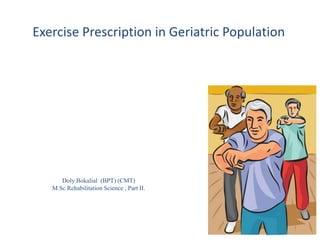
Exercise Prescription in Geriatric Population
Introduction
• Exercise plays a major role in human life; it may be to
remain fit or may be to recover from a disease or
impairment in all age groups.
• Lots of study has been done to prove the benefit of
exercise and its uses in different condition.
• Study says that there are undeniable suggestions that
regular exercise prevents primary and secondary
complications resulting from Chronic Illness
(Warburton D.E. et al., 2006).
• Elderly people who participate in any extent of physical
activity gain some health benefits, including
maintenance of good physical and cognitive function.
• Some physical activity is better than none, and more
physical activity provides greater health benefits.
• Study also found that the physical activity is
directly proportional to health status i.e. the
more you spend time doing exercise the more
physically and mentally healthy you are
(Warburton et al., 2006).
• The benefits of physical activity for elderly
people are well documented. It improves
cardiorespiratory function, reduces risk
factors for coronary artery disease, and most
importantly improves the ability to perform
daily activities (Lim J.Y , 1999).
• There are few clear evidence that exercise will improve
longevity, but there are lots of evidence that it
improves the quality of life in old age. It maintains
endurance, strength, and joint mobility while it reduces
the incidence and severity of hypertension,
osteoporosis, obesity, and diabetes mellitus (Singh,
M.A.F., 2002).
• Among older adults, higher level of physical activity
are associated with increased survival, better physical
functioning, low ill-health risk and better mental
health (Santos D.A et al., 2012).
• A combination of aerobic activity, strength training,
and flexibility exercises, along with increased general
daily activity can reduce medication dependence and
health care costs while maintaining functional
independence and improving quality of life in older
adult (Mcdermott A.Y and Mernitz H, 2006).
Prevalence of Elderly Population
Worldwide
• Almost one third of the world population is growing older in age,
according to the “World Population Aging-2013” report published
by United Nation Department of “the number of older persons
(aged 60 years or over) is expected to more than double, from 841
million people in 2013 to more than 2 billion in 2050”.
• About two thirds of the worlds’ older persons live in developing
countries, because the older population in developing countries is
growing faster than developed regions.
• By 2050, nearly 8 in 10 of the world’s older population will live in
the developing regions (UN, Department of Economic and Social
Affairs, population division-2013).
• Sri Lanka has the fastest growing ageing population in South Asia.
The proportion of older people (aged ≥60 years) is 13.1% at present
and is expected to increase to 22% by 2030, higher than the 14% in
India, 8% in Pakistan, and 10% in Bangladesh (Perera, B. et al.,
2015).
Current situation
Australia:
• Through a study among older South Australian it has
been found that rates of participation among adults
age 60 years and over in walking and vigorous physical
activity (68.1% and 11.7%, respectively) were
significantly lower than for those age 18–59 years
(77.6% and 38.9%, respectively). Walking was the most
popular activity among those ages 60 and over. The
result of the study says that increases in physical
inactivity coupled with declines in functional ability
with advancing age (Hamdorf ,P et al., 2002).
India:
• Based on survey overall 392 million individuals
are inactive in India. This is a surprising amount
and indicates a huge population at risk for
developing non-communicable diseases and age
related complications (Anjana, R.M et al.,2014).
South Asian Countries:
• In the South Asian regions females, skilled
workers, professionals and those with higher
education were more inactive.
• Majority of South Asian adults were inactive
during their leisure time and this shows the
chances of sufferings of these population at old
age (Ranasinghe, C.D et al., 2013).
Recommended Exercise for the Elderly
People
• The Overall Recommendations on Physical Activity for
Health published by the World Health Organization in
2010 state that adults over 18 years of age must do at
least 150 mins/week of moderate-intensity or 75
min/week of vigorous-intensity aerobic physical
activity or an equivalent combination of both.
• It also suggests that adult should perform muscle
strengthening training 2 days per week focusing on all
group of muscles.
• Adults over 65 years of age are advised to follow the
adult recommendations if possible or (if this is not
possible) they are advised to be as physically active as
they are able.
Basic Principle of Exercise Prescription:
• There are more chances of orthopedic injuries
and cardiovascular complications and systemic
diseases in elderly adults so prior assessment
is necessary to prevent from complications.
Furthermore, proper instruction on correct
and safe method of exercise is essential prior
to exercise prescription to reduce the risk of
injury as well as other health-related
complications.
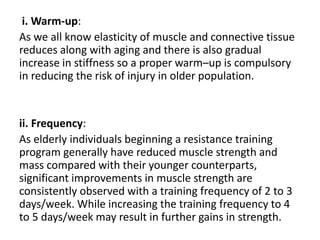
i. Warm-up:
As we all know elasticity of muscle and connective tissue
reduces along with aging and there is also gradual
increase in stiffness so a proper warm–up is compulsory
in reducing the risk of injury in older population.
ii. Frequency:
As elderly individuals beginning a resistance training
program generally have reduced muscle strength and
mass compared with their younger counterparts,
significant improvements in muscle strength are
consistently observed with a training frequency of 2 to 3
days/week. While increasing the training frequency to 4
to 5 days/week may result in further gains in strength.
iii. Exercise Intensity:
• Elderly individuals beginning a resistance
training program should start at a low
intensity and gradually progress over time.
• The intensity is generally prescribed as a
percentage of the individual’s 1-repetition
maximum (1-RM: the maximum amount of
weight that can be safely lifted 1 time).
• If they are looking for an increase in muscle
strength, it is generally recommended to use a
lower intensity weight that can be lifted for
more repetitions.
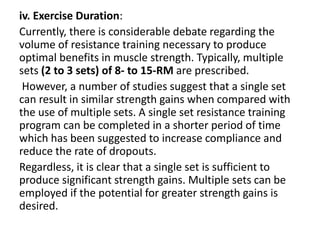
iv. Exercise Duration:
Currently, there is considerable debate regarding the
volume of resistance training necessary to produce
optimal benefits in muscle strength. Typically, multiple
sets (2 to 3 sets) of 8- to 15-RM are prescribed.
However, a number of studies suggest that a single set
can result in similar strength gains when compared with
the use of multiple sets. A single set resistance training
program can be completed in a shorter period of time
which has been suggested to increase compliance and
reduce the rate of dropouts.
Regardless, it is clear that a single set is sufficient to
produce significant strength gains. Multiple sets can be
employed if the potential for greater strength gains is
desired.
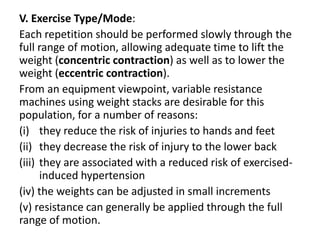
V. Exercise Type/Mode:
Each repetition should be performed slowly through the
full range of motion, allowing adequate time to lift the
weight (concentric contraction) as well as to lower the
weight (eccentric contraction).
From an equipment viewpoint, variable resistance
machines using weight stacks are desirable for this
population, for a number of reasons:
(i) they reduce the risk of injuries to hands and feet
(ii) they decrease the risk of injury to the lower back
(iii) they are associated with a reduced risk of exercised-
induced hypertension
(iv) the weights can be adjusted in small increments
(v) resistance can generally be applied through the full
range of motion.
Other specific exercises recommended
for elderly people:
Aerobic Training:
It is also called strength training, cardiovascular training, or
cardiorespiratory training. Aerobic activity includes walking,
swimming, cycling, dancing, or stair climbing. Walking is one
of the most easiest form of aerobic training to perform as it
does not required any special skills or training.
An elderly person can walk almost anywhere (inside or
outside) without any special equipment except a good pair of
shoes. Warm –up for at-least 5 min is necessary before
starting any activity. New walkers need to start slowly. It
should be according to the elderly person physical status.
Following steps need to follow:
1. Walk short distances.
2. Walk at a comfortable pace
3. Be sure the older adult can talk while walking.
Strength Training
Exercises for Upper & Lower Limbs:
• Based on several studies it is said that strength-
training program should be performed 2-3
times/week.
• It should be 20-30 min depending upon the elderly
person’s capacity. 8-15 repetition is recommended for
each type of exercises. If they cannot repeat it for 8
times then weight should be reduced to a lighter one &
they can perform 15 repetitions of each exercise.
• Once they completed 8 to 15 repetitions, rest for 1 to 2
minutes
• Repeat the exercise for another 8 to 15 repetitions.
Likewise they should complete 1-2 sets for all the
exercises
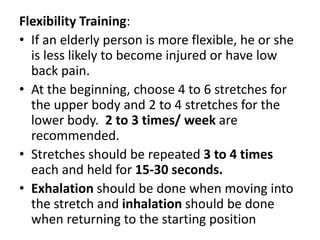
Flexibility Training:
• If an elderly person is more flexible, he or she
is less likely to become injured or have low
back pain.
• At the beginning, choose 4 to 6 stretches for
the upper body and 2 to 4 stretches for the
lower body. 2 to 3 times/ week are
recommended.
• Stretches should be repeated 3 to 4 times
each and held for 15-30 seconds.
• Exhalation should be done when moving into
the stretch and inhalation should be done
when returning to the starting position
Balance Training:
• Balance exercises are specific activities that
help build lower extremity (leg) muscle
strength as well as improve balance.
• Balance exercises can help an elderly people
to stay independent without any disabilities
and complication of falls.
Special consideration for the elderly
during exercise
Before starting any of the exercises by the elderly people
should do a health check-up in order to find out his/her
health status.
The health care provider should inform/ guide the elderly
person to stop exercising immediately if he or she
experiences any of the following symptoms:
• Chest pain
• Dizziness or numbness
• Unusual shortness of breath
• Abnormal joint or muscle pain/swelling
• Irregular or racing heart rate
Safety While Walking Outdoors:
• Walk in groups.
• Wear colors that are bright and reflect in the
night.
• Walk in areas where there is more of lights.
• Carry a whistle or cell phone to use if they need
help.
• Inform someone at home when they’re going for
a walk and when they will comeback.
• If walking alone, suggest them to take a route
that is highly visible to other people- if others
can see them, they’ll increase their safety.
• Use crosswalks when crossing streets and obey
traffic signals.
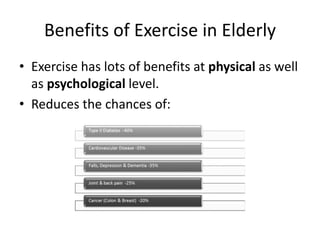
Benefits of Exercise in Elderly
• Exercise has lots of benefits at physical as well
as psychological level.
• Reduces the chances of:
Conclusion:
• Physical activity in elderly is a less popular
area of research, especially in a developing
country, where the aging population is
increasing rapidly.
• Exercise recommendation should be included
in the mainstream of other healthcare
recommendation.
• Attention should be given to increasing
confidence in the elderly to overcome barriers
to exercise and achieve relevant fitness
outcomes in exercise programs.
References:
• Anjana, R.M., Pradeepa, R., Das, A.K., Deepa, M., Bhansali, A., Joshi, S.R., Joshi, P.P., Dhandhania,
V.K., Rao, P.V., Sudha, V. and Subashini, R., 2014. Physical activity and inactivity patterns in India–
results from the ICMR-INDIAB study (Phase-1)[ICMR-INDIAB-5]. International Journal of Behavioral
Nutrition and Physical Activity, 11(1), p.26.
• Brassington, G.S., Atienza, A.A., Perczek, R.E., DiLorenzo, T.M. and King, A.C., 2002. Intervention-
related cognitive versus social mediators of exercise adherence in the elderly. American journal of
preventive medicine, 23(2), pp.80-86.
• DiPietro, L., 2001. Physical activity in aging changes in patterns and their relationship to health and
function. The Journals of Gerontology Series A: Biological Sciences and Medical Sciences, 56(suppl
2), pp.13-22.
• Hamdorf, P., Starr, G. and Williams, M., 2002. A survey of physical-activity levels and functional
capacity in older adults in South Australia. Journal of Aging and Physical Activity, 10(3), pp.281-289.
• Kisner, C. and Colby, L.A., 2012. Therapeutic exercise: foundations and techniques. Fa Davis.
• Kirk-Sanchez, N.J. and McGough, E.L., 2014. Physical exercise and cognitive performance in the
elderly: current perspectives. Clin Interv Aging, 9, pp.51-62.
• Lim, J.Y., 1999. Exercise testing and prescription for the senior population. The Sport Jour Sparling,
P.B., Howard, B.J., Dunstan, D.W. and Owen, N., 2015.
• Mcdermott, A.Y. and Mernitz, H., 2006. Exercise and older patients: prescribing guidelines.
American family physician, 74(3).
• Perera, B., Watt, M., Ostbye, T., Rajapakse, H., Ranabahu, S. and Maselko, J., 2015. Perceptions of
successful ageing in Sri Lankan older people: A qualitative study. Asian Journal of Gerontology &
Geriatrics, 10(1), pp.22-30.
• Ranasinghe, C.D., Ranasinghe, P., Jayawardena, R. and Misra, A., 2013. Physical
activity patterns among South-Asian adults: a systematic review. International
Journal of Behavioral Nutrition and Physical Activity, 10(1), p.116.
• Santos, D.A., Silva, A.M., Baptista, F., Santos, R., Vale, S., Mota, J. and Sardinha,
L.B., 2012. Sedentary behavior and physical activity are independently related to
functional fitness in older adults. Experimental gerontology, 47(12), pp.908-912.
• Shiu-Thornton, S., Schwartz, S., Taylor, M. and LoGerfo, J., 2004. Older adult
perspectives on physical activity and exercise: voices from multiple cultures.
Preventing Chronic Disease, 1, p.A09.
• Singh, M.A.F., 2002. Exercise comes of age rationale and recommendations for a
geriatric exercise prescription. The Journals of Gerontology Series A: Biological
Sciences and Medical Sciences, 57(5), pp.M262-M282.
• Singh, M.A.F., 2002.Recommendations for physical activity in older adults. BMJ:
British Medical Journal (Online), 350.nal, 2(1).
• Sullivan, G.M. and Pomidor, A.K. eds., 2015. Exercise for Aging Adults: A Guide for
Practitioners. Springer.
• Taylor, D., 2014. Physical activity is medicine for older adults. Postgraduate medical
journal, 90(1059), pp.26-32.
• Warburton, D.E., Nicol, C.W. and Bredin, S.S., 2006. Health benefits of physical
activity: the evidence. Canadian medical association journal, 174(6), pp.801-809.
Geriatric Exercise Prescription

Geriatric Exercise Prescription

  • 1.
    Doly Bokalial (BPT)(CMT) M.Sc Rehabilitation Science , Part II. Exercise Prescription in Geriatric Population
  • 2.
    Introduction • Exercise playsa major role in human life; it may be to remain fit or may be to recover from a disease or impairment in all age groups. • Lots of study has been done to prove the benefit of exercise and its uses in different condition. • Study says that there are undeniable suggestions that regular exercise prevents primary and secondary complications resulting from Chronic Illness (Warburton D.E. et al., 2006). • Elderly people who participate in any extent of physical activity gain some health benefits, including maintenance of good physical and cognitive function. • Some physical activity is better than none, and more physical activity provides greater health benefits.
  • 3.
    • Study alsofound that the physical activity is directly proportional to health status i.e. the more you spend time doing exercise the more physically and mentally healthy you are (Warburton et al., 2006). • The benefits of physical activity for elderly people are well documented. It improves cardiorespiratory function, reduces risk factors for coronary artery disease, and most importantly improves the ability to perform daily activities (Lim J.Y , 1999).
  • 4.
    • There arefew clear evidence that exercise will improve longevity, but there are lots of evidence that it improves the quality of life in old age. It maintains endurance, strength, and joint mobility while it reduces the incidence and severity of hypertension, osteoporosis, obesity, and diabetes mellitus (Singh, M.A.F., 2002). • Among older adults, higher level of physical activity are associated with increased survival, better physical functioning, low ill-health risk and better mental health (Santos D.A et al., 2012). • A combination of aerobic activity, strength training, and flexibility exercises, along with increased general daily activity can reduce medication dependence and health care costs while maintaining functional independence and improving quality of life in older adult (Mcdermott A.Y and Mernitz H, 2006).
  • 5.
    Prevalence of ElderlyPopulation Worldwide • Almost one third of the world population is growing older in age, according to the “World Population Aging-2013” report published by United Nation Department of “the number of older persons (aged 60 years or over) is expected to more than double, from 841 million people in 2013 to more than 2 billion in 2050”. • About two thirds of the worlds’ older persons live in developing countries, because the older population in developing countries is growing faster than developed regions. • By 2050, nearly 8 in 10 of the world’s older population will live in the developing regions (UN, Department of Economic and Social Affairs, population division-2013). • Sri Lanka has the fastest growing ageing population in South Asia. The proportion of older people (aged ≥60 years) is 13.1% at present and is expected to increase to 22% by 2030, higher than the 14% in India, 8% in Pakistan, and 10% in Bangladesh (Perera, B. et al., 2015).
  • 6.
    Current situation Australia: • Througha study among older South Australian it has been found that rates of participation among adults age 60 years and over in walking and vigorous physical activity (68.1% and 11.7%, respectively) were significantly lower than for those age 18–59 years (77.6% and 38.9%, respectively). Walking was the most popular activity among those ages 60 and over. The result of the study says that increases in physical inactivity coupled with declines in functional ability with advancing age (Hamdorf ,P et al., 2002).
  • 7.
    India: • Based onsurvey overall 392 million individuals are inactive in India. This is a surprising amount and indicates a huge population at risk for developing non-communicable diseases and age related complications (Anjana, R.M et al.,2014). South Asian Countries: • In the South Asian regions females, skilled workers, professionals and those with higher education were more inactive. • Majority of South Asian adults were inactive during their leisure time and this shows the chances of sufferings of these population at old age (Ranasinghe, C.D et al., 2013).
  • 8.
    Recommended Exercise forthe Elderly People • The Overall Recommendations on Physical Activity for Health published by the World Health Organization in 2010 state that adults over 18 years of age must do at least 150 mins/week of moderate-intensity or 75 min/week of vigorous-intensity aerobic physical activity or an equivalent combination of both. • It also suggests that adult should perform muscle strengthening training 2 days per week focusing on all group of muscles. • Adults over 65 years of age are advised to follow the adult recommendations if possible or (if this is not possible) they are advised to be as physically active as they are able.
  • 9.
    Basic Principle ofExercise Prescription: • There are more chances of orthopedic injuries and cardiovascular complications and systemic diseases in elderly adults so prior assessment is necessary to prevent from complications. Furthermore, proper instruction on correct and safe method of exercise is essential prior to exercise prescription to reduce the risk of injury as well as other health-related complications.
  • 10.
    i. Warm-up: As weall know elasticity of muscle and connective tissue reduces along with aging and there is also gradual increase in stiffness so a proper warm–up is compulsory in reducing the risk of injury in older population. ii. Frequency: As elderly individuals beginning a resistance training program generally have reduced muscle strength and mass compared with their younger counterparts, significant improvements in muscle strength are consistently observed with a training frequency of 2 to 3 days/week. While increasing the training frequency to 4 to 5 days/week may result in further gains in strength.
  • 11.
    iii. Exercise Intensity: •Elderly individuals beginning a resistance training program should start at a low intensity and gradually progress over time. • The intensity is generally prescribed as a percentage of the individual’s 1-repetition maximum (1-RM: the maximum amount of weight that can be safely lifted 1 time). • If they are looking for an increase in muscle strength, it is generally recommended to use a lower intensity weight that can be lifted for more repetitions.
  • 12.
    iv. Exercise Duration: Currently,there is considerable debate regarding the volume of resistance training necessary to produce optimal benefits in muscle strength. Typically, multiple sets (2 to 3 sets) of 8- to 15-RM are prescribed. However, a number of studies suggest that a single set can result in similar strength gains when compared with the use of multiple sets. A single set resistance training program can be completed in a shorter period of time which has been suggested to increase compliance and reduce the rate of dropouts. Regardless, it is clear that a single set is sufficient to produce significant strength gains. Multiple sets can be employed if the potential for greater strength gains is desired.
  • 13.
    V. Exercise Type/Mode: Eachrepetition should be performed slowly through the full range of motion, allowing adequate time to lift the weight (concentric contraction) as well as to lower the weight (eccentric contraction). From an equipment viewpoint, variable resistance machines using weight stacks are desirable for this population, for a number of reasons: (i) they reduce the risk of injuries to hands and feet (ii) they decrease the risk of injury to the lower back (iii) they are associated with a reduced risk of exercised- induced hypertension (iv) the weights can be adjusted in small increments (v) resistance can generally be applied through the full range of motion.
  • 14.
    Other specific exercisesrecommended for elderly people: Aerobic Training: It is also called strength training, cardiovascular training, or cardiorespiratory training. Aerobic activity includes walking, swimming, cycling, dancing, or stair climbing. Walking is one of the most easiest form of aerobic training to perform as it does not required any special skills or training. An elderly person can walk almost anywhere (inside or outside) without any special equipment except a good pair of shoes. Warm –up for at-least 5 min is necessary before starting any activity. New walkers need to start slowly. It should be according to the elderly person physical status. Following steps need to follow: 1. Walk short distances. 2. Walk at a comfortable pace 3. Be sure the older adult can talk while walking.
  • 15.
    Strength Training Exercises forUpper & Lower Limbs: • Based on several studies it is said that strength- training program should be performed 2-3 times/week. • It should be 20-30 min depending upon the elderly person’s capacity. 8-15 repetition is recommended for each type of exercises. If they cannot repeat it for 8 times then weight should be reduced to a lighter one & they can perform 15 repetitions of each exercise. • Once they completed 8 to 15 repetitions, rest for 1 to 2 minutes • Repeat the exercise for another 8 to 15 repetitions. Likewise they should complete 1-2 sets for all the exercises
  • 16.
    Flexibility Training: • Ifan elderly person is more flexible, he or she is less likely to become injured or have low back pain. • At the beginning, choose 4 to 6 stretches for the upper body and 2 to 4 stretches for the lower body. 2 to 3 times/ week are recommended. • Stretches should be repeated 3 to 4 times each and held for 15-30 seconds. • Exhalation should be done when moving into the stretch and inhalation should be done when returning to the starting position
  • 17.
    Balance Training: • Balanceexercises are specific activities that help build lower extremity (leg) muscle strength as well as improve balance. • Balance exercises can help an elderly people to stay independent without any disabilities and complication of falls.
  • 18.
    Special consideration forthe elderly during exercise Before starting any of the exercises by the elderly people should do a health check-up in order to find out his/her health status. The health care provider should inform/ guide the elderly person to stop exercising immediately if he or she experiences any of the following symptoms: • Chest pain • Dizziness or numbness • Unusual shortness of breath • Abnormal joint or muscle pain/swelling • Irregular or racing heart rate
  • 19.
    Safety While WalkingOutdoors: • Walk in groups. • Wear colors that are bright and reflect in the night. • Walk in areas where there is more of lights. • Carry a whistle or cell phone to use if they need help. • Inform someone at home when they’re going for a walk and when they will comeback. • If walking alone, suggest them to take a route that is highly visible to other people- if others can see them, they’ll increase their safety. • Use crosswalks when crossing streets and obey traffic signals.
  • 20.
    Benefits of Exercisein Elderly • Exercise has lots of benefits at physical as well as psychological level. • Reduces the chances of:
  • 21.
    Conclusion: • Physical activityin elderly is a less popular area of research, especially in a developing country, where the aging population is increasing rapidly. • Exercise recommendation should be included in the mainstream of other healthcare recommendation. • Attention should be given to increasing confidence in the elderly to overcome barriers to exercise and achieve relevant fitness outcomes in exercise programs.
  • 22.
    References: • Anjana, R.M.,Pradeepa, R., Das, A.K., Deepa, M., Bhansali, A., Joshi, S.R., Joshi, P.P., Dhandhania, V.K., Rao, P.V., Sudha, V. and Subashini, R., 2014. Physical activity and inactivity patterns in India– results from the ICMR-INDIAB study (Phase-1)[ICMR-INDIAB-5]. International Journal of Behavioral Nutrition and Physical Activity, 11(1), p.26. • Brassington, G.S., Atienza, A.A., Perczek, R.E., DiLorenzo, T.M. and King, A.C., 2002. Intervention- related cognitive versus social mediators of exercise adherence in the elderly. American journal of preventive medicine, 23(2), pp.80-86. • DiPietro, L., 2001. Physical activity in aging changes in patterns and their relationship to health and function. The Journals of Gerontology Series A: Biological Sciences and Medical Sciences, 56(suppl 2), pp.13-22. • Hamdorf, P., Starr, G. and Williams, M., 2002. A survey of physical-activity levels and functional capacity in older adults in South Australia. Journal of Aging and Physical Activity, 10(3), pp.281-289. • Kisner, C. and Colby, L.A., 2012. Therapeutic exercise: foundations and techniques. Fa Davis. • Kirk-Sanchez, N.J. and McGough, E.L., 2014. Physical exercise and cognitive performance in the elderly: current perspectives. Clin Interv Aging, 9, pp.51-62. • Lim, J.Y., 1999. Exercise testing and prescription for the senior population. The Sport Jour Sparling, P.B., Howard, B.J., Dunstan, D.W. and Owen, N., 2015. • Mcdermott, A.Y. and Mernitz, H., 2006. Exercise and older patients: prescribing guidelines. American family physician, 74(3). • Perera, B., Watt, M., Ostbye, T., Rajapakse, H., Ranabahu, S. and Maselko, J., 2015. Perceptions of successful ageing in Sri Lankan older people: A qualitative study. Asian Journal of Gerontology & Geriatrics, 10(1), pp.22-30.
  • 23.
    • Ranasinghe, C.D.,Ranasinghe, P., Jayawardena, R. and Misra, A., 2013. Physical activity patterns among South-Asian adults: a systematic review. International Journal of Behavioral Nutrition and Physical Activity, 10(1), p.116. • Santos, D.A., Silva, A.M., Baptista, F., Santos, R., Vale, S., Mota, J. and Sardinha, L.B., 2012. Sedentary behavior and physical activity are independently related to functional fitness in older adults. Experimental gerontology, 47(12), pp.908-912. • Shiu-Thornton, S., Schwartz, S., Taylor, M. and LoGerfo, J., 2004. Older adult perspectives on physical activity and exercise: voices from multiple cultures. Preventing Chronic Disease, 1, p.A09. • Singh, M.A.F., 2002. Exercise comes of age rationale and recommendations for a geriatric exercise prescription. The Journals of Gerontology Series A: Biological Sciences and Medical Sciences, 57(5), pp.M262-M282. • Singh, M.A.F., 2002.Recommendations for physical activity in older adults. BMJ: British Medical Journal (Online), 350.nal, 2(1). • Sullivan, G.M. and Pomidor, A.K. eds., 2015. Exercise for Aging Adults: A Guide for Practitioners. Springer. • Taylor, D., 2014. Physical activity is medicine for older adults. Postgraduate medical journal, 90(1059), pp.26-32. • Warburton, D.E., Nicol, C.W. and Bredin, S.S., 2006. Health benefits of physical activity: the evidence. Canadian medical association journal, 174(6), pp.801-809.