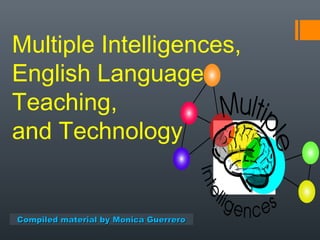
Multiple Intelligences,
English Language
Teaching,
and Technology
Compiled material by Monica GuerreroCompiled material by Monica Guerrero
The Theory of Multiple Intelligences
 Traditional View of Intelligences
Linguistic Intelligence
Mathematical-Logical Intelligence
 Gardner’s Ground Zero Project(1983)
 Humans are born with various types of intelligences –> Seven
types
 Each person possesses a different level in each type of
intelligence.
Linguistic Intelligence
 The intelligence of wordsThe intelligence of words
Love to play around with the sounds of language through puns,Love to play around with the sounds of language through puns,
word games, and tongue twistersword games, and tongue twisters
 Trivia experts, Masters of literacyTrivia experts, Masters of literacy
 Talk persuasively, Read a lot, Write clearlyTalk persuasively, Read a lot, Write clearly
Journalist, storyteller, poet, lawyer, etc.Journalist, storyteller, poet, lawyer, etc.
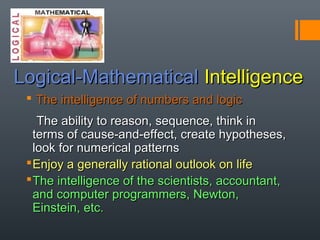
 The intelligence of numbers and logicThe intelligence of numbers and logic
The ability to reason, sequence, think inThe ability to reason, sequence, think in
terms of cause-and-effect, create hypotheses,terms of cause-and-effect, create hypotheses,
look for numerical patternslook for numerical patterns
Enjoy a generally rational outlook on lifeEnjoy a generally rational outlook on life
The intelligence of the scientists, accountant,The intelligence of the scientists, accountant,
and computer programmers, Newton,and computer programmers, Newton,
Einstein, etc.Einstein, etc.
Logical-MathematicalLogical-Mathematical IntelligenceIntelligence
Smart with pictures and imagesSmart with pictures and images
The ability to perceive, transform, andThe ability to perceive, transform, and
recreate different aspects of the visual-spatialrecreate different aspects of the visual-spatial
worldworld
 An acute sensitivity to visualize detailsAn acute sensitivity to visualize details
Can visualize vividly, draw, sketch their ideasCan visualize vividly, draw, sketch their ideas
graphically, and orient themselves in three-graphically, and orient themselves in three-
dimensional space with easedimensional space with ease
Visual-SpatialVisual-Spatial
IntelligenceIntelligence
Architects, photographers, artists,Architects, photographers, artists,
pilots, mechanical engineerspilots, mechanical engineers
 Designer of the Pyramids in Egypt,Designer of the Pyramids in Egypt,
Thomas Edison, Pable Piccaso,etc.Thomas Edison, Pable Piccaso,etc.
Visual-SpatialVisual-Spatial IntelligenceIntelligence
The capacity to perceive, appreciate, andThe capacity to perceive, appreciate, and
produce rhythms and melodiesproduce rhythms and melodies
 Has a good ear, can sing in tune, keep time to musicHas a good ear, can sing in tune, keep time to music
 Can listen to different musical selections with some degree ofCan listen to different musical selections with some degree of
discernmentdiscernment
 Bach, Beethoven, Brahms, etc.Bach, Beethoven, Brahms, etc.
MusicalMusical IntelligenceIntelligence
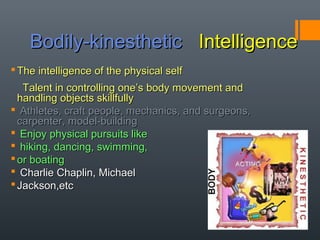
 The intelligence of the physical selfThe intelligence of the physical self
Talent in controlling one’s body movement andTalent in controlling one’s body movement and
handling objects skillfullyhandling objects skillfully
 Athletes, craft people, mechanics, and surgeons,Athletes, craft people, mechanics, and surgeons,
carpenter, model-buildingcarpenter, model-building
 Enjoy physical pursuits likeEnjoy physical pursuits like
 hiking, dancing, swimming,hiking, dancing, swimming,
 or boatingor boating
 Charlie Chaplin, MichaelCharlie Chaplin, Michael
 Jackson,etcJackson,etc
Bodily-kinestheticBodily-kinesthetic IntelligenceIntelligence
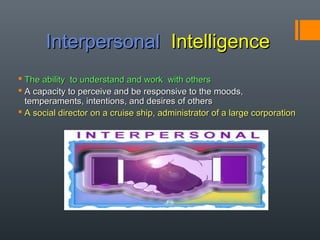
 The ability to understand and work with othersThe ability to understand and work with others
 A capacity to perceive and be responsive to the moods,A capacity to perceive and be responsive to the moods,
temperaments, intentions, and desires of otherstemperaments, intentions, and desires of others
 A social director on a cruise ship, administrator of a large corporationA social director on a cruise ship, administrator of a large corporation
InterpersonalInterpersonal IntelligenceIntelligence
 Very compassionate and socially responsible like Gandhi, MachiavelliVery compassionate and socially responsible like Gandhi, Machiavelli
 The ability to get inside the skin of another person and view the worldThe ability to get inside the skin of another person and view the world
from the individual perspectivefrom the individual perspective
Networkers, negotiators, teachersNetworkers, negotiators, teachers
IntrapersonalIntrapersonal IntelligenceIntelligence
 The intelligence of the inner selfThe intelligence of the inner self
Can access one’s own feelings andCan access one’s own feelings and
discriminate between many different kinds ofdiscriminate between many different kinds of
inner emotional statesinner emotional states
 Can use one’s self-understanding to enrich and guide her lifeCan use one’s self-understanding to enrich and guide her life
 Very introspective, enjoy meditation, contemplation, deep soulVery introspective, enjoy meditation, contemplation, deep soul
searchingsearching
IntrapersonalIntrapersonal IntelligenceIntelligence
 Independent, highly goal-oriented, and self-disciplinedIndependent, highly goal-oriented, and self-disciplined
 Counselors, theologians, self-employed business peopleCounselors, theologians, self-employed business people
 Prefer to work on their own rather than with othersPrefer to work on their own rather than with others
IntrapersonalIntrapersonal IntelligenceIntelligence
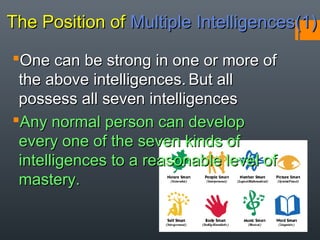
One can be strong in one or more ofOne can be strong in one or more of
the above intelligences.the above intelligences. But allBut all
possess all seven intelligencespossess all seven intelligences
Any normal person can developAny normal person can develop
every one of the seven kinds ofevery one of the seven kinds of
intelligences to a reasonable level ofintelligences to a reasonable level of
mastery.mastery.
The Position ofThe Position of Multiple Intelligences(1)Multiple Intelligences(1)
ExampleExample: German thinker Rudolf Steiner was a: German thinker Rudolf Steiner was a
philosopher, writer, scientist, sculptor, socialphilosopher, writer, scientist, sculptor, social
theorist, architect. He also created a system oftheorist, architect. He also created a system of
dance, a theory of color, and a system ofdance, a theory of color, and a system of
gardeninggardening
 There are a few people who have developed only oneThere are a few people who have developed only one
intelligence to a high level, while the other intelligences lagged farintelligence to a high level, while the other intelligences lagged far
behindbehind
The Position ofThe Position of Multiple Intelligences(2)Multiple Intelligences(2)
We have a few intelligences that stand out,We have a few intelligences that stand out,
some that seem average, and others that wesome that seem average, and others that we
have difficulty with in our lives.have difficulty with in our lives.
There is room for everyone to shine in this newThere is room for everyone to shine in this new
model of intelligence.model of intelligence.
The farmer, the parent, the painter, theThe farmer, the parent, the painter, the
mechanic, and the merchant have as muchmechanic, and the merchant have as much
right to the term intelligence as do theright to the term intelligence as do the
psychiatrist, the brain surgeon, and the lawpsychiatrist, the brain surgeon, and the law
professor.professor.
The Position ofThe Position of
Multiple Intelligences(3)Multiple Intelligences(3)
Various Types of Technology Support
the Intelligences
The Integration of M.I. & Technology:
The Positive Effects:
 Students find topics more interestingStudents find topics more interesting
 when information is presented in a variety of ways.when information is presented in a variety of ways.
 Students feel more comfortable andStudents feel more comfortable and
 motivated when they know that theirmotivated when they know that their
 learning styles will be addressed.learning styles will be addressed.
 Students believe their learning has moreStudents believe their learning has more
 meaning when the way in which they learn and presentmeaning when the way in which they learn and present
new information is acknowledged.new information is acknowledged.
 Students are more challenged, engaged,Students are more challenged, engaged,
 and independent.and independent.
M.I. & Technology: Positive Effects, cont.
 Students have more control over what and how they learn (selfStudents have more control over what and how they learn (self
pacing).pacing).
 Students gain a greater sense of responsibility for their work.Students gain a greater sense of responsibility for their work.
 Students remain on task for longer periods of time.Students remain on task for longer periods of time.
Positive Effects, cont.
Students produce higher quality work, that reflects theStudents produce higher quality work, that reflects the
increased depth and breadth of their knowledge andincreased depth and breadth of their knowledge and
talents.talents.
Students become better at critical thinking, organizing &Students become better at critical thinking, organizing &
evaluating information, and presenting their newevaluating information, and presenting their new
knowledge in creative ways.knowledge in creative ways.
Reference Material
• www.riverdeep.com
• www.nifl.gov/nifl/eliteracy
• www.glef.org
• www.learningspace.org
• www.iearn.org
• www.iste.org
- Rescue at Boone’s Meadow (5- Rescue at Boone’s Meadow (5thth
Grade)Grade)
http://peabody.vanderbilt.edu/ltc/Researhttp://peabody.vanderbilt.edu/ltc/Resear
ch/ch/
jasper.overview.htmljasper.overview.html
• Thinking Skills; Visual Venture)Thinking Skills; Visual Venture)
http://www.hots.orghttp://www.hots.org

Multiple intelligence ppt

  • 1.
    Multiple Intelligences, English Language Teaching, andTechnology Compiled material by Monica GuerreroCompiled material by Monica Guerrero
  • 2.
    The Theory ofMultiple Intelligences  Traditional View of Intelligences Linguistic Intelligence Mathematical-Logical Intelligence  Gardner’s Ground Zero Project(1983)  Humans are born with various types of intelligences –> Seven types  Each person possesses a different level in each type of intelligence.
  • 3.
    Linguistic Intelligence  Theintelligence of wordsThe intelligence of words Love to play around with the sounds of language through puns,Love to play around with the sounds of language through puns, word games, and tongue twistersword games, and tongue twisters  Trivia experts, Masters of literacyTrivia experts, Masters of literacy  Talk persuasively, Read a lot, Write clearlyTalk persuasively, Read a lot, Write clearly Journalist, storyteller, poet, lawyer, etc.Journalist, storyteller, poet, lawyer, etc.
  • 4.
     The intelligenceof numbers and logicThe intelligence of numbers and logic The ability to reason, sequence, think inThe ability to reason, sequence, think in terms of cause-and-effect, create hypotheses,terms of cause-and-effect, create hypotheses, look for numerical patternslook for numerical patterns Enjoy a generally rational outlook on lifeEnjoy a generally rational outlook on life The intelligence of the scientists, accountant,The intelligence of the scientists, accountant, and computer programmers, Newton,and computer programmers, Newton, Einstein, etc.Einstein, etc. Logical-MathematicalLogical-Mathematical IntelligenceIntelligence
  • 5.
    Smart with picturesand imagesSmart with pictures and images The ability to perceive, transform, andThe ability to perceive, transform, and recreate different aspects of the visual-spatialrecreate different aspects of the visual-spatial worldworld  An acute sensitivity to visualize detailsAn acute sensitivity to visualize details Can visualize vividly, draw, sketch their ideasCan visualize vividly, draw, sketch their ideas graphically, and orient themselves in three-graphically, and orient themselves in three- dimensional space with easedimensional space with ease Visual-SpatialVisual-Spatial IntelligenceIntelligence
  • 6.
    Architects, photographers, artists,Architects,photographers, artists, pilots, mechanical engineerspilots, mechanical engineers  Designer of the Pyramids in Egypt,Designer of the Pyramids in Egypt, Thomas Edison, Pable Piccaso,etc.Thomas Edison, Pable Piccaso,etc. Visual-SpatialVisual-Spatial IntelligenceIntelligence
  • 7.
    The capacity toperceive, appreciate, andThe capacity to perceive, appreciate, and produce rhythms and melodiesproduce rhythms and melodies  Has a good ear, can sing in tune, keep time to musicHas a good ear, can sing in tune, keep time to music  Can listen to different musical selections with some degree ofCan listen to different musical selections with some degree of discernmentdiscernment  Bach, Beethoven, Brahms, etc.Bach, Beethoven, Brahms, etc. MusicalMusical IntelligenceIntelligence
  • 8.
     The intelligenceof the physical selfThe intelligence of the physical self Talent in controlling one’s body movement andTalent in controlling one’s body movement and handling objects skillfullyhandling objects skillfully  Athletes, craft people, mechanics, and surgeons,Athletes, craft people, mechanics, and surgeons, carpenter, model-buildingcarpenter, model-building  Enjoy physical pursuits likeEnjoy physical pursuits like  hiking, dancing, swimming,hiking, dancing, swimming,  or boatingor boating  Charlie Chaplin, MichaelCharlie Chaplin, Michael  Jackson,etcJackson,etc Bodily-kinestheticBodily-kinesthetic IntelligenceIntelligence
  • 9.
     The abilityto understand and work with othersThe ability to understand and work with others  A capacity to perceive and be responsive to the moods,A capacity to perceive and be responsive to the moods, temperaments, intentions, and desires of otherstemperaments, intentions, and desires of others  A social director on a cruise ship, administrator of a large corporationA social director on a cruise ship, administrator of a large corporation InterpersonalInterpersonal IntelligenceIntelligence
  • 10.
     Very compassionateand socially responsible like Gandhi, MachiavelliVery compassionate and socially responsible like Gandhi, Machiavelli  The ability to get inside the skin of another person and view the worldThe ability to get inside the skin of another person and view the world from the individual perspectivefrom the individual perspective Networkers, negotiators, teachersNetworkers, negotiators, teachers IntrapersonalIntrapersonal IntelligenceIntelligence
  • 11.
     The intelligenceof the inner selfThe intelligence of the inner self Can access one’s own feelings andCan access one’s own feelings and discriminate between many different kinds ofdiscriminate between many different kinds of inner emotional statesinner emotional states  Can use one’s self-understanding to enrich and guide her lifeCan use one’s self-understanding to enrich and guide her life  Very introspective, enjoy meditation, contemplation, deep soulVery introspective, enjoy meditation, contemplation, deep soul searchingsearching IntrapersonalIntrapersonal IntelligenceIntelligence
  • 12.
     Independent, highlygoal-oriented, and self-disciplinedIndependent, highly goal-oriented, and self-disciplined  Counselors, theologians, self-employed business peopleCounselors, theologians, self-employed business people  Prefer to work on their own rather than with othersPrefer to work on their own rather than with others IntrapersonalIntrapersonal IntelligenceIntelligence
  • 13.
    One can bestrong in one or more ofOne can be strong in one or more of the above intelligences.the above intelligences. But allBut all possess all seven intelligencespossess all seven intelligences Any normal person can developAny normal person can develop every one of the seven kinds ofevery one of the seven kinds of intelligences to a reasonable level ofintelligences to a reasonable level of mastery.mastery. The Position ofThe Position of Multiple Intelligences(1)Multiple Intelligences(1)
  • 14.
    ExampleExample: German thinkerRudolf Steiner was a: German thinker Rudolf Steiner was a philosopher, writer, scientist, sculptor, socialphilosopher, writer, scientist, sculptor, social theorist, architect. He also created a system oftheorist, architect. He also created a system of dance, a theory of color, and a system ofdance, a theory of color, and a system of gardeninggardening  There are a few people who have developed only oneThere are a few people who have developed only one intelligence to a high level, while the other intelligences lagged farintelligence to a high level, while the other intelligences lagged far behindbehind The Position ofThe Position of Multiple Intelligences(2)Multiple Intelligences(2)
  • 15.
    We have afew intelligences that stand out,We have a few intelligences that stand out, some that seem average, and others that wesome that seem average, and others that we have difficulty with in our lives.have difficulty with in our lives. There is room for everyone to shine in this newThere is room for everyone to shine in this new model of intelligence.model of intelligence. The farmer, the parent, the painter, theThe farmer, the parent, the painter, the mechanic, and the merchant have as muchmechanic, and the merchant have as much right to the term intelligence as do theright to the term intelligence as do the psychiatrist, the brain surgeon, and the lawpsychiatrist, the brain surgeon, and the law professor.professor. The Position ofThe Position of Multiple Intelligences(3)Multiple Intelligences(3)
  • 16.
    Various Types ofTechnology Support the Intelligences
  • 17.
    The Integration ofM.I. & Technology: The Positive Effects:  Students find topics more interestingStudents find topics more interesting  when information is presented in a variety of ways.when information is presented in a variety of ways.  Students feel more comfortable andStudents feel more comfortable and  motivated when they know that theirmotivated when they know that their  learning styles will be addressed.learning styles will be addressed.  Students believe their learning has moreStudents believe their learning has more  meaning when the way in which they learn and presentmeaning when the way in which they learn and present new information is acknowledged.new information is acknowledged.  Students are more challenged, engaged,Students are more challenged, engaged,  and independent.and independent.
  • 18.
    M.I. & Technology:Positive Effects, cont.  Students have more control over what and how they learn (selfStudents have more control over what and how they learn (self pacing).pacing).  Students gain a greater sense of responsibility for their work.Students gain a greater sense of responsibility for their work.  Students remain on task for longer periods of time.Students remain on task for longer periods of time.
  • 19.
    Positive Effects, cont. Studentsproduce higher quality work, that reflects theStudents produce higher quality work, that reflects the increased depth and breadth of their knowledge andincreased depth and breadth of their knowledge and talents.talents. Students become better at critical thinking, organizing &Students become better at critical thinking, organizing & evaluating information, and presenting their newevaluating information, and presenting their new knowledge in creative ways.knowledge in creative ways.
  • 20.
    Reference Material • www.riverdeep.com •www.nifl.gov/nifl/eliteracy • www.glef.org • www.learningspace.org • www.iearn.org • www.iste.org - Rescue at Boone’s Meadow (5- Rescue at Boone’s Meadow (5thth Grade)Grade) http://peabody.vanderbilt.edu/ltc/Researhttp://peabody.vanderbilt.edu/ltc/Resear ch/ch/ jasper.overview.htmljasper.overview.html • Thinking Skills; Visual Venture)Thinking Skills; Visual Venture) http://www.hots.orghttp://www.hots.org

Editor's Notes

  • #17 Palette = Visual/Spatial Intelligence Computer = Logical/Mathematical Intellignece Musical Notes = Musical/ Rhythmic Intelligence Microscope = Naturalist Intelligence Runner = Intrapersonal Intelligence Book = Verbal/ Linguistic Intelligence People = Interpersonal Intelligence “Thinker” = Existential Intelligence