GARDNER’S THEORY OF
MULTIPLE INTELLIGENCES
Prepared by:
Rohjan Mas Reyes
Learning Objectives:
At the end of this lesson, students are able to:
1. Understand Gardner’s Theory of Multiple
Intelligences and differentiate its nine
intelligences.
2. Develop empathy for diverse intelligences and
appreciate one’s own strengths.
3. Apply Multiple Intelligences in solving a real-
life problems.
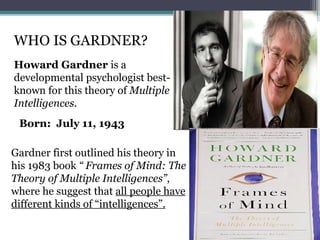
WHO IS GARDNER?
Howard Gardner is a
developmental psychologist best-
known for this theory of Multiple
Intelligences.
Gardner first outlined his theory in
his 1983 book “ Frames of Mind: The
Theory of Multiple Intelligences”,
where he suggest that all people have
different kinds of “intelligences”.
Born: July 11, 1943
MULTIPLE
INTELLIGENCES
This theory suggest that traditional psychometric
views of intelligence are too limited. Gardner
proposed that there are eight intelligences, and has
suggested the possible addition of a ninth known as
“ Existentialist Intelligence”.
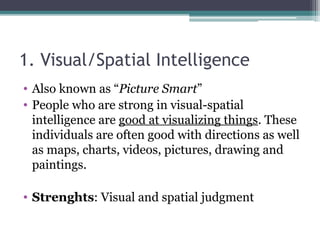
1. Visual/Spatial Intelligence
• Also known as “Picture Smart”
• People who are strong in visual-spatial
intelligence are good at visualizing things. These
individuals are often good with directions as well
as maps, charts, videos, pictures, drawing and
paintings.
• Strenghts: Visual and spatial judgment
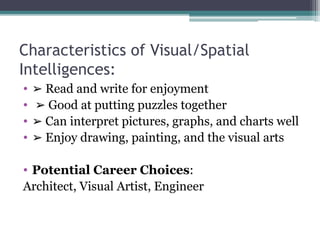
Characteristics of Visual/Spatial
Intelligences:
• ➢ Read and write for enjoyment
• ➢ Good at putting puzzles together
• ➢ Can interpret pictures, graphs, and charts well
• ➢ Enjoy drawing, painting, and the visual arts
• Potential Career Choices:
Architect, Visual Artist, Engineer
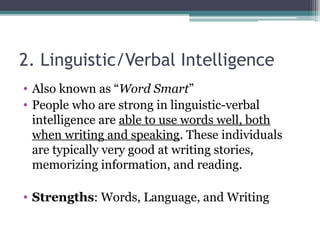
2. Linguistic/Verbal Intelligence
• Also known as “Word Smart”
• People who are strong in linguistic-verbal
intelligence are able to use words well, both
when writing and speaking. These individuals
are typically very good at writing stories,
memorizing information, and reading.
• Strengths: Words, Language, and Writing
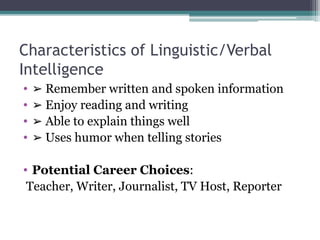
Characteristics of Linguistic/Verbal
Intelligence
• ➢ Remember written and spoken information
• ➢ Enjoy reading and writing
• ➢ Able to explain things well
• ➢ Uses humor when telling stories
• Potential Career Choices:
Teacher, Writer, Journalist, TV Host, Reporter
3.Logical/Mathematical Intelligence
• Also known as “Number Smart”
• People who are strong in logical-mathematical
intelligence are good at reasoning, recognizing
patterns, and logically analyzing problems.
These individuals tend to think conceptually
about numbers, relationships, and patterns.
• Strengths: Analyzing problems and
Mathematical operations.
Characteristics of
Logical/Mathematical Intelligence
• ➢ Have excellent problem-solving skills
• ➢ Enjoy thinking about abstract ideas
• ➢ Like conducting scientific experiments
• ➢ Can solve complex computations
• Potential Career Choices:
Mathematician, Accountant, Scientist
4.Bodily-Kinesthetic Intelligence
• Also known as “Body Smart”
• Those who have high bodily-kinesthetic
intelligence are said to be good at body
movement, performing actions, and physical
control. People who are strong in this area tend
to have excellent hand-eye coordination and
dexterity.
• Strengths: Physical Movement and Motor
Control
Characteristics of Bodily-Kinesthetic
Intelligence
• ➢ Skilled at dancing and sports
• ➢ Enjoy creating things with his or her hands
• ➢ Have excellent physical coordination
• ➢ Remember things by doing, rather than
hearing or seeing
• Potential Career Choices: Dancer, Sculptor,
Actor/Actress, Surgeon
5.Musical/Rhythmic Intellignce
• Also known as “Music Smart”
• People who have strong musical intelligence are
good at thinking in patterns, rhythms, and
sounds. They have a strong appreciation for
music and are often good at musical composition
and performance.
• Strengths: Rhythm and Music
Characteristics of Musical/Rhythmic
Intelligence
• ➢ Enjoy singing and playing musical
instruments
• ➢ Recognize musical patterns and tones easily
• ➢ Remember songs and melodies
• ➢ Have a rich understanding of musical
structure, rhythm, and notes
• Potential Career Choices: Musician, Singer,
Music Teacher, Instrumentalist, Composer
6.Interpersonal Intelligence
• Also known as “ People Smart”
• Those who have strong interpersonal
intelligence are good at understanding and
interacting with other people. These individuals
are skilled at assessing the emotions,
motivations, desires, and intentions of those
around them.
• Strengths: Understanding and Relating to
other people
Characteristics of Interpersonal
Intelligence
• ➢ Communicate well verbally
• ➢ See situations from different perspectives
• ➢ Create positive relationships with others
• ➢ Resolve conflicts in group settings
• Potential Career Choices: Psychologist,
Guidance Councilor, Philosopher, Politician
7.Intrapersonal Intelligence
• Also known as “Self Smart”
• Individuals who are strong in intrapersonal
intelligence are good at being aware of their own
emotional states, feelings, and motivations. They
tend to enjoy self-reflection and analysis,
including daydreaming, exploring relationships
with others, and assessing their personal
strengths.
• Strengths: Introspection and Self- Reflection
Characteristics of Intrapersonal
Intelligence
• ➢ Analyze their strengths and weaknesses well
• ➢ Have excellent self-awareness
• ➢ Understand the basis for his or her own
motivations and feelings
• Potential Career Choices: Writer, Theorist,
Scientist, Philosopher
8.Naturalistic Intelligence
• Also known as “Nature Smart”
• Naturalistic is the most recent addition to Gardner’s
theory and has been met with more resistance than
his original seven intelligences.
• According to Gardner, individuals who are high in
this type of intelligence are more in tune with nature
and are often interested in nurturing, exploring the
environment, and learning about other species.
These individuals are said to be highly aware of even
subtle changes to their environments.
• Strengths: Finding Patterns and Relationship to
Nature
Characteristics of Naturalistic
Intelligence
• ➢ Interested in subjects such as botany, biology,
and zoology
• ➢ Enjoy camping, gardening, hiking, and
exploring the outdoors
• ➢ Dislikes learning unfamiliar topics that have
no connection to nature
• Potential Career Choices: Biologist,
Zoologist, Farmer, Gardener
9. Existential Intelligence
• Also known as “Life Smart”
• Existential intelligence is the ninth type of
intelligence suggested as an addition to Gardner’s
original theory.
• He described existential intelligence as an ability to
delve into deeper questions about life and existence.
People with this type of intelligence contemplate the
“big” questions about topics such as the meaning of
life and how actions can serve larger goals.
• STRENGTHS: Ability to see the bigger picture
Characteristics of Existential
Intelligence
• ➢ Have a long-term outlook
• ➢ Consider how current actions influence future
outcomes
• ➢ Interest in questions about the meaning of life
and death
• ➢ Strong interest and concern for others
• ➢ The ability to see situations from an outside
perspective
• Potential Career Choices: Pastor,
Theologian, Philosopher
Conclusion:
• The theory of multiple intelligences is important because it allows
us to think about different types of mental strengths and abilities.
Learning more about which types of intelligence you lean towards
may help you learn to recognize your own preferences. However, it
shouldn't be used as a tool to label and should not be confused with
learning styles. Instead of trying to match what you learn to your
perceived type of intelligence, focus on learning new things via
various modalities and formats to strengthen encoding and
reinforce learning.
• Offering varied forms of assessments can be a teaching
strategy that aligns with Multiple Intelligences theory for
diverse students.
References:
• https://www.verywellmind.com/gardners-
theory-of-multiple-intelligences-2795161
• https://www.gfschools.org/site/handlers/
filedownload.ashx?
moduleinstanceid=845&dataid=3680&filename
=8-intelligences description-sheet.pdf
Thank You!
QUIZ
1. Which psychologist introduced
the theory of Multiple
Intelligences?
A) Sigmund Freud
B) Abraham Maslow
C) Howard Gardner
D) Erik Erikson
2. Your friend is excellent at reading
people’s emotions and providing
support when they’re upset. What
kind of Intelligence is your friend
displaying?
A) Logical-Mathematical Intelligence
B) Interpersonal Intelligence
C) Visual/Spatial Intelligence
D)Bodily-Kinesthetic Intelligence
3. You’re working on a complex puzzle
that requires pattern recognition and
problem-solving. Which intelligence is
most engaged in this activity?
A)Spatial Intelligence
B)Linguistic Intelligence
C)Interpersonal Intelligence
D)Bodily-Kinesthetic Intelligence
4. You’re meditating to gain better
self-awareness and understanding of
your emotions. Which intelligence
does this practice enhance?
A) Interpersonal Intelligence
B) Interpersonal Intelligence
C) Existentialist
D)Naturalist
5. You have a passion for hiking and
can easily identify various plant
species and animal tracks. Which
intelligence does this reflect?
A) Logical-Mathematical Intelligence
B) Naturalist
C) Intrapersonal Intelligence
D)Musical
6. You have deep curiosity about the meaning of
life, the universe, and your own existence. You
often find yourself contemplating philosophical
question. Which type of Intelligence is most
relevant to your introspective nature?
A) Linguistic Intelligence
B) Logical-Mathematical Intelligence
C) Existentialist
D)Spatial
7. Which of the following best
describes one of the key principles
of Multiple Intelligences theory?
A) Intelligence is a fixed trait that cannot be developed
B) There are only two types of intelligence: verbal and
mathematical
C) Each individual possesses a unique combination of
Multiple Intelligences
D) Intelligence is primarily determined by genetics and
cannot be influenced by environment
8. The ability to use words
effectively, both in speaking and
writing is associated with which
intelligence?
A) Linguistic Intelligence
B) Spatial Intelligence
C) Bodily-Kinesthetic Intelligence
D)Musical Intelligence
9. Which of the following is NOT
one of Howard Gardner’s original
seven intelligences?
A) Linguistic
B) Musical
C) Spatial
D)Emotional
10. What teaching strategy aligns
with Multiple Intelligences theory
for diverse student strengths?
A) Solely using traditional lectures
B) Offering varied forms of assessment
C) Assigning identical activities to all
students
D)Ignoring intelligence diversity in
teaching

Multiple Intelligences with Quiz 10 pptx

  • 1.
    GARDNER’S THEORY OF MULTIPLEINTELLIGENCES Prepared by: Rohjan Mas Reyes
  • 2.
    Learning Objectives: At theend of this lesson, students are able to: 1. Understand Gardner’s Theory of Multiple Intelligences and differentiate its nine intelligences. 2. Develop empathy for diverse intelligences and appreciate one’s own strengths. 3. Apply Multiple Intelligences in solving a real- life problems.
  • 3.
    WHO IS GARDNER? HowardGardner is a developmental psychologist best- known for this theory of Multiple Intelligences. Gardner first outlined his theory in his 1983 book “ Frames of Mind: The Theory of Multiple Intelligences”, where he suggest that all people have different kinds of “intelligences”. Born: July 11, 1943
  • 4.
    MULTIPLE INTELLIGENCES This theory suggestthat traditional psychometric views of intelligence are too limited. Gardner proposed that there are eight intelligences, and has suggested the possible addition of a ninth known as “ Existentialist Intelligence”.
  • 5.
    1. Visual/Spatial Intelligence •Also known as “Picture Smart” • People who are strong in visual-spatial intelligence are good at visualizing things. These individuals are often good with directions as well as maps, charts, videos, pictures, drawing and paintings. • Strenghts: Visual and spatial judgment
  • 6.
    Characteristics of Visual/Spatial Intelligences: •➢ Read and write for enjoyment • ➢ Good at putting puzzles together • ➢ Can interpret pictures, graphs, and charts well • ➢ Enjoy drawing, painting, and the visual arts • Potential Career Choices: Architect, Visual Artist, Engineer
  • 7.
    2. Linguistic/Verbal Intelligence •Also known as “Word Smart” • People who are strong in linguistic-verbal intelligence are able to use words well, both when writing and speaking. These individuals are typically very good at writing stories, memorizing information, and reading. • Strengths: Words, Language, and Writing
  • 8.
    Characteristics of Linguistic/Verbal Intelligence •➢ Remember written and spoken information • ➢ Enjoy reading and writing • ➢ Able to explain things well • ➢ Uses humor when telling stories • Potential Career Choices: Teacher, Writer, Journalist, TV Host, Reporter
  • 9.
    3.Logical/Mathematical Intelligence • Alsoknown as “Number Smart” • People who are strong in logical-mathematical intelligence are good at reasoning, recognizing patterns, and logically analyzing problems. These individuals tend to think conceptually about numbers, relationships, and patterns. • Strengths: Analyzing problems and Mathematical operations.
  • 10.
    Characteristics of Logical/Mathematical Intelligence •➢ Have excellent problem-solving skills • ➢ Enjoy thinking about abstract ideas • ➢ Like conducting scientific experiments • ➢ Can solve complex computations • Potential Career Choices: Mathematician, Accountant, Scientist
  • 11.
    4.Bodily-Kinesthetic Intelligence • Alsoknown as “Body Smart” • Those who have high bodily-kinesthetic intelligence are said to be good at body movement, performing actions, and physical control. People who are strong in this area tend to have excellent hand-eye coordination and dexterity. • Strengths: Physical Movement and Motor Control
  • 12.
    Characteristics of Bodily-Kinesthetic Intelligence •➢ Skilled at dancing and sports • ➢ Enjoy creating things with his or her hands • ➢ Have excellent physical coordination • ➢ Remember things by doing, rather than hearing or seeing • Potential Career Choices: Dancer, Sculptor, Actor/Actress, Surgeon
  • 13.
    5.Musical/Rhythmic Intellignce • Alsoknown as “Music Smart” • People who have strong musical intelligence are good at thinking in patterns, rhythms, and sounds. They have a strong appreciation for music and are often good at musical composition and performance. • Strengths: Rhythm and Music
  • 14.
    Characteristics of Musical/Rhythmic Intelligence •➢ Enjoy singing and playing musical instruments • ➢ Recognize musical patterns and tones easily • ➢ Remember songs and melodies • ➢ Have a rich understanding of musical structure, rhythm, and notes • Potential Career Choices: Musician, Singer, Music Teacher, Instrumentalist, Composer
  • 15.
    6.Interpersonal Intelligence • Alsoknown as “ People Smart” • Those who have strong interpersonal intelligence are good at understanding and interacting with other people. These individuals are skilled at assessing the emotions, motivations, desires, and intentions of those around them. • Strengths: Understanding and Relating to other people
  • 16.
    Characteristics of Interpersonal Intelligence •➢ Communicate well verbally • ➢ See situations from different perspectives • ➢ Create positive relationships with others • ➢ Resolve conflicts in group settings • Potential Career Choices: Psychologist, Guidance Councilor, Philosopher, Politician
  • 17.
    7.Intrapersonal Intelligence • Alsoknown as “Self Smart” • Individuals who are strong in intrapersonal intelligence are good at being aware of their own emotional states, feelings, and motivations. They tend to enjoy self-reflection and analysis, including daydreaming, exploring relationships with others, and assessing their personal strengths. • Strengths: Introspection and Self- Reflection
  • 18.
    Characteristics of Intrapersonal Intelligence •➢ Analyze their strengths and weaknesses well • ➢ Have excellent self-awareness • ➢ Understand the basis for his or her own motivations and feelings • Potential Career Choices: Writer, Theorist, Scientist, Philosopher
  • 19.
    8.Naturalistic Intelligence • Alsoknown as “Nature Smart” • Naturalistic is the most recent addition to Gardner’s theory and has been met with more resistance than his original seven intelligences. • According to Gardner, individuals who are high in this type of intelligence are more in tune with nature and are often interested in nurturing, exploring the environment, and learning about other species. These individuals are said to be highly aware of even subtle changes to their environments. • Strengths: Finding Patterns and Relationship to Nature
  • 20.
    Characteristics of Naturalistic Intelligence •➢ Interested in subjects such as botany, biology, and zoology • ➢ Enjoy camping, gardening, hiking, and exploring the outdoors • ➢ Dislikes learning unfamiliar topics that have no connection to nature • Potential Career Choices: Biologist, Zoologist, Farmer, Gardener
  • 21.
    9. Existential Intelligence •Also known as “Life Smart” • Existential intelligence is the ninth type of intelligence suggested as an addition to Gardner’s original theory. • He described existential intelligence as an ability to delve into deeper questions about life and existence. People with this type of intelligence contemplate the “big” questions about topics such as the meaning of life and how actions can serve larger goals. • STRENGTHS: Ability to see the bigger picture
  • 22.
    Characteristics of Existential Intelligence •➢ Have a long-term outlook • ➢ Consider how current actions influence future outcomes • ➢ Interest in questions about the meaning of life and death • ➢ Strong interest and concern for others • ➢ The ability to see situations from an outside perspective • Potential Career Choices: Pastor, Theologian, Philosopher
  • 23.
    Conclusion: • The theoryof multiple intelligences is important because it allows us to think about different types of mental strengths and abilities. Learning more about which types of intelligence you lean towards may help you learn to recognize your own preferences. However, it shouldn't be used as a tool to label and should not be confused with learning styles. Instead of trying to match what you learn to your perceived type of intelligence, focus on learning new things via various modalities and formats to strengthen encoding and reinforce learning. • Offering varied forms of assessments can be a teaching strategy that aligns with Multiple Intelligences theory for diverse students.
  • 24.
  • 25.
  • 26.
  • 27.
    1. Which psychologistintroduced the theory of Multiple Intelligences? A) Sigmund Freud B) Abraham Maslow C) Howard Gardner D) Erik Erikson
  • 28.
    2. Your friendis excellent at reading people’s emotions and providing support when they’re upset. What kind of Intelligence is your friend displaying? A) Logical-Mathematical Intelligence B) Interpersonal Intelligence C) Visual/Spatial Intelligence D)Bodily-Kinesthetic Intelligence
  • 29.
    3. You’re workingon a complex puzzle that requires pattern recognition and problem-solving. Which intelligence is most engaged in this activity? A)Spatial Intelligence B)Linguistic Intelligence C)Interpersonal Intelligence D)Bodily-Kinesthetic Intelligence
  • 30.
    4. You’re meditatingto gain better self-awareness and understanding of your emotions. Which intelligence does this practice enhance? A) Interpersonal Intelligence B) Interpersonal Intelligence C) Existentialist D)Naturalist
  • 31.
    5. You havea passion for hiking and can easily identify various plant species and animal tracks. Which intelligence does this reflect? A) Logical-Mathematical Intelligence B) Naturalist C) Intrapersonal Intelligence D)Musical
  • 32.
    6. You havedeep curiosity about the meaning of life, the universe, and your own existence. You often find yourself contemplating philosophical question. Which type of Intelligence is most relevant to your introspective nature? A) Linguistic Intelligence B) Logical-Mathematical Intelligence C) Existentialist D)Spatial
  • 33.
    7. Which ofthe following best describes one of the key principles of Multiple Intelligences theory? A) Intelligence is a fixed trait that cannot be developed B) There are only two types of intelligence: verbal and mathematical C) Each individual possesses a unique combination of Multiple Intelligences D) Intelligence is primarily determined by genetics and cannot be influenced by environment
  • 34.
    8. The abilityto use words effectively, both in speaking and writing is associated with which intelligence? A) Linguistic Intelligence B) Spatial Intelligence C) Bodily-Kinesthetic Intelligence D)Musical Intelligence
  • 35.
    9. Which ofthe following is NOT one of Howard Gardner’s original seven intelligences? A) Linguistic B) Musical C) Spatial D)Emotional
  • 36.
    10. What teachingstrategy aligns with Multiple Intelligences theory for diverse student strengths? A) Solely using traditional lectures B) Offering varied forms of assessment C) Assigning identical activities to all students D)Ignoring intelligence diversity in teaching