PHASES OF CURRICULUM
      PROCESS
INTRODUCTION

 Curriculum planning is based on philosophy
  and objectives.
 Curriculum construction requires an
  understanding of educational
  psychology, together with knowledge and
  skill in the practice of nursing education.
 There are five steps in the development of
  curriculum.
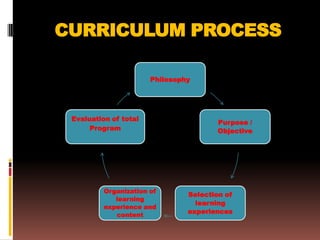
CURRICULUM PROCESS

                       Philosophy


 Evaluation of total
                                       Purpose /
      Program                          Objective


          Organization of
                                Selection of
             learning
                                  learning
          experience and
             content
                                experiences
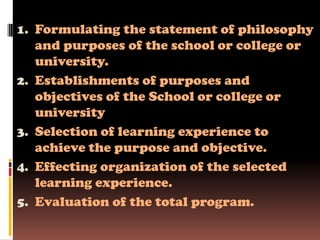
1. Formulating the statement of philosophy
   and purposes of the school or college or
   university.
2. Establishments of purposes and
   objectives of the School or college or
   university
3. Selection of learning experience to
   achieve the purpose and objective.
4. Effecting organization of the selected
   learning experience.
5. Evaluation of the total program.
FORMULATING THE STATEMENT OF
       THE PHILOSOPHY
 Philosophies are the beliefs and standards of the
  persons who starts a programme.
 The philosophy serves as a framework within
  which an organization, school or college or
  educational programme can function with an
  objective and purpose.
 The philosophy is expressed in different ways as
  the quality of education, selection, of teachers
  and students.
Guidelines for development
           of philosophy
 An educational philosophy states the
  values which are believed to be right, true
  and good by the persons responsibilities
  for the school or college.
 An educational philosophy will be unique
  to the particular society and individual
  whom it serves.
 All teaching staff should participate in
  the formulation of the school philosophy
  or college philosophy.
 College or school philosophy is used as a
  screen.
 College or school philosophy should not
  conflict with the philosophy of the
  institution of which it is a part.
 College or school philosophy should be re
  – examined periodically to determine its
  suitability in the light of the changing
  conditions.
AIMS GOALS AND OBJECTIVES

 The term ‘Purposes’ refers to describe
  the overall goals of the total education
  program and the term ‘objective’ refers
  to the breakdown of purposes into the
  specific goals which can be used to
  pinpoint the content.
 The objective is developed to indicate
  what changes in behavior it is hoped to
  bring about in the student as a result of
  the courses being offered.
Factors to be considered

 Statement of philosophy.
 Social and health needs of the people.
 Kind of students to be expected in the
  education program.
 Level of professional competence to be
  attained.
 Role of nurse (after qualifying) in society.
 Statutory minimum requirements.
 Teaching, physical and clinical resources
 availability.
SELECTION OF A LEARNING
           EXPERIENCES
 A learning experience is something in
  which the student actively participate
  and which results in a change of behavior.
 The    teacher    should    select    only
  experiences which will result in a change
  in behavior outlined in the objectives of
  the program.
CLASSIFICATION OF LEARNING
        EXPERIENCES
 Direct Learning Experiences
  These are first hand experiences with various objects
   or symbols.
 Examples for direct learning experiences are as follows
 • Observing samples or specimens
 • Experimenting with physical and chemical
   materials
 • Setting up apparatus for experiment
 • Operating machines
 • Constructing models, charts, plans
 • Drawing pictures and painting models
 Dramatizing historical events
 Summarizing a lengthy description
 Collecting, analyzing and interpreting the
    data and generalizing.
   Listing important facts and points
   Presenting ideas orally or in writing
   Conducting physical examination of
    clients
   Performing nursing procedures
   Handling different types of medical
    equipments and articles.
 Indirect Learning experiences
Those experiences which are not the
  first hand information.
Reading accounts or descriptions or
  discussion in books, journals,
  magazines and newspaper.
Observing pictures photos maps and
  models
Listenning to oral descriptions and
  lecture talks

Curriculum Development Process

  • 1.
  • 2.
    INTRODUCTION  Curriculum planningis based on philosophy and objectives.  Curriculum construction requires an understanding of educational psychology, together with knowledge and skill in the practice of nursing education.  There are five steps in the development of curriculum.
  • 3.
    CURRICULUM PROCESS Philosophy Evaluation of total Purpose / Program Objective Organization of Selection of learning learning experience and content experiences
  • 4.
    1. Formulating thestatement of philosophy and purposes of the school or college or university. 2. Establishments of purposes and objectives of the School or college or university 3. Selection of learning experience to achieve the purpose and objective. 4. Effecting organization of the selected learning experience. 5. Evaluation of the total program.
  • 5.
    FORMULATING THE STATEMENTOF THE PHILOSOPHY  Philosophies are the beliefs and standards of the persons who starts a programme.  The philosophy serves as a framework within which an organization, school or college or educational programme can function with an objective and purpose.  The philosophy is expressed in different ways as the quality of education, selection, of teachers and students.
  • 6.
    Guidelines for development of philosophy  An educational philosophy states the values which are believed to be right, true and good by the persons responsibilities for the school or college.  An educational philosophy will be unique to the particular society and individual whom it serves.  All teaching staff should participate in the formulation of the school philosophy or college philosophy.
  • 7.
     College orschool philosophy is used as a screen.  College or school philosophy should not conflict with the philosophy of the institution of which it is a part.  College or school philosophy should be re – examined periodically to determine its suitability in the light of the changing conditions.
  • 8.
    AIMS GOALS ANDOBJECTIVES  The term ‘Purposes’ refers to describe the overall goals of the total education program and the term ‘objective’ refers to the breakdown of purposes into the specific goals which can be used to pinpoint the content.  The objective is developed to indicate what changes in behavior it is hoped to bring about in the student as a result of the courses being offered.
  • 9.
    Factors to beconsidered  Statement of philosophy.  Social and health needs of the people.  Kind of students to be expected in the education program.  Level of professional competence to be attained.  Role of nurse (after qualifying) in society.  Statutory minimum requirements.  Teaching, physical and clinical resources availability.
  • 10.
    SELECTION OF ALEARNING EXPERIENCES  A learning experience is something in which the student actively participate and which results in a change of behavior.  The teacher should select only experiences which will result in a change in behavior outlined in the objectives of the program.
  • 11.
    CLASSIFICATION OF LEARNING EXPERIENCES  Direct Learning Experiences  These are first hand experiences with various objects or symbols. Examples for direct learning experiences are as follows • Observing samples or specimens • Experimenting with physical and chemical materials • Setting up apparatus for experiment • Operating machines • Constructing models, charts, plans • Drawing pictures and painting models
  • 12.
     Dramatizing historicalevents  Summarizing a lengthy description  Collecting, analyzing and interpreting the data and generalizing.  Listing important facts and points  Presenting ideas orally or in writing  Conducting physical examination of clients  Performing nursing procedures  Handling different types of medical equipments and articles.
  • 13.
     Indirect Learningexperiences Those experiences which are not the first hand information. Reading accounts or descriptions or discussion in books, journals, magazines and newspaper. Observing pictures photos maps and models Listenning to oral descriptions and lecture talks