The document discusses teacher education in comparative perspective. It begins by outlining the objectives of the subject, which include describing the aims and objectives of teacher education, understanding the competency and role of teachers, discussing teacher education in Pakistan and other countries, and explaining the role and responsibilities of teachers from an Islamic perspective. It then provides definitions of comparative education and teacher education. The remainder of the document discusses topics like the need for teacher education, objectives of teacher education programs, applying old and new teaching methods, the relationship between ideology and teacher education, the Islamic perspective on teaching, the relationship between communities and teacher education, and the role of research in teacher education, with examples from Pakistan.
By
Dr. Qaisar Abbas
AssistantProfessor
Riphah International University Faisalabad
drqaj@yahoo.com
0333-6700905
Teacher Education in Comparative
Perspective
2.
Objectives of Subject
1.Describe the Aims and Objectives of Teacher Education
2. Able to know the competency and role of the teacher
3. Discuss about the Teacher Education in Pakistan
4. Discuss the Teacher Education prospects and Future
5. Discuss teacher education in comparative perspective
6. Explain the role and responsibilities of a teacher in Islamic
perspective
3.
Definition
Comparative educationis the comparative study of
educational theories and practices in various
countries related to teacher education.
Comparative education considers the implications of
comparative studies for the formation and
implementation of policies in teacher education,
social, national and international development.
Comparative education invites contributions from
associated disciplines in the fields of government,
management, sociology, and technology and
communications which affect teachers’ educational
research and policy decisions.
4.
Teacher Education
Introduction
Aneducational institution performs a significant function
of providing learning experiences to lead their students
from the darkness of ignorance to the light of knowledge.
The key personnel in the institutions who play an
important role to bring about this transformation are
teachers.
Teacher education TE (TE) or teacher training refers to
the policies, procedures, and provision designed to equip
(prospective) teachers with
the knowledge, attitudes, behaviors, and skills they
require to perform their tasks effectively in
the classroom, school, and wider community.
5.
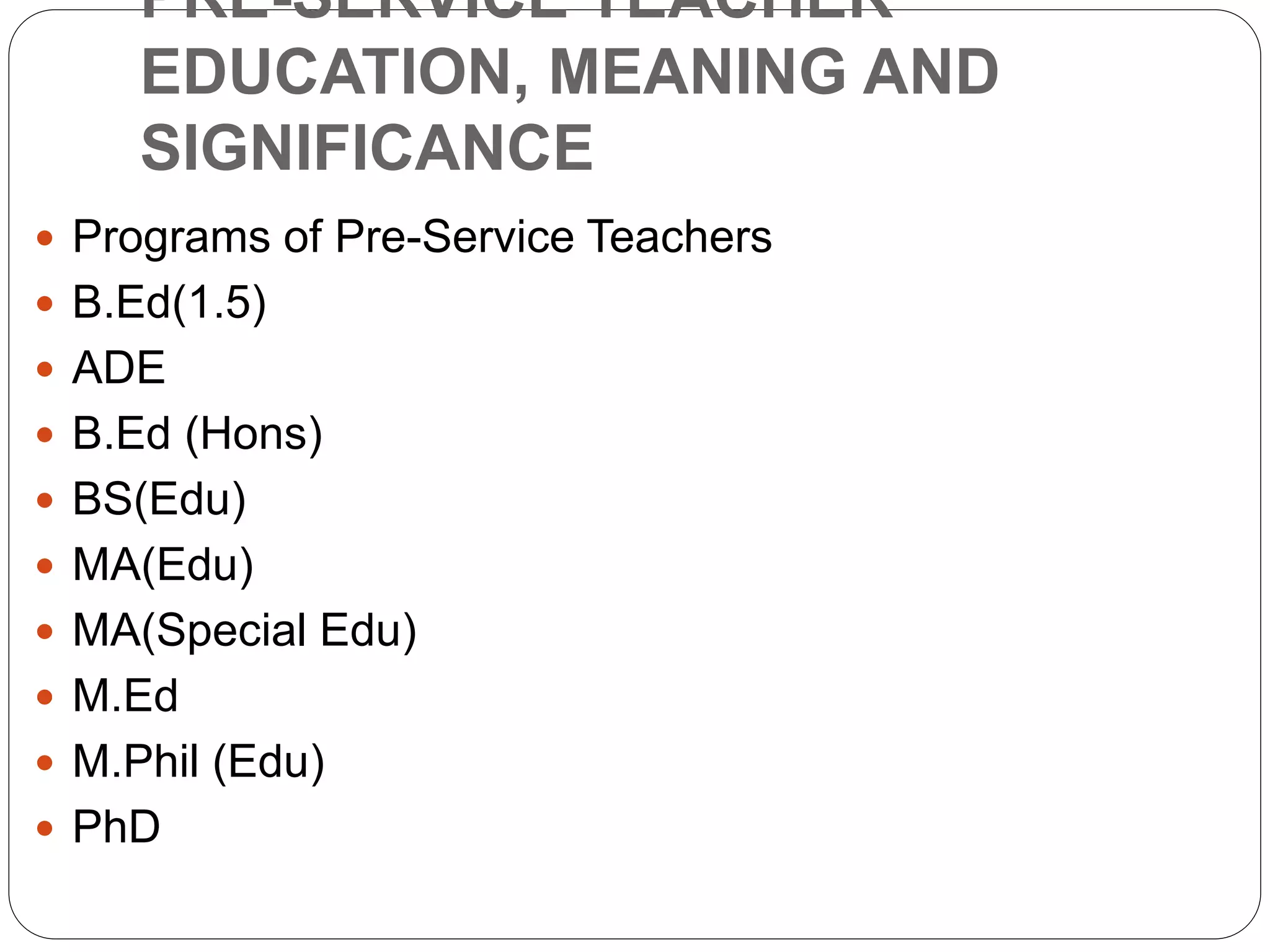
Teacher Education
Introduction
TeacherEducation is the programmed that is related to the
development of teacher proficiency and competency that would
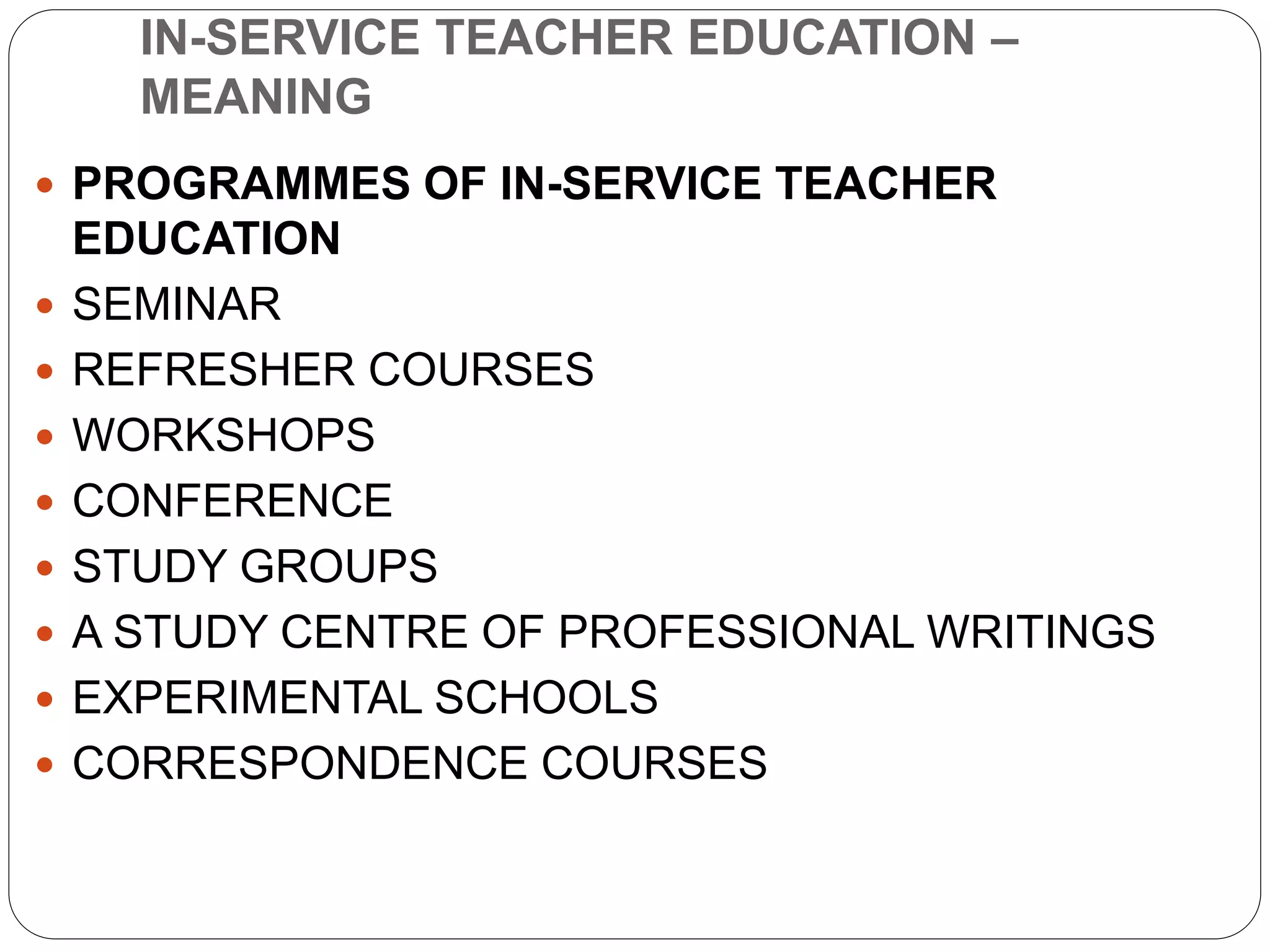
enable and empower the teacher to meet the requirements of
the profession and face the challenges therein.
It is that knowledge, skill and ability which is relevant to the
life of “teacher as a teacher”. A course in teacher education
should seek to reshape the attitudes, remodel the habits and in a
way to reconstitute the personality of a teacher.
The National Council for Teacher Education has defined
teacher education as – A program of education, research
and training of persons to teach from pre-primary to
higher education level.
6.
Teacher Education
Introduction
Accordingto Goods Dictionary of Education Teacher
education means, ―all the formal and non-formal
activities and experiences that help to qualify a
person to assume responsibilities of a member of the
educational profession or to discharge his
responsibilities more effectively.
Teacher education encompasses teaching skills,
sound pedagogical theory and professional skills.
Teacher Education = Teaching Skills + Pedagogical
theory + Professional skills.
7.
Teacher Education
Introduction
Teachingskills would include providing training and practice
in the different techniques, approaches and strategies that
would help the teachers to plan and impart instruction, provide
appropriate reinforcement and conduct effective assessment.
It includes effective classroom management skills, preparation
and use of instructional materials and communication skills.
Pedagogical theory includes the philosophical, sociological
and psychological considerations that would enable the
teachers to have a sound basis for practicing the teaching
skills in the classroom. The theory is stage specific and is
based on the needs and requirements that are characteristic
of that stage.
Professional skills include the techniques, strategies and
approaches that would help teachers to grow in the profession
and also work towards the growth of the profession. It includes
soft skills, counseling skills, interpersonal skills, computer
skills, information retrieving and management skills and above
8.
Teacher Education
Introduction
Ateacher's job is a highly respected and specialized field,
be it teaching kindergarten, grade school, high school,
college, or post-graduate courses. Teachers are necessary
in all fields of education, and in order to be teachers
themselves, they need to be educated by experts in their
desired fields.
Teacher education is a diverse field, covering numerous
subjects and various methods of teaching. Teaching in any
field is demanding and is a challenging task. Beyond regular
education, some people choose to follow specialized paths,
such as early childhood education or special education.
These teachers need extra educational background in order
to be certified to deal with their specific students. These
teachers need to have extensive patience and be friendly
9.
Teacher Education
Introduction
Anotherspecialized educational field is Montessori
teaching. This style of teaching appears to be simple, but in
reality, it is highly demanding. As this is a specific style of
teaching, aimed at gifted or advanced students, with a
degree of flexibility and customization not found in
traditional curriculums, teachers will need to learn the best
ways to work within the Montessori structure, and apply their
educational background to this style of teaching.
Ultimately, the goal of teacher education is to provide future
teachers - or teachers looking to further develop their
teaching ability - with the skills they need to convey
essential information to their students. The training they will
require depends on many factors, including the age group,
10.
Teacher Education
Introduction
Teachereducation is often divided into these stages:
initial teacher training / education (a pre-service
course before entering the classroom as a fully
responsible teacher);
induction (the process of providing training and
support during the first few years of teaching or the
first year in a particular school);
teacher development or continuing professional
development (CPD) (an in-service process for
practicing teachers).
16.
Need of TeacherEducation
The American Commission on Teacher Education rightly
observes as:
The quality of a nation depends upon the quality of its
citizens. The quality of its citizens depends not exclusively,
but in critical measure upon the quality of their education,
the quality of their education depends more than upon any
single factor, upon the quality of their teacher.
Teacher education is not teaching the teacher how to teach.
It is to light his initiative, to keep it alive, to minimize the evils
of “hit and miss” Process; and to save time, energy, money
and trouble of the teacher and taught.
The necessity of the teacher to perceive that the course in
teacher education would help him minimise his trouble, and
to appreciate that it would save the children from much of
painful process through which he has himself passed
teacher education is needed for developing a purpose and
for formation of a positive attitude for the profession.
17.
Objectives of Teacher
Education
1.Impartingan adequate knowledge of the subject-
matter:
The objective of teacher education is to develop a
good command of the subject matter of the assignment
given to him in the colleges.
2.Equipping the prospective teachers with necessary
pedagogic skills:
The main objective of teacher education is to develop
a skill to stimulate experience in the taught, under an
artificially created environment, less with material
resources and more by the creation of an emotional
atmosphere. The teacher should develop a capacity to
do, observe, infer and to generalize.
18.
Objectives of Teacher
Education
3.Enabling the teacher to acquire understanding of
child psychology:
The objective is to understand the child psychology so
that the teacher is able to appreciate the difficulties
experienced by children so as to bring about new
modes and methods of achieving the goals in
consonance with the reactions of the children.
4. Developing proper attitudes towards teaching:
One of the major objectives of teacher education is to
develop proper altitudes towards teaching as a result
of which he will be able to maximize the achievements
from both the material and human resources. There is
also development of a proper perception of the
problems of universal enrolment, regular attendance,
19.
Objectives of Teacher
Education
5.Developing self-confidence in the teachers:
The objectives of teacher education are development
of the ability to take care of himself in terms of.
Adjustment with the physical conditions, Healthy
adjustment with the social environment, and
Adjustment with himself to derive emotional
satisfaction with his life
6. Enabling teachers to make proper use of
instructional facilities:
The objective of teacher education is to develop the
capacity to extend the resources of the school by
means of improvisation of instructional facilities.
20.
Objectives of Teacher
Education
7.Enabling teachers to understand the significance of
individual differences of child and to take appropriate steps
for their optimum development:
The objective of teacher education is to know the causes of
individual differences as a result of which he will be able to
develop the ability to be a child with children, an adult with the
adults, and a responsible citizen among the community
8. Development of the ability to give direct satisfaction of
parents from the achievement of children in terms of:
Proper habits of taking care of the body.
Proper attitudes reflected in the behavior of the children at home,
in the school, in the streets, at the farms and fields etc
Progress in the class
The duties of the teacher is very much relevant in nursery,
primary, middle, secondary, higher secondary schools. Hence the
scope of teacher education is very vast.
21.
Application of oldand new methods
of instruction
Traditional/Old method of teaching is when a teacher directs
students to learn through memorization and recitation techniques
thereby not developing their critical thinking problem solving and
decision making skills (Sunal et al 1994) while modern or
constructivist approach to teaching involves a more interacting,
student-based of teaching. Here, the students learn through group
participation.
For effective teaching to take place, a good method must be
adopted by a teacher. A teacher has many options when choosing
a style by which to teach. The teacher may write lesson plans from
other teachers, or search online or within books for lesson plans.
When deciding what teaching method to use, a teacher needs to
consider students’ background, knowledge, environment, and
learning goals. Teachers are aware that students learn in different
ways, but almost all children will respond well to praise. Students
learn in different ways, of absorbing information and of
demonstrating their knowledge. Teachers often use techniques
which cater to multiple learning styles to help students retain
information and strengthen understanding. A variety of strategies
22.
Ideology and TeacherEducation
If we look at the history of education in Pakistan we see
how education has been used to propagate certain
ideologies favoured by powerful rulers.
In Ayub Khan's era, the whole emphasis was on 'economic
development' whereas social development was
undermined.
During Zia's regime, educational institutions were used to
'Islamise' society,
whereas Pervez Musharraf's emphasis was on an imported
brand of 'moderate enlightenment'.
This ideology of knowledge encourages a certain
pedagogy the sole objective of which is to transmit or pass
on pre-existing knowledge from one generation to another.
This ideology of pedagogical practices does not encourage
any innovation, creativity or reflection. The students are
23.
Ideology and TeacherEducation
The ideology of learning, encouraged by this kind of pedagogy,
is that of cramming and recalling, which is rightly dubbed by
Freire as the banking concept of knowledge. The ultimate aim of
this learning is to cram pre-existing and fixed items of
knowledge and reproduce them in examination papers. This
ideology of learning is devoid of any critical thinking. Thus
students find no motivation to reflect and reinterpret a
phenomenon.
This process of dominant teaching and passive learning gets
encouragement and reassurance by the ideology of the existing
assessment system. Our prevailing assessment system is
geared towards the piecemeal assessment of disjointed items
where students are not required to understand and apply
acquired knowledge. This prompts us to look at the ideology of a
broader aim of the present educational system that is biased in
favour of powerful groups. The kind of education, prevalent in
most educational institutions, not only supports existing power
24.
Ideology and TeacherEducation
Education has to move from transmission to transformation
for which we have to revisit our definitions of knowledge.
This would lead to more vibrant and interactive classroom
dynamics where students are engaged in co-construction
of knowledge. For this we need to challenge the ideology
of an existing assessment system which is memory-based
and is unable to tap thinking skills of a higher order.
We need to strive for an assessment system which
requires students to think critically and apply knowledge in
diverse contexts. For all these changes in learning,
pedagogy and assessment, it is important that we revisit
our ideology about the very aim of education. We need to
challenge the transmission mode of education that
supports existing power structures and move to the
transformation mode where the main objective is to reduce
socio-economic gaps in society and empower the
25.
Teacher and Teachingin Islamic
perspective
The Islamic concept of teaching and learning is not limited
to the memorization of Al- Quran and religious studies by
Muslim scholars. Islamic education is often erroneously
perceived as education on religious matters, whereas in
fact, Islamic education (based on the Quran and Sunnah)
provides a rich reservoir of knowledge in the modern
sciences such as medicine, genetics, and biology.
Naqli(revealed knowledge) is not all about recitation
scriptures from Al-Quran; rather it emphasizes a physical
and spiritual balance between everything.
In the view of the Islamic intellectual tradition, any solution
to the crises of our times can only be found in the
recovery of our true human nature. This nature, however,
cannot be grasped with the tools at the disposal of the
modern sciences and academic disciplines, but rather by
way of a process self-discovery.
26.
Teacher and Teachingin Islamic
perspective
Teaching, on the other hand, denotes a process to
facilitate learning. Teaching also refers to the
presentation of knowledge, and demonstration of
ability or skills. Effective teaching enables students to
make connections of the old and the new knowledge
to form new ideas. That is why competent teachers
have such a crucial role in the advancement of the
community.
In Islam, acquisition of knowledge is obligatory. Islam
teaches us to uphold the highest standard of morality
and teaches righteous thinking and action. Muslim
educators are duty bound to teach students the
purpose of creation and to inculcate the love of the
27.
Teacher and Teachingin Islamic
perspective
In Islam, the philosophy of knowledge or education is
created by Allah and He is the source of authentic
knowledge. It is compulsory to acquire knowledge and
practice what has been taught. Whatever knowledge
students acquire must be meaningful and purposeful, e.g.
to help mankind solve problems. He must also strive to
propagate knowledge for the benefit of others.
The Islamic philosophy of education stresses that both the
teacher and student are equally responsible for the
teaching-learning process. Essentially, the Islamic
philosophy of education is neither student-centered nor
teacher-centered. It is a complete code of conduct and a
collective system of learning and teaching, and also based
on the system of justice and brotherhood. No one in the
class is allowed to take advantage of another. As evident
from the above discussion, the philosophy of education
which Islam presents is aimed at developing human beings
spiritually, emotionally, morally, ethically, socially as well as
economically. Hence, Islam gives guidance to Muslims on
28.
Community and Teacher
Education
One of the basic purposes of the Teacher Education is to understand the
relationships between school and community and how to capitalize on
these relationships for enhancing student achievement. The prospective
teachers need to be introduced to the basic building blocks of these
institutions in order to understand the nature of interaction between and
among these institutions.
It is important for the prospective teachers to understand group dynamics
to be able to appreciate the nature of the nested relationships between
school and community for enhancing student achievement. This theme
will expose students to the theoretical bases and practical importance of
communication and interaction between and among stakeholders.
Student Teachers should consider future aspirations while grounding
their discussion in their own school experiences, especially their
recollections of 'good' teachers or their role models.
Teachers should focus on the non-traditional roles Pakistani
teachers play within their school and community.
Prospective teachers will be asked to draw on examples from their own
regions of birth/ residence. This will help in identifying the social factors
affecting education. It will also bring out the contextual role of schools in
supporting the development of education in the country in general and
29.
Research and TeacherEducation
The teacher educator profession has also been seen
as under-researched; empirical research on
professional practice is also scarce.
However, the importance of the quality of this
profession for the quality of teaching and learning has
been underlined by international bodies including the
OECD and the European Commission.
Some writers have therefore identified a need for
more research into “what teachers of teachers
themselves need to know”, and what institutional
supports are needed to “meet the complex demands
of preparing teachers for the 21st century.”
In response to this perceived need, more research
projects are now focussing on the teacher educator
profession. Several academic journals cover this field.
30.
Teacher Education inPakistan
"Teacher" is the core to achieve quality education in
Pakistan. The teaching force in Pakistan is estimated
to be 1.35m working in government schools from
primary to higher education.
There are 270 teacher training institutions providing
pre-service training (certificates, diplomas and
degrees).
In addition, there are 300 teacher training resource
centers in the districts.
The teacher training institutions are managed by the
Bureau of Curriculum and Extension for pre-service
programmes while the Provincial Institutes of Teacher
Education (PITEs) are responsible for in-service
training programmes.
31.
Teacher Education inPakistan
Primary, Middle & Secondary School Teacher
Training In Pakistan
No system of education is above the level of its
teachers. Teachers play a crucial role in the system of
education. It is important that these teachers are
equipped with proper knowledge, skills and attitudes in
carrying out the goals of education and fulfilling their
obligations.
Teachers training have certain levels which
correspond with the general education ability of the
teachers. There are three levels of teachers training.
32.
Teacher Education inPakistan
Primary, Middle & Secondary School Teacher Training
In Pakistan
Teachers for the primary schools are trained, and must
have passed Secondary School examination. They are
provided one year training. After completion of this training
they are awarded a certificate called Primary Teacher’s
certificate (PTC). Those who possess FA/F.Sc certificate
are given one year training and awarded a certificate called
Certificate in Education (CT).
PTC and CT training is provided by the Government
Colleges of Elementary Education (GCEE). There are
separate elementary Colleges of Education for girls and
boys who have been established at all the district
headquarters within the country
33.
Teacher Education inPakistan
Primary, Middle & Secondary School Teacher Training
In Pakistan
Those who possess BA/.Sc degrees are provided one year
training called “Bachelor of Education” (B.Ed.) at the
Government Colleges of Education. These colleges are at
a few selected places in each province of the country.
Those who further want to specialize in the subject of
education undergo one year course called Master in
Education (M.Ed.). This course is conducted by the
Colleges of Education and in the Institutes of Education in
the Universities.
Teachers also do M.Phil. And Ph.D. in Education from the
universities. Those who possess M.Ed. or M.Phil. teach in
the Colleges of Education. At the University level Ph.Ds.
Are employed to train teachers
34.
Teacher Education inPakistan
Primary, Middle & Secondary School Teacher Training
In Pakistan
Allama Iqbal Open University has started teacher training
courses through its distance education system for those
students who cannot afford to attend formal regular
courses in the teacher training institutions. National
Education policy (1998-2011) provides for modernizing the
courses in teachers training. Accordingly, the duration and
period of training at all levels of training is being increased,
including better salaries for the teachers.
There are few problems in the teacher-training programme
which include non -availability of qualified teaching faculty
for the Colleges of Education, quality training programmes,
financial problems of the Training Institutions, lack of
quality material for training and lack of effective system of
management and supervision. But the most serious
problem is that the teachers do not use those teaching
skills and methods in their classes which were taught to
35.
Teacher Education inPakistan
Number of Teacher Education/Training Institutions by Provinces:
Province Total
Punjab Government 75, Private 7
Total 82
Sindh Government 56, Private 24
Total 80
NWFP Government 39, Private 8
Total 47
Balochistan Government 28, Private 2
Total 30
Federal Area Government 8, Private 2
Total 10
FATA & FANA Government 8, Private:2
Total 10
AJK Government 13, Private 3
Total 16
Total Government 227, Private 53
Grand Total 270
36.
2.Development of TeacherEducation in
Pakistan
Teacher Education System in Pakistan (New Programs)
In every society, teachers play a pivotal role and
considered as the nation builders because the role of the
teacher in any society both significant and valuable.
Teachers who educate children deserve more honor than
parents. A good teacher is like a candle that consumes
itself to light others. A mediocre teacher tells, the good
teacher explains, the superior teacher demonstrates, the
great teacher inspires. Highly skilled teachers with having
sound professional attitude and training are very important
to raise the standards of Education.
Teachers are responsible for the training and development
of the students; they polish their personalities and make
them responsible citizens. These are the only teachers
who mold the minds of the students in order to make them
self-confident, self-supportive and self-motivated
individuals of the challenging world. In Islam, the teacher’s
role is considerably more important and has been
equalized with that of Prophets. This profession is so
37.
2.Development of TeacherEducation in
Pakistan
Teacher Education System in Pakistan (New Programs)
There are about 22 million teachers working in
moreover 131000 Public schools and 203800 Private
Schools of Pakistan. About 7 million teachers are working
in Public schools and 15 million in Private Schools of
Pakistan.
But unfortunately, Some 49 percent of government school
teachers and 86 percent of private school teachers across
the country received no formal training during the past ten
years, sparking a decline in student enrolments.
All Pakistan Private Schools Federation’s survey has
shown — both in the public and private sectors — that
almost 58 percent of public school teachers and 78 percent
private school teachers have no knowledge of the national
curriculum and also have not been offered any courses on
assessment techniques during their pre-service training.
Despite having better-qualified and more experienced
teachers, public schools fail to match the education quality
of private schools.
38.
2.Development of TeacherEducation in
Pakistan
Teacher Education System in Pakistan (New Programs)
The situation has now changed, and many factors are
responsible for it. The teacher’s invisible contributions to
the betterment of individuals and thus betterment of
society are not being appreciated enough nowadays.
Direct and visible material contributions, even by those
less qualified, attract more recognition. This has meant
diminished importance and, hence, diminished pay for
teachers. The fact that this societal injustice is recognized
by those in power does not help.
To call him a nation builder and keep him in both material
and social poverty, on the one hand, and publicly
condemning black marketeers while still maintaining their
social prestige and official patronage, on the other, has
affected the attitude of the teaching community. Neglect of
this community has produced a shortage of teachers at
both the primary and secondary levels. The low status of
39.
2.Development of TeacherEducation in
Pakistan
Teacher Education System in Pakistan (New Programs)
Concept of Teacher Education
Teacher education is a discipline and sub sector of
education with its distinct pre service and in service forms.
It equips prospective and in service teachers with
information, knowledge and pedagogical skills to help
reform their attitudes and behaviour to the profession of
education. The key objective is to facilitate the transfer of
knowledge (cognitive, affective and psychomotor) to
students and to build their character and personalities. In
other words teacher education refers to the policies and
procedures designed to equip teachers with the
knowledge, attitudes, behaviours and skills they require to
perform their tasks effectively in the school and classroom.
According to Sheikh M.A (1998), teacher education
encompasses acquiring all that knowledge, skills and
abilities which are relevant to the life of a “teacher as a
40.
2.Development of TeacherEducation in
Pakistan
Teacher Education System in Pakistan (New Programs)
Need for Teacher Education
Teachers’ general education and professional training both require
utmost care and attention, as whatever is acquired by them is
transferred to their students with high multiple effects. The present
has witnessed and is still experiencing a rapidly but positively
changing scenario of processes and procedures of teacher
training. New innovative methods are continuously being added to
the already practiced traditional pedagogical techniques.
Acquainting with these developments to the point of mastery is
needed for the promotion and maintenance of good teaching
learning standards. Good quality teacher education about these
key elements paves the way of the development of the education
system in the long run.
Teachers are the layers of the foundations of future citizens, hence
need to be educated with futuristic perspective, so that they can
develop the personalities of their students, not only as per present
requirements but also for the years to come, accommodating the
new trends from the global outlook. This is very important as
teacher is one of the key agents of change in all communities and
a service provider as per needs of the future. Changes are taking
41.
2.Development of TeacherEducation in
Pakistan
Teacher Education System in Pakistan (New Programs)
Purpose of Teacher Education
The purpose of teacher education primarily is to equip prospective
teachers not only with suitable aptitudes for teaching but also with
appropriate skills and abilities required to make them effective and
efficient professionals. Through different theoretical and practical
activities, they are helped to understand not only the philosophical,
psychological, and sociological basis of teaching, but also the
relationship of education with the society and its values through
teaching and learning processes.
The process of formal teacher education can help the prospective
teachers minimize the troubles and save the students from the
wastages of hit and trial. Appropriately rendered teacher
education, provides ample opportunities to would be teachers to
understand the nature of teaching; to envisage responsibilities of a
teacher; to discover that to be a teacher is much more than
learning by heart the philosophies and theories of learning; and to
comprehend the practical implications of the pedagogical
strategies. It is learnt that the profession of teaching is in fact
facilitating the acquisition and retention of knowledge, values, skills
and right attitudes for successful life that can initiate and promote
42.
2.Development of TeacherEducation in
Pakistan
Teacher Education System in Pakistan (New Programs)
Phases of Teacher Education
1) Initial Teacher Education
This education pertains to the training that is undertaken before
formally starting the teaching profession. It is a pre-service
course done before entering the classroom as a fully
responsible teacher. It is usually provided in education colleges
and education departments of universities where the student
teachers are introduced to the knowledge and skills needed to
be professional teachers. The students are formally taught the
important components of this profession including aims of
education, history of education, perspectives of education,
modern approaches to learning, assessment and evaluation of
learning and basics of curriculum development, educational
psychology, philosophy and pedagogy. It also provides first
hand experience of the practical aspects of the teaching
profession. It usually takes a year or so and culminates into a
43.
2.Development of TeacherEducation in
Pakistan
Teacher Education System in Pakistan (New
Programs)
Phases of Teacher Education
2) Induction
This informal phase begins when a student teacher
changes from being a part time, visiting student teacher
to a full time adequately responsible professional.
Basically induction refers to the process of providing on
the job guidance and support to the teachers during the
first few months of teaching or the first year of the
professional career. In countries like UK, during
induction the teacher is on probation, and receives
guidance and supervision formally by the teacher-tutor,
and informally from all other colleagues & head teacher.
The work load during this phase of education is reduced
44.
2.Development of TeacherEducation in
Pakistan
Teacher Education System in Pakistan (New Programs)
Phases of Teacher Education
3) Continuing Teacher Education
It is an in-service process for professional refinement of
practicing teachers. It is a life long process in which efforts
are made to improve and polish up the potentials of the
teachers. It includes professional trainings like workshops,
short courses and seminars. This is usually formally arranged
by good schools or can be self directed through reading of
professional books, discussions with colleagues, benefiting
from on line courses, or attending training workshops,
conferences, and symposiums.
With the passage of time, all institutions have started to value
in service training of teachers more and more; and are
regularly arranging training programs of different durations for
their teachers. These trainings are sometimes general in
nature for the improvement of the overall teaching
methodologies, and sometimes focused on improving
specific subject-teaching skills, enabling teachers master
45.
2.Development of TeacherEducation in
Pakistan
Teacher Education System in Pakistan (New Programs)
Phases of Teacher Education
3) Continuing Teacher Education
It is an in-service process for professional refinement of
practicing teachers. It is a life long process in which efforts
are made to improve and polish up the potentials of the
teachers. It includes professional trainings like workshops,
short courses and seminars. This is usually formally arranged
by good schools or can be self directed through reading of
professional books, discussions with colleagues, benefiting
from on line courses, or attending training workshops,
conferences, and symposiums.
With the passage of time, all institutions have started to value
in service training of teachers more and more; and are
regularly arranging training programs of different durations for
their teachers. These trainings are sometimes general in
nature for the improvement of the overall teaching
methodologies, and sometimes focused on improving
specific subject-teaching skills, enabling teachers master
46.
PRE-SERVICE TEACHER
EDUCATION, MEANINGAND
SIGNIFICANCE
Pre-service education of teacher means, education of
teachers before they enter into service as teacher. During
this period of teacher education programmes, teaching
practice goes side by side, while they are getting knowledge
about theory papers.
A good deal of improvement in the teacher education
programme is needed. Pre-service education is carried on
for preparing different types of teachers. Pre-service teacher
preparation is a collection of unrelated courses and field
experience. Research based curriculum development of pre-
service teacher education is yet to take roots. These
programmes are intended to support and enhance teacher
learning instill in them a greater degree of self confidence.
The beginning teachers in this case learn from their practice
47.
PRE-SERVICE TEACHER
EDUCATION, MEANINGAND
SIGNIFICANCE
It is important for teacher educators to learn the
methodology of how to get in touch with the core
qualities of a good teacher and how they can stimulate
these qualities in student teachers. This will lead to a
deeper involvement in the learning process of teacher
educators as well as student teachers. The inclusion of
appropriate content knowledge about essential qualities
of a good teacher in relevant theory papers and practice
of effective domain related traits in school situation for a
longer duration could help promote these traits in
student teachers. The teacher education programme
needs to allow the space where in a teacher’s
personality could be developed as someone who is
reflective, introspective and capable of analyzing his or
her own life and the process of education at school so
48.
PRE-SERVICE TEACHER
EDUCATION, MEANINGAND
SIGNIFICANCE
Programs of Pre-Service Teachers
There are three types of programs for training of teachers in
Pakistan. The first is the one-year primary school teacher-
training program in basic subjects and methods of teaching,
including child psychology. The secondary school teachers are
required to join one of the numerous teachers' training
colleges or a university department of education either for a
one-year program leading to the Bachelor of Education
diploma or a three-year program leading to a Bachelor of
Education degree. The admission to either program requires a
bachelor's or master's degree in any discipline from any
university. The higher-level work leading to degrees in
education at the master's or the doctorate level is done in the
departments of education in the universities, which produce
specialists as well as academic administrators. There are also
several in-service training programs for "untrained" teachers or
for upgrading the curriculum. Teachers sent to such programs
are nominated by the school principals and approved by the
49.
PRE-SERVICE TEACHER
EDUCATION, MEANINGAND
SIGNIFICANCE
Programs of Pre-Service Teachers
There are few facilities in Pakistan for special education. The
first to start courses leading to a master's degree in special
education were the University of Karachi, the National Institute
for the Handicapped at the University of Islamabad (NIHUS),
and the Allama Iqbal Open University. With the establishment
of the office of Director-General of Special Education within the
Ministry of Health, Social Welfare, and Special Education in
1985, special education attracted a national focus. In 1989
NIHUS received a major boost with the opening of 45 centers
for special education with a combined enrollment of 3,500.
Additionally, a National Training Center for the Disabled and a
national Mobility and Independence Training Center for
producing teachers in special education were established in
Islamabad. Most of these projects were made possible with
funds, overseas training, and technical guidance from WHO,
UNICEF, UNESCO, and UNDP. Programs were instituted for
training fellowships abroad as well as for visits by experts from
IN-SERVICE TEACHER EDUCATION–
MEANING
The moment a teacher has completed his training in a college of
education, it does not mean that he is now trained for all times to
come. A teaching degree, like B.Ed makes him enter into service
as a teacher. Thereafter his job continues well only if he continues
his studies everyday in the classroom situations and outside the
classroom, he comes across problems and side by side he is a
expected to sort them out. There is need of more and more
knowledge, more and more education for making him a better
teacher.
There are formal an informal programmes of in-service education
organized from time to time. The higher authorities concerned with
education want to ensure that the standards of education are
properly maintained. That is possible only if the teachers refresh
their knowledge and keep it up to the mark. The different
agencies, therefore keep on organizing teacher education
programmes for enriching the knowledge of teachers and also for
over all proficiency and betterment.
According to Lawrence, “In-service education is the education a
teacher receives after he has entered to teaching profession and
after he has had his education in a teacher’s college. It includes
all the programmes – educational, social and others in which the
52.
IN-SERVICE TEACHER EDUCATION–
MEANING
PROGRAMMES OF IN-SERVICE TEACHER
EDUCATION
SEMINAR
REFRESHER COURSES
WORKSHOPS
CONFERENCE
STUDY GROUPS
A STUDY CENTRE OF PROFESSIONAL WRITINGS
EXPERIMENTAL SCHOOLS
CORRESPONDENCE COURSES
53.
Role of Institutionin Teacher Education
Teachers’ professional education is viewed as one of the
most important factors in improving students’ learning.
Keeping this in view many developed and less developed
countries pay significant attention to improve the practices of
teacher education. In order to develop capable teachers they
make conscious efforts to establish and maintain quality
teacher education institutions.
The history of teacher education in Pakistan starts with the
establishment of the country. However, this area has been
facing various challenges such as lack of consistent policy,
inconsistency in curriculum, low resources, lack of quality
teachers, low quality of teaching process, lack of standard,
etc. Today, a range of public and private institutions are
engaged in preparing school teachers. In Pakistan, like
many other countries, public institutions are the main source
for developing teachers through pre-service and in-service
programmes. However, many studies have raised the
54.
Role of Institutionin Teacher Education
Currently, teacher education in Pakistan is passing through a
transition as an innovation has been initiated by the
Government of Pakistan with the support of USAID through
their Pre-Service Teachers Education Programme (STEP)
project. This reform is attempted in order to improve the
quality of teacher education by including different
innovations.
In this regard, a new curriculum has been developed for pre-
service programmes such as a two-year Associate Degree in
Education (ADE) and a four-year BEd (Hons). Effort has
been made to design the curriculum keeping in view the
modern educational principle along with the contextual
relevancy. These programmes are gradually replacing the
previous pre-service and in-service programmes such as
Primary Teacher Certificate (PTC), Certificate in Teaching
55.
Role of Institutionin Teacher Education
All the RITEs (Regional Institutes of Teacher Education and In
Service Schools) produce the primary teachers. The new system
ADE has been introduced, which is Two years programme.
All the Public Sectors and Private Sectors Universities produced
the Bachelors and Master as well as M. Phil and Ph. D Teachers
in Education.
University of education Lahore has been established and
dedicated to only teachers Education Programmes. Allama Iqbal
University produces teachers of all categories throughout
Pakistan, through distance education. Affiliated colleges are
another sector.
The Curriculum of Teacher Education is designed by HEC and
Provincial Bureau of Curriculum of different Provinces. Medium of
instruction is generally followed as English, but there is frequent
use of Urdu as National Language in teaching. However, the
Methods & Methodology as given in the respective syllabus it
varies from One Institution to another.
The Duration is one & half months, both for short and long
teaching Practice in the designated schools of male and female of
Education Department, University Education is Co-Education, but
56.
Role of Institutionin Teacher Education
National Professional Standards The policy and planning wing
Ministry of Education Govt. of Pakistan Islamabad in 2009 framed
the following Standards for teacher Education.
Subject matter Knowledge.
Human growth & Development.
Knowledge of Islamic ethical values / Social life Skills.
Instructional planning & Strategies.
Assessment.
Learning environment.
Effective communication & Proficient use of Information &
Communication. Technologies.
Collaboration & Partnerships.
Continuous Professional Development & Code of Conduct.
Teaching of English as a second language.
Each Standard has three parts i.e. 1) Knowledge & Understanding
(What Teacher Knows) 2) Dispositions (Behavior / attitude / value. 3)
Performance (Skills)
57.
Role of Institutionin Teacher Education
To accredit Teacher Education programmes of all the Public and
Private Universities who offer Teacher Education programme, the
Government in 2009 & the Higher Education Commission has
constituted the National Accreditation Council for Teacher
Education (NACTE), which is an autonomous body.
The conceptual framework of the standards for Accreditation of
Teacher Education is the following standards:
Curriculum & Instruction.
Assessment & Evaluation System.
Physical Infrastructure / Academic Facilities & learning resource
Human Resources.
Finance & Management.
Research & Scholarship.
Community Links & outreach.
It is expected that with these Steps taken by the institutions the
quality assurance and enhancement, visible changes may be
58.
Problems of TeacherEducation
Problems/Challenges of Teacher Education
In Pakistan Pre-service and in service teacher training institutions are facing a number of
general and specific problems and challenges. Some of the salient challenges that are
present in the area of teacher education are presented here below:
Challenges in Pre-service programmes
• Problems in In-service programmes
• Quality of teacher training programs
• Teachers reluctant to accept change
• Low entry level requirements
• Performance of public sector teacher training institutions
• Lack of research and innovation
• Absence of coordination among teacher education institutions
• Lack of professionalism
• Political interference
• Isolated curriculum
• problems relating to Teaching practice
• Flaws in Physical infrastructure
• promotion structure of teachers
• lack of Incentives for teachers
59.
Problems of TeacherEducation
Challenges in Pre-service programmes
According to Warwick and Reimers (1991) the content
knowledge of pre-service and in-service teachers in
Pakistan is very low. When teachers with or without pre-
service training were tested on content knowledge,
there was negligible difference between their
performance (MSU-SAP 1995). These warily pointed
out that the pre-service programs have added little
value to teachers which directly reflect on the level of
instruction and curriculum of the pre-service programs.
Likewise Khan (2004) stated that 75 percent of teachers
are provided outdated and irrelevant training through
the induct programme of studies. Trainees just take
teacher training just as another degree or certificate to
fulfill the criteria (a degree chasing exercise) rather than
an outlook or chance to enhance one’s pedagogical
60.
Problems of TeacherEducation
Problems of In-service programme
In-service teacher training programs are not properly
evaluated and lack adequate resources and delivery
aids. Master trainers and training specialists often are
not qualified, competent or provoked sufficiently to
make much difference in improving the knowledge and
capabilities of the trainees. Mostly courses are not
designed according to the requirements of in-service
teachers even no effort is made to modify and alter the
program of study as per the requirements of both the
class and the trainees.
Furthermore subject knowledge is not coping with
teaching skills. Likewise UNESCO and USAID (2005)
reported that in Pakistani rural areas most of the
teacher’s especially female teachers are reluctant to
61.
Problems of TeacherEducation
Quality of teacher education programs
Since the inception of Pakistan we are having the
problem of lack of specialized persons in the field of
teaching and this thing has mainly affected the quality of
education in the 884 country. The people having no
knowledge of, how to diagnose the student’s needs;
how to manage the class room; how to make a choice
for teaching methodologies among a number of
strategies etc consequently, the quality of Education is
compromised.
In 1998 Agha Khan Foundation (AKF) reported that
quality of teacher education and institutions extensively
influence organization’s improvement, and ultimately
pupil learning. Literature according to quality of teacher
education also suggests that the quality of a teacher is
62.
Problems of TeacherEducation
Teachers reluctant to accept change
It is universal phenomena that teachers are considered
to be conservative. This type of thinking is due to the
reason that teachers generally are reluctant to any such
change that may affect their used to work or routine.
They have many reasons for being unwilling to change
their change their approach.
According to Cresdee, (2002) school structures need to
become more flexible and teachers should be involved
in innovative practices of the school in order to
encourage them. Cresdee (2002) agrees that self-
efficacy of teacher influences the way they perceive and
cope with curriculum change. However, research proves
that but other characteristics relating to teachers like
63.
Problems of TeacherEducation
Low entry level requirements
Lack of merit and low entry level requirements also
pose a big challenge. There is a right concern that the
entry level qualification presently set for
primary/elementary teachers is very low. Additionally
there is no criterion for measuring aptitude and interest
in this profession Andrabi (2002). These low level entry
requirements particularly at the primary and middle level
have developed the general idea of teaching as a low
status profession. Sometimes this profession is
considered as a ‘part time’ job. The entry qualification
for teachers also varies from province to province,
creating variations in the quality of teachers and in
equal standards of measurements or assessment.
64.
Problems of TeacherEducation
Unclear role of public sector organizations
In Pakistan, in the public sector, the responsibility of the
professional development of teachers is performed the
bureaus of curriculum and extension centers and
Provincial Institutes for Teachers Education (PITE) and
Government Colleges for Elementary Teachers (GCETs)
However the responsibilities of these organizations are
vague and differ from province to province. UNESCO
and USAID (2006) scrutinized that in Baluchistan the
PITE does not particularly perform those duties and so
many other areas of other provinces as well; it is
supposed to perform in this regard.
65.
Problems of TeacherEducation
Lack of research and innovation
UNESCO and USAID (2006) research reports pointed
out that the big issue which is faced by the teachers
regarding teacher education in Pakistan is that no follow
ups are made and no sustained research studies are
even done mostly organizations have not improve their
course content, methodology and pedagogical skills of
teachers which is globally are used or being
researched. The recommendations of research studies
are not bothered and resultantly changes are not made.
On the other hand sometimes the absence of
professionals capable of producing presentable
research studies may in part be responsible for this
problem. Moreover, very little resources are set aside
66.
Problems of TeacherEducation
Lack of professionalism
The concept of professionalism may be described in the
words of “Laurie” (1998) as “if a teacher has not an
ideal aim he/she had better to take to shop keeping at
once, he/she will their doubtless find an ideal within his
capacity”. The teacher education institutes should feel
the importance of their line of work, but in Pakistan
many teaching training institutes lack the essential zeal
required by the teacher education and profession.
Without exclusive attention to their farm duties it can’t
be possible to bring a fine harvest of young men and
women who are able to contribute their best for the
welfare of mankind.
67.
Problems of TeacherEducation
Political Interference
Since independence of Pakistan, in our society, all the
institutions have become much politicized. Majority of
the induction is on political grounds this negative impact
of politics is immense that whoever wants to uphold
merit is pushed severely a teacher is not liable to merit
which inducted through this system but the political
force has inducted the person and commits all kinds of
blunders to favor them (Sultan, 2008). Another common
problem observed at the time of selecting the political
force employ those individuals who could promote their
agendas and political motives. In that way, the system
gets affected and could not perform independently and
transparently well.
68.
Problems of TeacherEducation
Hope and opportunities
Lack of hope and opportunities are the biggest
challenger that teacher education has to face now a
day’s especially in Pakistan. Because no teacher
training institute can hope to have a satisfactory
understanding that, what kind of subjects should taught
to a trainee which have a large scale of opportunities
according to the modern era, whether a trainee get a
good quality job or not after the completion of a course
from our institute. In the Pakistani context it can happen
because our system of education and other systems as
well distressed the people because they lack the hope
of structure being changed and even they also lack the
hope to get diverse chances after the completion of the
69.
Problems of TeacherEducation
Absence of coordination among teacher’s
education institutions
In Pakistan BOC, EC’s and PITE’s organized
professional training of teachers and each of them has
its own plans and different programmes are carried out
by them individually with No or very little coordination.
The linkage between teacher education institutes is
uncoordinated with each other there is a wide
communication and collaboration gap between them
(UNESCO and USAID 2005). Moreover the record of
teachers who participate in different in-service
programmes is not available. So there are conditions,
where some teachers participate in large number of
courses; while some remain totally deprived.
70.
Problems of TeacherEducation
Isolated Curriculum
Our education system is mainly dependent on the theories
imported from other countries. These theories might not be as
appropriate and beneficial to teach in Pakistan as particularly in
those contexts. The curriculum of teacher education programs
largely seems theoretical rather than practical this mismatch
creates many problems and lack of practice in teacher education
makes it difficult for the teachers to translate the theory into
practice. According to the draft of Situation analysis of teacher
education in Pakistan (2006) the current curricula being taught
does not focus on fostering a critical and creative thinking and
learning environment.
We can say that curriculum of teacher education in Pakistan is
isolated from realities of classroom. “Curriculum of teacher
education emphasizes to a great extent only on theoretical
knowledge about pedagogy that are generally not associated with
the day to day teaching learning activities of class rooms” Malik
(2005). Curriculum revision is not done on regular basis, and this
thing takes us out of the way from development and progress with
recent subject advances because in every two minutes new
researches and developments take place of previous ones. There
71.
Problems of TeacherEducation
Teaching practice problems
Teaching is an important element of teacher education
programmes but there many problems associated with
this activity. It has been seen that supervisors and
future teachers do not give as much importance to
student teaching practice. On the other hand the
schools generally avoid inducting prospective teachers
in their schools and considering this component an
interruption in their daily routine matters. In that way
trainee teachers adopt unfair means and start getting
bogus certificates as a proof of teaching practice.
72.
Problems of TeacherEducation
Flaws in Physical infrastructure
The teacher’s education Institutions also lacking physical
resources like laboratories and libraries. The schools are
limited to provide proper and useful A.V aids in the
classrooms which made student teacher more edgy and
multifarious. The classrooms are also not fully equipped with
modern equipment and materials. There is no separate
allocated for pre-service and in-service training programmes.
The working conditions in these institutions are also not
conducive. Thus the teacher education institutions become
non systematic.
Promotion structure of teachers
There are a very few opportunities and motivational factors
available to teachers. The teachers at different levels are
promoted on the basis of number of years they serve rather
than the professional competencies they posses. The
73.
Problems of TeacherEducation
Incentives for Teachers
The individuals who joins teaching profession with poor
motivation and do not contribute to teaching anything
significantly. Horace Mann (1999) rightly said: “A teacher
who is attempting to teach without inspiring the pupils with a
desire to learn is hammering on cold iron”.
Many researchers found that incentives can increase interest
in workplaces of their poor motivated employees if they do
so. Organizations that offer properly structured incentive
programs can attract and retain higher quality workers than
other organizations unfortunately in Pakistan many school
organizations pay no attention to offer incentives to teachers
in accordance to their need and the stage of their career
UNESCO (2005). Such incentives (salary increase,
allowances, and benefits) can be pecuniary. These
organizations can also offer food, transportation facilities,
subsidized housing, professional training, personal
notebooks and recognition of performance and can also
ensure provisions of it without any hindrances to provide
74.
Suggestions to overcomethe problems
After reviewing the literature regarding challenges of teacher
education in generally, and especially in following
suggestions are put forth for the purpose of meeting these
challenges:
Teachers may be offered special incentives for successful
implementation of any innovative programmes of teacher
education.
There is dire need to raise the entry criteria of into teaching
profession. For this purpose we need to develop entry
standards for teaching profession. At the same time there is
need to introduce specifically aptitude tests for entry into
teaching profession and making teaching profession
attractive for intelligent and talented people so that they may
join this profession as their first choice and not as their last
choice.
Our teachers training courses lack our teachers’ training in
75.
Suggestions to overcomethe problems
It is further suggested that curriculum of teacher
education courses may be redesigned to make it
correlated with real practices and problems of
classroom and school. There is need to make teacher
education curriculum more practice-oriented rather
merely theory- oriented.
Political interference may be stopped from
governmental level. Education may be considered as
social service. Therefore the government can check any
sort of political interference in appointment and training
of teachers.
Special budget funding may be reserved for promotion
of teacher education programmes in the country. A
special cadre and a national commission for teacher
education may be launched that deals with teacher
76.
Suggestions to overcomethe problems
For making programmes of in-service successful, it is
essential to conduct a research for finding out the
problems that teacher face in in-service programmes
and for exploring interest areas of teachers for further
training and likewise for offering incentives for in-service
programs of teacher education.
In short in order to face challenges of teacher
education, we need complete renovation and
overhauling of our teacher education programmes
through a systematic planning.
Teacher education curriculum can be made more
practical rather than theoretical.
Teacher education institutes may investigate about
innovative and effective teaching practices and
77.
3. Prospect ofTeacher Education and its
future
The future education will be less a system than an environment.
The learning process will be the natural attitude of a normally
developed mind in this universe during its whole life, an attitude of
inquiry, a joy of knowing, and a joy of being and of being able to
do. Education will bridge the inner and the outer worlds, science
and spirituality, geometry and ontology. “The Great Curve, in
which spirituality and the modern scientific theory called
geometric-dynamics converge in a vision of the universe which
unifies all its aspects of comprehension, plasticity and creativity...
It gives a direction for education in the future: a play, a union, an
intersection of everything with everything.
The true educator will choose a subject which interests the child
most, and study it with him in depth — any subject, linguistic,
mathematical, and scientific. The aim of education will be no
longer an accumulation of knowledge in the form of a multitude of
facts more or less well-organised, but an entirely new way of
being. “It is not that the child will acquire mathematical tricks, but
he will become a mathematician. He will not be cleverly instructed
78.
3. Prospect ofTeacher Education and its
future
Everything will be related to everything, every detail will find
the resonance of the whole... There will no longer be any
difference between work and play because everything will
be, above all, education, the joy of progress, the evolution of
the individual, the society, and our human environment.
Everything we do will be as servants, as playmates, as
architects of evolution.
Education will be a transmission of awareness from teacher
to student, and not a mere teaching of facts, even of new
facts and new techniques.
It will be rather the transmission of a capacity to handle
facts, to know where and how to find them and what to do
with them, to understand their limitations. The child should
learn through play. The minimum that we should be able to
give each learner is the opportunity to be creative, to be a
79.
3. Prospect ofTeacher Education and its
future
Only an education which transforms can be called
education. This transforming process does not need
endless hours day after day. It can take place in a few
minutes per day. We have to provide a stimulating
environment. Instead of spending money on schools,
we could easily build a stimulating environment for
children with museums, parks, playgrounds, excursions,
mountain climbing, visits to civic and industrial
institutions, underwater exploration.
80.
3. Prospect ofTeacher Education and its
future
Quality of future Teacher Education
The new vision comes from introspection or speculation. During such a moment
some questions raise in mind:
Does the management of teacher education institution provide opportunity for
quality development?
Do we want really some changes in teacher education?
Are we happy with present conditions of teacher education?
Do we think about it? If yes, then how much time we think!
Do we take accountability in our work?
Do we have sincerity?
Is there any harmony of our words and deeds?
Is there any hidden agenda?
Do we look transparency in work?
Do we love our profession?
Are we open to every situation?
Do we have excellence in our life?
Do we have a good work culture?
Do we have a positive attitude?
Do we enjoy our profession?
81.
3. Prospect ofTeacher Education and its
future
The assistance of technology may be taken. Positive
approach of thinking should be encouraged. It should be a
place of teaching and learning rather than earning only.
Learners’ leaning will be to learn more and more. There will
be no ending in learning. There must be a good play
ground, library and reading room. Seminar, conferences,
workshop, demonstration, group discussions, symposium,
Panel discussion, Team teaching, supervised study,
Tutorials, field study, action research, case study,
brainstorming, SWOT analysis, programmed learning,
publications etc. have more values to be utilised.
Self-discovery, self-learning, learning by doing, cooperation
etc. are encouraged. The trainees should be learnt the life
skills along with teaching skills. Flexibility, good conduct,
aptitude, accountability, empathy, love for profession are
some good qualities they should follow. There should be
harmony in work and deeds. There should be no
interference of politics. The teacher in ancient India was
represented as indispensable to knowledge. The future