Cerebrospinal fluid – interpreting
lumbar punctures
By JP Byass, 4th year, HYMS
CSF Facts
• Clear, colourless fluid
• Found in sub-arachnoid space within the brain
(ventricles) and spinal cord
• Produced by choroid plexus and cerebral
vessels at rate of 500ml/day
• Reabsorbed into venous sinus blood via
arachnoid granulations
• Choroid creates, arachnoid absorbs!
• Production matches reabsorption so total
circulating CSF at any time is around 130ml
CSF Functions – remember ICP-B
• Ischaemia prevention – by decreasing CSF and
ICP (intracranial pressure) and allowing adequate
blood perfusion to brain
• Chemical stability – homeostatic regulation of
neuroendocrine factors & removal of waste
metabolic products from neural tissue into blood
• Protection – protects brain from trauma
• Buoyancy – brain in suspended in CSF and
therefore not impeded by its own weight, which
would cut off blood supply and impede neurons.
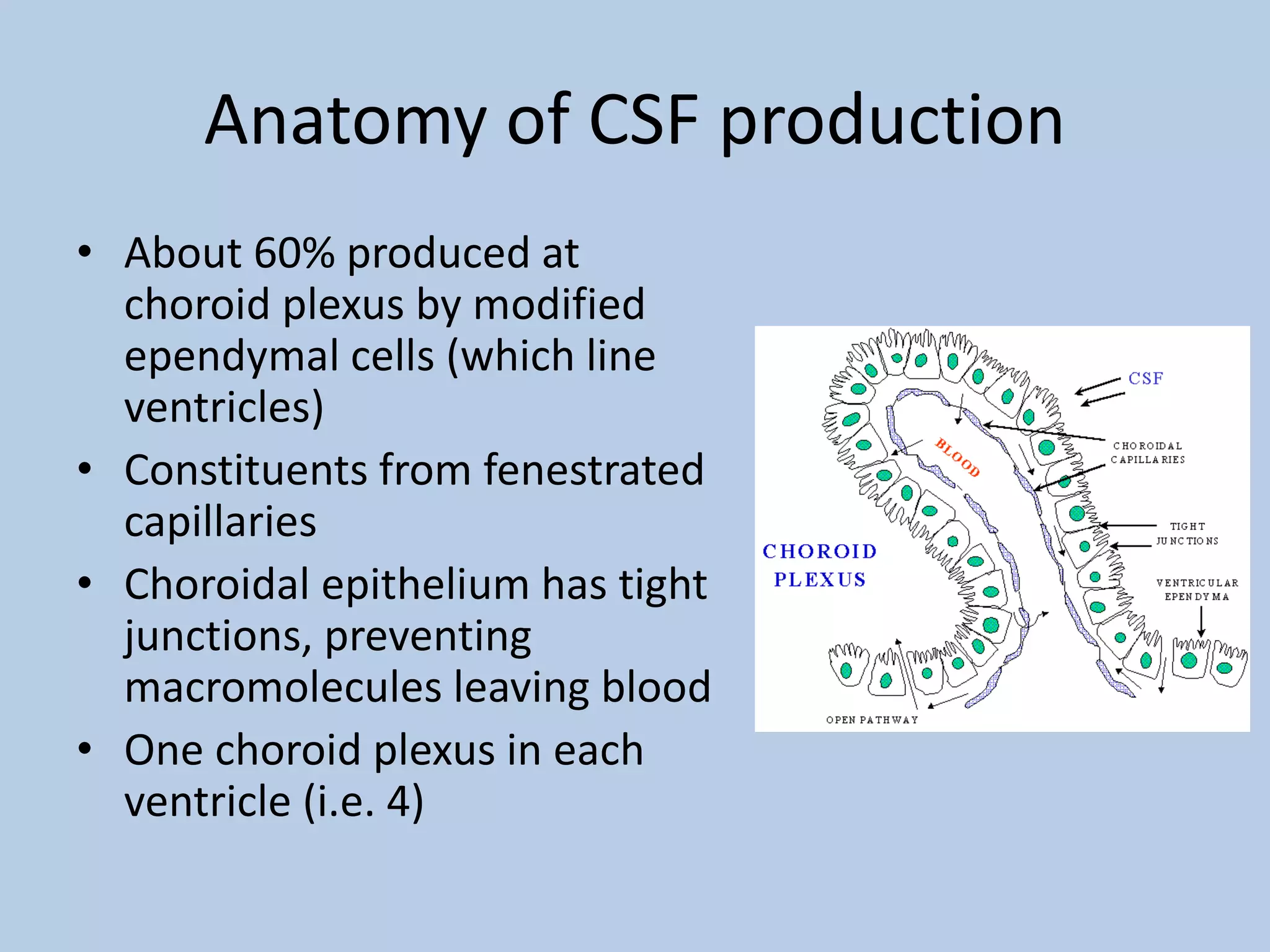
• About 60% produced at
choroid plexus by modified
ependymal cells (which line
ventricles)
• Constituents from fenestrated
capillaries
• Choroidal epithelium has tight
junctions, preventing
macromolecules leaving blood
• One choroid plexus in each
ventricle (i.e. 4)
Anatomy of CSF production
CSF circulation
Indications for lumbar puncture
• Suspected meningitis (normal in 8%), viral
encephalitis, TB
• Suspected intra-cranial bleeding (but CT more
valuable)
• Demyelinating disorders e.g. MS
• Check for sub-arachnoid haemorrhage
(performed after normal CT as a minority cannot
pick up SAH)
• Occasionally used to treat idiopathic raised ICP
When not to do an LP
• Skin infection overlying puncture area
• Thrombocytopenia
• Any suspicion of cerebral herniation with raised
intracranial pressure:
 Glasgow Coma Scale (GCS <8)
 Abnormal pupil size and reaction
 Absent doll's eye movements
 Abnormal tone
 Tonic posturing
 Abnormal respiration (hyperventilation, Cheyne-Stokes
breathing, apnoea, respiratory arrest - in this instance, a CT scan
should be performed to look for evidence of cerebral herniation
before proceeding to LP.)
Normal Constituents
Component Value
Protein 0.2-0.4g/l with albumin:globulin ratio of
8:1
Glucose 3.3-4.4mmol/l (at least 60-80% of blood
glucose)
Chloride 122-128mmol/l
Lactate ≤2.8mmol/l
Opening pressure 10-20cm of water
WCC ≤4 per cubic mm
Polymorphs None!
pH 7.31
Interpreting CSF results
• Protein – high (>0.4g/l) levels seen in any infection,
Guillan Barre syndrome and MS
• Glucose – plasma glucose should be taken at same
time as LP. If CSF glucose < 60-80% blood glucose then
increased uptake in neural tissue i.e. think infection
• WCC – presence indicates infection & MS. Need to
gram stain and culture (if appropriate)
• Blood stained CSF – maybe present as a result of
damage to blood vessels during procedure (‘bloody
tap’). Initially red, but clearer fluid will follow.
Interpreting CSF results

Cerebrospinal fluid (CSF) and interpreting lumbar puncture

  • 1.
    Cerebrospinal fluid –interpreting lumbar punctures By JP Byass, 4th year, HYMS
  • 2.
    CSF Facts • Clear,colourless fluid • Found in sub-arachnoid space within the brain (ventricles) and spinal cord • Produced by choroid plexus and cerebral vessels at rate of 500ml/day • Reabsorbed into venous sinus blood via arachnoid granulations • Choroid creates, arachnoid absorbs! • Production matches reabsorption so total circulating CSF at any time is around 130ml
  • 3.
    CSF Functions –remember ICP-B • Ischaemia prevention – by decreasing CSF and ICP (intracranial pressure) and allowing adequate blood perfusion to brain • Chemical stability – homeostatic regulation of neuroendocrine factors & removal of waste metabolic products from neural tissue into blood • Protection – protects brain from trauma • Buoyancy – brain in suspended in CSF and therefore not impeded by its own weight, which would cut off blood supply and impede neurons.
  • 4.
    • About 60%produced at choroid plexus by modified ependymal cells (which line ventricles) • Constituents from fenestrated capillaries • Choroidal epithelium has tight junctions, preventing macromolecules leaving blood • One choroid plexus in each ventricle (i.e. 4) Anatomy of CSF production
  • 5.
  • 6.
    Indications for lumbarpuncture • Suspected meningitis (normal in 8%), viral encephalitis, TB • Suspected intra-cranial bleeding (but CT more valuable) • Demyelinating disorders e.g. MS • Check for sub-arachnoid haemorrhage (performed after normal CT as a minority cannot pick up SAH) • Occasionally used to treat idiopathic raised ICP
  • 7.
    When not todo an LP • Skin infection overlying puncture area • Thrombocytopenia • Any suspicion of cerebral herniation with raised intracranial pressure:  Glasgow Coma Scale (GCS <8)  Abnormal pupil size and reaction  Absent doll's eye movements  Abnormal tone  Tonic posturing  Abnormal respiration (hyperventilation, Cheyne-Stokes breathing, apnoea, respiratory arrest - in this instance, a CT scan should be performed to look for evidence of cerebral herniation before proceeding to LP.)
  • 8.
    Normal Constituents Component Value Protein0.2-0.4g/l with albumin:globulin ratio of 8:1 Glucose 3.3-4.4mmol/l (at least 60-80% of blood glucose) Chloride 122-128mmol/l Lactate ≤2.8mmol/l Opening pressure 10-20cm of water WCC ≤4 per cubic mm Polymorphs None! pH 7.31
  • 9.
  • 10.
    • Protein –high (>0.4g/l) levels seen in any infection, Guillan Barre syndrome and MS • Glucose – plasma glucose should be taken at same time as LP. If CSF glucose < 60-80% blood glucose then increased uptake in neural tissue i.e. think infection • WCC – presence indicates infection & MS. Need to gram stain and culture (if appropriate) • Blood stained CSF – maybe present as a result of damage to blood vessels during procedure (‘bloody tap’). Initially red, but clearer fluid will follow. Interpreting CSF results