Blood Spatter Analysis
Blood-spatter Pattern Analysis or Bloodstain Pattern Interpretation(BPA/BPI)Reconstructing events that must have happened to produce bleedingRequires BPA specialist
Blood Pattern ReconstructionScene Pattern Reconstruction1.  Stain condition2.  Pattern3.  Distribution4.  Location5.  DirectionalityLab Results Reconstruction1.  Genetic marker typing2.  Age determination3.  Source determination4.  Race determination5.  Sex determination—From Cracking Cases by Dr. Henry C. Lee and Thomas W. O’Neil
Blood Spatter EvidenceA field of forensic investigation that deals with the physical properties of blood and the patterns produced under different conditions as a result of various forces being applied to the blood. Blood, as a fluid, follows the laws of physics.
Know Characterization of BloodstainsIs it blood?What species did it come from (human or animal)?If it’s human, can it be associated with a particular individual?
People of Historical SignificancePaul Kirk (1902–1970) was a professor of criminalistics and biochemistry at the University of California at Berkeley. He actively assisted law enforcement organizations from 1935 to 1967. His book Crime Investigation contained a chapter in which he discussed the application of bloodstain pattern analysis to criminal investigations. Dr. Kirk analyzed the bloodstain pattern photos from the Sam Sheppard case and was instrumental in Sheppard’s release after his second trial. Find out more about the case at truTV’s Crime Library.
Blood Droplet CharacteristicsA blood droplet remains spherical in space until it collides with a surface.Once a blood droplet impacts a surface, a bloodstain is formed.Droplets falling from the same height, hitting the same surface at the same angle, will produce stains with the same basic shape.How will the shape change as the height is increased or decreased?
Conditions Affecting Shape of Blood DropletSize of the dropletAngle of impactVelocity at which the blood droplet left its originHeight Texture of the target surfaceOn clean glass or plastic—droplet will have smooth outside edges
On a rough surface—will produce scalloping on the edges Questions Answered by Blood Spatter InterpretationThe distance between the target surface and the origin of the bloodThe point(s) of origin of the bloodMovement and direction of a person or an objectThe number of blows, shots, etc., causing the bloodshed and/or the dispersal of bloodType and direction of impact that produced the bloodshedThe position of the victim and/or object during bloodshedMovement of the victim and/or object after bloodshed
Bloodstain TerminologyAngle of impact—angle at which blood strikes a target surfaceBloodstain transfer—when a bloody object comes into contact with a surface and leaves a patterned blood image on the surfaceBackspatter—blood that is directed back toward the source of 	energyCast-off—blood that is thrown from an object in motion
Bloodstain Terminology, continuedContact stain—bloodstains caused by contact between a wet blood-bearing surface and a second surface that may or may not have blood on it   Transfer—an image is recognizable and may be identifiable       with a particular object   Swipe—wet blood is transferred to a surface that did not                  have blood on it   Wipe—a non-blood-bearing object moves through a wet      bloodstain, altering the appearance of the original stain
Bloodstain Terminology, continuedDirectionality—relates to the direction a drop of blood travels in space from its point of origin Terminal velocity—the greatest speed to which a free-falling drop of blood can accelerate in air. It is dependent upon the acceleration of gravity and the friction of the air against the blood—approximately 25.1 feet/second.   High velocity—greater than 25 feet per second, usually      100 feet per second; gives a fine mist appearance
   Medium velocity—5 to 25 feet per second
   Low velocity—5 feet per second or lessBloodstain PatternsThe shape of a blood drop:Round—if it falls straight down at a 90-degree angleElliptical—blood droplets elongate as the angle decreases from 90 to 0 degrees; the angle can be determined by the following formula:
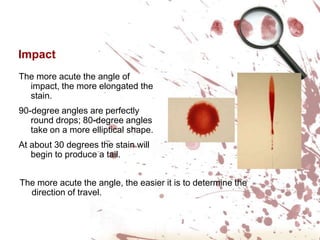
ImpactThe more acute the angle of impact, the more elongated the stain.90-degree angles are perfectly round drops; 80-degree angles take on a more elliptical shape.At about 30 degrees the stain will begin to produce a tail.The more acute the angle, the easier it is to determine the 		direction of travel.
Bloodstain PatternsThe harder and less porous the surface, the less the blood drop will break apart.The softer and more porous the surface, the more the blood drop will break apart.The pointed end of the bloodstain faces the direction of travel.
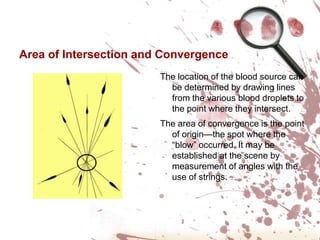
Area of Intersection and ConvergenceThe location of the blood source can be determined by drawing lines from the various blood droplets to the point where they intersect. The area of convergence is the point of origin—the spot where the “blow” occurred. It may be established at the scene by measurement of angles with the use of strings.
Blood EvidenceClass evidence for blood includes blood type. If you can determine the DNA, you will have individual evidence.  Bloodstain patterns are considered circumstantial evidence in a courtroom. Experts can argue many points, including direction of travel, height of the perpetrator, position of the victim, left/right hand, whether the body was moved, etc.
Once it’s determined to be human, it must be protected as part of the crime sceneBPA specialist will determine what POSITION and SHAPE indicateMeasurements are taken to determine TRAJECTORY and DISTANCEControlled experimentsUses surface materials similar to those at the scene
Herbert Leon MacDonellLeading authority on bloodstain interpretationTips for investigators
“It is possible to determine the impact angle of blood on a flat surface by measuring the degree of circular distortion of the stain.  In other words, the shape of the stain tends to change depending upon the angle of impact, which caused the stain.  For example, the more the angle decreases, the more the stain is less circular and longer.”
“Surface texture is one of the key components in determining spatter type.”Harder surface=less spatterImportant to duplicate surface in a controlled test
“When a droplet hits the surface, which is hard as well as smooth, the blood actually breaks apart upon impact.  This in turn creates smaller droplets.  The smaller droplets will continue to move in the same direction as the original droplet.”
Smaller the size of spatter=greater energy required to produce spatterLow, Medium, and high velocity impact spatter may be identified by representative sizes (but exceptions must also be considered)Diameter of large blood spatter will be of little or no value in estimating the distance a drop of blood has fallen prior to impact.
When considering the shape of a blood stain for use in calculating its angle of impact, only a sharp, well-defined blood stain should be used for measuring its width and lengthDirectionality of a blood drop while in flight is usually obvious from the geometry of its resulting blood stainThe pointed end indicates direction of travel of the drop prior to impact on a surfaceDirection of travel may also be determined when edge scallops only appear on one side of the stain
Before a drop of blood can fall, absent of any form of applied energy, gravitational attraction acting on blood drop must exceed its surface tensionSurface texture of material on which blood falls onto MUST be taken into consideration in BPA
Edge characteristics of drop have no value in establishing distance a drop may have fallen prior to impacting a surface  unless the nature of the surface is consideredSurface tension prevents spatteringRegardless of distance a drop has fallen before impacting a smooth, hard surface such as glass
A few blood stains do not make a patternDraw conclusions with reservations and/or qualificationsIt is ok to admit that there is insufficient evidence to draw a conclusion from BPANo opinion is better than an incorrect, forced opinion
When a dozen or more small bloodstains are present in a recognizable pattern, their size may allow for prediction as to the energy that was required to produce them
When the preponderance of individual bloodstain diameters are less than 1mm, they are consistent with having been produced as the result of high velocity impact (most often shooting)
When the preponderance of individual bloodstains are 1mm or more in diameter, they are consistent with having been produced as the result of medium velocity impact (most often beating or stabbing)
The shape of a bloodstain is a function of the angle at which it hits/impacts the surfacePerfectly roundninety-degree impact/drop angleAngle of impact of elliptical drop may be determined using length to width ratio of the drop
Blood stains may be lifted of the surface of which they have impactedThe smoother and harder the surface is, the easier it is to lift the stain
When measurements and angles are used to establish the origin or origins in space, not only will the actual origin be somewhere below the point or points of convergence, but it must be remembered that the investigator is determining a specific area and not a small point of origin
Sobriety of the victim will have NO significant effect on how the blood stain patterns are producedHigh blood alcohol level is of no concern to the interpretation of bloodstain patterns
When blood is projected upward with sufficient force to strike a ceiling, it will almost always be a result of a gunshot  having an upward trajectorySuch a trajectory is more often the result of a suicide rather than a homicide

Blood spatter analysis ppt

  • 1.
  • 2.
    Blood-spatter Pattern Analysisor Bloodstain Pattern Interpretation(BPA/BPI)Reconstructing events that must have happened to produce bleedingRequires BPA specialist
  • 3.
    Blood Pattern ReconstructionScenePattern Reconstruction1. Stain condition2. Pattern3. Distribution4. Location5. DirectionalityLab Results Reconstruction1. Genetic marker typing2. Age determination3. Source determination4. Race determination5. Sex determination—From Cracking Cases by Dr. Henry C. Lee and Thomas W. O’Neil
  • 4.
    Blood Spatter EvidenceAfield of forensic investigation that deals with the physical properties of blood and the patterns produced under different conditions as a result of various forces being applied to the blood. Blood, as a fluid, follows the laws of physics.
  • 5.
    Know Characterization ofBloodstainsIs it blood?What species did it come from (human or animal)?If it’s human, can it be associated with a particular individual?
  • 6.
    People of HistoricalSignificancePaul Kirk (1902–1970) was a professor of criminalistics and biochemistry at the University of California at Berkeley. He actively assisted law enforcement organizations from 1935 to 1967. His book Crime Investigation contained a chapter in which he discussed the application of bloodstain pattern analysis to criminal investigations. Dr. Kirk analyzed the bloodstain pattern photos from the Sam Sheppard case and was instrumental in Sheppard’s release after his second trial. Find out more about the case at truTV’s Crime Library.
  • 7.
    Blood Droplet CharacteristicsAblood droplet remains spherical in space until it collides with a surface.Once a blood droplet impacts a surface, a bloodstain is formed.Droplets falling from the same height, hitting the same surface at the same angle, will produce stains with the same basic shape.How will the shape change as the height is increased or decreased?
  • 8.
    Conditions Affecting Shapeof Blood DropletSize of the dropletAngle of impactVelocity at which the blood droplet left its originHeight Texture of the target surfaceOn clean glass or plastic—droplet will have smooth outside edges
  • 9.
    On a roughsurface—will produce scalloping on the edges Questions Answered by Blood Spatter InterpretationThe distance between the target surface and the origin of the bloodThe point(s) of origin of the bloodMovement and direction of a person or an objectThe number of blows, shots, etc., causing the bloodshed and/or the dispersal of bloodType and direction of impact that produced the bloodshedThe position of the victim and/or object during bloodshedMovement of the victim and/or object after bloodshed
  • 10.
    Bloodstain TerminologyAngle ofimpact—angle at which blood strikes a target surfaceBloodstain transfer—when a bloody object comes into contact with a surface and leaves a patterned blood image on the surfaceBackspatter—blood that is directed back toward the source of energyCast-off—blood that is thrown from an object in motion
  • 11.
    Bloodstain Terminology, continuedContactstain—bloodstains caused by contact between a wet blood-bearing surface and a second surface that may or may not have blood on it Transfer—an image is recognizable and may be identifiable with a particular object Swipe—wet blood is transferred to a surface that did not have blood on it Wipe—a non-blood-bearing object moves through a wet bloodstain, altering the appearance of the original stain
  • 12.
    Bloodstain Terminology, continuedDirectionality—relatesto the direction a drop of blood travels in space from its point of origin Terminal velocity—the greatest speed to which a free-falling drop of blood can accelerate in air. It is dependent upon the acceleration of gravity and the friction of the air against the blood—approximately 25.1 feet/second. High velocity—greater than 25 feet per second, usually 100 feet per second; gives a fine mist appearance
  • 13.
    Medium velocity—5 to 25 feet per second
  • 14.
    Low velocity—5 feet per second or lessBloodstain PatternsThe shape of a blood drop:Round—if it falls straight down at a 90-degree angleElliptical—blood droplets elongate as the angle decreases from 90 to 0 degrees; the angle can be determined by the following formula:
  • 15.
    ImpactThe more acutethe angle of impact, the more elongated the stain.90-degree angles are perfectly round drops; 80-degree angles take on a more elliptical shape.At about 30 degrees the stain will begin to produce a tail.The more acute the angle, the easier it is to determine the direction of travel.
  • 16.
    Bloodstain PatternsThe harderand less porous the surface, the less the blood drop will break apart.The softer and more porous the surface, the more the blood drop will break apart.The pointed end of the bloodstain faces the direction of travel.
  • 17.
    Area of Intersectionand ConvergenceThe location of the blood source can be determined by drawing lines from the various blood droplets to the point where they intersect. The area of convergence is the point of origin—the spot where the “blow” occurred. It may be established at the scene by measurement of angles with the use of strings.
  • 18.
    Blood EvidenceClass evidencefor blood includes blood type. If you can determine the DNA, you will have individual evidence. Bloodstain patterns are considered circumstantial evidence in a courtroom. Experts can argue many points, including direction of travel, height of the perpetrator, position of the victim, left/right hand, whether the body was moved, etc.
  • 19.
    Once it’s determinedto be human, it must be protected as part of the crime sceneBPA specialist will determine what POSITION and SHAPE indicateMeasurements are taken to determine TRAJECTORY and DISTANCEControlled experimentsUses surface materials similar to those at the scene
  • 20.
    Herbert Leon MacDonellLeadingauthority on bloodstain interpretationTips for investigators
  • 21.
    “It is possibleto determine the impact angle of blood on a flat surface by measuring the degree of circular distortion of the stain. In other words, the shape of the stain tends to change depending upon the angle of impact, which caused the stain. For example, the more the angle decreases, the more the stain is less circular and longer.”
  • 22.
    “Surface texture isone of the key components in determining spatter type.”Harder surface=less spatterImportant to duplicate surface in a controlled test
  • 23.
    “When a droplethits the surface, which is hard as well as smooth, the blood actually breaks apart upon impact. This in turn creates smaller droplets. The smaller droplets will continue to move in the same direction as the original droplet.”
  • 24.
    Smaller the sizeof spatter=greater energy required to produce spatterLow, Medium, and high velocity impact spatter may be identified by representative sizes (but exceptions must also be considered)Diameter of large blood spatter will be of little or no value in estimating the distance a drop of blood has fallen prior to impact.
  • 25.
    When considering theshape of a blood stain for use in calculating its angle of impact, only a sharp, well-defined blood stain should be used for measuring its width and lengthDirectionality of a blood drop while in flight is usually obvious from the geometry of its resulting blood stainThe pointed end indicates direction of travel of the drop prior to impact on a surfaceDirection of travel may also be determined when edge scallops only appear on one side of the stain
  • 26.
    Before a dropof blood can fall, absent of any form of applied energy, gravitational attraction acting on blood drop must exceed its surface tensionSurface texture of material on which blood falls onto MUST be taken into consideration in BPA
  • 27.
    Edge characteristics ofdrop have no value in establishing distance a drop may have fallen prior to impacting a surface unless the nature of the surface is consideredSurface tension prevents spatteringRegardless of distance a drop has fallen before impacting a smooth, hard surface such as glass
  • 28.
    A few bloodstains do not make a patternDraw conclusions with reservations and/or qualificationsIt is ok to admit that there is insufficient evidence to draw a conclusion from BPANo opinion is better than an incorrect, forced opinion
  • 29.
    When a dozenor more small bloodstains are present in a recognizable pattern, their size may allow for prediction as to the energy that was required to produce them
  • 30.
    When the preponderanceof individual bloodstain diameters are less than 1mm, they are consistent with having been produced as the result of high velocity impact (most often shooting)
  • 31.
    When the preponderanceof individual bloodstains are 1mm or more in diameter, they are consistent with having been produced as the result of medium velocity impact (most often beating or stabbing)
  • 32.
    The shape ofa bloodstain is a function of the angle at which it hits/impacts the surfacePerfectly roundninety-degree impact/drop angleAngle of impact of elliptical drop may be determined using length to width ratio of the drop
  • 33.
    Blood stains maybe lifted of the surface of which they have impactedThe smoother and harder the surface is, the easier it is to lift the stain
  • 34.
    When measurements andangles are used to establish the origin or origins in space, not only will the actual origin be somewhere below the point or points of convergence, but it must be remembered that the investigator is determining a specific area and not a small point of origin
  • 35.
    Sobriety of thevictim will have NO significant effect on how the blood stain patterns are producedHigh blood alcohol level is of no concern to the interpretation of bloodstain patterns
  • 36.
    When blood isprojected upward with sufficient force to strike a ceiling, it will almost always be a result of a gunshot having an upward trajectorySuch a trajectory is more often the result of a suicide rather than a homicide