Bloodstain Recognition, Documentation and Basic Pattern AnalysisCrime Scene SectionForensic DivisionAustin Police Department
Bloodstain AnalysisThe study of the physical properties of blood and the use of those physical properties to analyze and help interpret actions committed during a blood-letting event at a crime scene or on clothing, etc.
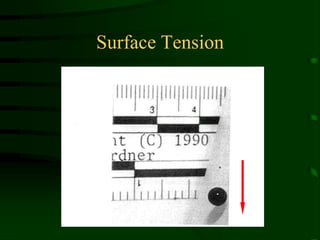
Factors Relating to Bloodstain EvidenceBloodstain evidence is a reproducible phenomenon.Blood as a fluid is subject to the same physical laws as all matter.One important constant: blood droplets retain a spherical shape while in flight due to surface tension.
Surface TensionMolecular bonding of the blood drop results in a cohesive force or surface tension.  The greatest force is on the surface, holding the bloodstain compactly together in a sphere.
Other Factors Relating to Bloodstain EvidenceBlood also has viscosity, or the resistance to flow.Because of surface tension and viscosity, a blood drop will not spontaneously break up during flight.
Surface Tension
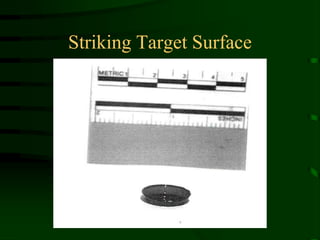
Striking Target Surface
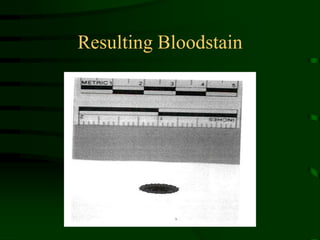
Resulting Bloodstain
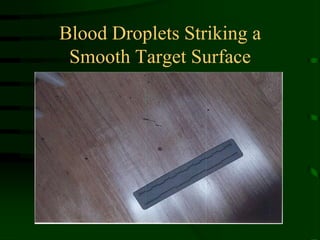
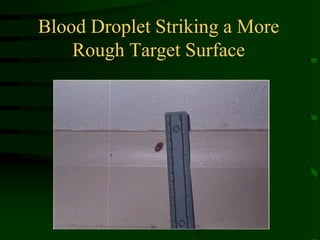
Target SurfaceThe most critical aspect of bloodstain analysis involves the target surface or the surface on which the blood droplet strikes.The smoother the target surface, the greater the chance that a useful stain will be found.The rougher the target surface, the greater the chance the surface tension of the blood droplet will be ruptured upon impact and cause distortion.
Blood Droplets Striking a Smooth Target Surface
Blood Droplet Striking a More Rough Target Surface
Use of Bloodstain EvidenceBloodstain evidence found on surfaces, including clothing, can be very useful in the reconstruction of a crime.  Reconstruction of crime scene events can then be used to corroborate or disprove statements from a suspect, witness or victim.
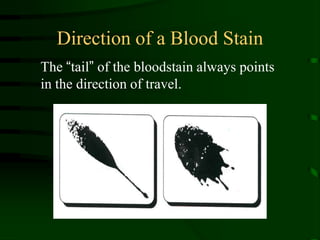
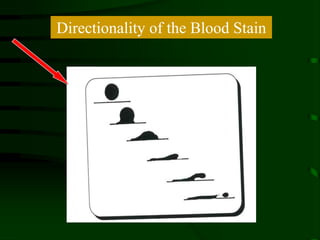
What Can be Determined from Bloodstain EvidenceDirectionality of the stain.Upon impacting a surface, inertia caused by the motion of the blood droplet forces a wave to form and then well up on the opposite side of the impact point.A “satellite” stain may form as the wave continues to narrow along the surface and eventually separate from the initial droplet.
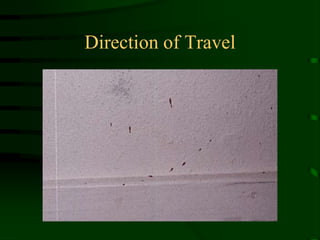
Direction of a Blood StainThe “tail” of the bloodstain always points in the direction of travel.
Directionality of the Blood Stain
Direction of Travel
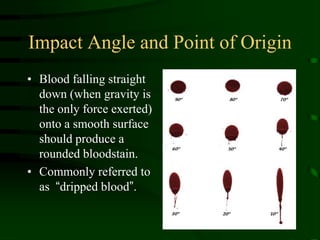
Impact Angle and Point of Origin of the StainAs blood strikes a target surface the shape of the bloodstain is dependent on the angle at which the blood strikes the target surface.The more acute the angle of impact is to the surface, the more elongated the blood stain will be.
Impact Angle and Point of OriginBlood falling straight down (when gravity is the only force exerted) onto a smooth surface should produce a rounded bloodstain.Commonly referred to as  “dripped blood”.
Type of Force Involved in BloodshedBlood stains are typically categorized into three force velocities levels:Low (i.e. stomping)Medium (i.e. some beatings)High (i.e. gunshot)There will be some overlap of stain size that exists in each pattern, but only the preponderance of stains in a given pattern will be considered.
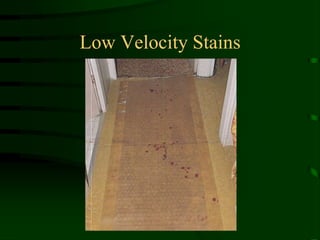
Low Velocity StainsResult from normal gravitational force or a force or energy of 5 feet per second or less.These stains are typical of blood loss from an injury which subsequently falls to the floor.The majority of stains will be 5mm in size or greater.
Low Velocity Stains
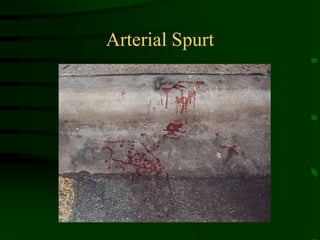
Arterial Spurt
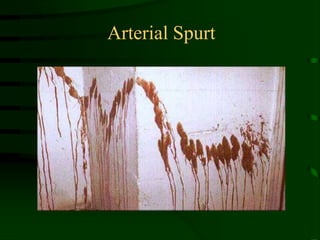
Arterial Spurt
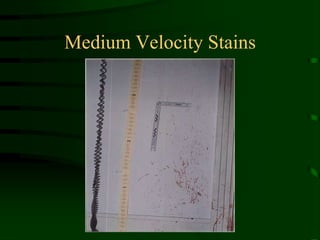
Medium Velocity StainsThe result of force or energy in excess of 5 feet per second and reaching no more than 25 feet per second.  The spatter is more broken up due to the increase in energy applied.The majority of stains will range between  1-4mm in size.
Medium Velocity Stains
High Velocity StainsThe result of a force or energy in excess of 100 feet per second.The stains are typically mist-like, with the majority of stains being 1 mm in size or less.Usually the result of gunshot injuries.Be careful not to confuse with expiratory blood.
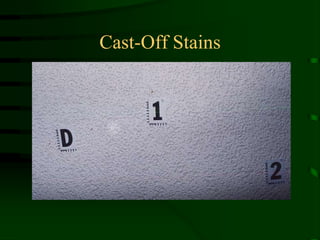
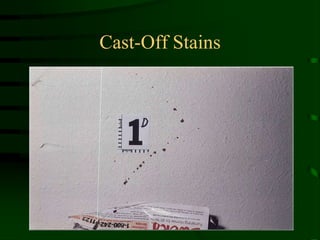
Minimum Number of BlowsAt scenes where blunt force trauma results from a wounding agent, the minimum number of blows struck by the assailant (plus one) can often be approximated.“Cast-off” stains are produced from the swinging of an instrument or object which has been saturated with blood.
Cast-Off Stains
Cast-Off Stains
Cast-Off Stains
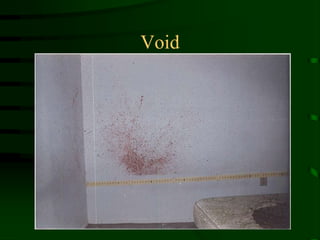
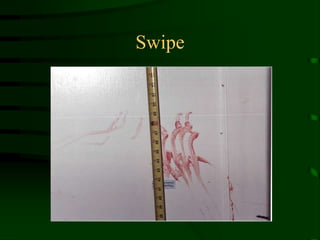
Position of Persons/Objects During an AssaultSometimes it is not the presence of blood stains at a scene, but rather the lack of stains that are important.A “void” may provide specific information as to the relative position of people/objects in the scene at the time of bloodshed.“Swipe” and “transfer” patterns may also assist in these areas.
Void
Transfer Pattern
Swipe
Blood Scene DocumentationIf a Blood Stain Pattern Analyst is not available to respond to the scene, later analysis may still be performed if careful documentation is obtained through proper photography, sketches and/or video.
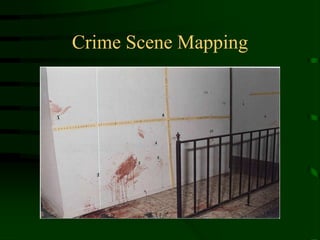
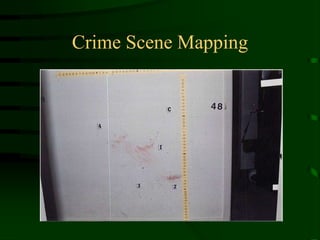
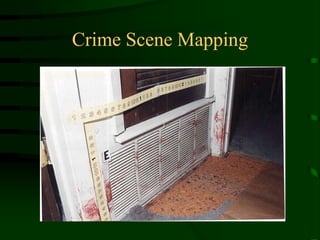
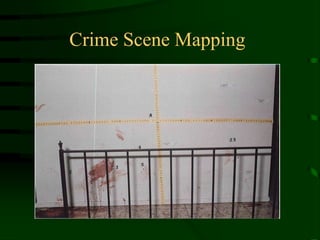
Proper Blood Documentation at Crime ScenesCrime scene “mapping” should be utilized anytime there is a possibility that an analyst may be consulted.Mapping involves the documentation of specific areas/zones within the crime scene. Walls, floors, ceilings, etc. that exhibit blood stain patterns should be documented as individual areas within the scene.
Crime Scene Mapping
Crime Scene Mapping
Crime Scene Mapping
Crime Scene Mapping
PhotographyGood photographs of the scene are crucial for any future analysis and for court. Overall photographs, showing the general layout of the scene, as well as...Mid-range photos, showing the relationship of pertinent areas within the scene, should include all blood stain pattern areas.
PhotographyMid-range photos assist in orienting the patterns between long range and close up photography.Close-up photography is very important in blood scene documentation.  In order to complete analysis of the scene, the size, shape and distribution of blood stains must be distinguishable.
PhotographyIndividual blood stains and patterns, as well as other evidence, should be photographed with and without a scale (ruler).  All close-up photography of blood stains must be taken at a ninety degree angle, in order to limit the amount of distortion.If in doubt, photograph it. There is no set number of photos.
VideographyVideography is a valuable form of scene documentation that provides the analyst a better understanding of scene layout, etc.Video (and photography) should start at the outside perimeter and continue on through the center of the scene.All personnel should exit the scene.Audio is optional depending on the agency.
SketchesA sketch is also an important asset to the investigation and interpretation of blood stained scenes.Sketches help to orient the evidence exactly within a scene and used to overlap the other forms of documentation.Aid other witnesses with their testimony.
Evidence CollectionPresumptive tests should be conducted in the pattern area before collection.Blood samples should be collected from all pattern areas that could prove beneficial, such as impact areas, transfers, blood trails.The case investigator should determine what elements need to be proved and what evidence/areas may prove it.
Evidence CollectionCollect bloody items in paper.Using plastic will deteriorate the samples, thus making DNA analysis impossible.Dry the evidence as soon as possible to prevent deterioration.Keep out of sunlight and excessive heat.
Blood vs. FingerprintsAny item collected that exhibits blood and holds a possibility of fingerprints should be handled in such a way as to collect both.Protocol will typically state that it should go to the DNA Lab first and the analyst informed to preserve the item for latent print processing.What if only one can be obtained?
ClothingIn some cases blood on clothing becomes more important than the blood in the scene.Blood directly on victims can be useful in positioning, signs of struggle, or may be a target surface for blood from the suspect.Blood stains on suspect clothing can be used to further determine actions of the suspect, i.e. inside cuffs, down back, etc.
ClothingRecovered clothing should be dried and packaged carefully so as not to disturb patterns on the clothing.Laying clothing flat and placing paper between folds will prevent cross transfer of stains.The analyst should determine what stains need to be tested and about any other trace evidence that may be present.
Questions?

Bloodstain pattern recognition

  • 2.
    Bloodstain Recognition, Documentationand Basic Pattern AnalysisCrime Scene SectionForensic DivisionAustin Police Department
  • 3.
    Bloodstain AnalysisThe studyof the physical properties of blood and the use of those physical properties to analyze and help interpret actions committed during a blood-letting event at a crime scene or on clothing, etc.
  • 4.
    Factors Relating toBloodstain EvidenceBloodstain evidence is a reproducible phenomenon.Blood as a fluid is subject to the same physical laws as all matter.One important constant: blood droplets retain a spherical shape while in flight due to surface tension.
  • 5.
    Surface TensionMolecular bondingof the blood drop results in a cohesive force or surface tension. The greatest force is on the surface, holding the bloodstain compactly together in a sphere.
  • 6.
    Other Factors Relatingto Bloodstain EvidenceBlood also has viscosity, or the resistance to flow.Because of surface tension and viscosity, a blood drop will not spontaneously break up during flight.
  • 7.
  • 8.
  • 9.
  • 10.
    Target SurfaceThe mostcritical aspect of bloodstain analysis involves the target surface or the surface on which the blood droplet strikes.The smoother the target surface, the greater the chance that a useful stain will be found.The rougher the target surface, the greater the chance the surface tension of the blood droplet will be ruptured upon impact and cause distortion.
  • 11.
    Blood Droplets Strikinga Smooth Target Surface
  • 12.
    Blood Droplet Strikinga More Rough Target Surface
  • 13.
    Use of BloodstainEvidenceBloodstain evidence found on surfaces, including clothing, can be very useful in the reconstruction of a crime. Reconstruction of crime scene events can then be used to corroborate or disprove statements from a suspect, witness or victim.
  • 14.
    What Can beDetermined from Bloodstain EvidenceDirectionality of the stain.Upon impacting a surface, inertia caused by the motion of the blood droplet forces a wave to form and then well up on the opposite side of the impact point.A “satellite” stain may form as the wave continues to narrow along the surface and eventually separate from the initial droplet.
  • 15.
    Direction of aBlood StainThe “tail” of the bloodstain always points in the direction of travel.
  • 16.
  • 17.
  • 18.
    Impact Angle andPoint of Origin of the StainAs blood strikes a target surface the shape of the bloodstain is dependent on the angle at which the blood strikes the target surface.The more acute the angle of impact is to the surface, the more elongated the blood stain will be.
  • 19.
    Impact Angle andPoint of OriginBlood falling straight down (when gravity is the only force exerted) onto a smooth surface should produce a rounded bloodstain.Commonly referred to as “dripped blood”.
  • 20.
    Type of ForceInvolved in BloodshedBlood stains are typically categorized into three force velocities levels:Low (i.e. stomping)Medium (i.e. some beatings)High (i.e. gunshot)There will be some overlap of stain size that exists in each pattern, but only the preponderance of stains in a given pattern will be considered.
  • 21.
    Low Velocity StainsResultfrom normal gravitational force or a force or energy of 5 feet per second or less.These stains are typical of blood loss from an injury which subsequently falls to the floor.The majority of stains will be 5mm in size or greater.
  • 22.
  • 23.
  • 24.
  • 25.
    Medium Velocity StainsTheresult of force or energy in excess of 5 feet per second and reaching no more than 25 feet per second. The spatter is more broken up due to the increase in energy applied.The majority of stains will range between 1-4mm in size.
  • 26.
  • 27.
    High Velocity StainsTheresult of a force or energy in excess of 100 feet per second.The stains are typically mist-like, with the majority of stains being 1 mm in size or less.Usually the result of gunshot injuries.Be careful not to confuse with expiratory blood.
  • 28.
    Minimum Number ofBlowsAt scenes where blunt force trauma results from a wounding agent, the minimum number of blows struck by the assailant (plus one) can often be approximated.“Cast-off” stains are produced from the swinging of an instrument or object which has been saturated with blood.
  • 29.
  • 30.
  • 31.
  • 32.
    Position of Persons/ObjectsDuring an AssaultSometimes it is not the presence of blood stains at a scene, but rather the lack of stains that are important.A “void” may provide specific information as to the relative position of people/objects in the scene at the time of bloodshed.“Swipe” and “transfer” patterns may also assist in these areas.

  • 33.
  • 34.
  • 35.
  • 36.
    Blood Scene DocumentationIfa Blood Stain Pattern Analyst is not available to respond to the scene, later analysis may still be performed if careful documentation is obtained through proper photography, sketches and/or video.
  • 37.
    Proper Blood Documentationat Crime ScenesCrime scene “mapping” should be utilized anytime there is a possibility that an analyst may be consulted.Mapping involves the documentation of specific areas/zones within the crime scene. Walls, floors, ceilings, etc. that exhibit blood stain patterns should be documented as individual areas within the scene.
  • 38.
  • 39.
  • 40.
  • 41.
  • 42.
    PhotographyGood photographs ofthe scene are crucial for any future analysis and for court. Overall photographs, showing the general layout of the scene, as well as...Mid-range photos, showing the relationship of pertinent areas within the scene, should include all blood stain pattern areas.
  • 43.
    PhotographyMid-range photos assistin orienting the patterns between long range and close up photography.Close-up photography is very important in blood scene documentation. In order to complete analysis of the scene, the size, shape and distribution of blood stains must be distinguishable.
  • 44.
    PhotographyIndividual blood stainsand patterns, as well as other evidence, should be photographed with and without a scale (ruler). All close-up photography of blood stains must be taken at a ninety degree angle, in order to limit the amount of distortion.If in doubt, photograph it. There is no set number of photos.
  • 45.
    VideographyVideography is avaluable form of scene documentation that provides the analyst a better understanding of scene layout, etc.Video (and photography) should start at the outside perimeter and continue on through the center of the scene.All personnel should exit the scene.Audio is optional depending on the agency.
  • 46.
    SketchesA sketch isalso an important asset to the investigation and interpretation of blood stained scenes.Sketches help to orient the evidence exactly within a scene and used to overlap the other forms of documentation.Aid other witnesses with their testimony.
  • 47.
    Evidence CollectionPresumptive testsshould be conducted in the pattern area before collection.Blood samples should be collected from all pattern areas that could prove beneficial, such as impact areas, transfers, blood trails.The case investigator should determine what elements need to be proved and what evidence/areas may prove it.
  • 48.
    Evidence CollectionCollect bloodyitems in paper.Using plastic will deteriorate the samples, thus making DNA analysis impossible.Dry the evidence as soon as possible to prevent deterioration.Keep out of sunlight and excessive heat.
  • 49.
    Blood vs. FingerprintsAnyitem collected that exhibits blood and holds a possibility of fingerprints should be handled in such a way as to collect both.Protocol will typically state that it should go to the DNA Lab first and the analyst informed to preserve the item for latent print processing.What if only one can be obtained?
  • 50.
    ClothingIn some casesblood on clothing becomes more important than the blood in the scene.Blood directly on victims can be useful in positioning, signs of struggle, or may be a target surface for blood from the suspect.Blood stains on suspect clothing can be used to further determine actions of the suspect, i.e. inside cuffs, down back, etc.
  • 51.
    ClothingRecovered clothing shouldbe dried and packaged carefully so as not to disturb patterns on the clothing.Laying clothing flat and placing paper between folds will prevent cross transfer of stains.The analyst should determine what stains need to be tested and about any other trace evidence that may be present.
  • 52.