Standard for comparison
in FDE
By Kiran Malik
• One of the first steps in the investigation of a suspected or
disputed writing should be the seeking out of genuine
writings with which it may be compared.
• Under this peculiar and unfortunate condition it is usual
that only very inadequate if not wholly improper standards
are available and under such conditions it is not surprising
that so-called proof of handwriting is often a mere farce.
• The amount of writing necessary for comparison differs in
different cases, but enough should always be obtained to
show clearly the writing habits of the one whose writing is
under investigation.
• A positive conclusion that a signature is fraudulent can
sometimes be reached by comparison with a small amount
of genuine writing, especially, as stated above, if the
disputed signature is a bungling forgery that is suspicious
in itself.
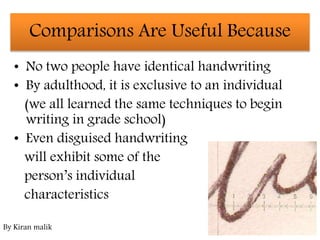
• No two people have identical handwriting
• By adulthood, it is exclusive to an individual
(we all learned the same techniques to begin
writing in grade school)
• Even disguised handwriting
will exhibit some of the
person’s individual
characteristics
Comparisons Are Useful Because
By Kiran malik
EXEMPLARS
 Exemplars are legally admissible, authentic samples of
handwriting used for comparison with questioned writing
to determine the authenticity or spuriousness of the
questioned writing.
 Exemplars are also referred to as known handwriting
samples or standards.
 There are two kinds of exemplar:
1. Informal, which describe documents previously written in
the normal course of business and known to be genuine .
2. Formal, which are request writing samples.
When a document examiner is hired to examine
documents, he or she is often given material that may not
be suitable for examination.
By Kiran malik
What Standards Are Required for Handwriting
Comparisons?
Writing standards, or exemplars as they are sometimes called,
are of two kinds: collected standards or request standards.
• Collected standards are those samples of writing or lettering
that have been executed in the normal course of business or
social activity, and are usually unrelated to any matter in
dispute.
• Request standards are those writings or letterings that are
executed at the request of an investigator, a counsel, or some
other person involved in the process under proceedings.
By Kiran malik
• From the viewpoint of the examiner of handwriting,
collected standards are the preferred material to
work with in most cases, for it is the more normal
and natural product.
• Collected standards, however, consisting of similar
texts to that of the questioned writing, such that they
will contain similar letters, letter combinations and
letter locations may not exist, or may be difficult to
find.
By Kiran malik
What time frame is considered
appropriate?
• Documents executed within 2 to 3 years are generally acceptable
unless there has been a major change in the writer, such as
deteriorating health, trauma, or drug addiction, in which case a
shorter time period would be necessary.
• Documents similar to the questioned document make the best
exemplars.
• Compare contracts with contracts and canceled checks with
canceled checks. Obtain like signatures. If the questioned signature
is in ink, obtain signatures in ink, if pencil, obtain pencil specimens.
• If the questioned document is lined paper, find documents written
on lined paper. If the questioned document contains hand printing,
collect documents that are hand printed.
• When no similar documents are available, try to locate documents
with authenticity that can be verified, such as canceled checks that
have been accepted by a bank. Other documents executed in the
normal course of business are also.
By Kiran malik
How many writing samples must one
collect?
• Twenty to 25 signatures or 4 to 5 pages of handwriting or
hand printing are recommended.
• Do not rely on too little writing.
• How much is enough?
• Collect enough to positively identify or eliminate the writer.
Although it may be possible to make a match with only a few
exemplars, more are better.
By Kiran malik
Collected standard or non requested writing
Non request writing samples. They usually real authentic
writing habits and of adequate writings are available show
normal variations which have taken:
• Amount of specimen writing available.
• Similarity of subject matter letter, numeral, and word
combination.
• Relative dates of the disputed and standard writing.
• Conditions under which both questioned and known
specimen were prepared.
• Type of writing instrument, paper and form used.
By Kiran malik
Sources of standard
• Cancelled check
• Traveller’s checks
• Signature card for saving, checking, safe deposit box.
• Signed courier receipt
• Diaries
• Personal letters
• Agreement
• Bills of sales
• Contract
• Notes.
By Kiran malik
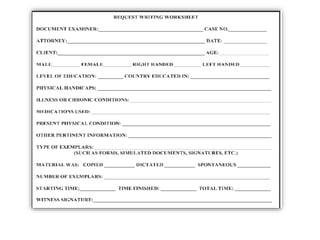
REQUEST WRITING
• Request writing exemplars are handwriting samples made at the
request and under the supervision of police, document examiners,
or attorneys for the purpose of creating known writing samples to
compare with questioned writing.
• Request writing leads to self-consciousness in the writing act, thus
request writing samples are generally not as useful as informal
writing.
• The writer may attempt to disguise his or her writing to avoid
being identified.
• Request writing forms contain all the upper and lowercase letters,
plus numbers and punctuation marks.
• Material can be dictated to the writer as well.
• Dictation should include the material in question, plus additional
writing containing words or phrases similar to the questioned
material.
By Kiran malik
Procedure for taking request writing
sample
If someone else is taking the request writing samples, he or she should also
follow an established procedure as described:
1. Use a questionnaire to identify any circumstances that could affect the
writings, such as illness, injury, or substance abuse.
2. The writing conditions of the questioned document should be replicated. If
a suspect writing is handwritten, obtain handwriting for proper
comparison. If a suspect document is printed in uppercase printing, the
request writing should be uppercase printing as well. Be sure to make
notes of any special instructions to the suspect
3. Replicate the writing instrument. Compare ballpoint pen with ballpoint
pen, and pencil with pencil.
4. Replicate the writing environment. Photocopy the document, white out the
suspect writing, and duplicate the form several times. Have the suspect
sign the samples one at a time removing each sample as it is completed so
the suspect cannot copy from earlier work. If the questioned document is
not available, use similar size paper to make up exemplars.
By Kiran malik
5. If the questioned document was written under unusual
circumstances, those circumstances should be duplicated. If the
writer was standing while signing a questioned document, the
writer should be asked to write in a standing position
6. To prevent the writer from disguising exemplars, increase the
speed of dictation and rush the writer. Distract the suspect
between handwriting samples. The writer will not be able to
maintain his or her disguise if distracted.
7. Have the suspect write with both hands. Indicate which hand is
being used on each form that is completed 8. Date and initial all
request writing. Number the documents in the order in which they
were executed
9. Additional request writing can be worded to include words,
expressions, letters, names, and combinations found in the
questioned writing. When a case involves numbers, have the
suspect write numbers from 1 to 100. One can organize a
diversity of alphanumeric characters into a paragraph
By Kiran malik
How Should Request Standards be
Prepared?
• Bearing in mind that, ideally, writing standards should reflect
the normal, natural, unconscious writing habits of the
individual, there are three key words that provide the
necessary guidance in obtaining request writings:
 Dictate
 Duplicate
 isolate
By Kiran malik
 Dictation
• It is a basic rule that request writings should be
prepared from dictation, leaving the subject free to
make his or her own decisions as to how material is
arranged or spelled.
• Only the writing style; block letters, script or cursive
writing should be stipulate. Eg. Personal cheques is of
special interest, then blank documents of the same
type should be supplied for completion.
• The speed of dictation should prompt the subject to
write as rapidly as he or she may be comfortably.
• In so doing, the writer is compelled to direct attention
more so at what is being written rather then how it is
being written.
By Kiran malik
 Duplication
• As the general rules for writing standards indicated, the
duplication of the writing conditions and circumstances is
a means of controlling the variables that may influence a
writing.
• This control can be exercised conveniently in the
production of request writings, whereas, duplication of
writing conditions in collected samples is much more
difficult to achieve.
• On the other hand, the variable produced by time cannot
be controlled in request writings.
• If a questioned writing is alleged to have been executed at
some time in the past, only collected standards of the same
vintage/period will portray/reveal the writer’s capabilities
and practices of that period.
By Kiran malik
 Isolation
• To avoid biasing the standards in any fashion it is a basic rule that
the questioned writing should never be exposed to the subject from
whom writing samples are being taken. Depending on the
individual and the instructions given, exposure of the questioned
document may have one of two consequences.
• 1. It may induce the subject to imitate, unintentionally, the features
of the questioned writing, which diminishes the significance of
similarities found in a subsequent handwriting study. The danger is
that evidence might be generated that could wrongly incriminate
an innocent person.
• 2. It may induce the subject to modify or to omit features that he or
she considers to be similar to the questioned writing, to avoid
association with it, which diminishes the significance of differences
found in a subsequent handwriting study. The danger is that
evidence might be generated that could wrongly exonerate a guilty
person.
By Kiran malik
Are There Standard Texts for Request
Writings?
• A number of attempts have been made to compose a standard
or universal text for request writings, that would contain two
or more examples of each letter of the alphabet in upper and
lowercase, all of the numerals and some of the various
punctuation marks.
By Kiran malik
What Legal Requirements do Writing
Standards have to Meet?
• In Canada, the Canada Evidence Act permits testimony to be given
respecting comparisons of questioned or disputed writings with writings
proved to the satisfaction of the court to be genuine. This is not unlike the
rules of evidence regarding admissibility in the United States, and in both
countries one of four conditions usually serves to qualify a writing
standard for acceptance.
1. The standard is acknowledged by the writer, to the court or to another
party who is prepared to testify to such acknowledgment.
2. The writing of the standard was witnessed by a party who is prepared to
testify to the action.
3. The standard is identified as the product of the writer by a party who is
familiar with his or her writing through some business, social, or family
relationship.
4. The circumstances surrounding the standard make a conclusion that a
particular person executed the writing to be the only reasonable
conclusion that the court may reach.
By Kiran malik
Contd…
 Obviously, the latter two methods of proof are open to challenge
more so than the former two. Furthermore, greater latitude is
allowed in civil cases than in criminal matters.
 The requirements of the law, however, must be borne in mind, for
a denial by the court to admit any of the standards may
significantly alter the findings of the handwriting examiner based
on the remainder of the writings.
 If the proof of a particular standard is likely to be challenged or is
doubtful for other reasons, and these circumstances can be
anticipated, the examiner should be advised so that the writing
examination can be conducted in stages that will determine first,
the results that can be supported by the more limited material, and,
subsequently, the results that are supported by the standards as a
whole.
By Kiran malik
Collection of request writings
• Must be sufficient amount of writing to ensure that the normal
variations that are present in everyone handwriting are
represented.
• Each writing sample should be on separate sheet of paper and
should be removed from the sight of the writer before collecting
the next sample.
• Requested writing should be collected by dictation, not copying.
• Dictates passage should be long. They will also help uncover
attempts to deliberately alter handwriting because longer someone
to forced to write, harder it is to make deliberate alteration to what
is essentially a subconscious process.’
• Writing contain some words phrases in questioned writing.
• Same type of writing instrument paper used in the questioned
writing.
By Kiran malik
If and When Errors Occur in Handwriting
Examination,
• It cannot be denied that handwriting study and examination, that is, as
yet, a largely subjective assessment of writing elements, has on rare
occasions been known to err. Osborn, Harrison, Hilton, and others have
commented on the circumstances that lead to erroneous conclusions.
1. Inadequate, fallacious or self serving standards for comparison.
2. Quantitative insufficiency of questioned writing.
3. Lack of comprehension respecting the discriminating elements of writing.
4. Lack of appreciation for the writing movement underlying the form.
5. Improper assessment of divergences.
6. Over-evaluation of class or system characteristics.
7. Overlooking or ignoring disparities.
8. Omission of inter comparison of standards to confirm common authorship.
9. Influence of external information respecting the matter.
10. Incompetence on the part of the examiner.
By Kiran malik
DO’S AND DON’TS FOR COLLECTING
STANDARDS
• Do obtain sufficient handwriting exemplars, at least 20 to 25 signatures or 4 to 5
pages of handwriting or hand printing
• Don’t rely on too little writing. How much is enough? Enough to identify the
writer.
• Do collect like samples, handprinting with handprinting, ink signatures with ink
signatures, lined paper with lined paper, same size with same size.
• Don’t rely exclusively on writing that differs significantly from the questioned
writing.
• Do collect standards dated at approximately the same time as the questioned
writing.
• Don’t rely on documents recently written if the comparison questioned documents
were written many years ago.
• Do collect documents that duplicate the writing environment, checks with checks,
contracts with contracts.
• Don’t compare writing written under abnormal conditions, such as intoxication,
with normal writing.
By Kiran malik

Standard for comparison

  • 1.
    Standard for comparison inFDE By Kiran Malik
  • 2.
    • One ofthe first steps in the investigation of a suspected or disputed writing should be the seeking out of genuine writings with which it may be compared. • Under this peculiar and unfortunate condition it is usual that only very inadequate if not wholly improper standards are available and under such conditions it is not surprising that so-called proof of handwriting is often a mere farce. • The amount of writing necessary for comparison differs in different cases, but enough should always be obtained to show clearly the writing habits of the one whose writing is under investigation. • A positive conclusion that a signature is fraudulent can sometimes be reached by comparison with a small amount of genuine writing, especially, as stated above, if the disputed signature is a bungling forgery that is suspicious in itself.
  • 3.
    • No twopeople have identical handwriting • By adulthood, it is exclusive to an individual (we all learned the same techniques to begin writing in grade school) • Even disguised handwriting will exhibit some of the person’s individual characteristics Comparisons Are Useful Because By Kiran malik
  • 4.
    EXEMPLARS  Exemplars arelegally admissible, authentic samples of handwriting used for comparison with questioned writing to determine the authenticity or spuriousness of the questioned writing.  Exemplars are also referred to as known handwriting samples or standards.  There are two kinds of exemplar: 1. Informal, which describe documents previously written in the normal course of business and known to be genuine . 2. Formal, which are request writing samples. When a document examiner is hired to examine documents, he or she is often given material that may not be suitable for examination. By Kiran malik
  • 5.
    What Standards AreRequired for Handwriting Comparisons? Writing standards, or exemplars as they are sometimes called, are of two kinds: collected standards or request standards. • Collected standards are those samples of writing or lettering that have been executed in the normal course of business or social activity, and are usually unrelated to any matter in dispute. • Request standards are those writings or letterings that are executed at the request of an investigator, a counsel, or some other person involved in the process under proceedings. By Kiran malik
  • 6.
    • From theviewpoint of the examiner of handwriting, collected standards are the preferred material to work with in most cases, for it is the more normal and natural product. • Collected standards, however, consisting of similar texts to that of the questioned writing, such that they will contain similar letters, letter combinations and letter locations may not exist, or may be difficult to find. By Kiran malik
  • 7.
    What time frameis considered appropriate? • Documents executed within 2 to 3 years are generally acceptable unless there has been a major change in the writer, such as deteriorating health, trauma, or drug addiction, in which case a shorter time period would be necessary. • Documents similar to the questioned document make the best exemplars. • Compare contracts with contracts and canceled checks with canceled checks. Obtain like signatures. If the questioned signature is in ink, obtain signatures in ink, if pencil, obtain pencil specimens. • If the questioned document is lined paper, find documents written on lined paper. If the questioned document contains hand printing, collect documents that are hand printed. • When no similar documents are available, try to locate documents with authenticity that can be verified, such as canceled checks that have been accepted by a bank. Other documents executed in the normal course of business are also. By Kiran malik
  • 8.
    How many writingsamples must one collect? • Twenty to 25 signatures or 4 to 5 pages of handwriting or hand printing are recommended. • Do not rely on too little writing. • How much is enough? • Collect enough to positively identify or eliminate the writer. Although it may be possible to make a match with only a few exemplars, more are better. By Kiran malik
  • 9.
    Collected standard ornon requested writing Non request writing samples. They usually real authentic writing habits and of adequate writings are available show normal variations which have taken: • Amount of specimen writing available. • Similarity of subject matter letter, numeral, and word combination. • Relative dates of the disputed and standard writing. • Conditions under which both questioned and known specimen were prepared. • Type of writing instrument, paper and form used. By Kiran malik
  • 10.
    Sources of standard •Cancelled check • Traveller’s checks • Signature card for saving, checking, safe deposit box. • Signed courier receipt • Diaries • Personal letters • Agreement • Bills of sales • Contract • Notes. By Kiran malik
  • 11.
    REQUEST WRITING • Requestwriting exemplars are handwriting samples made at the request and under the supervision of police, document examiners, or attorneys for the purpose of creating known writing samples to compare with questioned writing. • Request writing leads to self-consciousness in the writing act, thus request writing samples are generally not as useful as informal writing. • The writer may attempt to disguise his or her writing to avoid being identified. • Request writing forms contain all the upper and lowercase letters, plus numbers and punctuation marks. • Material can be dictated to the writer as well. • Dictation should include the material in question, plus additional writing containing words or phrases similar to the questioned material. By Kiran malik
  • 12.
    Procedure for takingrequest writing sample If someone else is taking the request writing samples, he or she should also follow an established procedure as described: 1. Use a questionnaire to identify any circumstances that could affect the writings, such as illness, injury, or substance abuse. 2. The writing conditions of the questioned document should be replicated. If a suspect writing is handwritten, obtain handwriting for proper comparison. If a suspect document is printed in uppercase printing, the request writing should be uppercase printing as well. Be sure to make notes of any special instructions to the suspect 3. Replicate the writing instrument. Compare ballpoint pen with ballpoint pen, and pencil with pencil. 4. Replicate the writing environment. Photocopy the document, white out the suspect writing, and duplicate the form several times. Have the suspect sign the samples one at a time removing each sample as it is completed so the suspect cannot copy from earlier work. If the questioned document is not available, use similar size paper to make up exemplars. By Kiran malik
  • 13.
    5. If thequestioned document was written under unusual circumstances, those circumstances should be duplicated. If the writer was standing while signing a questioned document, the writer should be asked to write in a standing position 6. To prevent the writer from disguising exemplars, increase the speed of dictation and rush the writer. Distract the suspect between handwriting samples. The writer will not be able to maintain his or her disguise if distracted. 7. Have the suspect write with both hands. Indicate which hand is being used on each form that is completed 8. Date and initial all request writing. Number the documents in the order in which they were executed 9. Additional request writing can be worded to include words, expressions, letters, names, and combinations found in the questioned writing. When a case involves numbers, have the suspect write numbers from 1 to 100. One can organize a diversity of alphanumeric characters into a paragraph By Kiran malik
  • 15.
    How Should RequestStandards be Prepared? • Bearing in mind that, ideally, writing standards should reflect the normal, natural, unconscious writing habits of the individual, there are three key words that provide the necessary guidance in obtaining request writings:  Dictate  Duplicate  isolate By Kiran malik
  • 16.
     Dictation • Itis a basic rule that request writings should be prepared from dictation, leaving the subject free to make his or her own decisions as to how material is arranged or spelled. • Only the writing style; block letters, script or cursive writing should be stipulate. Eg. Personal cheques is of special interest, then blank documents of the same type should be supplied for completion. • The speed of dictation should prompt the subject to write as rapidly as he or she may be comfortably. • In so doing, the writer is compelled to direct attention more so at what is being written rather then how it is being written. By Kiran malik
  • 17.
     Duplication • Asthe general rules for writing standards indicated, the duplication of the writing conditions and circumstances is a means of controlling the variables that may influence a writing. • This control can be exercised conveniently in the production of request writings, whereas, duplication of writing conditions in collected samples is much more difficult to achieve. • On the other hand, the variable produced by time cannot be controlled in request writings. • If a questioned writing is alleged to have been executed at some time in the past, only collected standards of the same vintage/period will portray/reveal the writer’s capabilities and practices of that period. By Kiran malik
  • 18.
     Isolation • Toavoid biasing the standards in any fashion it is a basic rule that the questioned writing should never be exposed to the subject from whom writing samples are being taken. Depending on the individual and the instructions given, exposure of the questioned document may have one of two consequences. • 1. It may induce the subject to imitate, unintentionally, the features of the questioned writing, which diminishes the significance of similarities found in a subsequent handwriting study. The danger is that evidence might be generated that could wrongly incriminate an innocent person. • 2. It may induce the subject to modify or to omit features that he or she considers to be similar to the questioned writing, to avoid association with it, which diminishes the significance of differences found in a subsequent handwriting study. The danger is that evidence might be generated that could wrongly exonerate a guilty person. By Kiran malik
  • 19.
    Are There StandardTexts for Request Writings? • A number of attempts have been made to compose a standard or universal text for request writings, that would contain two or more examples of each letter of the alphabet in upper and lowercase, all of the numerals and some of the various punctuation marks. By Kiran malik
  • 20.
    What Legal Requirementsdo Writing Standards have to Meet? • In Canada, the Canada Evidence Act permits testimony to be given respecting comparisons of questioned or disputed writings with writings proved to the satisfaction of the court to be genuine. This is not unlike the rules of evidence regarding admissibility in the United States, and in both countries one of four conditions usually serves to qualify a writing standard for acceptance. 1. The standard is acknowledged by the writer, to the court or to another party who is prepared to testify to such acknowledgment. 2. The writing of the standard was witnessed by a party who is prepared to testify to the action. 3. The standard is identified as the product of the writer by a party who is familiar with his or her writing through some business, social, or family relationship. 4. The circumstances surrounding the standard make a conclusion that a particular person executed the writing to be the only reasonable conclusion that the court may reach. By Kiran malik
  • 21.
    Contd…  Obviously, thelatter two methods of proof are open to challenge more so than the former two. Furthermore, greater latitude is allowed in civil cases than in criminal matters.  The requirements of the law, however, must be borne in mind, for a denial by the court to admit any of the standards may significantly alter the findings of the handwriting examiner based on the remainder of the writings.  If the proof of a particular standard is likely to be challenged or is doubtful for other reasons, and these circumstances can be anticipated, the examiner should be advised so that the writing examination can be conducted in stages that will determine first, the results that can be supported by the more limited material, and, subsequently, the results that are supported by the standards as a whole. By Kiran malik
  • 22.
    Collection of requestwritings • Must be sufficient amount of writing to ensure that the normal variations that are present in everyone handwriting are represented. • Each writing sample should be on separate sheet of paper and should be removed from the sight of the writer before collecting the next sample. • Requested writing should be collected by dictation, not copying. • Dictates passage should be long. They will also help uncover attempts to deliberately alter handwriting because longer someone to forced to write, harder it is to make deliberate alteration to what is essentially a subconscious process.’ • Writing contain some words phrases in questioned writing. • Same type of writing instrument paper used in the questioned writing. By Kiran malik
  • 23.
    If and WhenErrors Occur in Handwriting Examination, • It cannot be denied that handwriting study and examination, that is, as yet, a largely subjective assessment of writing elements, has on rare occasions been known to err. Osborn, Harrison, Hilton, and others have commented on the circumstances that lead to erroneous conclusions. 1. Inadequate, fallacious or self serving standards for comparison. 2. Quantitative insufficiency of questioned writing. 3. Lack of comprehension respecting the discriminating elements of writing. 4. Lack of appreciation for the writing movement underlying the form. 5. Improper assessment of divergences. 6. Over-evaluation of class or system characteristics. 7. Overlooking or ignoring disparities. 8. Omission of inter comparison of standards to confirm common authorship. 9. Influence of external information respecting the matter. 10. Incompetence on the part of the examiner. By Kiran malik
  • 24.
    DO’S AND DON’TSFOR COLLECTING STANDARDS • Do obtain sufficient handwriting exemplars, at least 20 to 25 signatures or 4 to 5 pages of handwriting or hand printing • Don’t rely on too little writing. How much is enough? Enough to identify the writer. • Do collect like samples, handprinting with handprinting, ink signatures with ink signatures, lined paper with lined paper, same size with same size. • Don’t rely exclusively on writing that differs significantly from the questioned writing. • Do collect standards dated at approximately the same time as the questioned writing. • Don’t rely on documents recently written if the comparison questioned documents were written many years ago. • Do collect documents that duplicate the writing environment, checks with checks, contracts with contracts. • Don’t compare writing written under abnormal conditions, such as intoxication, with normal writing. By Kiran malik