Forensic Serology: Blood Written By: Alice Yang Period 7 Instructor Mary Villani
The Forensic Serologist The forensic serologist studies body  fluids such as semen, saliva, and blood  mainly for identification purposes. Role(s) :  • Establishing type and characteristics of  blood • Blood testing • Examination of bloodstains • DNA typing • Preparation of court testimony &  evidence
Blood Evidence Blood is the most  well-known and significant evidence in the modern criminal justice system. Blood evidence is important to the forensic investigator because : • It can link a victim to a suspect  (Locard’s Exchange Principle] • Bloodstain patterns can reveal a great  deal about position and movement during  the crime • It has managed to destroy self-defense arguments of suspects
Forensic Value of Blood In forensic science, blood has always been  considered class evidence. However,  individualized blood evidence is possible  in the near future. In fact, in some cases,  forensic serologists were able to link a  single perpetrator to a bloodstain with  strong probability estimates.
Nature of Blood:  General Characteristics Blood is a slightly alkaline fluid that  circulates throughout our bodies,  nourishing our cells, and transporting  oxygen and waste. The fluid portion of  blood consists of plasma and serum, while the non-fluid portion consists of red blood  cells. Blood is composed of : • Water • Cells • Enzymes • Proteins • Other inorganic substances
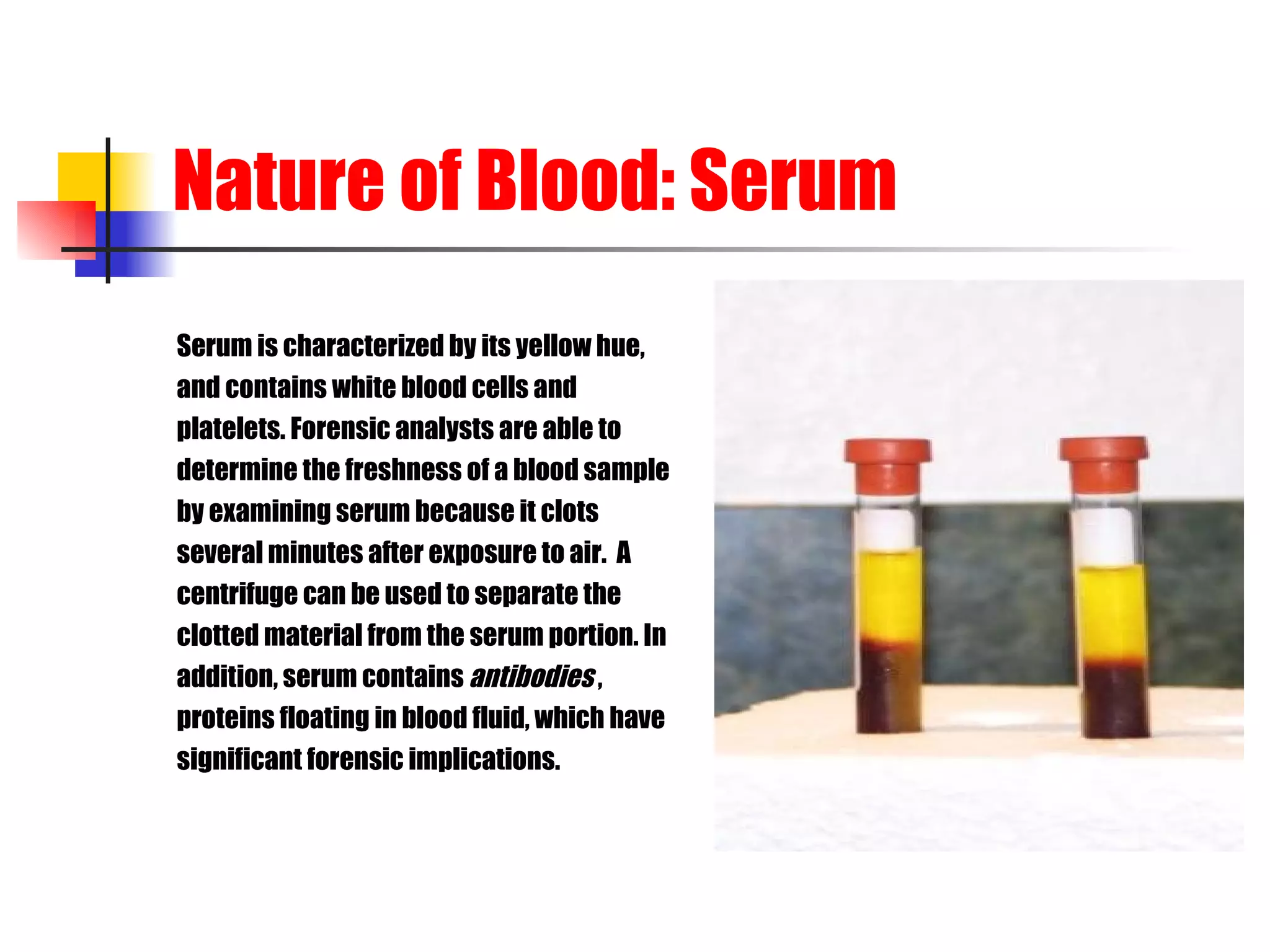
Nature of Blood: Serum Serum is characterized by its yellow hue,  and contains white blood cells and  platelets. Forensic analysts are able to determine the freshness of a blood sample  by examining serum because it clots several minutes after exposure to air.  A  centrifuge can be used to separate the  clotted material from the serum portion. In  addition, serum contains  antibodies  ,  proteins floating in blood fluid, which have significant forensic implications.
Nature of Blood: Red Blood Cells Red blood cells, the most prevalent blood cells in the human body, are the primary means of delivering oxygen from the lungs  to the body’s tissues via the blood. For red  blood cells, the forensic analyst  searches for smaller chemical substances  residing on their surfaces, such as antigens  , which also tend to have  important forensic implications.
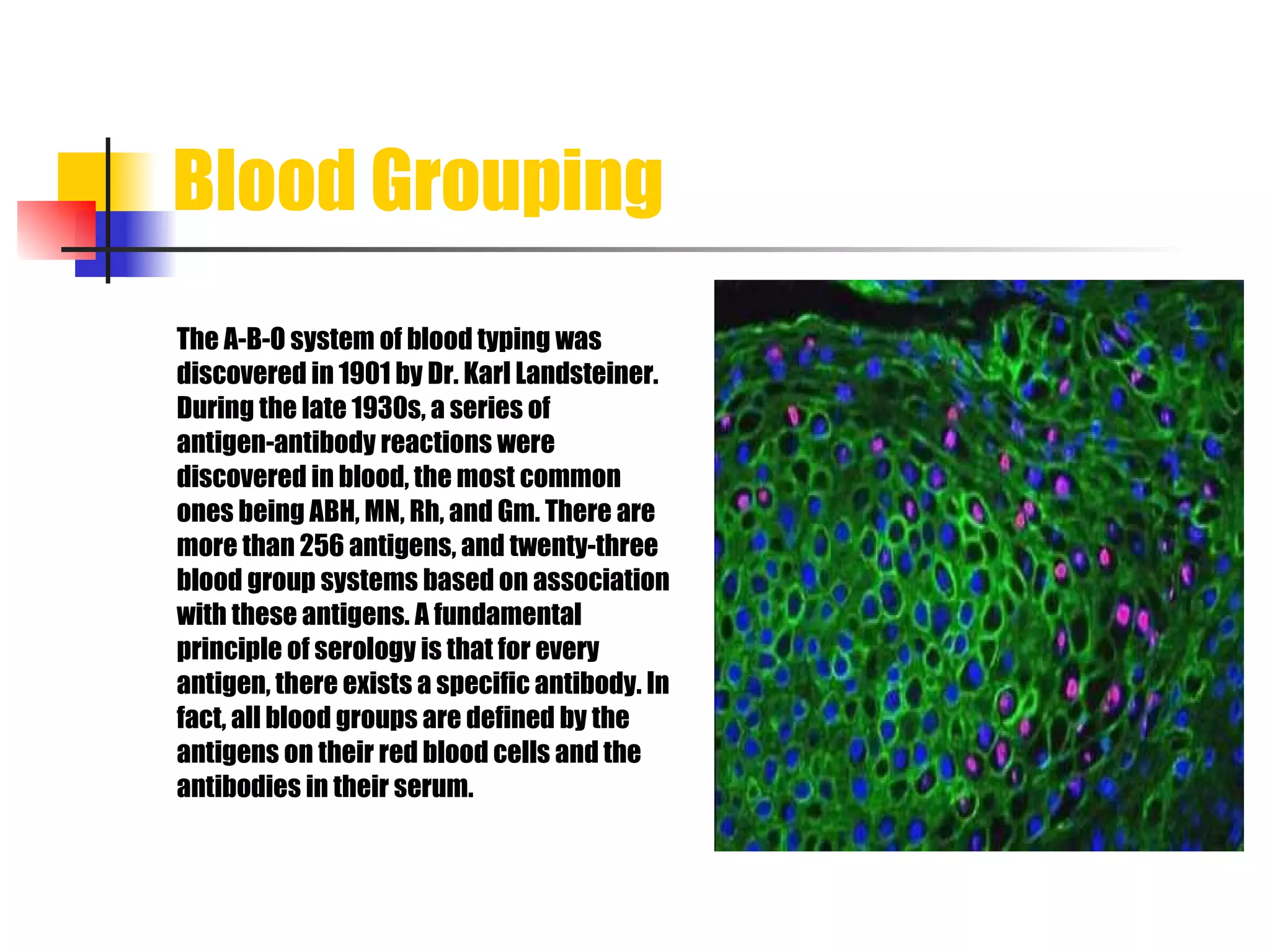
Blood Grouping The A-B-O system of blood typing was  discovered in 1901 by Dr. Karl Landsteiner.  During the late 1930s, a series of  antigen-antibody reactions were  discovered in blood, the most common  ones being ABH, MN, Rh, and Gm. There are  more than 256 antigens, and twenty-three blood group systems based on association with these antigens. A fundamental principle of serology is that for every  antigen, there exists a specific antibody. In  fact, all blood groups are defined by the  antigens on their red blood cells and  the antibodies in their serum.
Blood Typing Blood typing requires two antiserums:  anti-A and anti-B. By inserting a droplet of  these antiserums in samples of blood, one  can determine which samples maintain a  normal appearance and which samples  become clotted, or agglutinated, under  microscopic examination. Type-A blood will  be agglutinated by anti-A serum; Type-B  blood will be agglutinated by anti-B serum;  Type-AB blood by both; and Type-O blood by  neither.
Rh Factor Blood can also be categorized using the Rh  (Rhesus disease) factor.  If an individual   has a positive Rh factor, this means that  his/her blood contains a protein that is   also found in Rhesus   monkeys.   Approximately 85% of the population has a  positive Rh factor, and doctors are trained  to monitor closely any woman who is Rh  negative and becomes pregnant. The Rh  factor, like other antigens, can be found on the surface of red blood cells. 
Individualization of Blood The potential for the individualization of  blood is based on the typing of proteins an d enzymes. Blood proteins and enzymes have  the quality of being  polymorphisms  or  iso-enzymes   , which means they exist in  several forms and variants. Most people  are familiar with at least one common  polymorphism in blood: Hb, which causes sickle-cell anemia.
Secretors In 1925, a blood-related discovery valuable  to forensic science was made.   Approximately eighty-percent of the human  population was found to be "secretors,"  individuals whose specific types of  antigens, proteins, antibodies, and  enzymes characteristic of their blood can  be found in other bodily fluids and   tissues.  In the case of a secretor,  investigators can conclude the blood type  by examining the saliva, teardrops, skin  tissue, urine, or semen. In a rape case, for  example, where the perpetrator is a  secretor, potential suspects can be  narrowed down through blood type  analysis.
Bloodstain Analysis:  The General Questions During bloodstain analysis, the forensic  investigator uses these five specific  questions as guidelines for determining   the nature of a crime. 1.  Is the sample blood? 2.   Is the sample animal blood? 3. If  the sample is  animal blood, from what  species  did it come from ? 4. If  the sample is  human blood, what type is it ? 5. Can the sex, age, and race of the source  of blood be determined?
Bloodstain Analysis:  Blood or not? To determine whether or not blood is  present at a crime scene, forensic investigators use color or crystalline tests.  In the past, police investigators were trusted to verify the presence or absence of  blood, but  Miller v. Pate  (1967) enforced that  physical tests should be completed in the  search for blood. The  B enzidine test   was  widely implemented until it was discovered  to be a known carcinogen. The current  Kastle-Meyer test , which uses the   chemical, phenolphthalein, operates on the  fact that when phenolphthalein comes in  contact with hemoglobin, it releases  peroxidase enzymes that cause a bright  pink color to appear. 
Bloodstain Analysis:  Blood or not?   In order to detect invisible bloodstains,  forensic investigators use the  luminol test . Luminol, a chemical sprayed on carpets and furniture, reveals a slightly   phosphorescent light in the dark where  bloodstains (and other stains) are present.  Long-dried blood has a tendency to   crystallize, or can be made to crystallize  with various saline-acid mixtures. The  names of various crystal tests are the  Teichman test   , the  Takayama test   , and  Wagenhaar test . 
Bloodstain Analysis: Animal Blood? To determine whether blood at the crime  scene originated from an animal, forensic  investigators use antiserum or gel tests.  Establishing whether or not blood is animal blood is significant because any possibility  of an injury to the household pet, caused by  a perpetrator or another animal, must be  eliminated. Pets generally spread human bloodstains throughout the crime scene,  but the pet can be a victim, perpetrator, or  witness (through the cross transfer of  evidence between the animal’s DNA and the perpetrator). Veterinary forensics may be a necessary unit if pets are involved in the  crime.
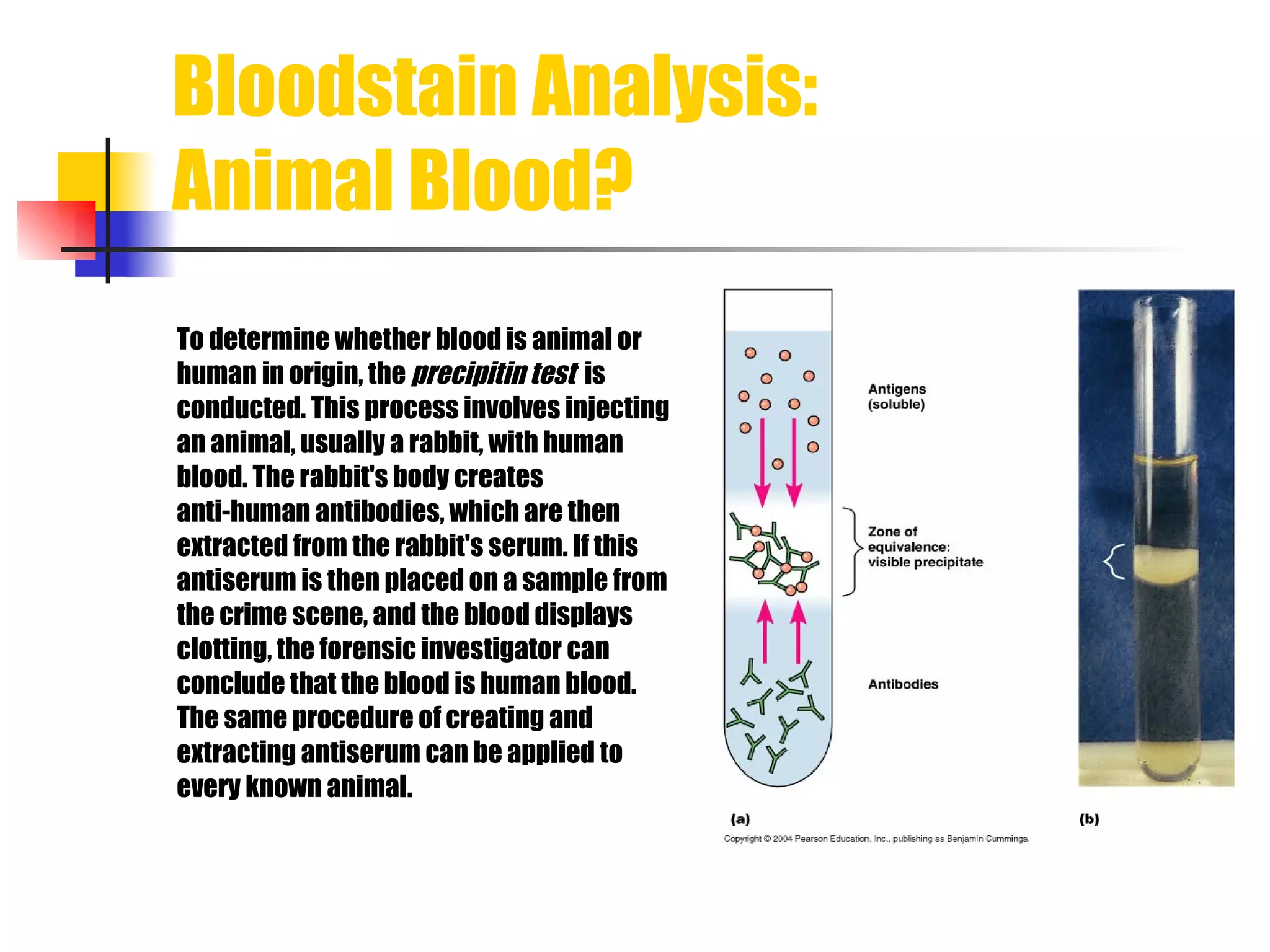
Bloodstain Analysis: Animal Blood? To determine whether blood is animal or  human in origin, the  precipitin test   is conducted. This process involves injecting  an animal, usually a rabbit, with human  blood. The rabbit's body creates  anti-human antibodies, which are then  extracted from the rabbit's serum. If this  antiserum is then placed on a sample from the crime scene, and the blood displays  clotting, the forensic investigator can  conclude that the blood is human blood.  The same procedure of creating and  extracting antiserum can be applied to  every known animal.
Bloodstain Analysis: Human Blood? To confirm whether blood is human in   origin, the forensic investigator must first  determine that he has an adequate and  quality blood sample. A blood sample that  meets these requirements can undergo  direct typing using the A-B-O system. If  severely dried stains are uncovered,  indirect typing should be completed using  techniques such as the  absorption-elution test . During this test, the forensic scientist  adds compatible antiserum antibodies to a  sample, heats the sample to break the  antibody-antigen bonds, and finally inserts  known red blood cells from standard blood  groups to see what coagulates.
Bloodstain Analysis: Age, Sex, & Race To estimate the age, sex, and race using  blood found at the crime scene, the  forensic scientist uses various color and  nitrate tests, and applies heredity  principles to  his  tests. Unfortunately, no  exact determinations are possible.  However, clotting and crystallization can  help approximate age, testosterone and  chromosome testing can help determine  sex, and certain racial genetic markers  involving protein and enzyme tests can  help establish race.
Blood & Crime Scene: Wet vs. Dry Blood Wet blood is more significant than dried  blood because the forensic scientist can perform more tests in order to gain insight  to the happenings of the crime. For  example, alcohol and drug content can be  determined from wet blood only. Blood  begins to dry after three to five minutes of  exposure to air. As it dries, it changes color from a deep red towards brown and black.  Blood can be categorized into pools, drops,  smears, or crusts.
Projection of Blood Forensic investigators can determine how blood was projected from the body by  examining factors such as:  Type of injuries The order in which the wounds were received Whose blood is present The type of weapon that caused the injuries Whether the victim was in motion or lying still when the injury was inflicted Whether the victim was moved after the injury was inflicted How far the blood drops fell before hitting the surface where they were found.
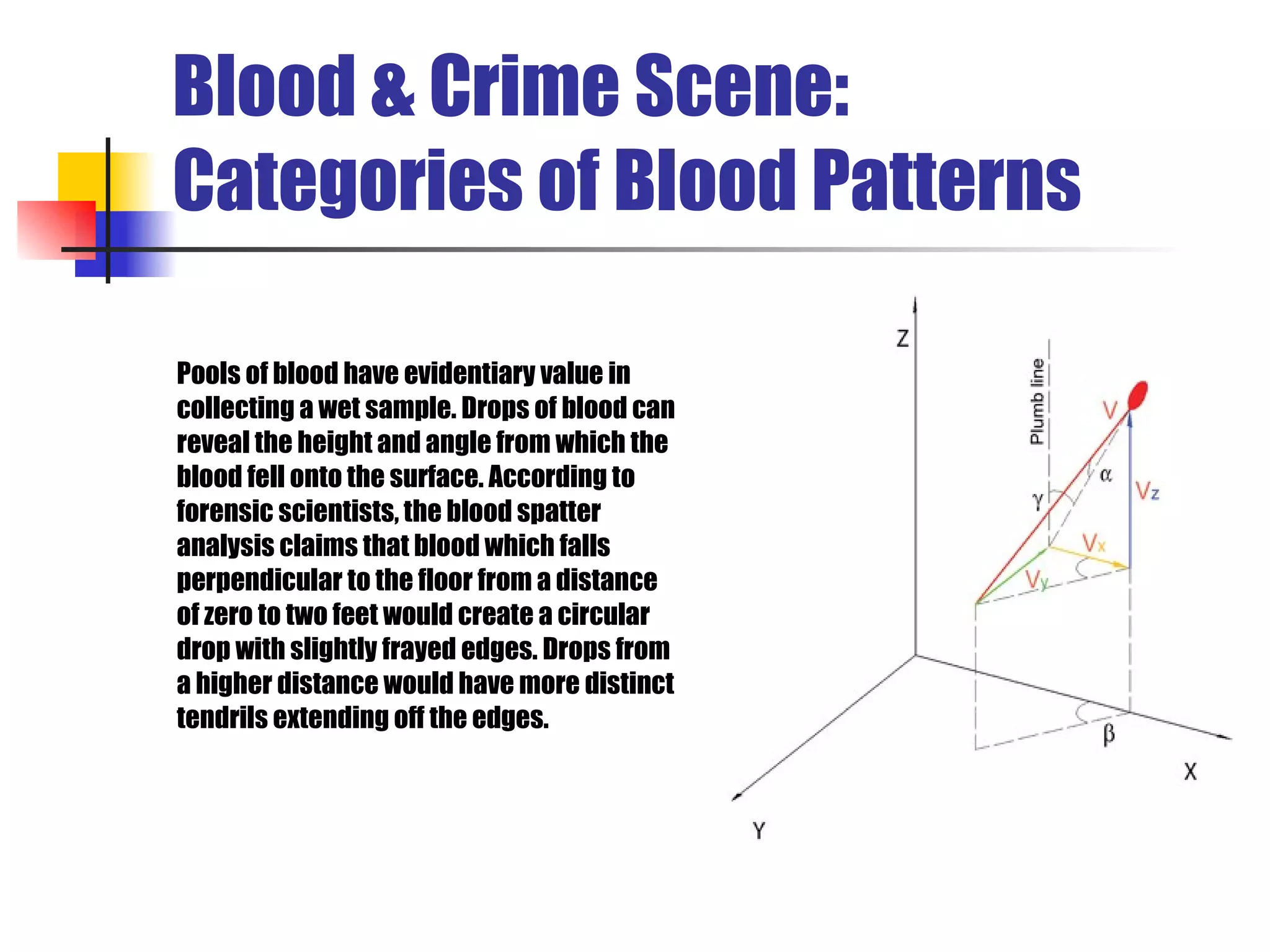
Blood & Crime Scene: Categories of Blood Patterns Pools of blood have evidentiary value in   collecting a wet sample. Drops of blood can  reveal the height and angle from which the  blood  fell onto the surface . According to  forensic scientists, the blood spatter  analysis claims that blood which falls  perpendicular to the floor from a distance  of zero to two feet would  create  a circular  drop with slightly frayed edges. Drops from a higher distance would have more distinct  tendrils extending off the edges.
Blood & Crime Scene: Categories of Blood Patterns A blood smear on the wall or floor can  indicate the direction of force of the  blow.  The direction of force is always in the direction towards the tail, or smaller end, of the smear. In other words, the largest area  of the smear is the point of origin. Blood  crusts must be tested with crystalline  techniques to verify that they are actually  blood.  Refrigerated red blood cells have a shelf life of about forty-two days, and the  serum containing white blood cells can be refrigerated much longer, almost up to a  year.  DNA can be extracted from blood (if  white blood cells which always contain a  nucleus are present), and also from sperm, bone marrow, tooth pulp, and hair roots.
Blood & DNA Testing Blood is used in DNA testing, as shown by  the following steps: 1.  Blood samples are collected from the victim, defendant, and crime scene. 2. White blood cells are separated from red  blood cells. 3. DNA is extracted from the nuclei of white blood cells. 4. A restrictive enzyme is used to cut  fragments of the DNA strand. 5. DNA fragments are put into a bed of gel  with electrodes at either end. 6. Electric current sorts DNA fragments by  length. 7. An absorbent blotter soaks up the imprint; it  is radioactively treated, and an X-ray   photograph,  called an autoradiograph, is  produced.
Blood & Crime Scene Regardless of what type of  analysis is used  on the blood at  the  crime scene, care must  be taken to handle it properly and to  prevent putrefaction.  Photo graphs  and  notes should be taken before any blood is  lifted.  Samples should not be exposed to  heat, moisture, or bacterial contamination, b ecause th ese factors can shorten  the  survival time of proteins, enzymes, and  antigens.  Delays in  bringing  samples to the  lab must be avoided at all cost, because it  can diminish evidential value.
Court Significance Experts in bloodstain examination are  usually law enforcement personnel. In  certain jurisdictions, a police investigator or blood specialist may testify on the core issue because blood evidence is usually a vital aspect of the crime scene. An expert in bloodstain examination has : • Completed specialized training • Conducted a sufficient number of examinations • Accumulated enough reference patterns  to reinforce an argument
References Data http://www.crimelibrary.com/criminal_mind/forensics/serology/3.html http://www.policensw.com/info/forensic/forensic6a.html Images Slide 1 : http://www.fbi.gov/hq/lab/fsc/backissu/oct2004/images/2004_10/kienker02.jpg Slide 2 : http://www.separationsnow.com/FCKeditor/UserFiles/Image/sepNOW_ezines_2006/0602 _dep.jpg Slide 3 : http://www.fdle.state.fl.us/CrimeLab/images/dna%20feathered.jpg Slide 4 : http://www.ecmagazine.net/Winter0607/winter06webphotos/Blood%20Serum. Pg Slide 5 :  http://www.freewebs.com/soaring_sphincter_travel_agency/red%20blood%20cells.bmp
References Slide 6 : http://www.antibody.com/images/CD4.gif Slide 7 : http://web.indstate.edu/thcme/PSP/blood/bld-type.jpg Slide 8 :  http://www.dnr.state.md.us/education/horseshoecrab/2005art/testtube2.jpg Slide 9 : http://science.uwe.ac.uk/projectshowcase/blood_cells%20copy.JPG Slide 10 : http://www.ljmu.ac.uk/MKG_Global_Images/testtube_blood.jpg Slide 11 : http://www.ronsmithandassociates.com/bloodstain.jpg Slide 12 : http://www.ct.gov/dps/cwp/view.asp?a=2155&Q=315022&PM=1 Slide 13 : http://static.howstuffworks.com/gif/luminol-crimescene.jpg Slide 14 : http://wwwimage.cbsnews.com/images/2007/12/18/image3627828g.jpg Slide 15 : http://diverge.hunter.cuny.edu/~weigang/Images/18-03_precipitin_1.jpg Slide 16 : http://www.eko.de/~eko_web/img_files/mibi_top3.jpg Slide 17 : http://library.thinkquest.org/04oct/00206/images/bloodanalysis.JPG Slide 18 : http://www.wagnerandson.com/images/drop114.jpg
References Slide 19 : http://upload.wikimedia.org/wikipedia/en/thumb/0/0d/BPA_ellipse_example.jpg/350px- BPA_ellipse_example.jpg Slide 20 : http://content.answers.com/main/content/wp/en/a/a7/BPA_AOI.jpg Slide 21 : http://bodmas.org/blog/images/secondary_wavelet_spatter.jpg Slide 22 : http://www.spaceflight.esa.int/users/images/gbf/ep-trom-samp.jpg Slide 23 : http://www1.istockphoto.com/file_thumbview_approve/4166625/2/istockphoto_4166625 _close_up_crime_scene.jpg Slide 24 : http://www.justice.gov.gu/images/gavel.jpg

Forensic Serology: BLOOD

  • 1.
    Forensic Serology: BloodWritten By: Alice Yang Period 7 Instructor Mary Villani
  • 2.
    The Forensic SerologistThe forensic serologist studies body fluids such as semen, saliva, and blood mainly for identification purposes. Role(s) : • Establishing type and characteristics of blood • Blood testing • Examination of bloodstains • DNA typing • Preparation of court testimony & evidence
  • 3.
    Blood Evidence Bloodis the most well-known and significant evidence in the modern criminal justice system. Blood evidence is important to the forensic investigator because : • It can link a victim to a suspect (Locard’s Exchange Principle] • Bloodstain patterns can reveal a great deal about position and movement during the crime • It has managed to destroy self-defense arguments of suspects
  • 4.
    Forensic Value ofBlood In forensic science, blood has always been considered class evidence. However, individualized blood evidence is possible in the near future. In fact, in some cases, forensic serologists were able to link a single perpetrator to a bloodstain with strong probability estimates.
  • 5.
    Nature of Blood: General Characteristics Blood is a slightly alkaline fluid that circulates throughout our bodies, nourishing our cells, and transporting oxygen and waste. The fluid portion of blood consists of plasma and serum, while the non-fluid portion consists of red blood cells. Blood is composed of : • Water • Cells • Enzymes • Proteins • Other inorganic substances
  • 6.
    Nature of Blood:Serum Serum is characterized by its yellow hue, and contains white blood cells and platelets. Forensic analysts are able to determine the freshness of a blood sample by examining serum because it clots several minutes after exposure to air. A centrifuge can be used to separate the clotted material from the serum portion. In addition, serum contains antibodies , proteins floating in blood fluid, which have significant forensic implications.
  • 7.
    Nature of Blood:Red Blood Cells Red blood cells, the most prevalent blood cells in the human body, are the primary means of delivering oxygen from the lungs to the body’s tissues via the blood. For red blood cells, the forensic analyst searches for smaller chemical substances residing on their surfaces, such as antigens , which also tend to have important forensic implications.
  • 8.
    Blood Grouping TheA-B-O system of blood typing was discovered in 1901 by Dr. Karl Landsteiner. During the late 1930s, a series of antigen-antibody reactions were discovered in blood, the most common ones being ABH, MN, Rh, and Gm. There are more than 256 antigens, and twenty-three blood group systems based on association with these antigens. A fundamental principle of serology is that for every antigen, there exists a specific antibody. In fact, all blood groups are defined by the antigens on their red blood cells and the antibodies in their serum.
  • 9.
    Blood Typing Bloodtyping requires two antiserums: anti-A and anti-B. By inserting a droplet of these antiserums in samples of blood, one can determine which samples maintain a normal appearance and which samples become clotted, or agglutinated, under microscopic examination. Type-A blood will be agglutinated by anti-A serum; Type-B blood will be agglutinated by anti-B serum; Type-AB blood by both; and Type-O blood by neither.
  • 10.
    Rh Factor Bloodcan also be categorized using the Rh (Rhesus disease) factor.  If an individual has a positive Rh factor, this means that his/her blood contains a protein that is also found in Rhesus monkeys.  Approximately 85% of the population has a positive Rh factor, and doctors are trained to monitor closely any woman who is Rh negative and becomes pregnant. The Rh factor, like other antigens, can be found on the surface of red blood cells. 
  • 11.
    Individualization of BloodThe potential for the individualization of blood is based on the typing of proteins an d enzymes. Blood proteins and enzymes have the quality of being polymorphisms or iso-enzymes , which means they exist in several forms and variants. Most people are familiar with at least one common polymorphism in blood: Hb, which causes sickle-cell anemia.
  • 12.
    Secretors In 1925,a blood-related discovery valuable to forensic science was made. Approximately eighty-percent of the human population was found to be "secretors," individuals whose specific types of antigens, proteins, antibodies, and enzymes characteristic of their blood can be found in other bodily fluids and tissues.  In the case of a secretor, investigators can conclude the blood type by examining the saliva, teardrops, skin tissue, urine, or semen. In a rape case, for example, where the perpetrator is a secretor, potential suspects can be narrowed down through blood type analysis.
  • 13.
    Bloodstain Analysis: The General Questions During bloodstain analysis, the forensic investigator uses these five specific questions as guidelines for determining the nature of a crime. 1. Is the sample blood? 2. Is the sample animal blood? 3. If the sample is animal blood, from what species did it come from ? 4. If the sample is human blood, what type is it ? 5. Can the sex, age, and race of the source of blood be determined?
  • 14.
    Bloodstain Analysis: Blood or not? To determine whether or not blood is present at a crime scene, forensic investigators use color or crystalline tests. In the past, police investigators were trusted to verify the presence or absence of blood, but Miller v. Pate (1967) enforced that physical tests should be completed in the search for blood. The B enzidine test was widely implemented until it was discovered to be a known carcinogen. The current Kastle-Meyer test , which uses the chemical, phenolphthalein, operates on the fact that when phenolphthalein comes in contact with hemoglobin, it releases peroxidase enzymes that cause a bright pink color to appear. 
  • 15.
    Bloodstain Analysis: Blood or not? In order to detect invisible bloodstains, forensic investigators use the luminol test . Luminol, a chemical sprayed on carpets and furniture, reveals a slightly phosphorescent light in the dark where bloodstains (and other stains) are present. Long-dried blood has a tendency to crystallize, or can be made to crystallize with various saline-acid mixtures. The names of various crystal tests are the Teichman test , the Takayama test , and Wagenhaar test . 
  • 16.
    Bloodstain Analysis: AnimalBlood? To determine whether blood at the crime scene originated from an animal, forensic investigators use antiserum or gel tests. Establishing whether or not blood is animal blood is significant because any possibility of an injury to the household pet, caused by a perpetrator or another animal, must be eliminated. Pets generally spread human bloodstains throughout the crime scene, but the pet can be a victim, perpetrator, or witness (through the cross transfer of evidence between the animal’s DNA and the perpetrator). Veterinary forensics may be a necessary unit if pets are involved in the crime.
  • 17.
    Bloodstain Analysis: AnimalBlood? To determine whether blood is animal or human in origin, the precipitin test is conducted. This process involves injecting an animal, usually a rabbit, with human blood. The rabbit's body creates anti-human antibodies, which are then extracted from the rabbit's serum. If this antiserum is then placed on a sample from the crime scene, and the blood displays clotting, the forensic investigator can conclude that the blood is human blood. The same procedure of creating and extracting antiserum can be applied to every known animal.
  • 18.
    Bloodstain Analysis: HumanBlood? To confirm whether blood is human in origin, the forensic investigator must first determine that he has an adequate and quality blood sample. A blood sample that meets these requirements can undergo direct typing using the A-B-O system. If severely dried stains are uncovered, indirect typing should be completed using techniques such as the absorption-elution test . During this test, the forensic scientist adds compatible antiserum antibodies to a sample, heats the sample to break the antibody-antigen bonds, and finally inserts known red blood cells from standard blood groups to see what coagulates.
  • 19.
    Bloodstain Analysis: Age,Sex, & Race To estimate the age, sex, and race using blood found at the crime scene, the forensic scientist uses various color and nitrate tests, and applies heredity principles to his tests. Unfortunately, no exact determinations are possible. However, clotting and crystallization can help approximate age, testosterone and chromosome testing can help determine sex, and certain racial genetic markers involving protein and enzyme tests can help establish race.
  • 20.
    Blood & CrimeScene: Wet vs. Dry Blood Wet blood is more significant than dried blood because the forensic scientist can perform more tests in order to gain insight to the happenings of the crime. For example, alcohol and drug content can be determined from wet blood only. Blood begins to dry after three to five minutes of exposure to air. As it dries, it changes color from a deep red towards brown and black. Blood can be categorized into pools, drops, smears, or crusts.
  • 21.
    Projection of BloodForensic investigators can determine how blood was projected from the body by examining factors such as: Type of injuries The order in which the wounds were received Whose blood is present The type of weapon that caused the injuries Whether the victim was in motion or lying still when the injury was inflicted Whether the victim was moved after the injury was inflicted How far the blood drops fell before hitting the surface where they were found.
  • 22.
    Blood & CrimeScene: Categories of Blood Patterns Pools of blood have evidentiary value in collecting a wet sample. Drops of blood can reveal the height and angle from which the blood fell onto the surface . According to forensic scientists, the blood spatter analysis claims that blood which falls perpendicular to the floor from a distance of zero to two feet would create a circular drop with slightly frayed edges. Drops from a higher distance would have more distinct tendrils extending off the edges.
  • 23.
    Blood & CrimeScene: Categories of Blood Patterns A blood smear on the wall or floor can indicate the direction of force of the blow.  The direction of force is always in the direction towards the tail, or smaller end, of the smear. In other words, the largest area of the smear is the point of origin. Blood crusts must be tested with crystalline techniques to verify that they are actually blood. Refrigerated red blood cells have a shelf life of about forty-two days, and the serum containing white blood cells can be refrigerated much longer, almost up to a year.  DNA can be extracted from blood (if white blood cells which always contain a nucleus are present), and also from sperm, bone marrow, tooth pulp, and hair roots.
  • 24.
    Blood & DNATesting Blood is used in DNA testing, as shown by the following steps: 1. Blood samples are collected from the victim, defendant, and crime scene. 2. White blood cells are separated from red blood cells. 3. DNA is extracted from the nuclei of white blood cells. 4. A restrictive enzyme is used to cut fragments of the DNA strand. 5. DNA fragments are put into a bed of gel with electrodes at either end. 6. Electric current sorts DNA fragments by length. 7. An absorbent blotter soaks up the imprint; it is radioactively treated, and an X-ray photograph, called an autoradiograph, is produced.
  • 25.
    Blood & CrimeScene Regardless of what type of analysis is used on the blood at the crime scene, care must be taken to handle it properly and to prevent putrefaction.  Photo graphs and notes should be taken before any blood is lifted.  Samples should not be exposed to heat, moisture, or bacterial contamination, b ecause th ese factors can shorten the survival time of proteins, enzymes, and antigens.  Delays in bringing samples to the lab must be avoided at all cost, because it can diminish evidential value.
  • 26.
    Court Significance Expertsin bloodstain examination are usually law enforcement personnel. In certain jurisdictions, a police investigator or blood specialist may testify on the core issue because blood evidence is usually a vital aspect of the crime scene. An expert in bloodstain examination has : • Completed specialized training • Conducted a sufficient number of examinations • Accumulated enough reference patterns to reinforce an argument
  • 27.
    References Data http://www.crimelibrary.com/criminal_mind/forensics/serology/3.htmlhttp://www.policensw.com/info/forensic/forensic6a.html Images Slide 1 : http://www.fbi.gov/hq/lab/fsc/backissu/oct2004/images/2004_10/kienker02.jpg Slide 2 : http://www.separationsnow.com/FCKeditor/UserFiles/Image/sepNOW_ezines_2006/0602 _dep.jpg Slide 3 : http://www.fdle.state.fl.us/CrimeLab/images/dna%20feathered.jpg Slide 4 : http://www.ecmagazine.net/Winter0607/winter06webphotos/Blood%20Serum. Pg Slide 5 : http://www.freewebs.com/soaring_sphincter_travel_agency/red%20blood%20cells.bmp
  • 28.
    References Slide 6: http://www.antibody.com/images/CD4.gif Slide 7 : http://web.indstate.edu/thcme/PSP/blood/bld-type.jpg Slide 8 : http://www.dnr.state.md.us/education/horseshoecrab/2005art/testtube2.jpg Slide 9 : http://science.uwe.ac.uk/projectshowcase/blood_cells%20copy.JPG Slide 10 : http://www.ljmu.ac.uk/MKG_Global_Images/testtube_blood.jpg Slide 11 : http://www.ronsmithandassociates.com/bloodstain.jpg Slide 12 : http://www.ct.gov/dps/cwp/view.asp?a=2155&Q=315022&PM=1 Slide 13 : http://static.howstuffworks.com/gif/luminol-crimescene.jpg Slide 14 : http://wwwimage.cbsnews.com/images/2007/12/18/image3627828g.jpg Slide 15 : http://diverge.hunter.cuny.edu/~weigang/Images/18-03_precipitin_1.jpg Slide 16 : http://www.eko.de/~eko_web/img_files/mibi_top3.jpg Slide 17 : http://library.thinkquest.org/04oct/00206/images/bloodanalysis.JPG Slide 18 : http://www.wagnerandson.com/images/drop114.jpg
  • 29.
    References Slide 19: http://upload.wikimedia.org/wikipedia/en/thumb/0/0d/BPA_ellipse_example.jpg/350px- BPA_ellipse_example.jpg Slide 20 : http://content.answers.com/main/content/wp/en/a/a7/BPA_AOI.jpg Slide 21 : http://bodmas.org/blog/images/secondary_wavelet_spatter.jpg Slide 22 : http://www.spaceflight.esa.int/users/images/gbf/ep-trom-samp.jpg Slide 23 : http://www1.istockphoto.com/file_thumbview_approve/4166625/2/istockphoto_4166625 _close_up_crime_scene.jpg Slide 24 : http://www.justice.gov.gu/images/gavel.jpg