Bloodstain Evidence May reveal: Origin(s) of bloodstain Distance of bloodstain from target Direction from which blood impacted Speed with which blood left its source Position of victim & assailant Movement of victim & assailant Number of blows/shots 1
Liquid Blood Physical properties viscosity surface tension specific gravity Behaves as a projectile in motion biology, physics, maths 2
Surface Tension Resistance to penetration & separation Surface acts to reduce surface area Smallest SA to Volume ratio is offered  by sphere 3
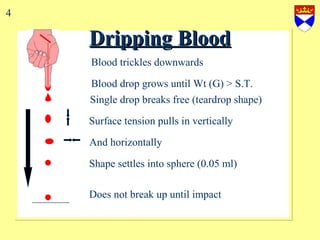
Dripping Blood Blood drop grows until Wt (G) > S.T. Single drop breaks free (teardrop shape) Surface tension pulls in vertically Shape settles into sphere (0.05 ml)  Does not break up until impact And horizontally Blood trickles downwards 4
Drop size . Standard drop  size 50ul (0.05ml) . Rapid bleeding gives  slightly larger drop Shaking/movement casts off smaller drops . 5
Terminal Velocity  v Distance Fallen (metric) 6
Terminal Velocity  v Distance Fallen (imperial) 7
Free Falling Blood Droplets 8 . 50 ul 4.6 mm 7.5 m/s 4.2 to 5.4 m 0.5 ul 2.12 mm 2.4 to  3 m . 4.6 m/s 0.12 ul 1.32 mm 0.84  to 1 m . 3.3 m/s 0.06 ul 1.1 mm 0.5 to  0.65 m . 2.2 m/s
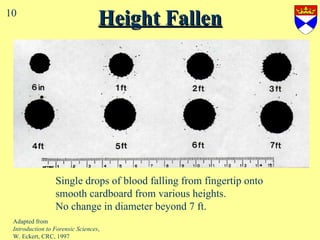
Shape & Size of Bloodspot Depends mostly on nature of target surface texture (rough or smooth) porous or non porous Size  is related to distance fallen, provided: standard 50 ul drop of blood There is little change in spot diameter beyond a fall distance of 1.2 m 9
Height Fallen Single drops of blood falling from fingertip onto smooth cardboard from various heights. No change in diameter beyond 7 ft. Adapted from  Introduction to Forensic Sciences , W. Eckert, CRC, 1997 10
Effect of Target Surface . . Spreads out smoothly ST of spreading edge is  broken by irregular surface 11 . . . .
Experiments with Falling Blood Droplets Terazzo floor whiteboard rough paper towel paper Fabric (theatre green) Height Target Surface 12 blood dropper ruler
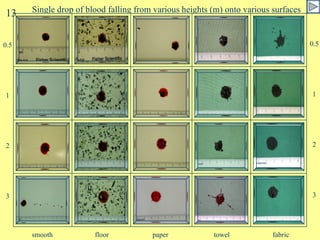
Height/Surface Single drop of blood falling from various heights (m) onto various surfaces smooth floor paper towel fabric 13 0.5 1 2 3 0.5 1 2 3
Angle of Impact Adapted from  Introduction to Forensic Sciences , W. Eckert, CRC, 1997 Gravitational dense zone at lower edge 14 90  10  70  20  30  60  50  40  80 
Wave Cast-off David Sadler: 15 . Parent drop wave cast-off Tail of wave cast-off points  back to parent drop Tail of elongated stain  points in direction of travel
Point of Convergence 16
Point of Convergence 5 ml blood squirted from a  syringe from height of 1 m 17
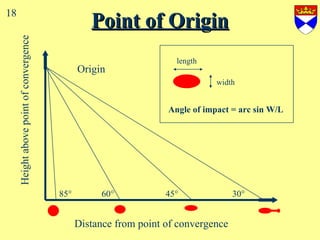
Point of Origin length width Angle of impact = arc sin W/L 18 1 Distance from point of convergence Height above point of convergence Origin 85  60  45  30 
Tracing Origin of Bloodspots Point of convergence method 2 dimensional image Point of origin method adds 3rd dimension to image In practice: use of string & protractor at scene use of computer at laboratory 19
Blood Spatter Low velocity (5 f/s, 1.5 m/s) e.g. free-falling drops, cast off from weapon Medium velocity (25 - 100 f/s, 7.5 - 30 m/s) e.g. baseball bat blows High velocity (>100 f/s, 30 m/s) e.g. gunshot, machinery 20
Herbert Leon MacDonell, Laboratory of Forensic Science, P.O. Box 1111, Corning, New York, 14830, USA 21
Low Velocity Blood Spatter Blood source subjected to LV impact < 5 f/s (1.5 m/s) Spot diameter:  mostly  4 - 8 mm  some smaller, some larger Free-falling drops (gravity only) Cast off from fist, shoe, weapon Dripping Splashing Arterial spurting 22
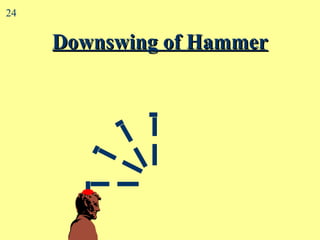
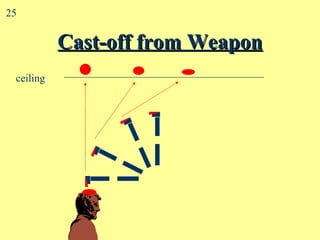
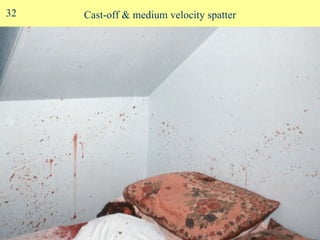
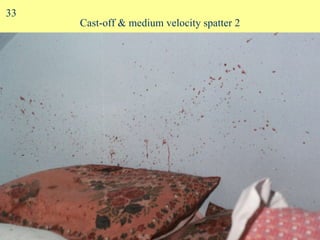
Cast-off from Weapon First blow causes bleeding Subsequent blows contaminate weapon with blood Blood is cast-off tangientially to arc of upswing or backswing Pattern & intensity depends on: type of weapon amount of blood adhering to weapon length of arc 23
Downswing of Hammer 24
Cast-off from Weapon ceiling 25
Overhead swing with bloodied metal bar 26
Cast-off Pattern (1/2) 27
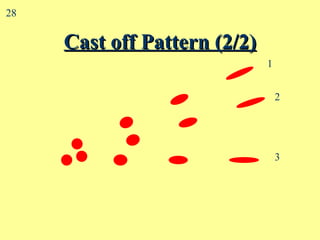
Cast off Pattern (2/2) 1 2 3 28
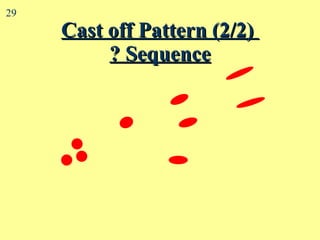
Cast off Pattern (2/2)  ? Sequence 29
Cast off Pattern (2/2)  ? Sequence 1 (4 spots) 2 (3 spots) 3 (2 spots) If weapon does not pick up more blood, spatter from subsequent backswings becomes progressively less. In practice weapon picks up more blood with each successful blow. 30
Three overhead swings with hatchet 31
Cast-off & medium velocity spatter 32
Cast-off & medium velocity spatter 2 33
Cast-off Pattern ? Object 34
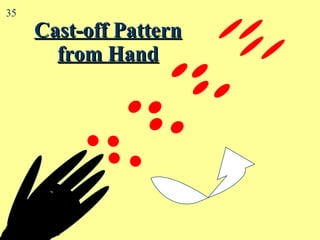
Cast-off Pattern from Hand 35
Cast-off pattern from bloodied hand swung  in front of target 6” ruler 36
Drip Pattern Free-falling drops dripping into wet blood Large irregular central stain Small round & oval satellite stains . . . . 37 . . . . . . . . . . . . . . . . .
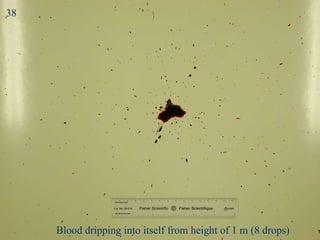
Drip 1: Blood dripping into itself from height of 1 m (8 drops) 38
Drip 2 Blood dripping into itself from height of 1 m (8 drops) 39
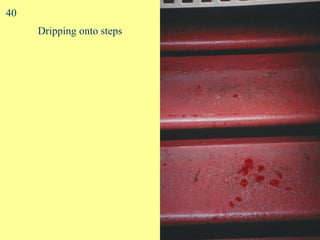
Dripping onto steps 40
Splash Pattern Volume > 1 ml  Subjected to LV impact  Thrown  Tipped Large central irregular area surrounded by elongated peripheral spatter pattern 41
Splash 1 5 ml blood squirted from a syringe from a height of 1 m 42
Splash 2 5 ml blood squirted from a  syringe from a height of 1 m 43
Splash 3 5 ml blood squirted from a syringe from a height of 1 m 44
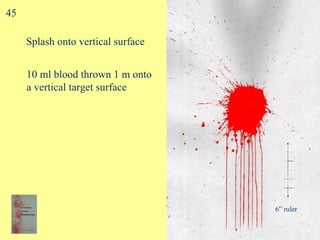
Splash onto vertical surface 6” ruler 10 ml blood thrown 1 m onto  a vertical target surface 45
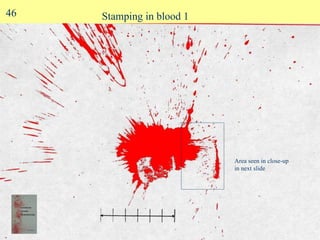
Stamping in blood 1 Area seen in close-up  in next slide 46
Stamping in blood  Close-up of heel area 47
Stamp 1 Blood pool (10 drops) before stamping 48
Stamp 2 Blood pool (10 drops) after stamping 49
Arterial Spurt Pattern Blood exiting body under arterial pressure Large stains with downward flow on vertical surfaces wave-form of pulsatile flow may be apparent 50
Small arterial spurt spatter broken pottery 51
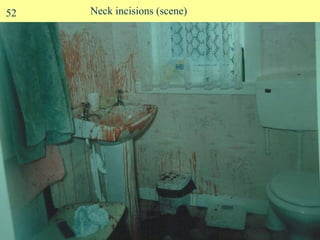
Neck incisions (scene) 52
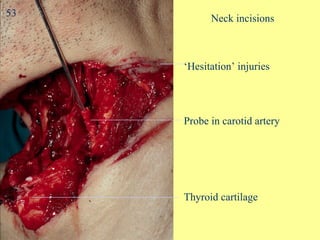
Neck incisions  Thyroid cartilage Probe in carotid artery ‘ Hesitation’ injuries 53
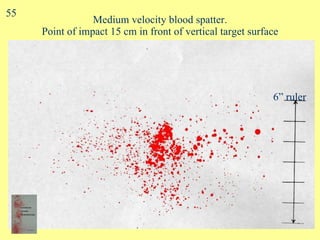
Medium Velocity  Blood Spatter Blood source subjected to MV impact (25 - 100 f/s, 7.5 - 30 m/s) Spot diameter: mostly 1 - 4 mm Blows with weapon (e.g. baseball bat) 54
Medium velocity blood spatter. Point of impact 15 cm in front of vertical target surface 6” ruler 55
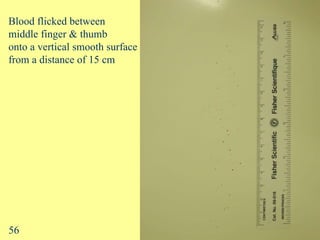
Flick 1: Blood flicked between  middle finger & thumb  onto a vertical smooth surface  from a distance of 15 cm 56
Flick 2: Blood flicked between  middle finger & thumb  onto a vertical smooth surface  from a distance of 15 cm 57
High Velocity Blood Spatter Blood source subjected to HV impact > 100 f/s, 30 m/s Fine mist: spot size < 0.1 mm Small mass limits spread to 1 m !Some larger droplets reach further Gunshot back-spatter from entry wound forward spatter from exit wound High speed machinery 58
Gunshot: back& forward spatter Bloodstained foam held just above target surface. Back-spatter  on entry Forward spatter on exit Bullet passing L to R just above sheet 59 bullet Bullet enters  foam bullet exits foam
Gunshot Back Spatter Arises from entrance wound Passes back towards weapon & shooter Seen only at close range of fire Seen on: inside of barrel exterior of weapon hand, arm, chest of shooter 60
Back spatter  on steadying hand 61
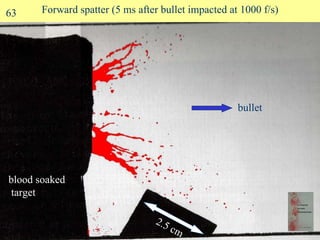
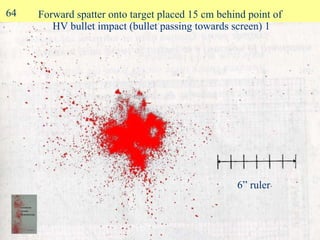
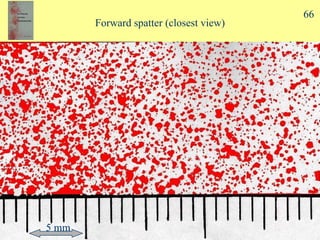
Gunshot Forward Spatter   Arises from exit wound Passes forwards in same direction as shot More copious than back-spatter Can be seen at any range of fire Seen on nearby surfaces, objects, persons especially on wall behind victim 62
Forward spatter (5 ms after bullet impacted at 1000 f/s) blood soaked target bullet 63 2.5 cm
Forward spatter onto target placed 15 cm behind point of  HV bullet impact (bullet passing towards screen) 1 6” ruler 64
Forward spatter (closer view) 65
Forward spatter (closest view) 5 mm 66
Wipe Patterns Object moves through a wet bloodstain Feathered edge suggests direction 67
Transfer Patterns Wet, bloodied object contacts a secondary surface Transfer from: hand, fingers shoes, weapon hair Transfer to: walls, ceilings  clothing, bedding Produces mirror-image of bloodied object 68
Transfer from hair  (hair-swipe) 1 69
Transfer from hair  (hair-swipe) 2 70
Flow Patterns Blood flows horizontally & vertically Altered by contours, obstacles Often ends in pool 71
Flow pattern 72
Trapped! 73
Stabbing 1 74
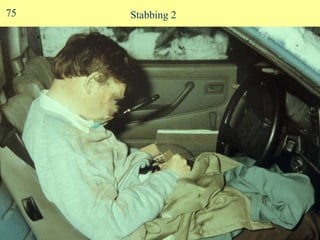
Stabbing 2 75
Blood flow on shirt Horizontally to R side 76
Pattern on shirt 77
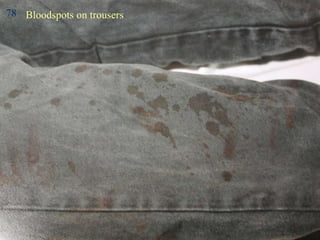
Bloodspots on trousers 78

Bloodspatter

  • 1.
    Bloodstain Evidence Mayreveal: Origin(s) of bloodstain Distance of bloodstain from target Direction from which blood impacted Speed with which blood left its source Position of victim & assailant Movement of victim & assailant Number of blows/shots 1
  • 2.
    Liquid Blood Physicalproperties viscosity surface tension specific gravity Behaves as a projectile in motion biology, physics, maths 2
  • 3.
    Surface Tension Resistanceto penetration & separation Surface acts to reduce surface area Smallest SA to Volume ratio is offered by sphere 3
  • 4.
    Dripping Blood Blooddrop grows until Wt (G) > S.T. Single drop breaks free (teardrop shape) Surface tension pulls in vertically Shape settles into sphere (0.05 ml) Does not break up until impact And horizontally Blood trickles downwards 4
  • 5.
    Drop size .Standard drop size 50ul (0.05ml) . Rapid bleeding gives slightly larger drop Shaking/movement casts off smaller drops . 5
  • 6.
    Terminal Velocity v Distance Fallen (metric) 6
  • 7.
    Terminal Velocity v Distance Fallen (imperial) 7
  • 8.
    Free Falling BloodDroplets 8 . 50 ul 4.6 mm 7.5 m/s 4.2 to 5.4 m 0.5 ul 2.12 mm 2.4 to 3 m . 4.6 m/s 0.12 ul 1.32 mm 0.84 to 1 m . 3.3 m/s 0.06 ul 1.1 mm 0.5 to 0.65 m . 2.2 m/s
  • 9.
    Shape & Sizeof Bloodspot Depends mostly on nature of target surface texture (rough or smooth) porous or non porous Size is related to distance fallen, provided: standard 50 ul drop of blood There is little change in spot diameter beyond a fall distance of 1.2 m 9
  • 10.
    Height Fallen Singledrops of blood falling from fingertip onto smooth cardboard from various heights. No change in diameter beyond 7 ft. Adapted from Introduction to Forensic Sciences , W. Eckert, CRC, 1997 10
  • 11.
    Effect of TargetSurface . . Spreads out smoothly ST of spreading edge is broken by irregular surface 11 . . . .
  • 12.
    Experiments with FallingBlood Droplets Terazzo floor whiteboard rough paper towel paper Fabric (theatre green) Height Target Surface 12 blood dropper ruler
  • 13.
    Height/Surface Single dropof blood falling from various heights (m) onto various surfaces smooth floor paper towel fabric 13 0.5 1 2 3 0.5 1 2 3
  • 14.
    Angle of ImpactAdapted from Introduction to Forensic Sciences , W. Eckert, CRC, 1997 Gravitational dense zone at lower edge 14 90  10  70  20  30  60  50  40  80 
  • 15.
    Wave Cast-off DavidSadler: 15 . Parent drop wave cast-off Tail of wave cast-off points back to parent drop Tail of elongated stain points in direction of travel
  • 16.
  • 17.
    Point of Convergence5 ml blood squirted from a syringe from height of 1 m 17
  • 18.
    Point of Originlength width Angle of impact = arc sin W/L 18 1 Distance from point of convergence Height above point of convergence Origin 85  60  45  30 
  • 19.
    Tracing Origin ofBloodspots Point of convergence method 2 dimensional image Point of origin method adds 3rd dimension to image In practice: use of string & protractor at scene use of computer at laboratory 19
  • 20.
    Blood Spatter Lowvelocity (5 f/s, 1.5 m/s) e.g. free-falling drops, cast off from weapon Medium velocity (25 - 100 f/s, 7.5 - 30 m/s) e.g. baseball bat blows High velocity (>100 f/s, 30 m/s) e.g. gunshot, machinery 20
  • 21.
    Herbert Leon MacDonell,Laboratory of Forensic Science, P.O. Box 1111, Corning, New York, 14830, USA 21
  • 22.
    Low Velocity BloodSpatter Blood source subjected to LV impact < 5 f/s (1.5 m/s) Spot diameter: mostly 4 - 8 mm some smaller, some larger Free-falling drops (gravity only) Cast off from fist, shoe, weapon Dripping Splashing Arterial spurting 22
  • 23.
    Cast-off from WeaponFirst blow causes bleeding Subsequent blows contaminate weapon with blood Blood is cast-off tangientially to arc of upswing or backswing Pattern & intensity depends on: type of weapon amount of blood adhering to weapon length of arc 23
  • 24.
  • 25.
  • 26.
    Overhead swing withbloodied metal bar 26
  • 27.
  • 28.
    Cast off Pattern(2/2) 1 2 3 28
  • 29.
    Cast off Pattern(2/2) ? Sequence 29
  • 30.
    Cast off Pattern(2/2) ? Sequence 1 (4 spots) 2 (3 spots) 3 (2 spots) If weapon does not pick up more blood, spatter from subsequent backswings becomes progressively less. In practice weapon picks up more blood with each successful blow. 30
  • 31.
    Three overhead swingswith hatchet 31
  • 32.
    Cast-off & mediumvelocity spatter 32
  • 33.
    Cast-off & mediumvelocity spatter 2 33
  • 34.
  • 35.
  • 36.
    Cast-off pattern frombloodied hand swung in front of target 6” ruler 36
  • 37.
    Drip Pattern Free-fallingdrops dripping into wet blood Large irregular central stain Small round & oval satellite stains . . . . 37 . . . . . . . . . . . . . . . . .
  • 38.
    Drip 1: Blooddripping into itself from height of 1 m (8 drops) 38
  • 39.
    Drip 2 Blooddripping into itself from height of 1 m (8 drops) 39
  • 40.
  • 41.
    Splash Pattern Volume> 1 ml Subjected to LV impact Thrown Tipped Large central irregular area surrounded by elongated peripheral spatter pattern 41
  • 42.
    Splash 1 5ml blood squirted from a syringe from a height of 1 m 42
  • 43.
    Splash 2 5ml blood squirted from a syringe from a height of 1 m 43
  • 44.
    Splash 3 5ml blood squirted from a syringe from a height of 1 m 44
  • 45.
    Splash onto verticalsurface 6” ruler 10 ml blood thrown 1 m onto a vertical target surface 45
  • 46.
    Stamping in blood1 Area seen in close-up in next slide 46
  • 47.
    Stamping in blood Close-up of heel area 47
  • 48.
    Stamp 1 Bloodpool (10 drops) before stamping 48
  • 49.
    Stamp 2 Bloodpool (10 drops) after stamping 49
  • 50.
    Arterial Spurt PatternBlood exiting body under arterial pressure Large stains with downward flow on vertical surfaces wave-form of pulsatile flow may be apparent 50
  • 51.
    Small arterial spurtspatter broken pottery 51
  • 52.
  • 53.
    Neck incisions Thyroid cartilage Probe in carotid artery ‘ Hesitation’ injuries 53
  • 54.
    Medium Velocity Blood Spatter Blood source subjected to MV impact (25 - 100 f/s, 7.5 - 30 m/s) Spot diameter: mostly 1 - 4 mm Blows with weapon (e.g. baseball bat) 54
  • 55.
    Medium velocity bloodspatter. Point of impact 15 cm in front of vertical target surface 6” ruler 55
  • 56.
    Flick 1: Bloodflicked between middle finger & thumb onto a vertical smooth surface from a distance of 15 cm 56
  • 57.
    Flick 2: Bloodflicked between middle finger & thumb onto a vertical smooth surface from a distance of 15 cm 57
  • 58.
    High Velocity BloodSpatter Blood source subjected to HV impact > 100 f/s, 30 m/s Fine mist: spot size < 0.1 mm Small mass limits spread to 1 m !Some larger droplets reach further Gunshot back-spatter from entry wound forward spatter from exit wound High speed machinery 58
  • 59.
    Gunshot: back& forwardspatter Bloodstained foam held just above target surface. Back-spatter on entry Forward spatter on exit Bullet passing L to R just above sheet 59 bullet Bullet enters foam bullet exits foam
  • 60.
    Gunshot Back SpatterArises from entrance wound Passes back towards weapon & shooter Seen only at close range of fire Seen on: inside of barrel exterior of weapon hand, arm, chest of shooter 60
  • 61.
    Back spatter on steadying hand 61
  • 62.
    Gunshot Forward Spatter Arises from exit wound Passes forwards in same direction as shot More copious than back-spatter Can be seen at any range of fire Seen on nearby surfaces, objects, persons especially on wall behind victim 62
  • 63.
    Forward spatter (5ms after bullet impacted at 1000 f/s) blood soaked target bullet 63 2.5 cm
  • 64.
    Forward spatter ontotarget placed 15 cm behind point of HV bullet impact (bullet passing towards screen) 1 6” ruler 64
  • 65.
  • 66.
  • 67.
    Wipe Patterns Objectmoves through a wet bloodstain Feathered edge suggests direction 67
  • 68.
    Transfer Patterns Wet,bloodied object contacts a secondary surface Transfer from: hand, fingers shoes, weapon hair Transfer to: walls, ceilings clothing, bedding Produces mirror-image of bloodied object 68
  • 69.
    Transfer from hair (hair-swipe) 1 69
  • 70.
    Transfer from hair (hair-swipe) 2 70
  • 71.
    Flow Patterns Bloodflows horizontally & vertically Altered by contours, obstacles Often ends in pool 71
  • 72.
  • 73.
  • 74.
  • 75.
  • 76.
    Blood flow onshirt Horizontally to R side 76
  • 77.
  • 78.