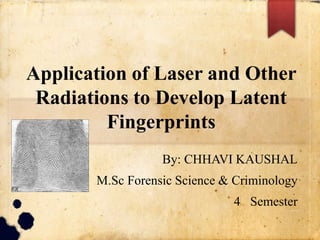
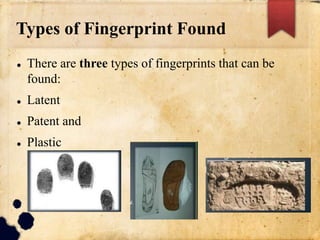
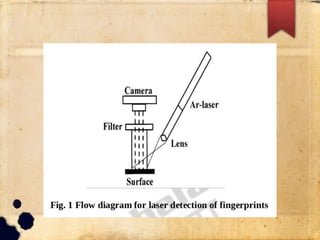
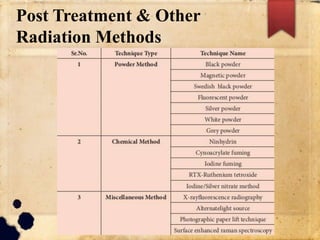
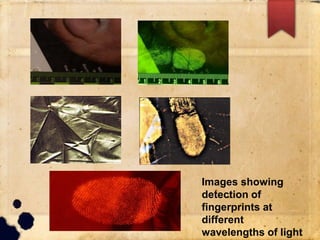
This document discusses various techniques for developing latent fingerprints, including the application of lasers. It describes how argon lasers can cause fingerprints to fluoresce without treatment due to components like riboflavin and pyridoxine in sweat. However, post-treatment is usually needed to improve fluorescence. Methods include using luminescent materials or chemicals that react with sweat to form luminous products. Other techniques discussed are forensic light sources, chromatic white light sensors, and x-ray fluorescence radiography which detects fingerprint ridge patterns through fluorescence of elements like sodium and potassium in sweat.