Serology and Forensics Blood Typing And Blood Splatter Analysis
What is blood? Blood is connective tissue.  It is composed of a sticky fluid called PLASMA Plasma is mostly water but it also has other substances dissolved in the water. Plasma contains: Proteins:  antibodies, clotting proteins Salts and ions:  calcium, sodium chlorine Circulating wastes and nutrients: glucose, lipids, hormones, and wastes
40% of blood volume is actually occupied by cells Leukocytes:  only about 1% of the cells.  Defend the body against invasion Platelets:  fragments of bone marrow cells that help in blood clotting. Erythrocytes:  Red blood cells.  5 billion of these cells in 1 ml of blood.  Shaped like a flat disk with a central depression on both sides. Hemoglobin carrying oxygen makes them red.
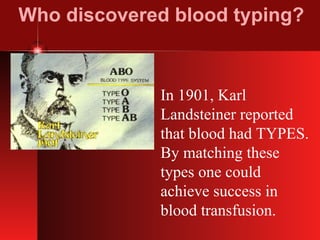
Who discovered blood typing? In 1901, Karl  Landsteiner reported that blood had TYPES. By matching these types one could  achieve success in blood transfusion.
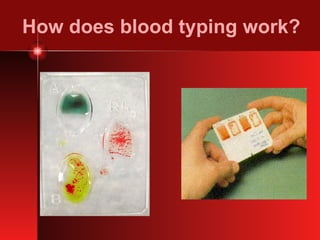
How does blood typing work?
ABO Blood Groups A reaction outside the body between like antigens and antibodies results in  Agglutination  where the blood cells clump together. A reaction within the body between like antigens and antibodies results in  Hemolysis  of the cells (they burst).
Blood Typing Blood typing detects sugars that act as recognition markers on the surface of our own erythrocytes (red blood cells, RBC’s).  These sugars are recognized by our own immune system and are called  cell surface antigens. There are  THREE  possible genes to code for the markers:
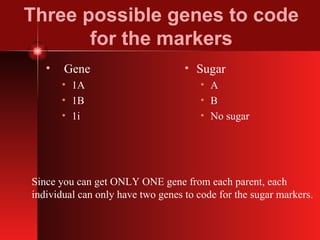
Three possible genes to code for the markers Gene 1A 1B 1i Sugar A B No sugar Since you can get ONLY ONE gene from each parent, each  individual can only have two genes to code for the sugar markers.
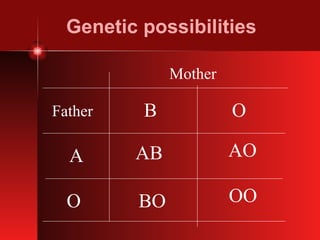
Genetic possibilities Mother Father A O B O AB AO BO OO
What are the possible  Blood Groups ?  ABO TWO facts you need to know to interpret how the genes combine to give blood groups. Gene 1A and Gene 1B are co-dominant.  Both sugars are equal in their presence on the RBC’s Gene 1i codes for  no  sugar, so it is dominated by both 1A and 1B.
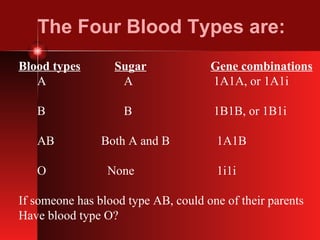
The Four Blood Types are: Blood types Sugar Gene combinations A   A  1A1A, or 1A1i B   B  1B1B, or 1B1i AB   Both A and B   1A1B O   None   1i1i If someone has blood type AB, could one of their parents  Have blood type O?
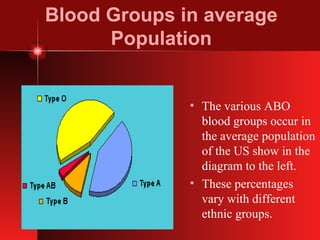
Blood Groups in average Population The various ABO blood groups occur in the average population of the US show in the diagram to the left. These percentages vary with different ethnic groups.
Rh Factor Discovered (1946)  by Karl Landsteiner, Phillip Levine, and Alexander Weiner and their research on the Rhesus monkey, hence the name Rh factor. Three genes ( C, D, and E ) code for the Rh antigens present on the RBC cell membrane.
Rh Factors Blood Types Based on Rh Factors Rh+  Rh antigens are present on the  RBC’s Rh-  Rh are  not  present on the  RBC’s. 85% of Americans are Rh+
More Rh Factors Normally the plasma does not contain Rh antibodies. Rh negative individuals that receive Rh+ blood can have their immune system develop Rh antibodies that will remain in the blood.
Erythroblastosis fetalis (Hemolytic disease of the newborn) A Rh  negative  mother may be exposed to the Rh antigen from the blood cells of the Rh  positive  baby during pregnancy or at the time of birth. If the Rh +  blood cells enter the Rh -  mother’ blood the mother’s immune system may become sensitized and produce antibodies against Rh +  blood antigens In subsequent pregnancies, these antigens may cross the placenta and causes the hemolysis of the Rh +  blood cells in the fetus.
What Happens and What  Can Be Done? The Rh positive baby will become anemic. This can be avoided by injecting the Rh negative woman with antibodies (RhoGAM) during each pregnancy and within 72 hours after birth of each Rh positive baby. The injection of antibodies into the woman inactivates the Rh antigens on those blood cells that might have entered the mother’s blood and prevents her body from activating her immune system.
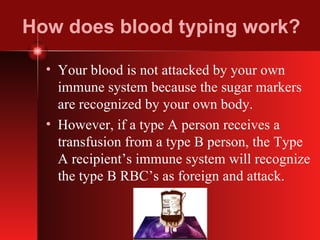
How does blood typing work? Your blood is not attacked by your own immune system because the sugar markers are recognized by your own body. However, if a type A person receives a transfusion from a type B person, the Type A recipient’s immune system will recognize the type B RBC’s as foreign and attack.
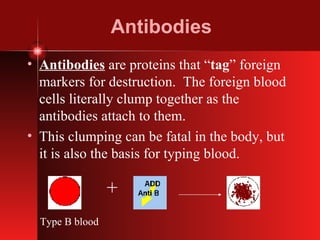
Antibodies Antibodies  are proteins that “ tag ” foreign markers for destruction.  The foreign blood cells literally clump together as the antibodies attach to them. This clumping can be fatal in the body, but it is also the basis for typing blood. + Type B blood
Other Examples Blood Donor Type   Antigen   Antibody   Clump? A   A   Anti-A   YES O   None   Anti-A   NO Why are Type O people called universal donors? What would happen if you gave a type O person, type B blood? Who is the universal recipient?
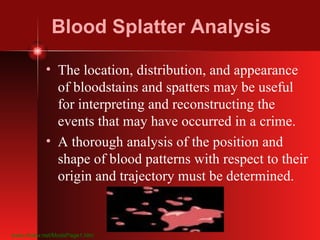
Blood Splatter Analysis The location, distribution, and appearance of bloodstains and spatters may be useful for interpreting and reconstructing the events that may have occurred in a crime. A thorough analysis of the position and shape of blood patterns with respect to their origin and trajectory must be determined. www.rfview.net/ModsPage1.htm
Stain Patterns of Blood The harder and less porous surface The less spatter results. Direction of travel of blood striking an object. Pointed end of a bloodstain always faces its direction of travel. Impact of angle Look at degree of circular distortion of the stain.  A drop of blood striking a surface at right angles gives rise to a nearly circular stain.  As the angle decreases, the stain becomes elongated in shape. Stain convergence on a two-dimensional plane. Can be established by drawing straight lines through the long axis of several individual bloodstains.  The intersection or point of convergence of the lines represents the point from which the blood emanated.
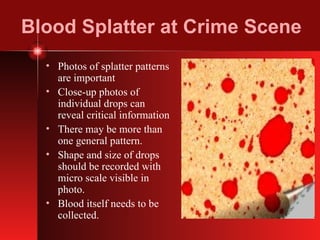
Blood Splatter at Crime Scene Photos of splatter patterns are important Close-up photos of individual drops can reveal critical information There may be more than one general pattern. Shape and size of drops should be recorded with micro scale visible in photo. Blood itself needs to be collected.
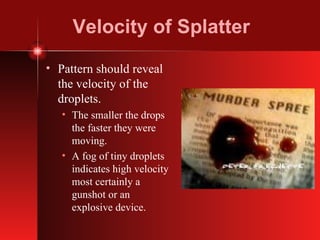
Velocity of Splatter Pattern should reveal the velocity of the droplets. The smaller the drops the faster they were moving. A fog of tiny droplets indicates high velocity most certainly a gunshot or an explosive device.
Many types of blood splatter In the field there may be several wounds, all with their own pattern. Impact splatters Traveling drip patterns Result from blood that falls from a wounded person or person that has blood on them Bizarre splatter patterns Droplets flicked from blood soaked hair of a running person. Weapons carried through scene especially blunt force weapons and knives can leave their own drip pattern. Arterial spurting Patterns reflects the beating of a heart.
Serology Lab In this lab you will be using simulated blood to determine blood types You will first use known blood types and look at the effects when adding antibody A or antibody B. You will then have unknowns to determine what blood type it is. Record all your work on the data sheets. Make sure you answer all questions, and clean up when done.
Bibliography Genge, N. E., “The Forensic Casebook”, Ballantine Books, 2002 Lee, Henry, “Crime Scene Handbook”. Academic Press, 2001. Saferstein, Richard, “Criminalistics an Introduction to Forensics Science”, Prentice Hall, 2001. Google Image Search, Blood typing and splatter analysis.

Serology spatter

  • 1.
    Serology and ForensicsBlood Typing And Blood Splatter Analysis
  • 2.
    What is blood?Blood is connective tissue. It is composed of a sticky fluid called PLASMA Plasma is mostly water but it also has other substances dissolved in the water. Plasma contains: Proteins: antibodies, clotting proteins Salts and ions: calcium, sodium chlorine Circulating wastes and nutrients: glucose, lipids, hormones, and wastes
  • 3.
    40% of bloodvolume is actually occupied by cells Leukocytes: only about 1% of the cells. Defend the body against invasion Platelets: fragments of bone marrow cells that help in blood clotting. Erythrocytes: Red blood cells. 5 billion of these cells in 1 ml of blood. Shaped like a flat disk with a central depression on both sides. Hemoglobin carrying oxygen makes them red.
  • 4.
    Who discovered bloodtyping? In 1901, Karl Landsteiner reported that blood had TYPES. By matching these types one could achieve success in blood transfusion.
  • 5.
    How does bloodtyping work?
  • 6.
    ABO Blood GroupsA reaction outside the body between like antigens and antibodies results in Agglutination where the blood cells clump together. A reaction within the body between like antigens and antibodies results in Hemolysis of the cells (they burst).
  • 7.
    Blood Typing Bloodtyping detects sugars that act as recognition markers on the surface of our own erythrocytes (red blood cells, RBC’s). These sugars are recognized by our own immune system and are called cell surface antigens. There are THREE possible genes to code for the markers:
  • 8.
    Three possible genesto code for the markers Gene 1A 1B 1i Sugar A B No sugar Since you can get ONLY ONE gene from each parent, each individual can only have two genes to code for the sugar markers.
  • 9.
    Genetic possibilities MotherFather A O B O AB AO BO OO
  • 10.
    What are thepossible Blood Groups ? ABO TWO facts you need to know to interpret how the genes combine to give blood groups. Gene 1A and Gene 1B are co-dominant. Both sugars are equal in their presence on the RBC’s Gene 1i codes for no sugar, so it is dominated by both 1A and 1B.
  • 11.
    The Four BloodTypes are: Blood types Sugar Gene combinations A A 1A1A, or 1A1i B B 1B1B, or 1B1i AB Both A and B 1A1B O None 1i1i If someone has blood type AB, could one of their parents Have blood type O?
  • 12.
    Blood Groups inaverage Population The various ABO blood groups occur in the average population of the US show in the diagram to the left. These percentages vary with different ethnic groups.
  • 13.
    Rh Factor Discovered(1946) by Karl Landsteiner, Phillip Levine, and Alexander Weiner and their research on the Rhesus monkey, hence the name Rh factor. Three genes ( C, D, and E ) code for the Rh antigens present on the RBC cell membrane.
  • 14.
    Rh Factors BloodTypes Based on Rh Factors Rh+ Rh antigens are present on the RBC’s Rh- Rh are not present on the RBC’s. 85% of Americans are Rh+
  • 15.
    More Rh FactorsNormally the plasma does not contain Rh antibodies. Rh negative individuals that receive Rh+ blood can have their immune system develop Rh antibodies that will remain in the blood.
  • 16.
    Erythroblastosis fetalis (Hemolyticdisease of the newborn) A Rh negative mother may be exposed to the Rh antigen from the blood cells of the Rh positive baby during pregnancy or at the time of birth. If the Rh + blood cells enter the Rh - mother’ blood the mother’s immune system may become sensitized and produce antibodies against Rh + blood antigens In subsequent pregnancies, these antigens may cross the placenta and causes the hemolysis of the Rh + blood cells in the fetus.
  • 17.
    What Happens andWhat Can Be Done? The Rh positive baby will become anemic. This can be avoided by injecting the Rh negative woman with antibodies (RhoGAM) during each pregnancy and within 72 hours after birth of each Rh positive baby. The injection of antibodies into the woman inactivates the Rh antigens on those blood cells that might have entered the mother’s blood and prevents her body from activating her immune system.
  • 18.
    How does bloodtyping work? Your blood is not attacked by your own immune system because the sugar markers are recognized by your own body. However, if a type A person receives a transfusion from a type B person, the Type A recipient’s immune system will recognize the type B RBC’s as foreign and attack.
  • 19.
    Antibodies Antibodies are proteins that “ tag ” foreign markers for destruction. The foreign blood cells literally clump together as the antibodies attach to them. This clumping can be fatal in the body, but it is also the basis for typing blood. + Type B blood
  • 20.
    Other Examples BloodDonor Type Antigen Antibody Clump? A A Anti-A YES O None Anti-A NO Why are Type O people called universal donors? What would happen if you gave a type O person, type B blood? Who is the universal recipient?
  • 21.
    Blood Splatter AnalysisThe location, distribution, and appearance of bloodstains and spatters may be useful for interpreting and reconstructing the events that may have occurred in a crime. A thorough analysis of the position and shape of blood patterns with respect to their origin and trajectory must be determined. www.rfview.net/ModsPage1.htm
  • 22.
    Stain Patterns ofBlood The harder and less porous surface The less spatter results. Direction of travel of blood striking an object. Pointed end of a bloodstain always faces its direction of travel. Impact of angle Look at degree of circular distortion of the stain. A drop of blood striking a surface at right angles gives rise to a nearly circular stain. As the angle decreases, the stain becomes elongated in shape. Stain convergence on a two-dimensional plane. Can be established by drawing straight lines through the long axis of several individual bloodstains. The intersection or point of convergence of the lines represents the point from which the blood emanated.
  • 23.
    Blood Splatter atCrime Scene Photos of splatter patterns are important Close-up photos of individual drops can reveal critical information There may be more than one general pattern. Shape and size of drops should be recorded with micro scale visible in photo. Blood itself needs to be collected.
  • 24.
    Velocity of SplatterPattern should reveal the velocity of the droplets. The smaller the drops the faster they were moving. A fog of tiny droplets indicates high velocity most certainly a gunshot or an explosive device.
  • 25.
    Many types ofblood splatter In the field there may be several wounds, all with their own pattern. Impact splatters Traveling drip patterns Result from blood that falls from a wounded person or person that has blood on them Bizarre splatter patterns Droplets flicked from blood soaked hair of a running person. Weapons carried through scene especially blunt force weapons and knives can leave their own drip pattern. Arterial spurting Patterns reflects the beating of a heart.
  • 26.
    Serology Lab Inthis lab you will be using simulated blood to determine blood types You will first use known blood types and look at the effects when adding antibody A or antibody B. You will then have unknowns to determine what blood type it is. Record all your work on the data sheets. Make sure you answer all questions, and clean up when done.
  • 27.
    Bibliography Genge, N.E., “The Forensic Casebook”, Ballantine Books, 2002 Lee, Henry, “Crime Scene Handbook”. Academic Press, 2001. Saferstein, Richard, “Criminalistics an Introduction to Forensics Science”, Prentice Hall, 2001. Google Image Search, Blood typing and splatter analysis.

Editor's Notes

  • #5 Before Landsteiner, blood transfusions could result in death. Landsteiner won the Nobel Prize for his finding. For the first time physicians had the key for properly matching the blood of a donor to a recipient.
  • #26 Arterial spurting patterns form a wave pattern of droplets that show alternating angle and velocity.