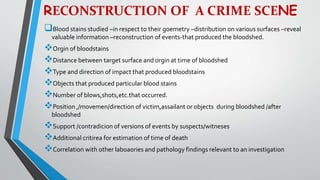
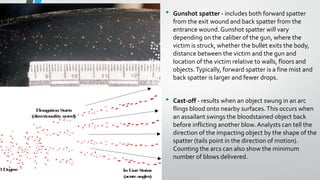
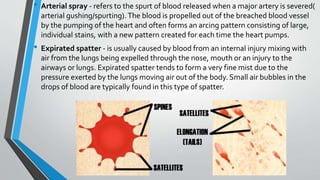
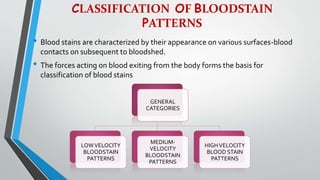
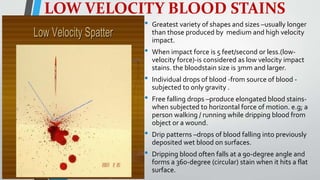
The document discusses bloodstain pattern interpretation, emphasizing its role in forensic science for determining events surrounding bloodshed through the analysis of blood size, shape, and distribution. It details the various professionals involved, including forensic pathologists, toxicologists, and serologists, as well as methods for reconstructing crime scenes using bloodstain geometry. Additionally, it categorizes bloodstains into passive, transfer, and projected types while explaining the physics and biology underlying blood spatter behavior and characteristics.











![Presentation_(2)[1].pptx_20250924_112433_0000.pptx](https://cdn.slidesharecdn.com/ss_thumbnails/presentation21-250930161119-93f53032-thumbnail.jpg?width=640&height=640&fit=bounds)
![Presentation_(2)[1].pptx_20250924_112433_0000.pptx](https://cdn.slidesharecdn.com/ss_thumbnails/presentation21-250930161119-194c9291-thumbnail.jpg?width=640&height=640&fit=bounds)


