Blood spatter analysis
anusha singh
Introduction
Blood is one of the most important and
frequently encountered evidence. It can be
found in almost every type of crime like
murders, assaults, rape, etc. During
commission of violent crimes blood stains are
deposited on floors, walls, and other objects
on the crime scene. Analysis of blood stains
can be very useful in reconstructing actions,
that took place at the scene.
anusha singh
Blood stain pattern analysis
• Blood stain pattern: Blood stain pattern is a
physical geometric image created by blood
contacting the surface or surface contacting
the blood.
• Blood stain pattern analysis: It is the
interpretation of information created by blood
stain patterns.
anusha singh
Info obtained from bloodstain
pattern analysis
• Direction from which blood originated.
• Angle of impact.
• Nature of the force involved.
• Probable distance from the target from which
droplets originated.
• Relative position of the suspect, victim and other
related objects.
• Approximate number of blows during an incident.
anusha singh
• Confirm or refute the assumptions concerning
events and their sequence-
1 ) position of victims
2) evidence of struggle
• Movement of a bleeding individual at a crime
scene.
• Which wounds were inflicted first.
• Type and velocity of weapon.
• Handedness of assailant(right or left handed)
anusha singh
Analyzing spatter stains
Velocity of blood drops :
• The sizes of bloodstains are affected by the
external force.
• Increasing energy of external force will reduce
surface tension thus decreasing the size of
droplets.
• Bloodstains can be divided into 3 categories
based on different travelling speed:-
I. Low velocity impact spatter
II. Medium velocity impact spatter
III. High velocity impact spatteranusha singh
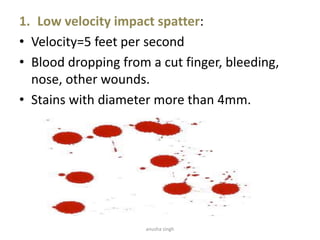
1. Low velocity impact spatter:
• Velocity=5 feet per second
• Blood dropping from a cut finger, bleeding,
nose, other wounds.
• Stains with diameter more than 4mm.
anusha singh
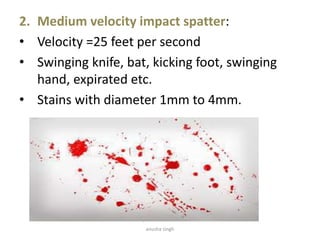
2. Medium velocity impact spatter:
• Velocity =25 feet per second
• Swinging knife, bat, kicking foot, swinging
hand, expirated etc.
• Stains with diameter 1mm to 4mm.
anusha singh
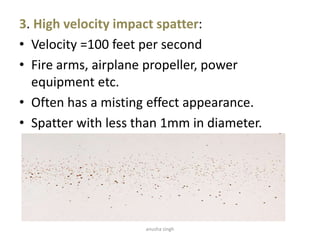
3. High velocity impact spatter:
• Velocity =100 feet per second
• Fire arms, airplane propeller, power
equipment etc.
• Often has a misting effect appearance.
• Spatter with less than 1mm in diameter.
anusha singh
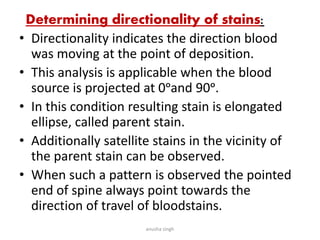
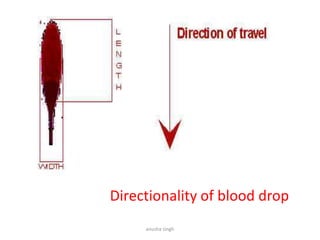
Determining directionality of stains:
• Directionality indicates the direction blood
was moving at the point of deposition.
• This analysis is applicable when the blood
source is projected at 0ᵒand 90ᵒ.
• In this condition resulting stain is elongated
ellipse, called parent stain.
• Additionally satellite stains in the vicinity of
the parent stain can be observed.
• When such a pattern is observed the pointed
end of spine always point towards the
direction of travel of bloodstains.
anusha singh
Directionality of blood drop
anusha singh
Determining angles of impact :
• The shapes of the spatter stains are affected
by the angle of impact.
• When a blood drop strikes surface at 90ᵒ a
circular parent stain is observed.
• As the impact angle decreases shape of stain
becomes more elongated.
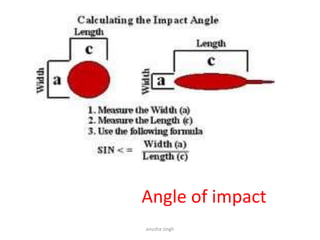
• Ratio of width and length of parent stain is
proportional to sine of angle of impact.
• Sinα= w÷l ; here α is angle of impact
anusha singh
Angle of impact
anusha singh
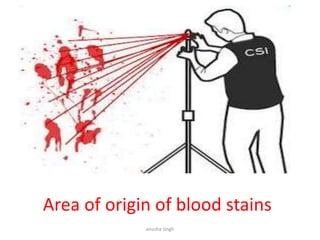
Determining area of origin :
• Area of origin is a 3D location from which spatter
originated.
• Using simple trigonometry, area of origin can be
determined. This can be accomplished by using
by using string or tangent method.
• In string method angle of impact of each stain is
calculated.
• A string is connected between stain and surface.
Path of string indicating trajectory of stain is set
using a protactor based on calculated angle of
impact.
• For a spatter pattern generated from single event,
the strings converge. The area where strings meet
is area of origin. anusha singh
Area of origin of blood stains
anusha singh
Types of stain
• Passive bloodstains- formed due to bleeding
from wound deposited on surface under
influence of gravity
• Transfer bloodstains- resulting from contact
between a blood bearing surface and other
• Projected bloodstain- formed when a volume
of blood is deposited on a surface under a
pressure or a force that is greater than the force
of gravity
anusha singh
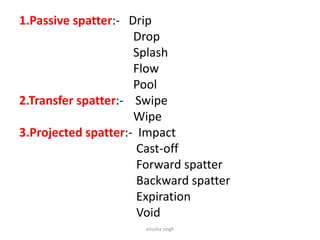
1.Passive spatter:- Drip
Drop
Splash
Flow
Pool
2.Transfer spatter:- Swipe
Wipe
3.Projected spatter:- Impact
Cast-off
Forward spatter
Backward spatter
Expiration
Void
anusha singh
Drip pattern
A bloodstain
pattern resulting
from a liquid
that dripped into
another liquid,
at least one of
which was
blood.
anusha singh
Drop pattern
A bloodstain
resulting from
a falling drop
that formed
due to gravity.
anusha singh
Splash pattern
A bloodstain
pattern
resulting from
a volume of
liquid blood
that falls or
spills onto a
surface.
anusha singh
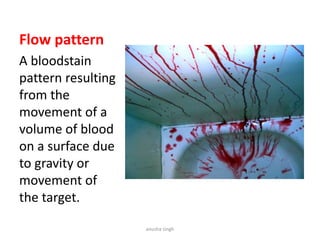
Flow pattern
A bloodstain
pattern resulting
from the
movement of a
volume of blood
on a surface due
to gravity or
movement of
the target.
anusha singh
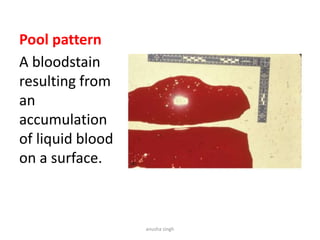
Pool pattern
A bloodstain
resulting from
an
accumulation
of liquid blood
on a surface.
anusha singh
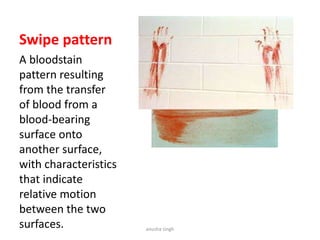
Swipe pattern
A bloodstain
pattern resulting
from the transfer
of blood from a
blood-bearing
surface onto
another surface,
with characteristics
that indicate
relative motion
between the two
surfaces. anusha singh
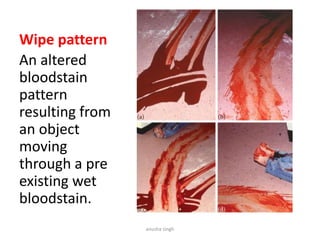
Wipe pattern
An altered
bloodstain
pattern
resulting from
an object
moving
through a pre
existing wet
bloodstain.
anusha singh
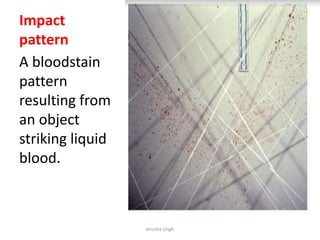
Impact
pattern
A bloodstain
pattern
resulting from
an object
striking liquid
blood.
anusha singh
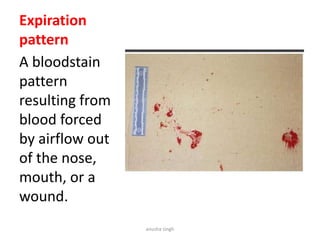
Expiration
pattern
A bloodstain
pattern
resulting from
blood forced
by airflow out
of the nose,
mouth, or a
wound.
anusha singh
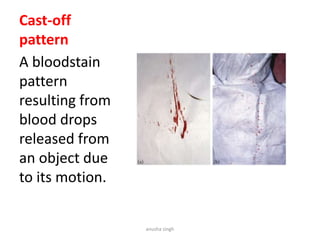
Cast-off
pattern
A bloodstain
pattern
resulting from
blood drops
released from
an object due
to its motion.
anusha singh
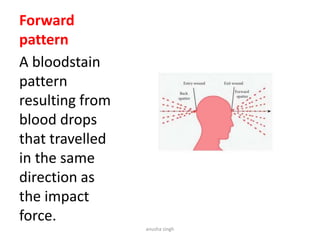
Forward
pattern
A bloodstain
pattern
resulting from
blood drops
that travelled
in the same
direction as
the impact
force.
anusha singh
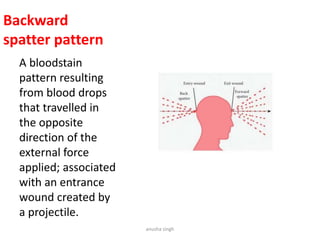
Backward
spatter pattern
A bloodstain
pattern resulting
from blood drops
that travelled in
the opposite
direction of the
external force
applied; associated
with an entrance
wound created by
a projectile.
anusha singh
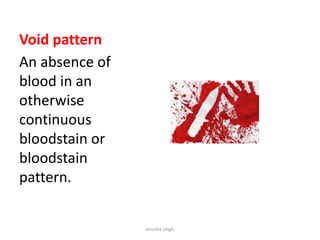
Void pattern
An absence of
blood in an
otherwise
continuous
bloodstain or
bloodstain
pattern.
anusha singh

blood spatter analysis

  • 1.
  • 2.
    Introduction Blood is oneof the most important and frequently encountered evidence. It can be found in almost every type of crime like murders, assaults, rape, etc. During commission of violent crimes blood stains are deposited on floors, walls, and other objects on the crime scene. Analysis of blood stains can be very useful in reconstructing actions, that took place at the scene. anusha singh
  • 3.
    Blood stain patternanalysis • Blood stain pattern: Blood stain pattern is a physical geometric image created by blood contacting the surface or surface contacting the blood. • Blood stain pattern analysis: It is the interpretation of information created by blood stain patterns. anusha singh
  • 4.
    Info obtained frombloodstain pattern analysis • Direction from which blood originated. • Angle of impact. • Nature of the force involved. • Probable distance from the target from which droplets originated. • Relative position of the suspect, victim and other related objects. • Approximate number of blows during an incident. anusha singh
  • 5.
    • Confirm orrefute the assumptions concerning events and their sequence- 1 ) position of victims 2) evidence of struggle • Movement of a bleeding individual at a crime scene. • Which wounds were inflicted first. • Type and velocity of weapon. • Handedness of assailant(right or left handed) anusha singh
  • 6.
    Analyzing spatter stains Velocityof blood drops : • The sizes of bloodstains are affected by the external force. • Increasing energy of external force will reduce surface tension thus decreasing the size of droplets. • Bloodstains can be divided into 3 categories based on different travelling speed:- I. Low velocity impact spatter II. Medium velocity impact spatter III. High velocity impact spatteranusha singh
  • 7.
    1. Low velocityimpact spatter: • Velocity=5 feet per second • Blood dropping from a cut finger, bleeding, nose, other wounds. • Stains with diameter more than 4mm. anusha singh
  • 8.
    2. Medium velocityimpact spatter: • Velocity =25 feet per second • Swinging knife, bat, kicking foot, swinging hand, expirated etc. • Stains with diameter 1mm to 4mm. anusha singh
  • 9.
    3. High velocityimpact spatter: • Velocity =100 feet per second • Fire arms, airplane propeller, power equipment etc. • Often has a misting effect appearance. • Spatter with less than 1mm in diameter. anusha singh
  • 10.
    Determining directionality ofstains: • Directionality indicates the direction blood was moving at the point of deposition. • This analysis is applicable when the blood source is projected at 0ᵒand 90ᵒ. • In this condition resulting stain is elongated ellipse, called parent stain. • Additionally satellite stains in the vicinity of the parent stain can be observed. • When such a pattern is observed the pointed end of spine always point towards the direction of travel of bloodstains. anusha singh
  • 11.
    Directionality of blooddrop anusha singh
  • 12.
    Determining angles ofimpact : • The shapes of the spatter stains are affected by the angle of impact. • When a blood drop strikes surface at 90ᵒ a circular parent stain is observed. • As the impact angle decreases shape of stain becomes more elongated. • Ratio of width and length of parent stain is proportional to sine of angle of impact. • Sinα= w÷l ; here α is angle of impact anusha singh
  • 13.
  • 14.
    Determining area oforigin : • Area of origin is a 3D location from which spatter originated. • Using simple trigonometry, area of origin can be determined. This can be accomplished by using by using string or tangent method. • In string method angle of impact of each stain is calculated. • A string is connected between stain and surface. Path of string indicating trajectory of stain is set using a protactor based on calculated angle of impact. • For a spatter pattern generated from single event, the strings converge. The area where strings meet is area of origin. anusha singh
  • 15.
    Area of originof blood stains anusha singh
  • 16.
    Types of stain •Passive bloodstains- formed due to bleeding from wound deposited on surface under influence of gravity • Transfer bloodstains- resulting from contact between a blood bearing surface and other • Projected bloodstain- formed when a volume of blood is deposited on a surface under a pressure or a force that is greater than the force of gravity anusha singh
  • 17.
    1.Passive spatter:- Drip Drop Splash Flow Pool 2.Transferspatter:- Swipe Wipe 3.Projected spatter:- Impact Cast-off Forward spatter Backward spatter Expiration Void anusha singh
  • 18.
    Drip pattern A bloodstain patternresulting from a liquid that dripped into another liquid, at least one of which was blood. anusha singh
  • 19.
    Drop pattern A bloodstain resultingfrom a falling drop that formed due to gravity. anusha singh
  • 20.
    Splash pattern A bloodstain pattern resultingfrom a volume of liquid blood that falls or spills onto a surface. anusha singh
  • 21.
    Flow pattern A bloodstain patternresulting from the movement of a volume of blood on a surface due to gravity or movement of the target. anusha singh
  • 22.
    Pool pattern A bloodstain resultingfrom an accumulation of liquid blood on a surface. anusha singh
  • 23.
    Swipe pattern A bloodstain patternresulting from the transfer of blood from a blood-bearing surface onto another surface, with characteristics that indicate relative motion between the two surfaces. anusha singh
  • 24.
    Wipe pattern An altered bloodstain pattern resultingfrom an object moving through a pre existing wet bloodstain. anusha singh
  • 25.
    Impact pattern A bloodstain pattern resulting from anobject striking liquid blood. anusha singh
  • 26.
    Expiration pattern A bloodstain pattern resulting from bloodforced by airflow out of the nose, mouth, or a wound. anusha singh
  • 27.
    Cast-off pattern A bloodstain pattern resulting from blooddrops released from an object due to its motion. anusha singh
  • 28.
    Forward pattern A bloodstain pattern resulting from blooddrops that travelled in the same direction as the impact force. anusha singh
  • 29.
    Backward spatter pattern A bloodstain patternresulting from blood drops that travelled in the opposite direction of the external force applied; associated with an entrance wound created by a projectile. anusha singh
  • 30.
    Void pattern An absenceof blood in an otherwise continuous bloodstain or bloodstain pattern. anusha singh