LESSON 6: GENETIC ENGINEERING
GENERAL BIOLOGY 2
OBJECTIVES OF THE DAY!
 At the end of the lesson, the learners will be able to:
a. Compare classical breeding with modern genetic
engineering techniques;
b. Enumerate the steps in molecular cloning;
c. Describe some methods to introduce DNA into cells; and
d. Explain the selection and screening of transformants /
genetically modified organisms (GMO’s)
INTRODUCTION
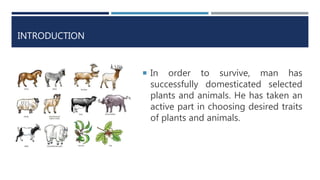
 In order to survive, man has
successfully domesticated selected
plants and animals. He has taken an
active part in choosing desired traits
of plants and animals.
INTRODUCTION
 Traits that were considered valuable were sought out and
propagated.
 The process involved may include classical breeding practices
such as controlled pollination of plants, and the mating of animals
with desired traits.
In today’s modern science, molecular biology techniques are being
employed in the insertion and expression of proteins in different
organisms for various purposes.
KOBE / WAGYU BEEF
BEEF WITH GOOD FAT DISTRIBUTION
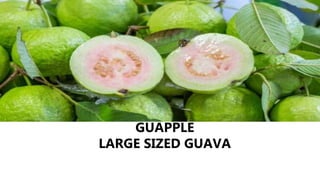
GUAPPLE
LARGE SIZED GUAVA
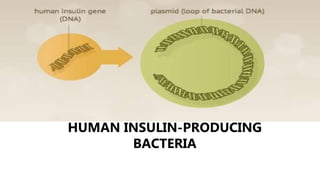
HUMAN INSULIN-PRODUCING
BACTERIA
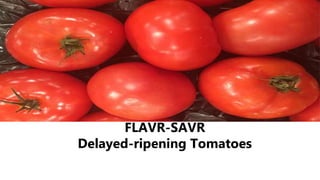
FLAVR-SAVR
Delayed-ripening Tomatoes
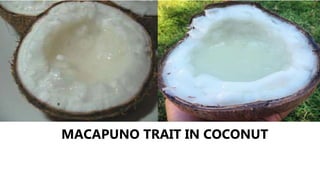
MACAPUNO TRAIT IN COCONUT
CLASSICAL BREEDING
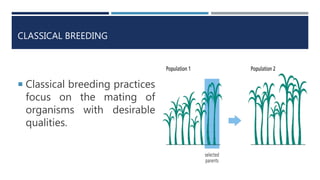
 Classical breeding practices
focus on the mating of
organisms with desirable
qualities.
GENETIC ENGINEERING
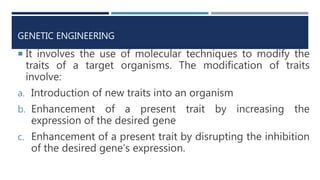
 It involves the use of molecular techniques to modify the
traits of a target organisms. The modification of traits
involve:
a. Introduction of new traits into an organism
b. Enhancement of a present trait by increasing the
expression of the desired gene
c. Enhancement of a present trait by disrupting the inhibition
of the desired gene’s expression.
GENERAL OUTLINE
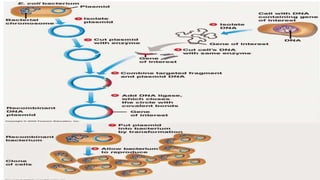
RECOMBINANT DNA
WAYS
Ways in which these plasmids may be introduced into host
organism.
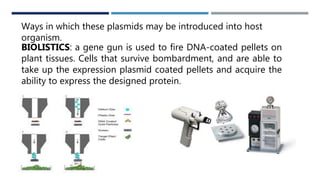
BIOLISTICS: a gene gun is used to fire DNA-coated pellets on
plant tissues. Cells that survive bombardment, and are able to
take up the expression plasmid coated pellets and acquire the
ability to express the designed protein.
WAYS
Ways in which these plasmids may be introduced into host
organism.
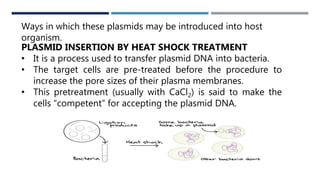
PLASMID INSERTION BY HEAT SHOCK TREATMENT
• It is a process used to transfer plasmid DNA into bacteria.
• The target cells are pre-treated before the procedure to
increase the pore sizes of their plasma membranes.
• This pretreatment (usually with CaCl2) is said to make the
cells “competent” for accepting the plasmid DNA.
WAYS
Ways in which these plasmids may be introduced into host
organism.
PLASMID INSERTION BY HEAT SHOCK TREATMENT
• After the cells are made competent, they are incubated with
the desired plasmid at about 4°C for about 30min.
• The plasmids concentrate near the cells during this time.
Afterwards, a “Heat Shock” is done on the plasmid-cell
solution by incubating it at 42°C for 1 minute then back to
4°C for 2 minutes.
WAYS
Ways in which these plasmids may be introduced into host
organism.
PLASMID INSERTION BY HEAT SHOCK TREATMENT
• The rapid rise and drop of temperature is believed to
increase and decrease the pore sizes in the membrane.
• The plasmid DNA near the membrane surface are taken into
the cells by this process. The cells that took up the plasmids
acquire new traits and are said to be “transformed”.
WAYS
Ways in which these plasmids may be introduced into host
organism.
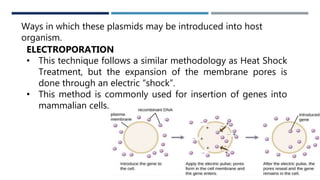
ELECTROPORATION
• This technique follows a similar methodology as Heat Shock
Treatment, but the expansion of the membrane pores is
done through an electric “shock”.
• This method is commonly used for insertion of genes into
mammalian cells.
GENETICALLY MODIFIED ORGANISMS (GMO)
 With the ability to insert gene sequences, comes the possibility of
providing new traits for these target organisms.
 This has allowed the development of GMOs. Some of these genetic
modifications promise higher product yield for their targets. These
include the Flavr-Savr Tomato and Bt-Corn.
GENETICALLY MODIFIED ORGANISMS (GMO)
 The Flavr-Savr (“Flavor Savor”) tomato was the first genetically
modified organism that was licensed for human consumption. The
trait modified in this tomato is its ripening process.
 A gene for an enzyme that causes the degradation of pectin in the
cell walls (i.e. polygalacturonase) normally softens the fruit as it
ripens.
 In Flavr Savr tomatoes, an inhibitor (i.e. antisense RNA) disrupts the
expression of this gene, thereby delaying the softening of the fruit
and extending the time it may be kept in storage and transported
to markets.
GENETICALLY MODIFIED ORGANISMS (GMO)
 Bt-Corn was developed to incorporate the production of a toxin
(i.e. Bt-endotoxin) from Bacillus thuringiensis in corn plants.
 This toxin results in the death of pests that feed on these plants
like the corn borer larvae. The toxin has been shown to be selective
for Lepidoptera larvae and is non-toxic to humans, mammals, fish
and birds.
GENETICALLY MODIFIED ORGANISMS (GMO)
 The selective toxicity of the toxin allows its use in food crops.
 The introduction of the toxin is believed to increase crop
production due to decreased losses from pest infestation. The
same technology has been applied in the Philippines for the
development of Bt-Eggplant
GENETICALLY MODIFIED ORGANISMS (GMO)
 Despite the proposed benefits of GMOs, some people have raised
their concerns regarding the consumption of these modified foods.
While most of the products are tested for safety, concerns are
raised for the possibility of not being able to detect hazards that
are present, but are currently undetectable by today’s current
technology.
GENETICALLY MODIFIED ORGANISMS (GMO)
 Because of these issues, manufacturers are urged to provide labels
that notify consumers of GMO presence in their products. While
GMOs are believed to be safe when licensed by the food
regulatory agencies, it is believed that the consumers must be
provided with enough information to make their own choices
regarding their use.

Lesson 6: Genetic Engineering

  • 1.
    LESSON 6: GENETICENGINEERING GENERAL BIOLOGY 2
  • 2.
    OBJECTIVES OF THEDAY!  At the end of the lesson, the learners will be able to: a. Compare classical breeding with modern genetic engineering techniques; b. Enumerate the steps in molecular cloning; c. Describe some methods to introduce DNA into cells; and d. Explain the selection and screening of transformants / genetically modified organisms (GMO’s)
  • 3.
    INTRODUCTION  In orderto survive, man has successfully domesticated selected plants and animals. He has taken an active part in choosing desired traits of plants and animals.
  • 4.
    INTRODUCTION  Traits thatwere considered valuable were sought out and propagated.  The process involved may include classical breeding practices such as controlled pollination of plants, and the mating of animals with desired traits. In today’s modern science, molecular biology techniques are being employed in the insertion and expression of proteins in different organisms for various purposes.
  • 5.
    KOBE / WAGYUBEEF BEEF WITH GOOD FAT DISTRIBUTION
  • 6.
  • 7.
  • 8.
  • 9.
  • 10.
    CLASSICAL BREEDING  Classicalbreeding practices focus on the mating of organisms with desirable qualities.
  • 11.
    GENETIC ENGINEERING  Itinvolves the use of molecular techniques to modify the traits of a target organisms. The modification of traits involve: a. Introduction of new traits into an organism b. Enhancement of a present trait by increasing the expression of the desired gene c. Enhancement of a present trait by disrupting the inhibition of the desired gene’s expression.
  • 12.
  • 14.
    WAYS Ways in whichthese plasmids may be introduced into host organism. BIOLISTICS: a gene gun is used to fire DNA-coated pellets on plant tissues. Cells that survive bombardment, and are able to take up the expression plasmid coated pellets and acquire the ability to express the designed protein.
  • 15.
    WAYS Ways in whichthese plasmids may be introduced into host organism. PLASMID INSERTION BY HEAT SHOCK TREATMENT • It is a process used to transfer plasmid DNA into bacteria. • The target cells are pre-treated before the procedure to increase the pore sizes of their plasma membranes. • This pretreatment (usually with CaCl2) is said to make the cells “competent” for accepting the plasmid DNA.
  • 16.
    WAYS Ways in whichthese plasmids may be introduced into host organism. PLASMID INSERTION BY HEAT SHOCK TREATMENT • After the cells are made competent, they are incubated with the desired plasmid at about 4°C for about 30min. • The plasmids concentrate near the cells during this time. Afterwards, a “Heat Shock” is done on the plasmid-cell solution by incubating it at 42°C for 1 minute then back to 4°C for 2 minutes.
  • 17.
    WAYS Ways in whichthese plasmids may be introduced into host organism. PLASMID INSERTION BY HEAT SHOCK TREATMENT • The rapid rise and drop of temperature is believed to increase and decrease the pore sizes in the membrane. • The plasmid DNA near the membrane surface are taken into the cells by this process. The cells that took up the plasmids acquire new traits and are said to be “transformed”.
  • 18.
    WAYS Ways in whichthese plasmids may be introduced into host organism. ELECTROPORATION • This technique follows a similar methodology as Heat Shock Treatment, but the expansion of the membrane pores is done through an electric “shock”. • This method is commonly used for insertion of genes into mammalian cells.
  • 19.
    GENETICALLY MODIFIED ORGANISMS(GMO)  With the ability to insert gene sequences, comes the possibility of providing new traits for these target organisms.  This has allowed the development of GMOs. Some of these genetic modifications promise higher product yield for their targets. These include the Flavr-Savr Tomato and Bt-Corn.
  • 20.
    GENETICALLY MODIFIED ORGANISMS(GMO)  The Flavr-Savr (“Flavor Savor”) tomato was the first genetically modified organism that was licensed for human consumption. The trait modified in this tomato is its ripening process.  A gene for an enzyme that causes the degradation of pectin in the cell walls (i.e. polygalacturonase) normally softens the fruit as it ripens.  In Flavr Savr tomatoes, an inhibitor (i.e. antisense RNA) disrupts the expression of this gene, thereby delaying the softening of the fruit and extending the time it may be kept in storage and transported to markets.
  • 21.
    GENETICALLY MODIFIED ORGANISMS(GMO)  Bt-Corn was developed to incorporate the production of a toxin (i.e. Bt-endotoxin) from Bacillus thuringiensis in corn plants.  This toxin results in the death of pests that feed on these plants like the corn borer larvae. The toxin has been shown to be selective for Lepidoptera larvae and is non-toxic to humans, mammals, fish and birds.
  • 22.
    GENETICALLY MODIFIED ORGANISMS(GMO)  The selective toxicity of the toxin allows its use in food crops.  The introduction of the toxin is believed to increase crop production due to decreased losses from pest infestation. The same technology has been applied in the Philippines for the development of Bt-Eggplant
  • 23.
    GENETICALLY MODIFIED ORGANISMS(GMO)  Despite the proposed benefits of GMOs, some people have raised their concerns regarding the consumption of these modified foods. While most of the products are tested for safety, concerns are raised for the possibility of not being able to detect hazards that are present, but are currently undetectable by today’s current technology.
  • 24.
    GENETICALLY MODIFIED ORGANISMS(GMO)  Because of these issues, manufacturers are urged to provide labels that notify consumers of GMO presence in their products. While GMOs are believed to be safe when licensed by the food regulatory agencies, it is believed that the consumers must be provided with enough information to make their own choices regarding their use.