W H YS T U D Y
B I O L O G Y ?
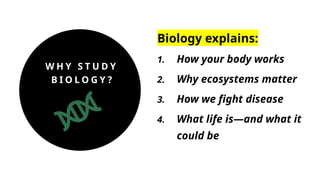
Biology explains:
1. How your body works
2. Why ecosystems matter
3. How we fight disease
4. What life is—and what it
could be
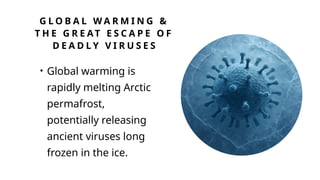
G L OB A L W A R M I N G &
T H E G R E AT E S C A P E O F
D E A D L Y V I R U S E S
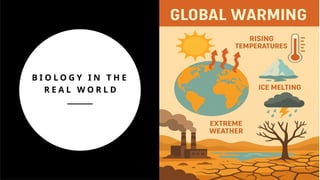
• Global warming is
rapidly melting Arctic
permafrost,
potentially releasing
ancient viruses long
frozen in the ice.
10.
G L OB A L WA R M I N G & T H E G R E AT
E S C A P E O F D E A D LY V I R U S E S .
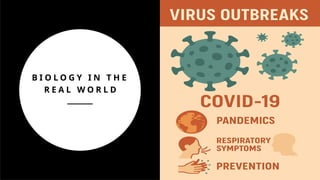
• In 2014, scientists revived Pithovirus sibericum, a 30,000-year-old virus found
in Siberian permafrost, making it the oldest known virus ever reactivated.
• Pithovirus is a giant DNA virus that infects amoebas but is harmless to
humans.
• Its large size and unique structure surprised scientists and revealed that
viruses can remain infectious after tens of thousands of years in frozen
conditions (Legendre et al., 2014).
11.
G L OB A L WA R M I N G & T H E G R E AT
E S C A P E O F D E A D LY V I R U S E S .
• The discovery highlights the growing concern that melting
permafrost could uncover other dormant pathogens, possibly
capable of infecting animals or humans—especially as climate
change intensifies and exposes previously undisturbed
ecosystems (WHO, 2022; NASA, 2023).
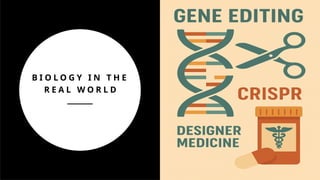
C R IS P R : C L U S T E R E D R E G U L A R L Y
I N T E R S P A C E D S H O R T P A L I N D R O M I C R E P E A T S
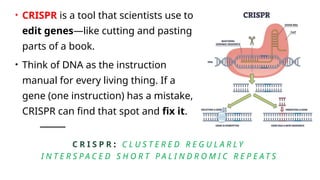
• CRISPR is a tool that scientists use to
edit genes—like cutting and pasting
parts of a book.
• Think of DNA as the instruction
manual for every living thing. If a
gene (one instruction) has a mistake,
CRISPR can find that spot and fix it.
14.
C R IS P R : C L U S T E R E D R E G U L A R L Y
I N T E R S P A C E D S H O R T P A L I N D R O M I C R E P E A T S
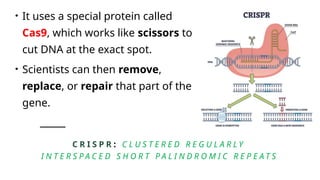
• It uses a special protein called
Cas9, which works like scissors to
cut DNA at the exact spot.
• Scientists can then remove,
replace, or repair that part of the
gene.
15.
D E SI G N E R M E D I C I N E
• Designer medicine (also called personalized medicine)
means creating treatments made just for you based on
your genes, not just using one-size-fits-all drugs.
• Example: Two people with the same disease might get
different treatments because their DNA is different.
• With CRISPR and other genetic tools, doctors can target
the exact cause of a disease in your body.
W H ATI S B I O L O G Y ?
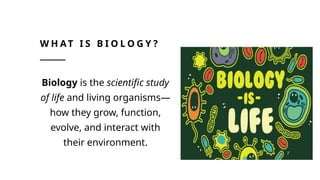
Biology is the scientific study
of life and living organisms—
how they grow, function,
evolve, and interact with
their environment.
22.
🧬 B IO L O G Y I S E V E R Y W H E R E !
• Biology isn’t just something you study
in a lab—it’s all around you.
• Every living thing, every breath, every
bite of food is connected to biology.
23.
🧬 B IO L O G Y I S E V E R Y W H E R E !
• Biology isn’t just something you study
in a lab—it’s all around you.
• Every living thing, every breath, every
bite of food is connected to biology.
24.
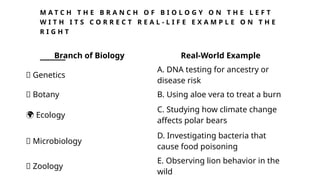
M A TC H T H E B R A N C H O F B I O L O G Y O N T H E L E F T
W I T H I T S C O R R E C T R E A L - L I F E E X A M P L E O N T H E
R I G H T
Branch of Biology Real-World Example
🧬 Genetics
A. DNA testing for ancestry or
disease risk
🌿 Botany B. Using aloe vera to treat a burn
🌍 Ecology
C. Studying how climate change
affects polar bears
🦠 Microbiology
D. Investigating bacteria that
cause food poisoning
🐾 Zoology
E. Observing lion behavior in the
wild
25.
H O WD I D L I F E B E G I N ?
Where did the first life on Earth come from?
• Billions of years ago, Earth was a very different
place—hot, stormy, and without oxygen.
• But somehow, non-living chemicals gave rise to the
first living cells.
26.
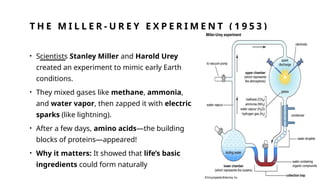
T H EM I L L E R - U R E Y E X P E R I M E N T ( 1 9 5 3 )
• Scientists Stanley Miller and Harold Urey
created an experiment to mimic early Earth
conditions.
• They mixed gases like methane, ammonia,
and water vapor, then zapped it with electric
sparks (like lightning).
• After a few days, amino acids—the building
blocks of proteins—appeared!
• Why it matters: It showed that life’s basic
ingredients could form naturally
27.
🌱 O TH E R H Y P O T H E S E S
• Deep-sea vents: Life may have started near hot,
mineral-rich underwater vents.
• Panspermia: Life (or its building blocks) may have
come from space via meteors.
• RNA world hypothesis: RNA might have been the
first self-replicating molecule before DNA.
28.
T H IN K , S H A R E A N D R E F L E C T
If life started from simple
molecules, what do YOU think
made it cross the line into
something ‘alive’?