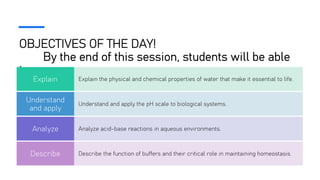
OBJECTIVES OF THEDAY!
By the end of this session, students will be able
to:
Explain the physical and chemical properties of water that make it essential to life.
Explain
Understand and apply the pH scale to biological systems.
Understand
and apply
Analyze acid-base reactions in aqueous environments.
Analyze
Describe the function of buffers and their critical role in maintaining homeostasis.
Describe
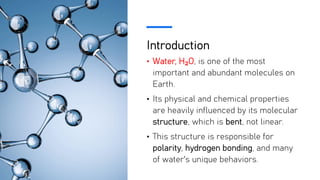
Introduction
• Water, H₂O,is one of the most
important and abundant molecules on
Earth.
• Its physical and chemical properties
are heavily influenced by its molecular
structure, which is bent, not linear.
• This structure is responsible for
polarity, hydrogen bonding, and many
of water's unique behaviors.
5.
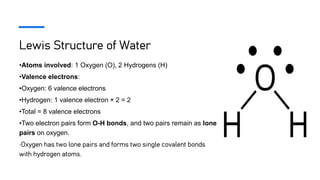
Lewis Structure ofWater
•Atoms involved: 1 Oxygen (O), 2 Hydrogens (H)
•Valence electrons:
•Oxygen: 6 valence electrons
•Hydrogen: 1 valence electron × 2 = 2
•Total = 8 valence electrons
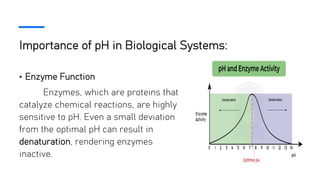
•Two electron pairs form O-H bonds, and two pairs remain as lone
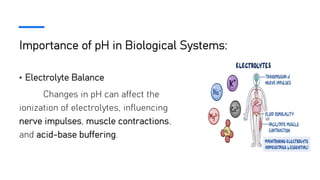
pairs on oxygen.
•Oxygen has two lone pairs and forms two single covalent bonds
with hydrogen atoms.
6.
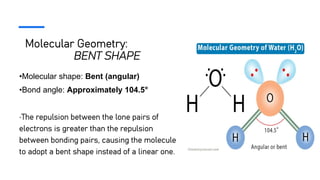
Molecular Geometry:
BENT SHAPE
•Molecularshape: Bent (angular)
•Bond angle: Approximately 104.5°
•The repulsion between the lone pairs of
electrons is greater than the repulsion
between bonding pairs, causing the molecule
to adopt a bent shape instead of a linear one.
7.
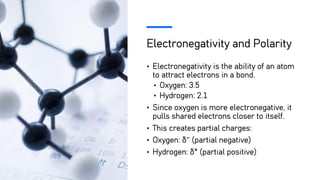
Electronegativity and Polarity
•Electronegativity is the ability of an atom
to attract electrons in a bond.
• Oxygen: 3.5
• Hydrogen: 2.1
• Since oxygen is more electronegative, it
pulls shared electrons closer to itself.
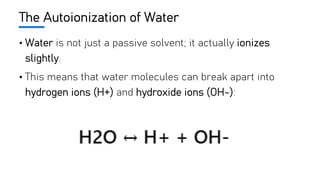
• This creates partial charges:
• Oxygen: δ⁻ (partial negative)
• Hydrogen: δ⁺ (partial positive)
8.
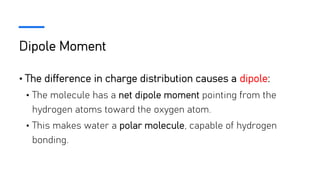
Dipole Moment
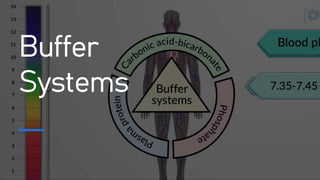
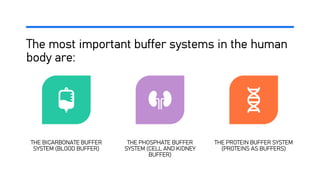
• Thedifference in charge distribution causes a dipole:
• The molecule has a net dipole moment pointing from the
hydrogen atoms toward the oxygen atom.
• This makes water a polar molecule, capable of hydrogen
bonding.
9.
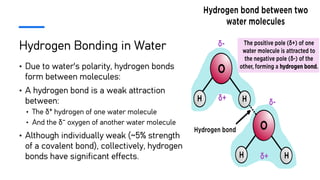
Hydrogen Bonding inWater
• Due to water's polarity, hydrogen bonds
form between molecules:
• A hydrogen bond is a weak attraction
between:
• The δ⁺ hydrogen of one water molecule
• And the δ⁻ oxygen of another water molecule
• Although individually weak (~5% strength
of a covalent bond), collectively, hydrogen
bonds have significant effects.
10.
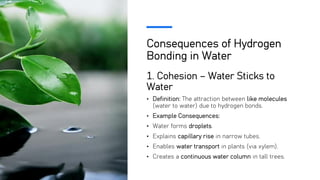
Consequences of Hydrogen
Bondingin Water
1. Cohesion – Water Sticks to
Water
• Definition: The attraction between like molecules
(water to water) due to hydrogen bonds.
• Example Consequences:
• Water forms droplets.
• Explains capillary rise in narrow tubes.
• Enables water transport in plants (via xylem).
• Creates a continuous water column in tall trees.
11.
Consequences of Hydrogen
Bondingin Water
2. Adhesion – Water Sticks to
Other Substances
• Definition: The attraction between unlike molecules (e.g.,
water to glass or plant cell walls).
• Example Consequences:
• Enhances capillary action by helping water climb up
polar surfaces.
• Water spreads out on hydrophilic surfaces (e.g., paper).
• Important in meniscus formation in lab equipment.
12.
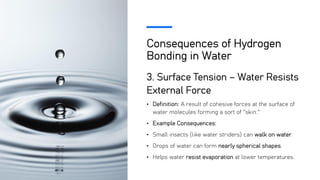
Consequences of Hydrogen
Bondingin Water
3. Surface Tension – Water Resists
External Force
• Definition: A result of cohesive forces at the surface of
water molecules forming a sort of "skin."
• Example Consequences:
• Small insects (like water striders) can walk on water.
• Drops of water can form nearly spherical shapes.
• Helps water resist evaporation at lower temperatures.
13.
Water’s Physical Properties
1.High Heat Capacity
Water can absorb or release a
large amount of heat with only a
small change in its temperature.
14.
Water’s Physical Properties
•Why?
Hydrogen bonds absorb heat energy. Instead of
immediately raising temperature, energy is first
used to disrupt bonds, buffering temperature
change.
• Biological Importance:
• Stabilizes climate and body temperature
• Oceans act as thermal buffers, moderating
coastal climates
• Important in homeostasis (body temp control)
15.
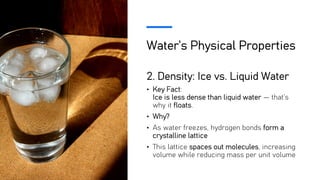
Water’s Physical Properties
2.Density: Ice vs. Liquid Water
• Key Fact:
Ice is less dense than liquid water — that’s
why it floats.
• Why?
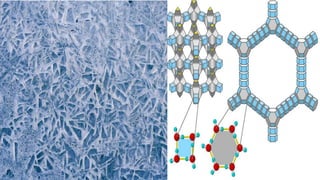
• As water freezes, hydrogen bonds form a
crystalline lattice
• This lattice spaces out molecules, increasing
volume while reducing mass per unit volume
17.
Water’s Physical Properties
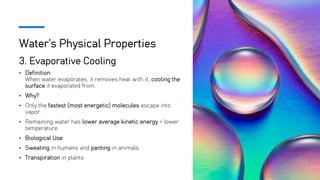
3.Evaporative Cooling
• Definition:
When water evaporates, it removes heat with it, cooling the
surface it evaporated from.
• Why?
• Only the fastest (most energetic) molecules escape into
vapor
• Remaining water has lower average kinetic energy = lower
temperature
• Biological Use:
• Sweating in humans and panting in animals
• Transpiration in plants
18.
Water as a
Universal
Solvent
HowWater Dissolves Ionic
and Polar Molecules?
Water is a polar molecule. This means it has
partial positive charges (δ⁺) on its hydrogen
atoms and partial negative charges (δ⁻) on its
oxygen atom.
"Like dissolves like":
Water dissolves substances that are polar or
charged, because it can interact with them
electrostatically.
19.
Water as aUniversal Solvent
• Dissolving Ionic Compounds (e.g., NaCl)
• Sodium chloride (NaCl) is an ionic compound, composed
of:
• Na⁺ (sodium ions)
• Cl⁻ (chloride ions)
20.
Water as aUniversal Solvent
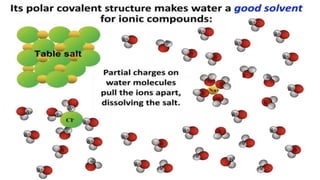
• Dissociation Process:
• Water molecules surround the NaCl crystal.
• The δ⁻ (oxygen) side of water is attracted to Na⁺.
• The δ⁺ (hydrogen) side of water is attracted to Cl⁻.
• Water molecules pull the ions away from the crystal lattice.
• Ions become hydrated (surrounded by water) and disperse in solution.
• This process is called ion-dipole interaction.
22.
Water as aUniversal Solvent
• Dissolving Polar Molecules (e.g., Sugar)
• Water can also dissolve polar covalent molecules:
• Example: Glucose (C₆H₁₂O₆)
• Water forms hydrogen bonds with hydroxyl (–OH) groups on
the sugar
• This allows the sugar to mix uniformly into solution
23.
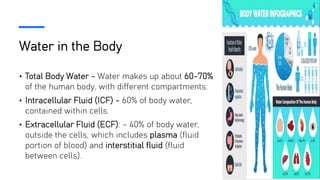
Water in theBody
• Total Body Water - Water makes up about 60-70%
of the human body, with different compartments:
• Intracellular Fluid (ICF) - 60% of body water,
contained within cells.
• Extracellular Fluid (ECF): - 40% of body water,
outside the cells, which includes plasma (fluid
portion of blood) and interstitial fluid (fluid
between cells).
24.
Water Regulation
Water
Regulation -
Thebody
regulates
water balance
to maintain
homeostasis,
using
mechanisms
such as:
Kidneys filter blood, reabsorbing water or excreting it as urine.
Antidiuretic Hormone (ADH) regulates water retention by the
kidneys.
Thirst Mechanism is triggered when water intake is low,
prompting drinking behavior.
Perspiration and Respiration - These processes contribute to
water loss and need to be balanced to avoid dehydration.
25.
Water Imbalances
• Dehydrationis caused by excessive loss of water or insufficient
intake, leading to hyperosmolarity (too concentrated body fluids).
• Water Excess can result from excessive intake or impaired
excretion, such as in renal failure.
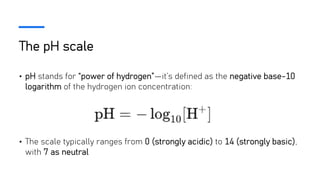
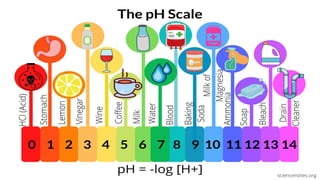
The pH scale
•pH stands for “power of hydrogen”—it’s defined as the negative base-10
logarithm of the hydrogen ion concentration:
• The scale typically ranges from 0 (strongly acidic) to 14 (strongly basic),
with 7 as neutral
29.
Importance of pHin Biological Systems:
• Enzyme Function
Enzymes, which are proteins that
catalyze chemical reactions, are highly
sensitive to pH. Even a small deviation
from the optimal pH can result in
denaturation, rendering enzymes
inactive.
30.
Importance of pHin Biological Systems:
• Electrolyte Balance
Changes in pH can affect the
ionization of electrolytes, influencing
nerve impulses, muscle contractions,
and acid-base buffering.
31.
pH in differentBody Fluids
• Blood pH
• Normal blood pH is between 7.35 and 7.45. Deviation from this range can
lead to acidosis (pH < 7.35) or alkalosis (pH > 7.45), both of which disrupt
normal cellular functions.
• Intracellular Fluid (ICF)
• Slightly more acidic (pH ~7.0) than blood, but tightly regulated to support
metabolic reactions.
32.
Causes of pHImbalance
• Acidosis - Results from an accumulation of hydrogen ions or
carbonic acid, which can occur due to respiratory or metabolic
disturbances.
• Respiratory Acidosis: Caused by a carbon dioxide (CO2) buildup,
leading to increased H+ concentration.
• Metabolic Acidosis: Can be caused by excessive lactic acid buildup
(e.g., from anaerobic exercise) or kidney failure.
33.
Causes of pHImbalance
• Alkalosis: Caused by excessive loss of hydrogen ions or
bicarbonate.
• Respiratory Alkalosis: Caused by hyperventilation, which
reduces CO2 levels in the blood.
• Metabolic Alkalosis: Can result from vomiting, which leads to
the loss of gastric acids.
34.
Real World
Application
Environmental sciences:
pHaffects water quality—acidity or
alkalinity has ecological impacts
Biological systems:
Blood pH must stay tightly between
7.35–7.45. Even small shifts can
have profound health effects
35.
Real World Comparison
SubstanceApprox. pH [H⁺] (M) Nature
Lemon juice ~2 to 3 1×10⁻² to 1×10⁻³ Strong acid
Human blood ~7.35–7.45 ~4.5×10⁻⁸ Slightly alkaline
Bleach ~11.5–12.6
~3×10⁻¹² to
~5×10⁻¹³
Strong base
36.
What This MeansPhysically
• Lemon juice (pH ~2):
• Highly acidic
• Its strong acidity can erode
tooth enamel and is irritating to
biological tissues.
37.
What This MeansPhysically
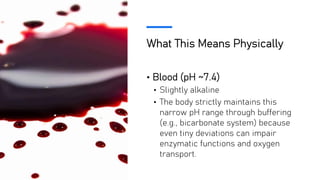
• Blood (pH ~7.4)
• Slightly alkaline
• The body strictly maintains this
narrow pH range through buffering
(e.g., bicarbonate system) because
even tiny deviations can impair
enzymatic functions and oxygen
transport.
38.
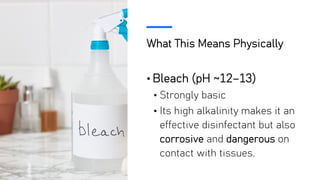
What This MeansPhysically
• Bleach (pH ~12–13)
• Strongly basic
• Its high alkalinity makes it an
effective disinfectant but also
corrosive and dangerous on
contact with tissues.
39.
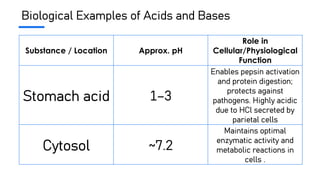
Biological Examples ofAcids and Bases
Substance / Location Approx. pH
Role in
Cellular/Physiological
Function
Stomach acid 1–3
Enables pepsin activation
and protein digestion;
protects against
pathogens. Highly acidic
due to HCl secreted by
parietal cells
Cytosol ~7.2
Maintains optimal
enzymatic activity and
metabolic reactions in
cells .
40.
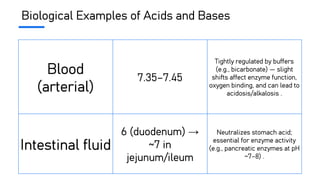
Biological Examples ofAcids and Bases
Blood
(arterial)
7.35–7.45
Tightly regulated by buffers
(e.g., bicarbonate) — slight
shifts affect enzyme function,
oxygen binding, and can lead to
acidosis/alkalosis .
Intestinal fluid
6 (duodenum) →
~7 in
jejunum/ileum
Neutralizes stomach acid;
essential for enzyme activity
(e.g., pancreatic enzymes at pH
~7–8) .
41.
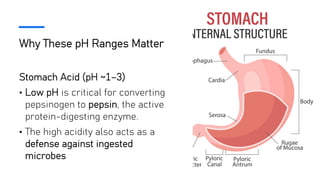
Why These pHRanges Matter
Stomach Acid (pH ~1–3)
• Low pH is critical for converting
pepsinogen to pepsin, the active
protein-digesting enzyme.
• The high acidity also acts as a
defense against ingested
microbes
42.
Why These pHRanges Matter
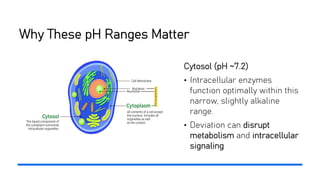
Cytosol (pH ~7.2)
• Intracellular enzymes
function optimally within this
narrow, slightly alkaline
range.
• Deviation can disrupt
metabolism and intracellular
signaling
43.
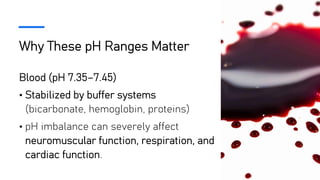
Why These pHRanges Matter
Blood (pH 7.35–7.45)
• Stabilized by buffer systems
(bicarbonate, hemoglobin, proteins)
• pH imbalance can severely affect
neuromuscular function, respiration, and
cardiac function.
44.
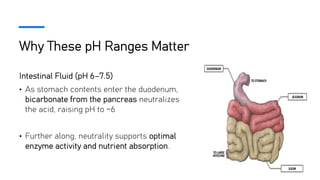
Why These pHRanges Matter
Intestinal Fluid (pH 6–7.5)
• As stomach contents enter the duodenum,
bicarbonate from the pancreas neutralizes
the acid, raising pH to ~6
• Further along, neutrality supports optimal
enzyme activity and nutrient absorption.
45.
Acid-Base Reactions inAqueous Environments
• In the body, acid-base reactions play a critical role in
maintaining proper pH balance.
• pH is a measure of the concentration of hydrogen ions (H+) in
a solution.
• The body needs to regulate pH within a narrow range to ensure
normal cell function, enzyme activity, and metabolic processes.
46.
What Are Acidsand Bases?
• In aqueous solutions (solutions that contain water), acids and
bases interact in specific ways:
• Acids are substances that release hydrogen ions (H+) when
dissolved in water. For example, hydrochloric acid (HCl)
dissociates into H+ and Cl-.
• Bases, on the other hand, can either accept hydrogen ions (H+) or
release hydroxide ions (OH-).
For example, sodium hydroxide (NaOH) dissociates into Na+
and OH-. The OH- ions can accept H+ ions, reducing acidity.
47.
What Are Acidsand Bases?
The balance between the
concentration of H+ (acidity) and
OH- (alkalinity) determines the pH
of a solution.
48.
The Bronsted-Lowry Theory
Tounderstand acids and bases more formally,
we use the Bronsted-Lowry Theory, which
defines acids and bases based on their behavior
with protons (which are just H+ ions)
49.
The Bronsted-Lowry Theory
•Acids are proton donors.
This means an acid releases H+ ions into a solution. For
example, when HCl dissociates, it releases H+.
• Bases are proton acceptors.
This means a base can accept an H+ ion from an acid or
release OH- ions. For example, when NaOH dissolves, the OH-
ions can accept H+ from the solution, reducing its acidity.
50.
The Autoionization ofWater
• Water is not just a passive solvent; it actually ionizes
slightly.
• This means that water molecules can break apart into
hydrogen ions (H+) and hydroxide ions (OH-):
51.
The Autoionization ofWater
• At any given moment, pure water contains equal amounts
of H+ and OH- ions.
• This equilibrium (the state of balance) is important
because it forms the foundation of the pH scale.
• Since water itself contains H+ ions, it can act as both an
acid (because it can donate H+) and a base (because it can
accept H+).
• This is why water is considered neutral with a pH of 7.
Buffer Systems inthe Body
• The body uses buffer systems to maintain pH balance
within a very narrow and specific range (around pH 7.35-
7.45 in blood).
• If the pH moves too far in either direction (too acidic or too
alkaline), it can disrupt critical biochemical reactions,
including enzyme function and cell metabolism.
54.
Buffer Systems inthe Body
• Buffer systems work by resisting changes in pH.
• They do this by either absorbing extra H+ (if the
environment becomes too acidic) or releasing H+ (if it
becomes too basic).
• A buffer system consists of:
• A weak acid (which can donate H+) and
• Its conjugate base (which can accept H+).
55.
The most importantbuffer systems in the human
body are:
THE BICARBONATE BUFFER
SYSTEM (BLOOD BUFFER)
THE PHOSPHATE BUFFER
SYSTEM (CELL AND KIDNEY
BUFFER)
THE PROTEIN BUFFER SYSTEM
(PROTEINS AS BUFFERS)
56.
The Bicarbonate BufferSystem (Blood Buffer)
• This system helps control the pH of the blood,
making sure it doesn’t get too acidic or too alkaline.
• It works with two important molecules: carbonic acid
(H₂CO₃) and bicarbonate ions (HCO₃⁻).
57.
The Bicarbonate BufferSystem (Blood Buffer)
•If the blood becomes too acidic (too many hydrogen ions, H+),
bicarbonate ions (HCO₃⁻) combine with the excess H+ to make
carbonic acid (H₂CO₃), which neutralizes the acid.
•If the blood becomes too alkaline (too few hydrogen ions, H+),
carbonic acid (H₂CO₃) breaks down to release H+, making the blood
more acidic again.
58.
The Phosphate BufferSystem (Cell and Kidney
Buffer)
• This system works inside cells and in the kidneys to
maintain a stable pH, just like the bicarbonate system.
• It involves phosphoric acid (H₂PO₄) and its conjugate base
(called monohydrogen phosphate, HPO₄²⁻).
59.
The Phosphate BufferSystem (Cell and Kidney
Buffer)
• In the body, when phosphoric acid releases H+ ions, it helps
neutralize excess base (OH-), preventing the environment from
becoming too alkaline.
• On the other hand, monohydrogen phosphate can absorb H+ ions,
helping neutralize acid when the body’s environment becomes too
acidic.
60.
The Protein BufferSystem (Proteins as Buffers)
• Your proteins, especially hemoglobin in red blood
cells, can also help maintain pH balance in the body.
61.
The Protein BufferSystem (Proteins as Buffers)
• Proteins have special parts (called amino groups) that can
accept or release H+ ions, acting as natural buffers.
• When the body becomes too acidic, these proteins can
absorb the extra H+ ions, making things less acidic.
• If the body becomes too alkaline, proteins can release
some H+ ions to help make things more acidic.
62.
Maintaining pH andHomeostasis
• Homeostasis refers to the maintenance of a stable internal
environment. In the context of pH, homeostasis is achieved
through the interaction of buffer systems, respiration, and
renal regulation.
63.
Maintaining pH andHomeostasis
• Chemical Buffers - Provide immediate resistance to pH changes, acting
within seconds.
• Respiratory Regulation -The respiratory center in the brain adjusts
breathing rates to control CO2, and therefore, the level of carbonic acid in
the blood.
• Renal Regulation -The kidneys regulate pH by excreting hydrogen ions (H+)
and reabsorbing bicarbonate (HCO3-) over longer periods (hours to days).


![Real World Comparison
Substance Approx. pH [H⁺] (M) Nature
Lemon juice ~2 to 3 1×10⁻² to 1×10⁻³ Strong acid
Human blood ~7.35–7.45 ~4.5×10⁻⁸ Slightly alkaline
Bleach ~11.5–12.6
~3×10⁻¹² to
~5×10⁻¹³
Strong base](https://image.slidesharecdn.com/week2-waterphbuffersandacid-base-250706160205-24f07e8e/85/Lesson-2-WATER-pH-BUFFERS-AND-ACID-BASE-pdf-35-320.jpg)


![Plant physiology report [autosaved]](https://cdn.slidesharecdn.com/ss_thumbnails/plantphysiologyreportautosaved-160801153356-thumbnail.jpg?width=640&height=640&fit=bounds)


