SEASON: - 2019-2020
SUBJECT: - PP 603- Assignment on
GMO , It’s Production Procedure And Application In Crop
Improvement & Transformation, Different Method Of Plant
Transformation
Definition - A genetically modified organism is one whose genetic
material has been altered using genetic engineering in order to favor
the expression of desired physiological traits or the generation of
desired biological products.
OR
“A genetically modified organism (GMO) is usually defined as a living
organism whose genetic composition has been altered by the insertion
of a new gene encoding a desired protein that is expressed.”
In genetic modification, however, recombinant genetic technologies
are employed to produce organisms whose genomes have been
precisely altered at the molecular level, usually by the inclusion
of genes from unrelated species of organisms that code for traits that
would not be obtained easily through conventional selective breeding.
Conventional methods of modifying plants and animals—selective breeding
and crossbreeding—can take a long time. Moreover, selective breeding and
crossbreeding often produce mixed results, with unwanted traits appearing
alongside desired characteristics. The specific targeted modification of DNA
using biotechnology has allowed scientists to avoid this problem and improve
the genetic makeup of an organism without unwanted characteristics tagging
along.
How to produce - By eliminating, modifying or adding copies of specific
genes often from other organisms through modern molecular biology
techniques viz.-
1. Recombinant DNA (rDNA)
2. Genetic engineering
3. Gene splicing
Recombinant DNA technology is a technique which changes the phenotype
of an organism (host) when a genetically altered vector is introduced and
integrated into the genome of the organism. So, basically, the process involves
introducing a foreign piece of DNA into the genome, which contains our gene
of interest. This gene, which is introduced is the recombinant gene and the
technique is called the recombinant DNA technology.
Process of Recombinant DNA Technology
Recombinant DNA technology involves the selection of the desired gene for
administration into the host followed by a selection of the perfect vector with
which the gene has to be integrated and recombinant DNA formed. This
recombinant DNA, then has to be introduced into the host. And at last, it has
to be maintained in the host and carried forward to the offspring's.
Isolation of DNA
Being a nucleic acid enclosed within the nucleus, isolation of DNA is not an
easy task. Isolation of DNA is an enzymatically controlled process where the
plant or animal cells are treated with certain enzymes. Enzyme such as cellulase
(plant cells), lysozyme (bacteria) and chitinase (fungi) . These are different
enzymes used to isolate a pure DNA from the cells.
Fragmentation of DNA
The isolated and purified DNA is treated with restriction endonucleases which
cut the DNA into fragments. The restriction enzymes used in recombinant DNA
technology play a major role in determining the location at which the desired
gene is inserted into the vector genome. The restriction endonucleases are
sequence-specific which is usually palindrome sequences and cut the DNA at
specific points. They scrutinize the length of DNA and make the cut at the
specific site called the restriction site. The desired genes and the vectors are cut
by the same restriction enzymes to obtain the complementary sticky notes, thus
making the work of the ligases easy to bind the desired gene to the vector.
Amplification of Gene of Interest
Polymerase chain reaction (PCR) is a process to amplify the gene once the
proper gene of interest has been cut using the restriction enzymes. Through
this process, multiple copies of the gene of interest can be produced. PCR
proceeds in three stages, denaturation, annealing and extension.
Insertion of recombinant DNA into the host
The host is the ultimate tool of recombinant DNA technology, which takes
in the vector engineered with the desired DNA with the help of the enzymes.
Insertion of the desired recombinant DNA into the host organism can be
achieved in various ways. This includes– microinjection, biolistics or the gene
gun, alternate cooling and heating, use of calcium ions, etc. The successfully
transformed cells or the organisms carry forward the recombinant gene to the
offspring's.
2- Genetic engineering
Genetically modified organisms (GMOs) are organisms that have been
altered using genetic engineering methods. Although genetic engineering is a
common and essential practice in biotechnology, its specific use in crops is
controversial. The key steps involved in genetic engineering are identifying a
trait of interest, isolating that trait, inserting that trait into a desired organism,
and then propagating that organism.
DNA Extraction
DNA extraction is the first step in the genetic engineering process. In order to
work with DNA, scientists must extract it from the desired organism. A sample
of an organism containing the gene of interest is taken through a series of steps
to remove the DNA.
Gene Cloning
The second step of the genetic engineering process is gene cloning. During
DNA extraction, all of the DNA from the organism is extracted at once.
Scientists use gene cloning to separate the single gene of interest from the rest
of the genes extracted and make thousands of copies of it.
Gene Design
Once a gene has been cloned, genetic engineers begin the third step,
designing the gene to work once inside a different organism. This is done in a
test tube by cutting the gene apart with enzymes and replacing gene regions
that have been separated.
Transformation
The new gene is inserted into some of the cells using various techniques.
Some of the more common methods include the gene gun, agrobacterium,
microfibers, and electroporation. The main goal of each of these methods is to
transport the new gene(s) and deliver them into the nucleus of a cell without
killing it. Transformed plant cells are then regenerated into
transgenic plants. The transgenic plants are grown to maturity in greenhouses
and the seed they produce, which has inherited the transgene, is collected. The
genetic engineer's job is now complete. He/she will hand the transgenic seeds
over to a plant breeder who is responsible for the final step.
Backcross Breeding
Transgenic plants are crossed with elite breeding lines using traditional plant
breeding methods to combine the desired traits of elite parents and the
transgene into a single line. The offspring are repeatedly crossed back to the
elite line to obtain a high yielding transgenic line. The result will be a plant with
a yield potential close to current hybrids that expresses the trait encoded by the
new transgene.
3. gene splicing
A term used to refer to the process by which the DNA of an organism is cut and
a gene, perhaps from another organism, is inserted. Gene splicing is often used in
industry to allow single-celled organisms to produce useful products, such as
human insulin.
Gene splicing is a form of genetic engineering where specific genes or gene
sequences are inserted into the genome of a different organism. Gene splicing can
also specifically refer to a step during the processing of deoxyribonucleic acid
(DNA) to prepare it to be translated into protein.
In gene splicing, scientists take a specific restriction enzyme to unravel a certain
strand or strands of DNA. The DNA's double helix structure is then separated
into single strands. With the strands separated, scientists add the desired base
pairs to the separated DNA strands, modifying the genetic code of the DNA and
will give the newly structured DNA the scientists desired. Finally, scientists use
ligase, another enzyme, which causes the DNA to reform its double helix
structure.
Below are some techniques of genetic modification of plants and
animals:
Application of GMO’S in crop improvement
The benefits of using genetically modified plants are:
1) Increased productivity through effective combating of weeds, diseases and
pests.
2) Positive impact on biodiversity, contributing to environmental protection
through overall reduction of the quantities of pesticides.
3) Improved consumer health through reducing adverse effects based on
reducing dependence on conventional pesticides.
4) Improving groundwater and surface water based on reducing pesticide
residues.
5) Higher profits for producers by reducing the cost of production.
6) Lower prices for consumers.
Examples Of Gm Crops
In the mid 1990s the first genetically modified crops were approved in the
US, and today, their farmers are by far the largest producers of such crops. Four
genetically modified field crops are grown on a large scale:
a. soya beans
b. Canola
c. Corn
d. Cotton
Other crops include:
a. tomatoes
b. papaya
c. Squas
Genetic modification of crops is undertaken to create crops with beneficial
characteristics like -
1. Built-in protection against a specific insect.
2. Built-in protection against a specific plant disease.
3. Built-in tolerance to a specific herbicide (or weed killer).
4. Improved nutritional composition.
“Transformation is the process by which genetic makeup of an organism is
altered by the insertion of new gene(or exogenous DNA) into its genome .This
is usually done using vectors such as plasmids.”
OR
Plant transformation is a scientific approach whereby DNA from any
organism is inserted into the genome of a species of interest. The inserted
DNA is called a “transgene”, and the resulting plant is said to be “transgenic”.
The aim of producing transgenic plants is to-
a) Improve crop yields.
b) Improvement of varietal trait.
c) Give cultivated plants more protection against their pests, parasites and
harsh weather conditions.
Agrobacterium tumefaciens mediate transformation –
Agrobacterium tumefaciens is a widespread naturally occurring soil
bacterium that causes crown gall, and has the ability to introduce new genetic
material into the plant cell (Gelvin, 2003). The genetic material that is
introduced is called T DNA (transferred DNA) which is located on a Ti plasmid.
A Ti plasmid is a circular piece of DNA found in almost all bacteria.
This natural ability to alter the plant’s genetic makeup was the foundation of
plant transformation using Agrobacterium. Currently, Agrobacterium-mediated
transformation is the most commonly used method for plant genetic
engineering because of relatively high efficiency. Initially it was believed that
this Agrobacterium only infects dicotyledonous plants, but it was later
established that it can also be used for transformation of monocotyledonous
plants such as rice.
The Agrobacterium-mediated transformation process involves a number of
steps -
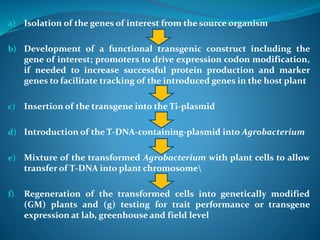
a) Isolation of the genes of interest from the source organism
b) Development of a functional transgenic construct including the
gene of interest; promoters to drive expression codon modification,
if needed to increase successful protein production and marker
genes to facilitate tracking of the introduced genes in the host plant
c) Insertion of the transgene into the Ti-plasmid
d) Introduction of the T-DNA-containing-plasmid into Agrobacterium
e) Mixture of the transformed Agrobacterium with plant cells to allow
transfer of T-DNA into plant chromosome
f) Regeneration of the transformed cells into genetically modified
(GM) plants and (g) testing for trait performance or transgene
expression at lab, greenhouse and field level
Other organism used as a vector in transformation process
A. Viruses
B. Bacteriophages
C. Cosmids
Viral vector - Viruses which are used as gizmo by molecular biologists to
carry genetic material into cells” are called viral vectors. Viral vectors are
non-integrative as compared to bacterial vectors.
Examples
1.Cauliflower mosaic virus based vectors. 2.Cowpea mosaic virus
3.Bean pod mottle virus (BPMV) 4.TMV based vectors.
5.Potato virus X (PVX) 6.Bean yellow dwarf virus
Characteristics of viral vectors
1. Safety 2. Low toxicity
3. Stability 4. Cell type specificity
Bacteriophage Lambda Vectors
 Viruses that can infect bacteria
 1000 times more efficient than plasmid vectors
The broad objectives in constructing various phage vectors are
(i) The presence of cloning sites only in the dispensable fragments.
(ii) The capacity to accommodate foreign DNA fragments of various sizes.
(iii) The presence of multiple cloning sites.
(iv) An indication of incorporation of DNA fragments by a change in the
plaque type.
(v) The ability to control transcription of a cloned fragment from promoters
on the vector.
(vi) The possibility of growing vectors and clones to high yield.
(vii) Easy and ready recovery of cloned DNA.
(viii)Introduction of features contributing to better biological containment.
Many phage vectors have been constructed in the recent past, each with its
own special features. There is no universal lambda vector which can fulfill all
the desired objectives of the cloning experiments. The choice of a vector
depends mainly on -
(i) The size of a DNA fragment to be inserted.
(ii) The restriction enzymes to be used.
(iii) The necessity for expression of the cloned fragment.
(iv) The method of screening to be used to select the desired clones.
 Bacteriophage lambda vectors can be broadly classified into two types:
(i) Replacement vectors
(ii) Insertion vectors.
Replacement Vectors - Replacement vector or substitution vector is a type of
phage vector developed from the removal of a middle ‘filler fragment’ region of
phage DNA.
Cloning of a foreign DNA in these vectors involves -
(i) Preparation of left and right arms by physical elimination of the
nonessential region.
(ii) Ligation of the foreign DNA fragment between the arms.
(iii) In vitro packaging and infection.
 The replacement vectors contain a pair of restriction sites to excise the
central stuffer fragments, which can be replaced by a desired DNA sequence
with compatible ends. The replacement vectors are convenient for cloning of
large (in some cases up to 24 kbp) DNA fragments and are useful in the
construction of genomic libraries of higher eukaryotes. Charon and EMBL are
among the popular replacement vectors.
Insertion Vectors
Because the maximum packagable size of lambda genome is 53 kb, small
DNA fragments can be introduced without removal of the nonessential
(stuffer) fragment. These vectors are therefore called insertion vectors.
Cloning of foreign DNA in these vectors exploits the insertional inactivation
of the biological function, which differentiates recombinants from non
recombinants. Insertion vectors are particularly useful in cloning of small
DNA fragments such as cDNA. AgtlO and Agtll are examples of this type of
vector.
Cosmids vectors
“A cosmid is a plasmid that contain phage sequence that allows the vector to
be packaged and transmitted to bacteria like phage vector”.
Or
“A cosmid is a type of hybrid plasmid that contains a Lambda phage cos
sequence. Cosmids (cos sites + plasmid = cosmids) DNA sequences are
originally from the lambda phage”.
 Cosmids are medium sized cloning vectors.
 The cloning capacity of these vectors is 35-45 kbp.
 Cosmid vector are developed by combining the features of plasmid vector
and bacteriophage vector.
 The first cosmid vector was described by Collins in 1978.
Properties of cosmid vector
 These are fused together to obtain the cosmid vector approximately 200 bp
lambda sequence is cloned into cosmid vector.
 A cosmid vector may have one or two cos site.
 Cosmid vector are used in construction of genomic libraries.
 Cosmid vector have cloning capacity up to 45 kbp.
Plant Transformation Using Particle Bombardment / Gene gun
The Particle bombardment device, also known as the gene gun, was
developed to enable penetration of the cell wall so that genetic material
containing a gene of interest can be transferred into the cell. Today the gene
gun is used for genetic transformation of many organisms to introduce a
diverse range of desirable traits.
With the use of a gene gun, the gene gun method delivers extra DNA
directly into a plant’s nucleus. The method is also commonly called particle
acceleration or microprojectile bombardment.
The gene gun can be used on seedlings or tissue culture cells. Prior to
injecting the DNA into the plant tissue via the gene gun, either microscopic
gold or tungsten particles are liberally coated with many hundreds of copies
of genes. The particles are then forced into the nucleus with the gene gun.
Particle bombardment also plays an important role in the transformation of
organelles such as chloroplasts, which enables engineering of organelle-
encoded herbicide or pesticide resistances in crop plants and to study
photosynthetic processes.
Plant transformation using particle bombardment follows the same
outline as Agrobacterium-mediated method. The steps taken include:
Isolate the genes of interest from the source organism.
Develop a functional transgenic construct including the gene of interest,
Promoters to drive expression, codon modification, if needed to increase
successful protein production and marker genes to facilitate tracking of
the introduced genes in the host plant.
Incorporate into a useful plasmid.
Introduce the transgenes into plant cells.
Regenerate the plants cells.
Test trait performance or gene expression at lab, greenhouse and
field level.
ADVANTAGES……….
1. Requirement of protoplast can be avoided .
2. Walled intact cells can be penetrated .
3. Manipulation of genome of sub cellular organelles can be achieved .
4. This technology has even allowed for modification of specific tissues in
situ, although this is likely to damage large numbers of cells and transform
only some, rather than all, cells of the tissue .
5. Relatively high efficiency
6. Technical simplicity
LIMITATIONS………..
1. Integration is random 2• Requirement of equipments
3• Shallow penetration of particles 4• Associated cell damage
5• The tissue to incorporate the DNA must be able to regenerate
•6 Equipment itself is very expensive

about genetic modified orgenism

  • 1.
    SEASON: - 2019-2020 SUBJECT:- PP 603- Assignment on GMO , It’s Production Procedure And Application In Crop Improvement & Transformation, Different Method Of Plant Transformation
  • 2.
    Definition - Agenetically modified organism is one whose genetic material has been altered using genetic engineering in order to favor the expression of desired physiological traits or the generation of desired biological products. OR “A genetically modified organism (GMO) is usually defined as a living organism whose genetic composition has been altered by the insertion of a new gene encoding a desired protein that is expressed.” In genetic modification, however, recombinant genetic technologies are employed to produce organisms whose genomes have been precisely altered at the molecular level, usually by the inclusion of genes from unrelated species of organisms that code for traits that would not be obtained easily through conventional selective breeding.
  • 3.
    Conventional methods ofmodifying plants and animals—selective breeding and crossbreeding—can take a long time. Moreover, selective breeding and crossbreeding often produce mixed results, with unwanted traits appearing alongside desired characteristics. The specific targeted modification of DNA using biotechnology has allowed scientists to avoid this problem and improve the genetic makeup of an organism without unwanted characteristics tagging along. How to produce - By eliminating, modifying or adding copies of specific genes often from other organisms through modern molecular biology techniques viz.- 1. Recombinant DNA (rDNA) 2. Genetic engineering 3. Gene splicing
  • 4.
    Recombinant DNA technologyis a technique which changes the phenotype of an organism (host) when a genetically altered vector is introduced and integrated into the genome of the organism. So, basically, the process involves introducing a foreign piece of DNA into the genome, which contains our gene of interest. This gene, which is introduced is the recombinant gene and the technique is called the recombinant DNA technology. Process of Recombinant DNA Technology Recombinant DNA technology involves the selection of the desired gene for administration into the host followed by a selection of the perfect vector with which the gene has to be integrated and recombinant DNA formed. This recombinant DNA, then has to be introduced into the host. And at last, it has to be maintained in the host and carried forward to the offspring's.
  • 6.
    Isolation of DNA Beinga nucleic acid enclosed within the nucleus, isolation of DNA is not an easy task. Isolation of DNA is an enzymatically controlled process where the plant or animal cells are treated with certain enzymes. Enzyme such as cellulase (plant cells), lysozyme (bacteria) and chitinase (fungi) . These are different enzymes used to isolate a pure DNA from the cells. Fragmentation of DNA The isolated and purified DNA is treated with restriction endonucleases which cut the DNA into fragments. The restriction enzymes used in recombinant DNA technology play a major role in determining the location at which the desired gene is inserted into the vector genome. The restriction endonucleases are sequence-specific which is usually palindrome sequences and cut the DNA at specific points. They scrutinize the length of DNA and make the cut at the specific site called the restriction site. The desired genes and the vectors are cut by the same restriction enzymes to obtain the complementary sticky notes, thus making the work of the ligases easy to bind the desired gene to the vector.
  • 7.
    Amplification of Geneof Interest Polymerase chain reaction (PCR) is a process to amplify the gene once the proper gene of interest has been cut using the restriction enzymes. Through this process, multiple copies of the gene of interest can be produced. PCR proceeds in three stages, denaturation, annealing and extension.
  • 8.
    Insertion of recombinantDNA into the host The host is the ultimate tool of recombinant DNA technology, which takes in the vector engineered with the desired DNA with the help of the enzymes. Insertion of the desired recombinant DNA into the host organism can be achieved in various ways. This includes– microinjection, biolistics or the gene gun, alternate cooling and heating, use of calcium ions, etc. The successfully transformed cells or the organisms carry forward the recombinant gene to the offspring's. 2- Genetic engineering Genetically modified organisms (GMOs) are organisms that have been altered using genetic engineering methods. Although genetic engineering is a common and essential practice in biotechnology, its specific use in crops is controversial. The key steps involved in genetic engineering are identifying a trait of interest, isolating that trait, inserting that trait into a desired organism, and then propagating that organism.
  • 10.
    DNA Extraction DNA extractionis the first step in the genetic engineering process. In order to work with DNA, scientists must extract it from the desired organism. A sample of an organism containing the gene of interest is taken through a series of steps to remove the DNA. Gene Cloning The second step of the genetic engineering process is gene cloning. During DNA extraction, all of the DNA from the organism is extracted at once. Scientists use gene cloning to separate the single gene of interest from the rest of the genes extracted and make thousands of copies of it. Gene Design Once a gene has been cloned, genetic engineers begin the third step, designing the gene to work once inside a different organism. This is done in a test tube by cutting the gene apart with enzymes and replacing gene regions that have been separated.
  • 11.
    Transformation The new geneis inserted into some of the cells using various techniques. Some of the more common methods include the gene gun, agrobacterium, microfibers, and electroporation. The main goal of each of these methods is to transport the new gene(s) and deliver them into the nucleus of a cell without killing it. Transformed plant cells are then regenerated into transgenic plants. The transgenic plants are grown to maturity in greenhouses and the seed they produce, which has inherited the transgene, is collected. The genetic engineer's job is now complete. He/she will hand the transgenic seeds over to a plant breeder who is responsible for the final step. Backcross Breeding Transgenic plants are crossed with elite breeding lines using traditional plant breeding methods to combine the desired traits of elite parents and the transgene into a single line. The offspring are repeatedly crossed back to the elite line to obtain a high yielding transgenic line. The result will be a plant with a yield potential close to current hybrids that expresses the trait encoded by the new transgene.
  • 12.
    3. gene splicing Aterm used to refer to the process by which the DNA of an organism is cut and a gene, perhaps from another organism, is inserted. Gene splicing is often used in industry to allow single-celled organisms to produce useful products, such as human insulin. Gene splicing is a form of genetic engineering where specific genes or gene sequences are inserted into the genome of a different organism. Gene splicing can also specifically refer to a step during the processing of deoxyribonucleic acid (DNA) to prepare it to be translated into protein. In gene splicing, scientists take a specific restriction enzyme to unravel a certain strand or strands of DNA. The DNA's double helix structure is then separated into single strands. With the strands separated, scientists add the desired base pairs to the separated DNA strands, modifying the genetic code of the DNA and will give the newly structured DNA the scientists desired. Finally, scientists use ligase, another enzyme, which causes the DNA to reform its double helix structure.
  • 13.
    Below are sometechniques of genetic modification of plants and animals:
  • 14.
    Application of GMO’Sin crop improvement The benefits of using genetically modified plants are: 1) Increased productivity through effective combating of weeds, diseases and pests. 2) Positive impact on biodiversity, contributing to environmental protection through overall reduction of the quantities of pesticides. 3) Improved consumer health through reducing adverse effects based on reducing dependence on conventional pesticides. 4) Improving groundwater and surface water based on reducing pesticide residues. 5) Higher profits for producers by reducing the cost of production. 6) Lower prices for consumers.
  • 15.
    Examples Of GmCrops In the mid 1990s the first genetically modified crops were approved in the US, and today, their farmers are by far the largest producers of such crops. Four genetically modified field crops are grown on a large scale: a. soya beans b. Canola c. Corn d. Cotton Other crops include: a. tomatoes b. papaya c. Squas Genetic modification of crops is undertaken to create crops with beneficial characteristics like - 1. Built-in protection against a specific insect. 2. Built-in protection against a specific plant disease. 3. Built-in tolerance to a specific herbicide (or weed killer). 4. Improved nutritional composition.
  • 18.
    “Transformation is theprocess by which genetic makeup of an organism is altered by the insertion of new gene(or exogenous DNA) into its genome .This is usually done using vectors such as plasmids.” OR Plant transformation is a scientific approach whereby DNA from any organism is inserted into the genome of a species of interest. The inserted DNA is called a “transgene”, and the resulting plant is said to be “transgenic”. The aim of producing transgenic plants is to- a) Improve crop yields. b) Improvement of varietal trait. c) Give cultivated plants more protection against their pests, parasites and harsh weather conditions.
  • 20.
    Agrobacterium tumefaciens mediatetransformation – Agrobacterium tumefaciens is a widespread naturally occurring soil bacterium that causes crown gall, and has the ability to introduce new genetic material into the plant cell (Gelvin, 2003). The genetic material that is introduced is called T DNA (transferred DNA) which is located on a Ti plasmid. A Ti plasmid is a circular piece of DNA found in almost all bacteria. This natural ability to alter the plant’s genetic makeup was the foundation of plant transformation using Agrobacterium. Currently, Agrobacterium-mediated transformation is the most commonly used method for plant genetic engineering because of relatively high efficiency. Initially it was believed that this Agrobacterium only infects dicotyledonous plants, but it was later established that it can also be used for transformation of monocotyledonous plants such as rice. The Agrobacterium-mediated transformation process involves a number of steps -
  • 21.
    a) Isolation ofthe genes of interest from the source organism b) Development of a functional transgenic construct including the gene of interest; promoters to drive expression codon modification, if needed to increase successful protein production and marker genes to facilitate tracking of the introduced genes in the host plant c) Insertion of the transgene into the Ti-plasmid d) Introduction of the T-DNA-containing-plasmid into Agrobacterium e) Mixture of the transformed Agrobacterium with plant cells to allow transfer of T-DNA into plant chromosome f) Regeneration of the transformed cells into genetically modified (GM) plants and (g) testing for trait performance or transgene expression at lab, greenhouse and field level
  • 25.
    Other organism usedas a vector in transformation process A. Viruses B. Bacteriophages C. Cosmids Viral vector - Viruses which are used as gizmo by molecular biologists to carry genetic material into cells” are called viral vectors. Viral vectors are non-integrative as compared to bacterial vectors. Examples 1.Cauliflower mosaic virus based vectors. 2.Cowpea mosaic virus 3.Bean pod mottle virus (BPMV) 4.TMV based vectors. 5.Potato virus X (PVX) 6.Bean yellow dwarf virus Characteristics of viral vectors 1. Safety 2. Low toxicity 3. Stability 4. Cell type specificity
  • 27.
    Bacteriophage Lambda Vectors Viruses that can infect bacteria  1000 times more efficient than plasmid vectors
  • 28.
    The broad objectivesin constructing various phage vectors are (i) The presence of cloning sites only in the dispensable fragments. (ii) The capacity to accommodate foreign DNA fragments of various sizes. (iii) The presence of multiple cloning sites. (iv) An indication of incorporation of DNA fragments by a change in the plaque type. (v) The ability to control transcription of a cloned fragment from promoters on the vector. (vi) The possibility of growing vectors and clones to high yield. (vii) Easy and ready recovery of cloned DNA. (viii)Introduction of features contributing to better biological containment. Many phage vectors have been constructed in the recent past, each with its own special features. There is no universal lambda vector which can fulfill all the desired objectives of the cloning experiments. The choice of a vector depends mainly on -
  • 29.
    (i) The sizeof a DNA fragment to be inserted. (ii) The restriction enzymes to be used. (iii) The necessity for expression of the cloned fragment. (iv) The method of screening to be used to select the desired clones.  Bacteriophage lambda vectors can be broadly classified into two types: (i) Replacement vectors (ii) Insertion vectors. Replacement Vectors - Replacement vector or substitution vector is a type of phage vector developed from the removal of a middle ‘filler fragment’ region of phage DNA. Cloning of a foreign DNA in these vectors involves - (i) Preparation of left and right arms by physical elimination of the nonessential region. (ii) Ligation of the foreign DNA fragment between the arms. (iii) In vitro packaging and infection.
  • 30.
     The replacementvectors contain a pair of restriction sites to excise the central stuffer fragments, which can be replaced by a desired DNA sequence with compatible ends. The replacement vectors are convenient for cloning of large (in some cases up to 24 kbp) DNA fragments and are useful in the construction of genomic libraries of higher eukaryotes. Charon and EMBL are among the popular replacement vectors.
  • 31.
    Insertion Vectors Because themaximum packagable size of lambda genome is 53 kb, small DNA fragments can be introduced without removal of the nonessential (stuffer) fragment. These vectors are therefore called insertion vectors. Cloning of foreign DNA in these vectors exploits the insertional inactivation of the biological function, which differentiates recombinants from non recombinants. Insertion vectors are particularly useful in cloning of small DNA fragments such as cDNA. AgtlO and Agtll are examples of this type of vector.
  • 32.
    Cosmids vectors “A cosmidis a plasmid that contain phage sequence that allows the vector to be packaged and transmitted to bacteria like phage vector”. Or “A cosmid is a type of hybrid plasmid that contains a Lambda phage cos sequence. Cosmids (cos sites + plasmid = cosmids) DNA sequences are originally from the lambda phage”.  Cosmids are medium sized cloning vectors.  The cloning capacity of these vectors is 35-45 kbp.  Cosmid vector are developed by combining the features of plasmid vector and bacteriophage vector.  The first cosmid vector was described by Collins in 1978.
  • 33.
    Properties of cosmidvector  These are fused together to obtain the cosmid vector approximately 200 bp lambda sequence is cloned into cosmid vector.  A cosmid vector may have one or two cos site.  Cosmid vector are used in construction of genomic libraries.  Cosmid vector have cloning capacity up to 45 kbp.
  • 34.
    Plant Transformation UsingParticle Bombardment / Gene gun The Particle bombardment device, also known as the gene gun, was developed to enable penetration of the cell wall so that genetic material containing a gene of interest can be transferred into the cell. Today the gene gun is used for genetic transformation of many organisms to introduce a diverse range of desirable traits. With the use of a gene gun, the gene gun method delivers extra DNA directly into a plant’s nucleus. The method is also commonly called particle acceleration or microprojectile bombardment. The gene gun can be used on seedlings or tissue culture cells. Prior to injecting the DNA into the plant tissue via the gene gun, either microscopic gold or tungsten particles are liberally coated with many hundreds of copies of genes. The particles are then forced into the nucleus with the gene gun. Particle bombardment also plays an important role in the transformation of organelles such as chloroplasts, which enables engineering of organelle- encoded herbicide or pesticide resistances in crop plants and to study photosynthetic processes.
  • 35.
    Plant transformation usingparticle bombardment follows the same outline as Agrobacterium-mediated method. The steps taken include: Isolate the genes of interest from the source organism. Develop a functional transgenic construct including the gene of interest, Promoters to drive expression, codon modification, if needed to increase successful protein production and marker genes to facilitate tracking of the introduced genes in the host plant. Incorporate into a useful plasmid. Introduce the transgenes into plant cells. Regenerate the plants cells. Test trait performance or gene expression at lab, greenhouse and field level.
  • 37.
    ADVANTAGES………. 1. Requirement ofprotoplast can be avoided . 2. Walled intact cells can be penetrated . 3. Manipulation of genome of sub cellular organelles can be achieved . 4. This technology has even allowed for modification of specific tissues in situ, although this is likely to damage large numbers of cells and transform only some, rather than all, cells of the tissue . 5. Relatively high efficiency 6. Technical simplicity LIMITATIONS……….. 1. Integration is random 2• Requirement of equipments 3• Shallow penetration of particles 4• Associated cell damage 5• The tissue to incorporate the DNA must be able to regenerate •6 Equipment itself is very expensive