BY-
B . S C ( H ) B I O T E C H N O L O G Y
( 6 T H S E M E S T E R )
A Y E S H A T A U S I F
B S B / 1 2 / 1 3 0
G . S H A N T H I P R I Y A
B S B / 1 2 / 1 0 3
K U M A R R A H U L
B S B / 1 2 / 1 2 4
K U M A R C H A N D A N
B S B / 1 2 / 1 4 4
N I K I T A S H A R M A
B S B M / 1 2 / 1 1 4
TRANSGENIC FOOD
AND POULTRY
INTRODUCTION TO TRANSGENIC FOOD
• Transgenic food is also known as genetically modified food.
• Genetically engineered foods have had foreign genes (genes from other
plants or animals) inserted into their genetic codes.
• The inserted gene sequence (transgene) may come from another
unrelated plant, or completely different species.
• Genetic engineering speeds up the process and increase the variety of
genes which can be inserted into a particular plant.
HISTORY
 Was under trial and error for almost 9900 years.
 The first genetically modified plant was produced in 1962’
using an antibiotic- resistant tobacco plant.
 The first genetically modified crop approved for sale in the
U.S., in 1994, was the FlavrSavr tomato, which had a longer
shelf life, as it took longer to soften after ripening.
 As of mid- 1996, a total of 35 approvals had been granted to
commercially grow 8 transgenic crops and one flower crop of
carnations, with 8 different traits in 6 countries plus the EU.
In 2000, with the production of golden rice, scientists
genetically modifies food to increase its nutrient value for the
first time.
TRANSGENIC FOODS IN THE WORLD
 A lot of foods has been altered and made genetically modified.
These are-
o Cotton
o Rice
o Soybean
o Sugar Cane
o Tomatoes
o Sweet corn
o Canola
o Potato
o Papaya
o Sugar beet
WHO’S ON THE TOP ?
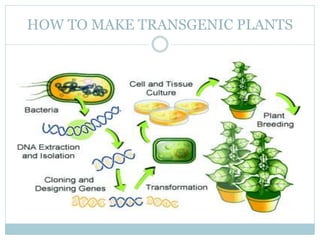
HOW TO MAKE TRANSGENIC PLANTS
 In order to make a transgenic crop, there are five main steps:
1. Extracting DNA
2. Cloning a gene of interest
3. Gene for plant infiltration
4. Transformation
5. Plant breeding
EXTRACTING DNA:
DNA is first extracted from cells and put into a bacterial plasmid.
Plasmid is a molecular biological tool that allows any segment of DNA in
be put into a carrier cell (usually a bacterial cell) and replicated
produce more of it.
CLONING A GENE OF INTEREST:
A bacterial cell (i.e. E. coli) that contain a plasmid can put aside and used over &
over again to produce copies of the gene the researcher is interested in, a process
that is generally referred to as “cloning” the gene.
GENE FOR PLANT INFILTERATION:
Once the gene of interest has been amplified, it is time to introduce it into
plant species we are interested in. The nucleus of the plant cell is the target
for the new transgenic DNA.
There are many methods of doing this but the two most common methods include
the “Gene Gun” and “Agro bacterium method”.
The “Gene Gun” method, also known as the micro-projectile bombardment
method, is most commonly used in species such as corn and rice. As its name
implies, this procedure involves high velocity micro-projectiles to deliver DNA
into living cells using a gun. It involves sticking DNA to small micro-projectiles
and then firing these into a cell. This technique is clean and safe. It enables
scientists to transform organized tissue of plant species and has a universal
delivery system common to many tissue types from many different species. It can
give rise to un-wanted side effects, such as the gene of interest being rearranged
upon entry or the target cell sustaining damage upon bombardment.
Nevertheless, it has been quite useful for getting trans genes into organisms when no other
options are available.
The Agrobacterium method involves the use of a soil- dwelling bacteria
known as Agrobacterium tumefaciens, which has the ability to infect plant
cells with a piece of its DNA. The piece of DNA that infects a plant is
integrated into a plants chromosome through a tumor-inducing plasmid
(Ti plasmid), which can take control of the plant’s cellular machinery and
use it to make many copies of its own bacterial DNA. The Ti plasmid is a
large circular DNA particle that replicates independently of the bacterial
chromosome.
Transfer DNA on a plasmid in Agrobacterium
The importance of this plasmid is that it contains regions of transfer DNA
(tDNA), where a researcher can insert a gene, which can be transferred to
a plant cell through a process known as a floral dip. A floral dip involves
dipping flowering plants into a solution of Agrobacterium carrying the gene of
interest, followed by the transgenic seeds being collected directly from the
plant. This process is useful in that it is a natural method of transfer and
therefore thought of as a more acceptable technique. In addition,
Agrobacterium is capable of transferring large fragments of DNA very
efficiently without substantial rearrangements, followed by maintaining high
stability of the gene that was transferred [1]. One of the biggest limitations of
Agrobacterium is that not all important food crops can be infected by this
bacteria.
TRANSFORMATION:
Transformation is the heritable change in a cell or organism brought
about by the uptake and establishment of introduced DNA.
PLANT BREEDING:
Plants are grown under controlled environmental conditions in a series of
media containing nutrients and hormones, a process known as tissue
culture. Once whole plants are generated and produce seed, evaluation of
the progeny begins. This regeneration step has been a stumbling block in
producing transgenic plants in many species, but specific varieties of most
crops can now be transformed and regenerated.
Tissue culture of transgenic plants in a controlled environmental chamber. Source: USDA
Leaf disc method for A.t mediated transformation
TYPES OF GENETIC ENGINEERING
 TRANSGENIC PLANTS: Have genes inserted into them that are
derived from another species. The inserted genes can come from
species within the same kingdom ( plant to plant) or between
kingdoms ( for example, bacteria to plant). Transgenic carrots have
been used to produce the drug Taliglucerase alfa which is used to
treat Gaucher’s disease.
 CISGENIC PLANTS: Are made using genes found within the same
species or a closely related one, where conventional plant breeding
can occur.
 SUBGENIC PLANTS: In 2014, Chinese researcher Gao Ciaxia filed
patents on the creations of a strain of wheat that is resistant to
powdery mildew. The strain lacks genes that encode proteins that
repress defenses against the mildew. The researchers deleted all
three copies of the genes from wheat’s hexaploid genome. The strain
promises to reduce or eliminate the heavy use of fungicides to
control the disease.
GM FOOD CLASSIFICATION
I
Generation
• Crops have enhanced
input traits, such as
herbicide tolerance,
better insect
resistance, and better
tolerance to
environmental stress.
II
Generation
• Crops include those
with added-value
output traits, such as
nutrient enhancement
for animal feed.
III
Generation
• Crops include those
that produce
pharmaceuticals,
improve the
processing of bio-
based fuels, or
produce products
beyond food and fiber
(Fernandez-Cornejo
and Caswell 2006).

Transgenic food

  • 1.
    BY- B . SC ( H ) B I O T E C H N O L O G Y ( 6 T H S E M E S T E R ) A Y E S H A T A U S I F B S B / 1 2 / 1 3 0 G . S H A N T H I P R I Y A B S B / 1 2 / 1 0 3 K U M A R R A H U L B S B / 1 2 / 1 2 4 K U M A R C H A N D A N B S B / 1 2 / 1 4 4 N I K I T A S H A R M A B S B M / 1 2 / 1 1 4 TRANSGENIC FOOD AND POULTRY
  • 2.
    INTRODUCTION TO TRANSGENICFOOD • Transgenic food is also known as genetically modified food. • Genetically engineered foods have had foreign genes (genes from other plants or animals) inserted into their genetic codes. • The inserted gene sequence (transgene) may come from another unrelated plant, or completely different species. • Genetic engineering speeds up the process and increase the variety of genes which can be inserted into a particular plant.
  • 3.
    HISTORY  Was undertrial and error for almost 9900 years.  The first genetically modified plant was produced in 1962’ using an antibiotic- resistant tobacco plant.  The first genetically modified crop approved for sale in the U.S., in 1994, was the FlavrSavr tomato, which had a longer shelf life, as it took longer to soften after ripening.  As of mid- 1996, a total of 35 approvals had been granted to commercially grow 8 transgenic crops and one flower crop of carnations, with 8 different traits in 6 countries plus the EU. In 2000, with the production of golden rice, scientists genetically modifies food to increase its nutrient value for the first time.
  • 4.
    TRANSGENIC FOODS INTHE WORLD  A lot of foods has been altered and made genetically modified. These are- o Cotton o Rice o Soybean o Sugar Cane o Tomatoes o Sweet corn o Canola o Potato o Papaya o Sugar beet
  • 6.
  • 7.
    HOW TO MAKETRANSGENIC PLANTS
  • 8.
     In orderto make a transgenic crop, there are five main steps: 1. Extracting DNA 2. Cloning a gene of interest 3. Gene for plant infiltration 4. Transformation 5. Plant breeding EXTRACTING DNA: DNA is first extracted from cells and put into a bacterial plasmid. Plasmid is a molecular biological tool that allows any segment of DNA in be put into a carrier cell (usually a bacterial cell) and replicated produce more of it. CLONING A GENE OF INTEREST: A bacterial cell (i.e. E. coli) that contain a plasmid can put aside and used over & over again to produce copies of the gene the researcher is interested in, a process that is generally referred to as “cloning” the gene.
  • 9.
    GENE FOR PLANTINFILTERATION: Once the gene of interest has been amplified, it is time to introduce it into plant species we are interested in. The nucleus of the plant cell is the target for the new transgenic DNA. There are many methods of doing this but the two most common methods include the “Gene Gun” and “Agro bacterium method”. The “Gene Gun” method, also known as the micro-projectile bombardment method, is most commonly used in species such as corn and rice. As its name implies, this procedure involves high velocity micro-projectiles to deliver DNA into living cells using a gun. It involves sticking DNA to small micro-projectiles and then firing these into a cell. This technique is clean and safe. It enables scientists to transform organized tissue of plant species and has a universal delivery system common to many tissue types from many different species. It can give rise to un-wanted side effects, such as the gene of interest being rearranged upon entry or the target cell sustaining damage upon bombardment. Nevertheless, it has been quite useful for getting trans genes into organisms when no other options are available.
  • 10.
    The Agrobacterium methodinvolves the use of a soil- dwelling bacteria known as Agrobacterium tumefaciens, which has the ability to infect plant cells with a piece of its DNA. The piece of DNA that infects a plant is integrated into a plants chromosome through a tumor-inducing plasmid (Ti plasmid), which can take control of the plant’s cellular machinery and use it to make many copies of its own bacterial DNA. The Ti plasmid is a large circular DNA particle that replicates independently of the bacterial chromosome. Transfer DNA on a plasmid in Agrobacterium
  • 11.
    The importance ofthis plasmid is that it contains regions of transfer DNA (tDNA), where a researcher can insert a gene, which can be transferred to a plant cell through a process known as a floral dip. A floral dip involves dipping flowering plants into a solution of Agrobacterium carrying the gene of interest, followed by the transgenic seeds being collected directly from the plant. This process is useful in that it is a natural method of transfer and therefore thought of as a more acceptable technique. In addition, Agrobacterium is capable of transferring large fragments of DNA very efficiently without substantial rearrangements, followed by maintaining high stability of the gene that was transferred [1]. One of the biggest limitations of Agrobacterium is that not all important food crops can be infected by this bacteria. TRANSFORMATION: Transformation is the heritable change in a cell or organism brought about by the uptake and establishment of introduced DNA.
  • 12.
    PLANT BREEDING: Plants aregrown under controlled environmental conditions in a series of media containing nutrients and hormones, a process known as tissue culture. Once whole plants are generated and produce seed, evaluation of the progeny begins. This regeneration step has been a stumbling block in producing transgenic plants in many species, but specific varieties of most crops can now be transformed and regenerated. Tissue culture of transgenic plants in a controlled environmental chamber. Source: USDA
  • 13.
    Leaf disc methodfor A.t mediated transformation
  • 14.
    TYPES OF GENETICENGINEERING  TRANSGENIC PLANTS: Have genes inserted into them that are derived from another species. The inserted genes can come from species within the same kingdom ( plant to plant) or between kingdoms ( for example, bacteria to plant). Transgenic carrots have been used to produce the drug Taliglucerase alfa which is used to treat Gaucher’s disease.  CISGENIC PLANTS: Are made using genes found within the same species or a closely related one, where conventional plant breeding can occur.  SUBGENIC PLANTS: In 2014, Chinese researcher Gao Ciaxia filed patents on the creations of a strain of wheat that is resistant to powdery mildew. The strain lacks genes that encode proteins that repress defenses against the mildew. The researchers deleted all three copies of the genes from wheat’s hexaploid genome. The strain promises to reduce or eliminate the heavy use of fungicides to control the disease.
  • 15.
    GM FOOD CLASSIFICATION I Generation •Crops have enhanced input traits, such as herbicide tolerance, better insect resistance, and better tolerance to environmental stress. II Generation • Crops include those with added-value output traits, such as nutrient enhancement for animal feed. III Generation • Crops include those that produce pharmaceuticals, improve the processing of bio- based fuels, or produce products beyond food and fiber (Fernandez-Cornejo and Caswell 2006).