TYPES OF LESSON
PLANSDR. MAHESWARI JAIKUMAR.
maheswarijaikumar2103@gmail.com
THE CRITERIA
• The criteria for classification of
lesson plan are as follows:
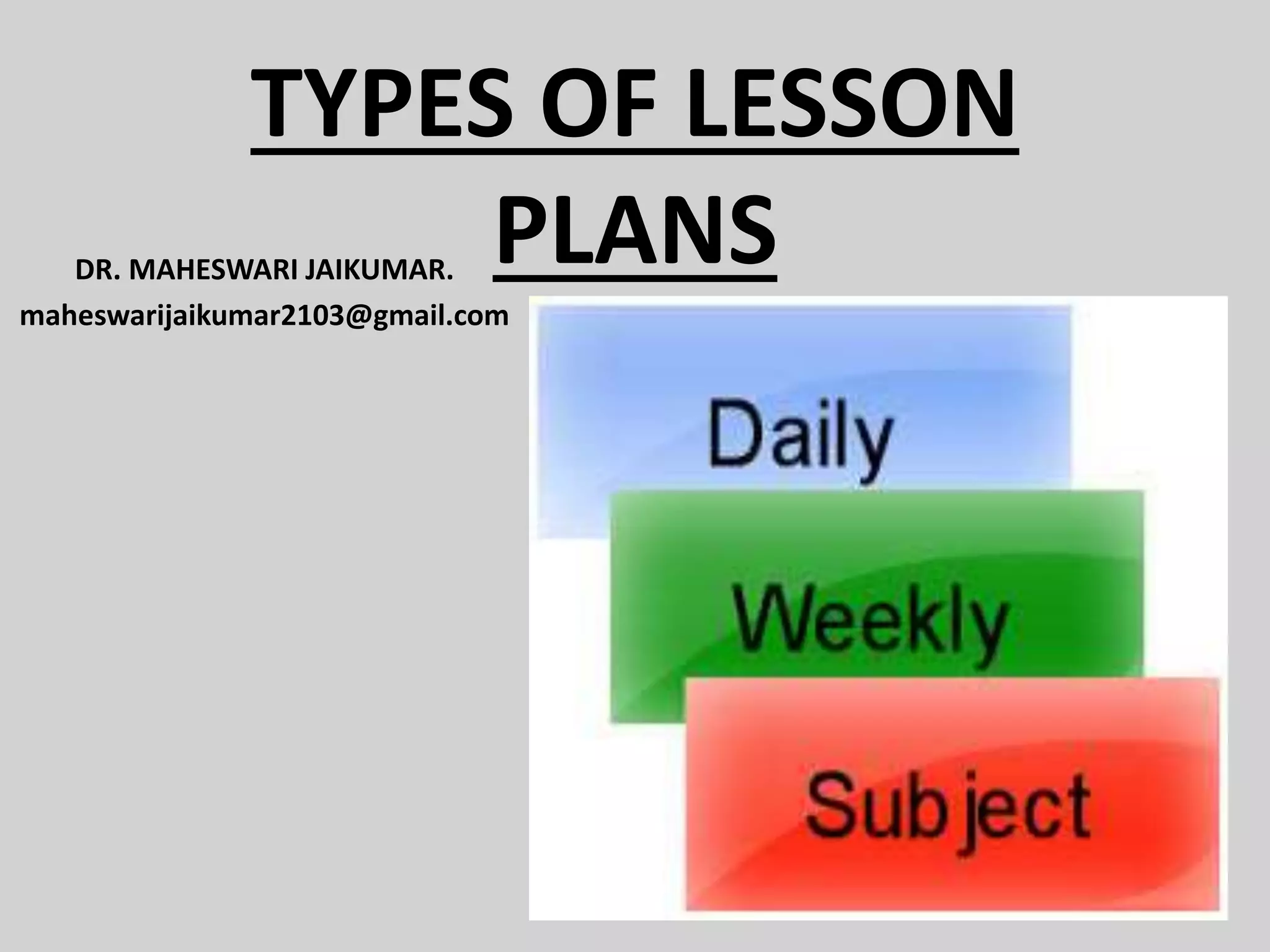
• TIME-DURATION (Daily, monthly,
weekly, annual)
• APPROACH (Herbartian, Bloom’s,
Gloverian, RCEM, etc)
• DOMAIN (LP affecting : cognitive,
affective & psychomotor domain)
APROACHES TO LESSON
PLAN
• HERBARTIAN APPROACH
• BLOOM’S APROACH
• GLOVERIAN APPROACH
• RCEM APPROACH
• SKILL APPROACH
HERBART
• John Fedrik Herbatrt: 1776-
1841
• German Philosopher who
identified teaching units
/activities in 5 steps
HERBARTIAN APPROACH
• Involves the following steps :
• 1. PREPARATION
• 2. PRESENTATION
• 3. ASSOCIATION/COMPARISON
• 4. GENERALIZATION
• 5. APPLICATION
• 6. SYSTEMATIZATION/RECAPITULATION
OUTLINE: HERBARTION
APPROACH
• 1.General Objectives
• 2.Specific Objectives
• 3.Introduction
• 4.Teaching Aids
• 5.Previous knowledge
• 6.Statement of Aim
• 7.Presentation
• 8.Explanation
• 9.Black –board Summary
• 10.Review Questions
• 11.Home assignments
BLOOM’S APPROACH
• Bloom (1961) considered education
as a Tripolar process :
• Formulating Educational
Objectives
• Creating learning experiences
• and Evaluating Change of
Behavior.
• According to Bloom,
education should be
objective-centered rather
than content-centered. This
approach has following
features:
• Education is a purposeful
process and all the
educational activities are
objective centered
• Includes the total behavioural
change of the students
• Evaluates the objectives,
methods and instructional aids
of providing learning
experiences
• Covers cognitive, affective and
psychomotor learning outcomes
GLOVERIAN APPROACH
• Involves the following
components :
• 1. QUESTIONING
• 2. DISCUSSION
• 3. INVESTIGATION
• 4. PUPIL ACTIVITY/EXPRESSION
RCEM APPROACH
• This approach was developed
by the Regional College of
Education, Mysore,
Karnataka, India.
• RCEM consists of three
aspects as follows :
• 1. INPUT
• 2. PROCESS
• 3. OUTCOME
RCEM-INPUT
• Input refers to the objectives
of the plan. They are known
as expected behavoiural
outcome. (EBO). They are
clsiified into following
categories :
EBO
• 1. KNOWLEDGE.
• 2. UNDERSTANDING.
• 3. APPLICATION.
• 4. ACTIVITY.
RCEM-PROCESS
• The process refers to the
teaching strategies. They are:
• Communication strategy.
• Instructional aids.
• Learning situation.
• Technique of motivation
RCEM-OUTCOME
• Refers to the real learning
outcome. This includes
general and specific
objectives.
RCEM FORMAT-LESSON
PLAN
• Name of the teacher :
• Name of the subject :
• Name of the topic :
• Name of the unit :
• Class/Group/Batch :
• Size of the class :
• Data & Time :
• Venue :
• Previous knowledge :
• Method of teaching :
• AV aids :
• General objectives :
1.
2.
• Specific objectives :
1.
2.
3.
RCEM FORMAT
INSTRUCTIONAL
OBJECTIVES
CONTENTS TEACHING
ACTIVITY
LEARNING
ACTIVITY
EVALUATION
General &
Specific
objectives
•Intro
•Aims
•Presentation
•Explanation
•Summary
•Assignment
•Explanation
•Clarification
• Listening
• Notes taking
•Recapitalization
TYPES
LESSON PLANS
HERBARTIAN
LESSON PLAN
SKILL LESSON
PLAN
APPRECIATION
LESSON PLAN
HERBARTIAN APPROACH
• Involves the following steps :
• 1. PREPARATION
• 2. PRESENTATION
• 3. ASSOCIATION/COMPARISON
• 4. GENERALIZATION
• 5. APPLICATION
• 6. SYSTEMATIZATION/RECAPITULATION
SKILL LESSON PLAN
• Involves two types of skills :
• 1. MECHANICAL.
• 2. MANIPILATION.
SKILL LP CONTENTS
• The contents include:
• METHODS OF TEACING
• DEMONSTRATION
• VERBAL INSTRUCTION
APPRECIATION LESSON
PLAN
• Aims at developing aesthetic
sense by the following steps :
• PREPARATION
• PRESENTATION
• CONTEMPLATION
• APPLICATION
TYPE BASED ON THE
CONTENT
• The lesson plan could be of the
following types based on the contents
:
• 1. DETAILED /ELABORATE LESSON
PLAN.
• 2. SEMI DETAILED LESSON PLAN.
• 3. SKELETAL OUTLINE/BRIEF LESSON
PLAN
DETAILED LESSON PLAN
• The teacher makes a detailed
lesson plan and puts down all
the class room activities. The
teacher visualizes in advance all
the activities of the learner with
an intention of tailoring the
teaching learning activities.
SEMI DETAILED LESSON PLAN
• This type of lesson plan omits
the learner’s activity. It
contains only the lesson and
procedural steps.
BRIEF LESSON PLAN
• An expert teacher usually
makes a brief lesson plan. The
time saves may be devoted to
other teaching learning
activities.
TIME BASED LESSON
PLAN
SHORT DAILY PLAN
• Teachers who teach regularly
on daily basis are expected to
keep their lesson plans on
regular basis.
• Administrators design lesson
plan format for a uniform
design of lesson plan for each
subject. Daily plans if kept
ready minimizes suffering if
the teacher has to be replaced
another in case of leave or
absenteeism.
• Many teachers resort to this
type of lesson plan. It is
essential that the lesson plans
are kept ready even if there
no demand for them, so that
when required the teacher
may handle the class in a
systematic manner.
WEEKLY/LONGER PLAN
• Teachers are trained to be
ready with their subject plans
on weekly basis on the whole
during their training period.
This helps to master teaching
skill which ensures quality
during their actual classes.
SUBJECT/UNIT PLAN
• The unit plan represents a
careful planning of unified
activity for the pupils. The
various types of unit plan
include : subject units,
experience units, resource
units and dynamic units.
THANK YOU

TYPES OF LESSON PLAN

  • 1.
    TYPES OF LESSON PLANSDR.MAHESWARI JAIKUMAR. maheswarijaikumar2103@gmail.com
  • 2.
    THE CRITERIA • Thecriteria for classification of lesson plan are as follows: • TIME-DURATION (Daily, monthly, weekly, annual) • APPROACH (Herbartian, Bloom’s, Gloverian, RCEM, etc) • DOMAIN (LP affecting : cognitive, affective & psychomotor domain)
  • 3.
    APROACHES TO LESSON PLAN •HERBARTIAN APPROACH • BLOOM’S APROACH • GLOVERIAN APPROACH • RCEM APPROACH • SKILL APPROACH
  • 4.
    HERBART • John FedrikHerbatrt: 1776- 1841 • German Philosopher who identified teaching units /activities in 5 steps
  • 5.
    HERBARTIAN APPROACH • Involvesthe following steps : • 1. PREPARATION • 2. PRESENTATION • 3. ASSOCIATION/COMPARISON • 4. GENERALIZATION • 5. APPLICATION • 6. SYSTEMATIZATION/RECAPITULATION
  • 6.
    OUTLINE: HERBARTION APPROACH • 1.GeneralObjectives • 2.Specific Objectives • 3.Introduction • 4.Teaching Aids • 5.Previous knowledge
  • 7.
    • 6.Statement ofAim • 7.Presentation • 8.Explanation • 9.Black –board Summary • 10.Review Questions • 11.Home assignments
  • 8.
    BLOOM’S APPROACH • Bloom(1961) considered education as a Tripolar process : • Formulating Educational Objectives • Creating learning experiences • and Evaluating Change of Behavior.
  • 9.
    • According toBloom, education should be objective-centered rather than content-centered. This approach has following features:
  • 10.
    • Education isa purposeful process and all the educational activities are objective centered • Includes the total behavioural change of the students
  • 11.
    • Evaluates theobjectives, methods and instructional aids of providing learning experiences • Covers cognitive, affective and psychomotor learning outcomes
  • 12.
    GLOVERIAN APPROACH • Involvesthe following components : • 1. QUESTIONING • 2. DISCUSSION • 3. INVESTIGATION • 4. PUPIL ACTIVITY/EXPRESSION
  • 13.
    RCEM APPROACH • Thisapproach was developed by the Regional College of Education, Mysore, Karnataka, India.
  • 14.
    • RCEM consistsof three aspects as follows : • 1. INPUT • 2. PROCESS • 3. OUTCOME
  • 15.
    RCEM-INPUT • Input refersto the objectives of the plan. They are known as expected behavoiural outcome. (EBO). They are clsiified into following categories :
  • 16.
    EBO • 1. KNOWLEDGE. •2. UNDERSTANDING. • 3. APPLICATION. • 4. ACTIVITY.
  • 17.
    RCEM-PROCESS • The processrefers to the teaching strategies. They are: • Communication strategy. • Instructional aids. • Learning situation. • Technique of motivation
  • 18.
    RCEM-OUTCOME • Refers tothe real learning outcome. This includes general and specific objectives.
  • 19.
    RCEM FORMAT-LESSON PLAN • Nameof the teacher : • Name of the subject : • Name of the topic : • Name of the unit :
  • 20.
    • Class/Group/Batch : •Size of the class : • Data & Time : • Venue : • Previous knowledge : • Method of teaching :
  • 21.
    • AV aids: • General objectives : 1. 2. • Specific objectives : 1. 2. 3.
  • 22.
    RCEM FORMAT INSTRUCTIONAL OBJECTIVES CONTENTS TEACHING ACTIVITY LEARNING ACTIVITY EVALUATION General& Specific objectives •Intro •Aims •Presentation •Explanation •Summary •Assignment •Explanation •Clarification • Listening • Notes taking •Recapitalization
  • 23.
    TYPES LESSON PLANS HERBARTIAN LESSON PLAN SKILLLESSON PLAN APPRECIATION LESSON PLAN
  • 24.
    HERBARTIAN APPROACH • Involvesthe following steps : • 1. PREPARATION • 2. PRESENTATION • 3. ASSOCIATION/COMPARISON • 4. GENERALIZATION • 5. APPLICATION • 6. SYSTEMATIZATION/RECAPITULATION
  • 25.
    SKILL LESSON PLAN •Involves two types of skills : • 1. MECHANICAL. • 2. MANIPILATION.
  • 26.
    SKILL LP CONTENTS •The contents include: • METHODS OF TEACING • DEMONSTRATION • VERBAL INSTRUCTION
  • 27.
    APPRECIATION LESSON PLAN • Aimsat developing aesthetic sense by the following steps : • PREPARATION • PRESENTATION • CONTEMPLATION • APPLICATION
  • 28.
    TYPE BASED ONTHE CONTENT • The lesson plan could be of the following types based on the contents : • 1. DETAILED /ELABORATE LESSON PLAN. • 2. SEMI DETAILED LESSON PLAN. • 3. SKELETAL OUTLINE/BRIEF LESSON PLAN
  • 29.
    DETAILED LESSON PLAN •The teacher makes a detailed lesson plan and puts down all the class room activities. The teacher visualizes in advance all the activities of the learner with an intention of tailoring the teaching learning activities.
  • 30.
    SEMI DETAILED LESSONPLAN • This type of lesson plan omits the learner’s activity. It contains only the lesson and procedural steps.
  • 31.
    BRIEF LESSON PLAN •An expert teacher usually makes a brief lesson plan. The time saves may be devoted to other teaching learning activities.
  • 32.
  • 33.
    SHORT DAILY PLAN •Teachers who teach regularly on daily basis are expected to keep their lesson plans on regular basis.
  • 34.
    • Administrators designlesson plan format for a uniform design of lesson plan for each subject. Daily plans if kept ready minimizes suffering if the teacher has to be replaced another in case of leave or absenteeism.
  • 35.
    • Many teachersresort to this type of lesson plan. It is essential that the lesson plans are kept ready even if there no demand for them, so that when required the teacher may handle the class in a systematic manner.
  • 36.
    WEEKLY/LONGER PLAN • Teachersare trained to be ready with their subject plans on weekly basis on the whole during their training period. This helps to master teaching skill which ensures quality during their actual classes.
  • 37.
    SUBJECT/UNIT PLAN • Theunit plan represents a careful planning of unified activity for the pupils. The various types of unit plan include : subject units, experience units, resource units and dynamic units.
  • 38.