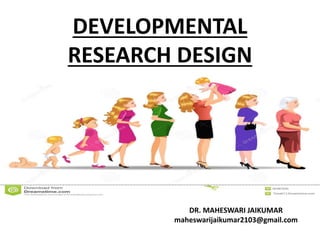
DEVELOPMENTAL
RESEARCH DESIGN
DR. MAHESWARI JAIKUMAR
maheswarijaikumar2103@gmail.com
• Developmental research designs
examines the phenomenon with
reference to time.
• This design is generally used as
adjunct research designs with other
research designs such as cross-
sectional-descriptive, longitudinal-
correlational research design.
TYPES
• 1. CROSS-SECTIONAL RESEARCH
DESIGN.
• 2. LONGITUDINAL RESEARCH
DESIGN.
CROSS-SECTIONAL RESEARCH
DESIGN
• Cross-sectional research designs
is the one in which the
researcher collects data at a
particular point of time.(one
time data collection).
• Cross-sectional design is easier
and convenient to carry out.
LONGITUDINAL RESEARCH
DESIGN
• Longitudinal research designs is
used to collect data over a
period of time. (long time study)
• The value of the longitudinal
design is in its ability to
demonstrate change over a
period of time.
• Longitudinal studies are
classified into three types :
TREND STUDIES, PANEL STUDIES,
FOLLOW-UP STUDIES.
TREND STUDIES
• Trend studies aims at
investigating a sample from a
general population over a time
with respect to some
phenomenon.
• Trend studies permit researchers
to examine pattern and rate of
changes and to make prediction
about future direction based on
previously identified patterns
and rates of changes.
PANEL STUDIES
• A sample of people involves in
the study are referred to as a
panel.
• In panel studies, same people are
involved and over a period of time
because they become more
informative on the phenomenon
than the subjects in trend studies
because ue the researcher cannot
only examine the patterns of
change, but also reasons for
change.
• The same selected people are
contacted for two or more times
to collect further data.
FOLLOW - UP STUDIES
• Follow-up studies are
undertaken to determine the
subsequent states of subjects
with a specified condition or
those who have received a
specific intervention.
THANK YOU

DEVELOPMENTAL RESEARCH DESIGN

  • 1.
    DEVELOPMENTAL RESEARCH DESIGN DR. MAHESWARIJAIKUMAR maheswarijaikumar2103@gmail.com
  • 2.
    • Developmental researchdesigns examines the phenomenon with reference to time. • This design is generally used as adjunct research designs with other research designs such as cross- sectional-descriptive, longitudinal- correlational research design.
  • 3.
    TYPES • 1. CROSS-SECTIONALRESEARCH DESIGN. • 2. LONGITUDINAL RESEARCH DESIGN.
  • 4.
    CROSS-SECTIONAL RESEARCH DESIGN • Cross-sectionalresearch designs is the one in which the researcher collects data at a particular point of time.(one time data collection).
  • 5.
    • Cross-sectional designis easier and convenient to carry out.
  • 6.
    LONGITUDINAL RESEARCH DESIGN • Longitudinalresearch designs is used to collect data over a period of time. (long time study)
  • 7.
    • The valueof the longitudinal design is in its ability to demonstrate change over a period of time. • Longitudinal studies are classified into three types : TREND STUDIES, PANEL STUDIES, FOLLOW-UP STUDIES.
  • 8.
    TREND STUDIES • Trendstudies aims at investigating a sample from a general population over a time with respect to some phenomenon.
  • 9.
    • Trend studiespermit researchers to examine pattern and rate of changes and to make prediction about future direction based on previously identified patterns and rates of changes.
  • 10.
    PANEL STUDIES • Asample of people involves in the study are referred to as a panel.
  • 11.
    • In panelstudies, same people are involved and over a period of time because they become more informative on the phenomenon than the subjects in trend studies because ue the researcher cannot only examine the patterns of change, but also reasons for change.
  • 12.
    • The sameselected people are contacted for two or more times to collect further data.
  • 13.
    FOLLOW - UPSTUDIES • Follow-up studies are undertaken to determine the subsequent states of subjects with a specified condition or those who have received a specific intervention.
  • 14.