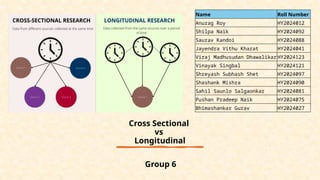
Cross Sectional
vs
Longitudinal
Group 6
Name Roll Number
Anurag Roy HY2024012
Shilpa Naik HY2024092
Saurav Kandoi HY2024088
Jayendra Vithu Kharat HY2024041
Viraj Madhusudan Dhawalikar HY2024123
Vinayak Singbal HY2024121
Shreyash Subhash Shet HY2024097
Shashank Mishra HY2024090
Sahil Saunlo Salgaonkar HY2024081
Pushan Pradeep Naik HY2024075
Bhimashankar Gurav HY2024027
Introduction
to Descriptive
Research
Designs
Anurag Roy
Introduction to Descriptive Research Designs
Descriptive research design is a type of research design that aims to systematically obtain information to describe a
phenomenon, situation, or population. More specifically, it helps answer the what, when, where, and how questions
regarding the research problem rather than the why. The researcher does not control or manipulate any variables,
unlike in experimental research. Instead, the variables are only identified, observed, and measured.
Uses of Descriptive Research Design:
1. Identifying Patterns and Trends
2. Understanding Characteristics and Behaviors
3. Providing a Basis for Further Research
4. Benchmarking and Comparison
5. To verify or validate existing conditions
6. Decision-Making and Policy Formulation
Steps to conduct a study using the descriptive method of research:
Step 1: Outline the research objective
Step 2: Determine the tools and techniques to be used for data collection
Step 3: Define the target population and sample group
Step 4: Analyze the data collected
Step 5: Write the report
Cross-sectional
Studies:
Definition and
Characteristics
Shilpa Naik
Cross-sectional Studies: Definition and Characteristics
Definition : Cross-sectional studies are a type of observational study that analyzes data
from a population at a specific point in time.
• Characteristics:
• Data is collected at a single point in time
o Example: A survey conducted to assess the dietary habits of adults in a city on a particular
day.
• There is no subsequent data collection after the initial point.
o Example: A health survey that measures the prevalence of diabetes in a population without any
follow-up visits.
• Can study multiple variables simultaneously.
o Example: A study examining the relationship between physical activity, diet, and obesity in a
population at a single point in time.
• Often used to determine the prevalence of an outcomes or conditions in a population
o Example: A study to determine the prevalence of smoking among teenagers in a specific region.
Advantages
of Cross-
sectional
Studies
Saurav Kandoi
Example: Smoking and Lung Cancer
A cross-sectional study is conducted to assess the relationship between smoking and lung cancer
in a population at a specific point in time. Researchers survey a group of people, recording
smoking habits and cancer incidence.
Advantages:
• Can establish temporal sequence – Identifies if smoking is linked with lung cancer at the time of
the study.
• Allows study of changes over time – Data can show smoking patterns by age groups.
• Distinguishes short and long-term phenomena – Differentiates recent smokers from long-term
smokers.
• Provides rich data – Offers insights into individual smoking behaviors and cancer status.
• Reduces recall bias – Real-time data collection reduces the need to rely on memory.
• Ideal for developmental trends – Helps track smoking-related health trends across
demographics.
Limitations of
Cross-sectional
Studies
Jayendra Kharat
Limitations of Cross-sectional Studies
Longitudinal
Studies:
Definition
and Types
Viraj Dhawalikar
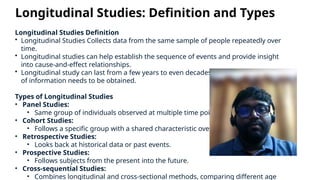
Longitudinal Studies: Definition and Types
Longitudinal Studies Definition
• Longitudinal Studies Collects data from the same sample of people repeatedly over
time.
• Longitudinal studies can help establish the sequence of events and provide insight
into cause-and-effect relationships.
• Longitudinal study can last from a few years to even decades depending on what kind
of information needs to be obtained.
Types of Longitudinal Studies
• Panel Studies:
• Same group of individuals observed at multiple time points.
• Cohort Studies:
• Follows a specific group with a shared characteristic over time.
• Retrospective Studies:
• Looks back at historical data or past events.
• Prospective Studies:
• Follows subjects from the present into the future.
• Cross-sequential Studies:
• Combines longitudinal and cross-sectional methods, comparing different age
Advantages
of
Longitudinal
Studies
Vinayak Singbal
Advantages of Longitudinal Studies
• Longitudinal Studies collect data from the same sample of people repeatedly over time. It can help establish the sequence of events and provide insight into cause-and-effect relationships as well as can last from a few years to even decades depending on what kind of information needs to be obtained.
Advantages:
• Can establish temporal sequence of events (helpful for causality).
• Allows study of changes over time.
• Can distinguish between short and long-term phenomena.
• Provides rich, detailed data on individual changes.
• Reduces certain types of bias (e.g., recall bias).
• Ideal for studying developmental trends.
Limitations
of
Longitudinal
Studies
Shreyash Shet
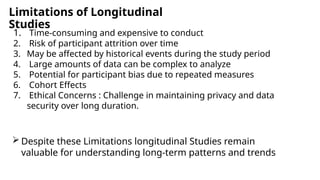
Limitations of Longitudinal
Studies
1. Time-consuming and expensive to conduct
2. Risk of participant attrition over time
3. May be affected by historical events during the study period
4. Large amounts of data can be complex to analyze
5. Potential for participant bias due to repeated measures
6. Cohort Effects
7. Ethical Concerns : Challenge in maintaining privacy and data
security over long duration.
 Despite these Limitations longitudinal Studies remain
valuable for understanding long-term patterns and trends
Comparison:
Data Collection
Methods
Shashank Mishra
Comparison: Data Collection Methods
Comparison:
Time and
Resource
Requirements
Sahil Salgaonkar
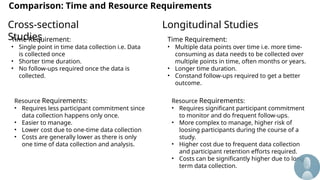
Comparison: Time and Resource Requirements
Cross-sectional
Studies
Longitudinal Studies
Time Requirement:
• Single point in time data collection i.e. Data
is collected once
• Shorter time duration.
• No follow-ups required once the data is
collected.
Time Requirement:
• Multiple data points over time i.e. more time-
consuming as data needs to be collected over
multiple points in time, often months or years.
• Longer time duration.
• Constand follow-ups required to get a better
outcome.
Resource Requirements:
• Requires less participant commitment since
data collection happens only once.
• Easier to manage.
• Lower cost due to one-time data collection
• Costs are generally lower as there is only
one time of data collection and analysis.
Resource Requirements:
• Requires significant participant commitment
to monitor and do frequent follow-ups.
• More complex to manage, higher risk of
loosing participants during the course of a
study.
• Higher cost due to frequent data collection
and participant retention efforts required.
• Costs can be significantly higher due to long-
term data collection.
Comparison:
Applicability
in Different
Fields
Pushan Naik
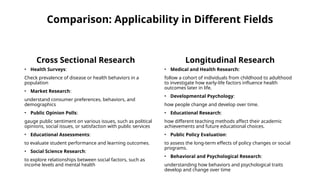
Comparison: Applicability in Different Fields
Cross Sectional Research
• Health Surveys:
Check prevalence of disease or health behaviors in a
population
• Market Research:
understand consumer preferences, behaviors, and
demographics
• Public Opinion Polls:
gauge public sentiment on various issues, such as political
opinions, social issues, or satisfaction with public services
• Educational Assessments:
to evaluate student performance and learning outcomes.
• Social Science Research:
to explore relationships between social factors, such as
income levels and mental health
Longitudinal Research
• Medical and Health Research:
follow a cohort of individuals from childhood to adulthood
to investigate how early-life factors influence health
outcomes later in life.
• Developmental Psychology:
how people change and develop over time.
• Educational Research:
how different teaching methods affect their academic
achievements and future educational choices.
• Public Policy Evaluation:
to assess the long-term effects of policy changes or social
programs.
• Behavioral and Psychological Research:
understanding how behaviors and psychological traits
develop and change over time
Conclusion
: Choosing
the Right
Design
Bhimashankar Gurav
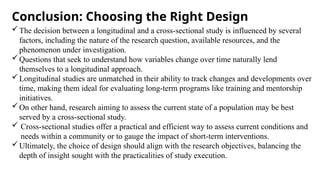
Conclusion: Choosing the Right Design
The decision between a longitudinal and a cross-sectional study is influenced by several
factors, including the nature of the research question, available resources, and the
phenomenon under investigation.
Questions that seek to understand how variables change over time naturally lend
themselves to a longitudinal approach.
Longitudinal studies are unmatched in their ability to track changes and developments over
time, making them ideal for evaluating long-term programs like training and mentorship
initiatives.
On other hand, research aiming to assess the current state of a population may be best
served by a cross-sectional study.
 Cross-sectional studies offer a practical and efficient way to assess current conditions and
needs within a community or to gauge the impact of short-term interventions.
Ultimately, the choice of design should align with the research objectives, balancing the
depth of insight sought with the practicalities of study execution.
Group6_QRM_ET_Project_CrossSectional_vs_Longitudinal.pptx

Group6_QRM_ET_Project_CrossSectional_vs_Longitudinal.pptx

  • 1.
    Cross Sectional vs Longitudinal Group 6 NameRoll Number Anurag Roy HY2024012 Shilpa Naik HY2024092 Saurav Kandoi HY2024088 Jayendra Vithu Kharat HY2024041 Viraj Madhusudan Dhawalikar HY2024123 Vinayak Singbal HY2024121 Shreyash Subhash Shet HY2024097 Shashank Mishra HY2024090 Sahil Saunlo Salgaonkar HY2024081 Pushan Pradeep Naik HY2024075 Bhimashankar Gurav HY2024027
  • 2.
  • 3.
    Introduction to DescriptiveResearch Designs Descriptive research design is a type of research design that aims to systematically obtain information to describe a phenomenon, situation, or population. More specifically, it helps answer the what, when, where, and how questions regarding the research problem rather than the why. The researcher does not control or manipulate any variables, unlike in experimental research. Instead, the variables are only identified, observed, and measured. Uses of Descriptive Research Design: 1. Identifying Patterns and Trends 2. Understanding Characteristics and Behaviors 3. Providing a Basis for Further Research 4. Benchmarking and Comparison 5. To verify or validate existing conditions 6. Decision-Making and Policy Formulation Steps to conduct a study using the descriptive method of research: Step 1: Outline the research objective Step 2: Determine the tools and techniques to be used for data collection Step 3: Define the target population and sample group Step 4: Analyze the data collected Step 5: Write the report
  • 4.
  • 5.
    Cross-sectional Studies: Definitionand Characteristics Definition : Cross-sectional studies are a type of observational study that analyzes data from a population at a specific point in time. • Characteristics: • Data is collected at a single point in time o Example: A survey conducted to assess the dietary habits of adults in a city on a particular day. • There is no subsequent data collection after the initial point. o Example: A health survey that measures the prevalence of diabetes in a population without any follow-up visits. • Can study multiple variables simultaneously. o Example: A study examining the relationship between physical activity, diet, and obesity in a population at a single point in time. • Often used to determine the prevalence of an outcomes or conditions in a population o Example: A study to determine the prevalence of smoking among teenagers in a specific region.
  • 6.
  • 7.
    Example: Smoking andLung Cancer A cross-sectional study is conducted to assess the relationship between smoking and lung cancer in a population at a specific point in time. Researchers survey a group of people, recording smoking habits and cancer incidence. Advantages: • Can establish temporal sequence – Identifies if smoking is linked with lung cancer at the time of the study. • Allows study of changes over time – Data can show smoking patterns by age groups. • Distinguishes short and long-term phenomena – Differentiates recent smokers from long-term smokers. • Provides rich data – Offers insights into individual smoking behaviors and cancer status. • Reduces recall bias – Real-time data collection reduces the need to rely on memory. • Ideal for developmental trends – Helps track smoking-related health trends across demographics.
  • 8.
  • 9.
  • 10.
  • 11.
    Longitudinal Studies: Definitionand Types Longitudinal Studies Definition • Longitudinal Studies Collects data from the same sample of people repeatedly over time. • Longitudinal studies can help establish the sequence of events and provide insight into cause-and-effect relationships. • Longitudinal study can last from a few years to even decades depending on what kind of information needs to be obtained. Types of Longitudinal Studies • Panel Studies: • Same group of individuals observed at multiple time points. • Cohort Studies: • Follows a specific group with a shared characteristic over time. • Retrospective Studies: • Looks back at historical data or past events. • Prospective Studies: • Follows subjects from the present into the future. • Cross-sequential Studies: • Combines longitudinal and cross-sectional methods, comparing different age
  • 12.
  • 13.
    Advantages of LongitudinalStudies • Longitudinal Studies collect data from the same sample of people repeatedly over time. It can help establish the sequence of events and provide insight into cause-and-effect relationships as well as can last from a few years to even decades depending on what kind of information needs to be obtained. Advantages: • Can establish temporal sequence of events (helpful for causality). • Allows study of changes over time. • Can distinguish between short and long-term phenomena. • Provides rich, detailed data on individual changes. • Reduces certain types of bias (e.g., recall bias). • Ideal for studying developmental trends.
  • 14.
  • 15.
    Limitations of Longitudinal Studies 1.Time-consuming and expensive to conduct 2. Risk of participant attrition over time 3. May be affected by historical events during the study period 4. Large amounts of data can be complex to analyze 5. Potential for participant bias due to repeated measures 6. Cohort Effects 7. Ethical Concerns : Challenge in maintaining privacy and data security over long duration.  Despite these Limitations longitudinal Studies remain valuable for understanding long-term patterns and trends
  • 16.
  • 17.
  • 18.
  • 19.
    Comparison: Time andResource Requirements Cross-sectional Studies Longitudinal Studies Time Requirement: • Single point in time data collection i.e. Data is collected once • Shorter time duration. • No follow-ups required once the data is collected. Time Requirement: • Multiple data points over time i.e. more time- consuming as data needs to be collected over multiple points in time, often months or years. • Longer time duration. • Constand follow-ups required to get a better outcome. Resource Requirements: • Requires less participant commitment since data collection happens only once. • Easier to manage. • Lower cost due to one-time data collection • Costs are generally lower as there is only one time of data collection and analysis. Resource Requirements: • Requires significant participant commitment to monitor and do frequent follow-ups. • More complex to manage, higher risk of loosing participants during the course of a study. • Higher cost due to frequent data collection and participant retention efforts required. • Costs can be significantly higher due to long- term data collection.
  • 20.
  • 21.
    Comparison: Applicability inDifferent Fields Cross Sectional Research • Health Surveys: Check prevalence of disease or health behaviors in a population • Market Research: understand consumer preferences, behaviors, and demographics • Public Opinion Polls: gauge public sentiment on various issues, such as political opinions, social issues, or satisfaction with public services • Educational Assessments: to evaluate student performance and learning outcomes. • Social Science Research: to explore relationships between social factors, such as income levels and mental health Longitudinal Research • Medical and Health Research: follow a cohort of individuals from childhood to adulthood to investigate how early-life factors influence health outcomes later in life. • Developmental Psychology: how people change and develop over time. • Educational Research: how different teaching methods affect their academic achievements and future educational choices. • Public Policy Evaluation: to assess the long-term effects of policy changes or social programs. • Behavioral and Psychological Research: understanding how behaviors and psychological traits develop and change over time
  • 22.
  • 23.
    Conclusion: Choosing theRight Design The decision between a longitudinal and a cross-sectional study is influenced by several factors, including the nature of the research question, available resources, and the phenomenon under investigation. Questions that seek to understand how variables change over time naturally lend themselves to a longitudinal approach. Longitudinal studies are unmatched in their ability to track changes and developments over time, making them ideal for evaluating long-term programs like training and mentorship initiatives. On other hand, research aiming to assess the current state of a population may be best served by a cross-sectional study.  Cross-sectional studies offer a practical and efficient way to assess current conditions and needs within a community or to gauge the impact of short-term interventions. Ultimately, the choice of design should align with the research objectives, balancing the depth of insight sought with the practicalities of study execution.

Editor's Notes

  • #3 In this slide, we will discuss the importance of research design. Research design is the blueprint for the collection, measurement, and analysis of data. It is critical in all fields as it ensures that the data collected is accurate and the analysis is valid. The research design should be chosen based on the research question to be answered.
  • #5 In this slide, we will discuss cross-sectional studies. Cross-sectional studies are a type of observational study where data is collected at a single point in time. They are used to describe the prevalence of an outcome in a population. They are useful for identifying associations but cannot determine causality.
  • #9 In this slide, we will discuss the limitations of cross-sectional studies. Cross-sectional studies cannot determine causality, as there may be other factors that affect the outcome. They are subject to selection and measurement bias, which can affect the accuracy of the results. They are not suitable for studying rare diseases or outcomes, as the sample size may be too small.
  • #11 In this slide, we will discuss longitudinal studies. Longitudinal studies are used to study changes over time. Data is collected at multiple time points, which allows for the identification of trends and patterns. Types of longitudinal studies include cohort, panel, and repeated measures studies.
  • #13 In this slide, we will discuss the advantages of longitudinal studies. Longitudinal studies can establish temporal relationships between variables, which allows for the determination of causality. They can provide more detailed information than cross-sectional studies, as they track changes over time. They are useful for studying rare diseases or outcomes, as they can follow a small number of individuals over time.
  • #15 In this slide, we will discuss the limitations of longitudinal studies. Longitudinal studies are expensive and time-consuming to conduct, as data is collected at multiple time points. They are subject to attrition and loss to follow-up, which can affect the accuracy of the results. They may be affected by confounding variables, which can make it difficult to establish causality.
  • #17 In this slide, we will compare cross-sectional and longitudinal studies in terms of data collection methods. Cross-sectional studies collect data at a single point in time, while longitudinal studies collect data at multiple time points. Cross-sectional studies are quicker and less expensive than longitudinal studies, but longitudinal studies provide more detailed information about changes over time.
  • #19 In this slide, we will compare cross-sectional and longitudinal studies in terms of time and resource requirements. Longitudinal studies require more time and resources than cross-sectional studies, as they collect data at multiple time points. They require a larger sample size than cross-sectional studies. Longitudinal studies are more suitable for studying changes over time, while cross-sectional studies provide a snapshot of a population at a given point in time.
  • #23 In this slide, we will conclude our discussion of research designs. The choice of study design depends on the research question, as different designs have different strengths and limitations. Cross-sectional studies are useful for generating hypotheses and studying prevalence, while longitudinal studies are useful for studying changes over time. Researchers should choose the design that is best suited to their research question and field of study.
  • #24 In this slide, we will conclude our discussion of research designs. The choice of study design depends on the research question, as different designs have different strengths and limitations. Cross-sectional studies are useful for generating hypotheses and studying prevalence, while longitudinal studies are useful for studying changes over time. Researchers should choose the design that is best suited to their research question and field of study.