BY.
RENU SHARMA
ROLL NO.14
J. G. College of Education
PAPER – A004
METHODS OF EDUCATIONAL RESEARCH
Unit – 2
DESCRIPTIVE RESEARCH METHOD
TO.
DR. DIPTI BHATT
PROFESSOR
WHAT IS DESCRIPTIVE RESEARCH
METHOD ?
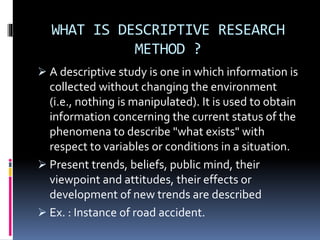
 A descriptive study is one in which information is
collected without changing the environment
(i.e., nothing is manipulated). It is used to obtain
information concerning the current status of the
phenomena to describe "what exists" with
respect to variables or conditions in a situation.
 Present trends, beliefs, public mind, their
viewpoint and attitudes, their effects or
development of new trends are described
 Ex. : Instance of road accident.
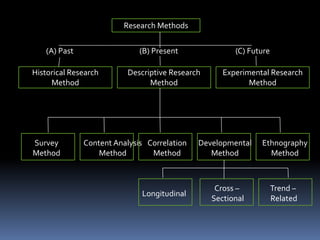
Research Methods
Historical Research
Method
Descriptive Research
Method
Experimental Research
Method
(A) Past (C) Future(B) Present
Survey
Method
Content Analysis
Method
Correlation
Method
Developmental
Method
Ethnography
Method
Longitudinal
Cross –
Sectional
Trend –
Related
DEVELOPMENTAL STUDY METHOD
 The longitudinal , cross-sectional and trend
studies of descriptive research are together
known as developmental research.
 It examines the change in specific characterstics
and the trends of development in context of
time.
 the systematic study of designing, developing,
and evaluating instructional programs,
processes, and products that must meet criteria
of internal consistency and effectiveness
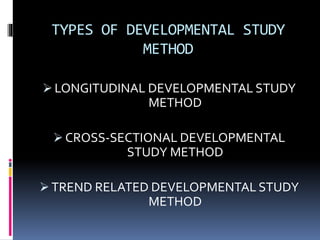
TYPES OF DEVELOPMENTAL STUDY
METHOD
 LONGITUDINAL DEVELOPMENTAL STUDY
METHOD
 CROSS-SECTIONAL DEVELOPMENTAL
STUDY METHOD
 TREND RELATED DEVELOPMENTAL STUDY
METHOD
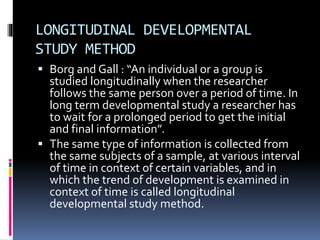
LONGITUDINAL DEVELOPMENTAL
STUDY METHOD
 Borg and Gall : “An individual or a group is
studied longitudinally when the researcher
follows the same person over a period of time. In
long term developmental study a researcher has
to wait for a prolonged period to get the initial
and final information”.
 The same type of information is collected from
the same subjects of a sample, at various interval
of time in context of certain variables, and in
which the trend of development is examined in
context of time is called longitudinal
developmental study method.
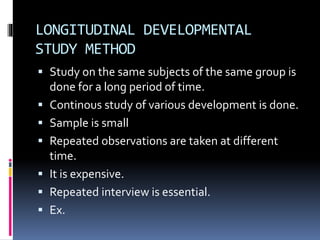
LONGITUDINAL DEVELOPMENTAL
STUDY METHOD
 Study on the same subjects of the same group is
done for a long period of time.
 Continous study of various development is done.
 Sample is small
 Repeated observations are taken at different
time.
 It is expensive.
 Repeated interview is essential.
 Ex.
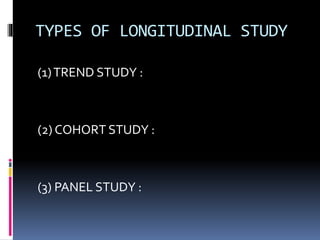
TYPES OF LONGITUDINAL STUDY
(1)TREND STUDY :
(2) COHORT STUDY :
(3) PANEL STUDY :
CROSS-SECTIONAL DEVELOPMENTAL
STUDY METHOD
 Cohen and Manyon, “When the different
respondent are studied simultaneously in
practical time, then it is called Cross-
Sectional Study”.
 To compare the subjects of samples
representing various stages of development
at a particular time and to evaluate the
changes occuring at a specific time.
CROSS-SECTIONAL DEVELOPMENTAL
STUDY METHOD
 Study is done on various subjects at one time.
 The rate of development is studied.
 A large sample is selected.
 Observation is taken at a same time.
 Interview is done once or twice.
 Less expensive.
 Ex.

Descriptive Research Method

  • 1.
    BY. RENU SHARMA ROLL NO.14 J.G. College of Education PAPER – A004 METHODS OF EDUCATIONAL RESEARCH Unit – 2 DESCRIPTIVE RESEARCH METHOD TO. DR. DIPTI BHATT PROFESSOR
  • 2.
    WHAT IS DESCRIPTIVERESEARCH METHOD ?  A descriptive study is one in which information is collected without changing the environment (i.e., nothing is manipulated). It is used to obtain information concerning the current status of the phenomena to describe "what exists" with respect to variables or conditions in a situation.  Present trends, beliefs, public mind, their viewpoint and attitudes, their effects or development of new trends are described  Ex. : Instance of road accident.
  • 3.
    Research Methods Historical Research Method DescriptiveResearch Method Experimental Research Method (A) Past (C) Future(B) Present Survey Method Content Analysis Method Correlation Method Developmental Method Ethnography Method Longitudinal Cross – Sectional Trend – Related
  • 4.
    DEVELOPMENTAL STUDY METHOD The longitudinal , cross-sectional and trend studies of descriptive research are together known as developmental research.  It examines the change in specific characterstics and the trends of development in context of time.  the systematic study of designing, developing, and evaluating instructional programs, processes, and products that must meet criteria of internal consistency and effectiveness
  • 5.
    TYPES OF DEVELOPMENTALSTUDY METHOD  LONGITUDINAL DEVELOPMENTAL STUDY METHOD  CROSS-SECTIONAL DEVELOPMENTAL STUDY METHOD  TREND RELATED DEVELOPMENTAL STUDY METHOD
  • 6.
    LONGITUDINAL DEVELOPMENTAL STUDY METHOD Borg and Gall : “An individual or a group is studied longitudinally when the researcher follows the same person over a period of time. In long term developmental study a researcher has to wait for a prolonged period to get the initial and final information”.  The same type of information is collected from the same subjects of a sample, at various interval of time in context of certain variables, and in which the trend of development is examined in context of time is called longitudinal developmental study method.
  • 7.
    LONGITUDINAL DEVELOPMENTAL STUDY METHOD Study on the same subjects of the same group is done for a long period of time.  Continous study of various development is done.  Sample is small  Repeated observations are taken at different time.  It is expensive.  Repeated interview is essential.  Ex.
  • 8.
    TYPES OF LONGITUDINALSTUDY (1)TREND STUDY : (2) COHORT STUDY : (3) PANEL STUDY :
  • 9.
    CROSS-SECTIONAL DEVELOPMENTAL STUDY METHOD Cohen and Manyon, “When the different respondent are studied simultaneously in practical time, then it is called Cross- Sectional Study”.  To compare the subjects of samples representing various stages of development at a particular time and to evaluate the changes occuring at a specific time.
  • 10.
    CROSS-SECTIONAL DEVELOPMENTAL STUDY METHOD Study is done on various subjects at one time.  The rate of development is studied.  A large sample is selected.  Observation is taken at a same time.  Interview is done once or twice.  Less expensive.  Ex.