
An Overview of Research Design
and
Conceptual Framework
Achyut Raj Pandey
Research Officer
Nepal Health Research Council1
An Overview of Research Design
and
Conceptual Framework
Research DesignResearch Design
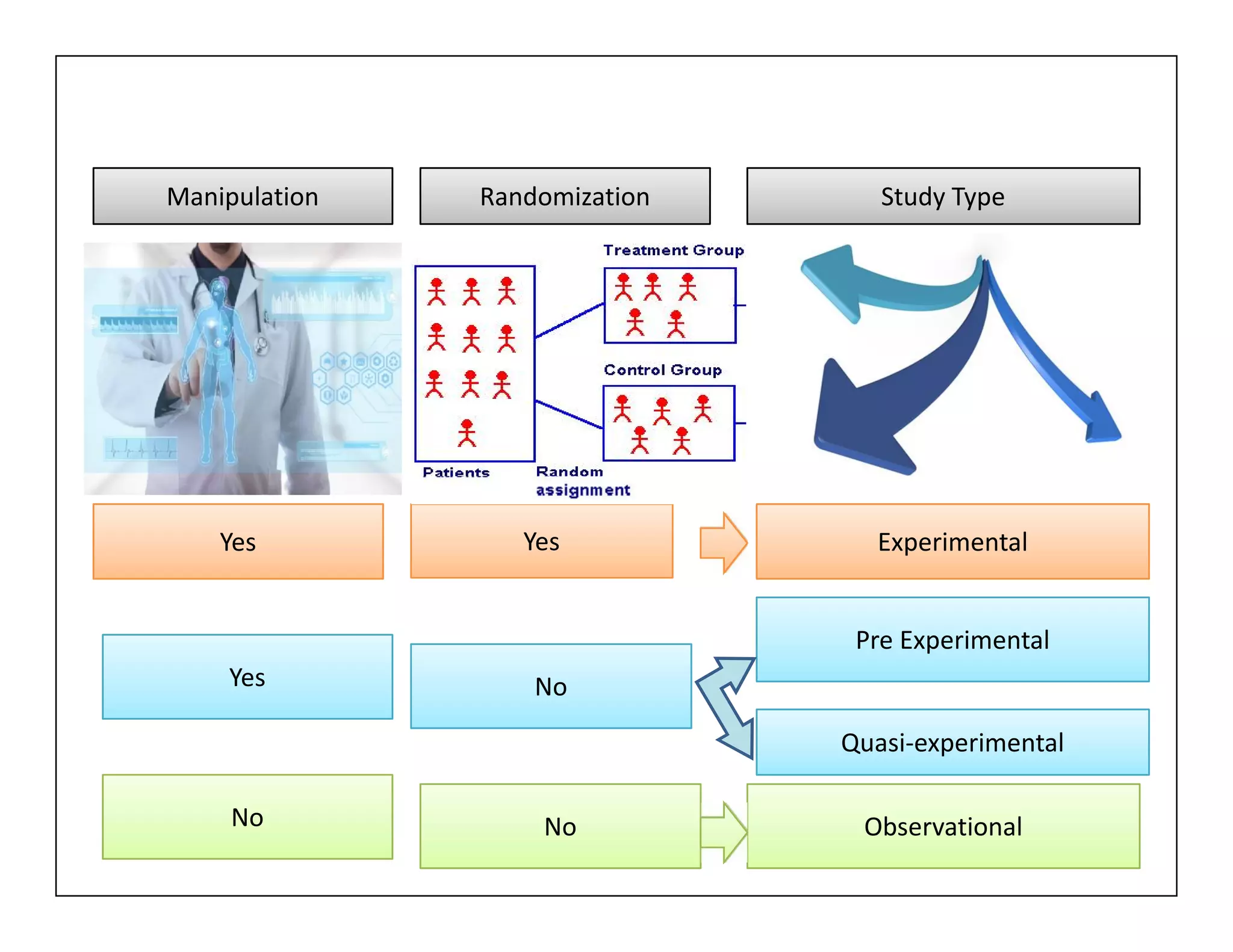
ManipulationManipulation RandomizationRandomization Study TypeStudy Type
ExperimentalExperimental
Pre ExperimentalPre Experimental
ObservationalObservational
YesYes
YesYes
NoNo NoNo
NoNo
YesYes
Quasi-experimentalQuasi-experimental
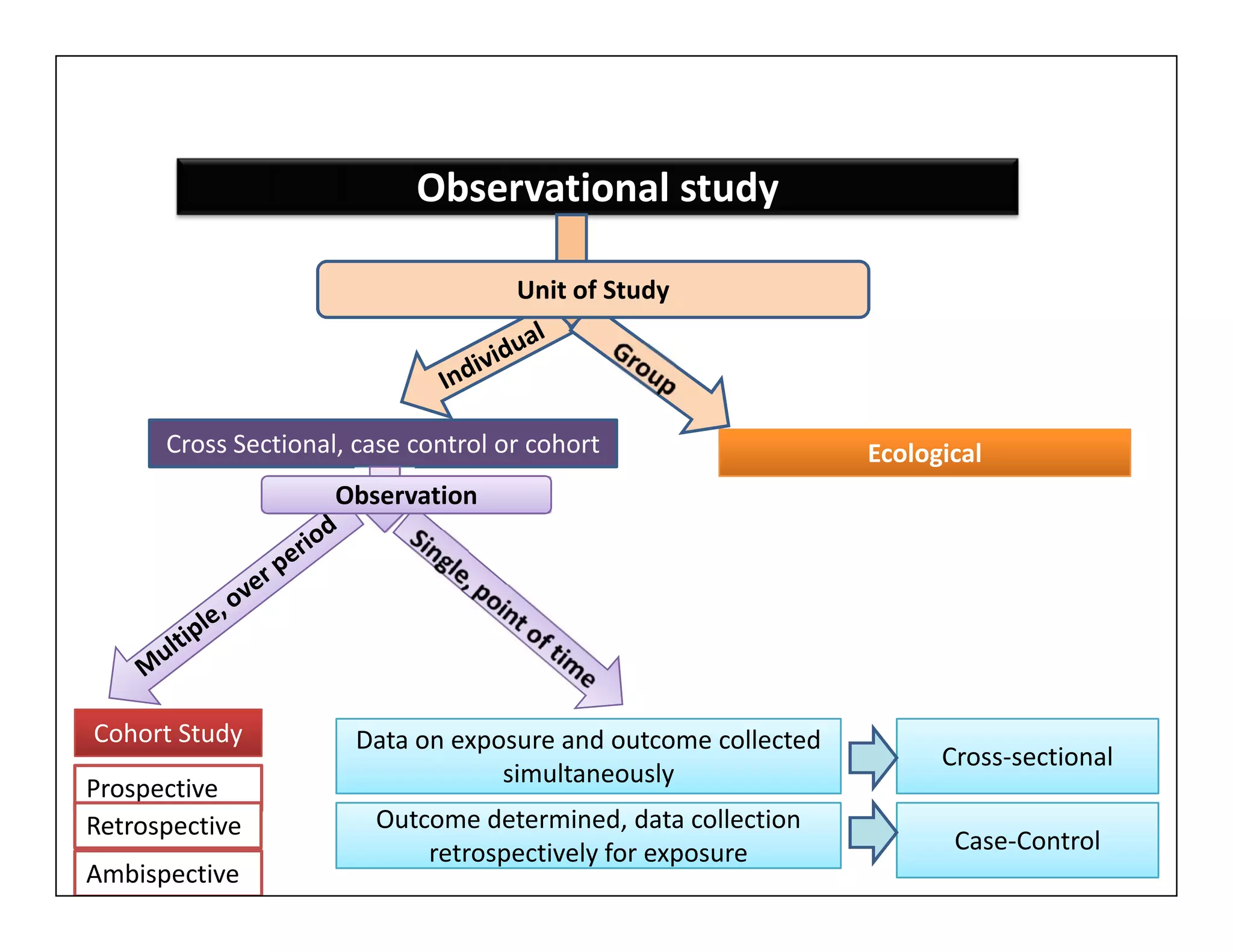
Observational study
EcologicalEcologicalCross Sectional, case control or cohort
Unit of Study
ObservationObservation
Ecological
Cohort StudyCohort Study
ObservationObservation
Data on exposure and outcome collected
simultaneously
Data on exposure and outcome collected
simultaneously
Outcome determined, data collection
retrospectively for exposure
Outcome determined, data collection
retrospectively for exposure
Cross-sectionalCross-sectional
Case-ControlCase-Control
Prospective
Retrospective
Ambispective
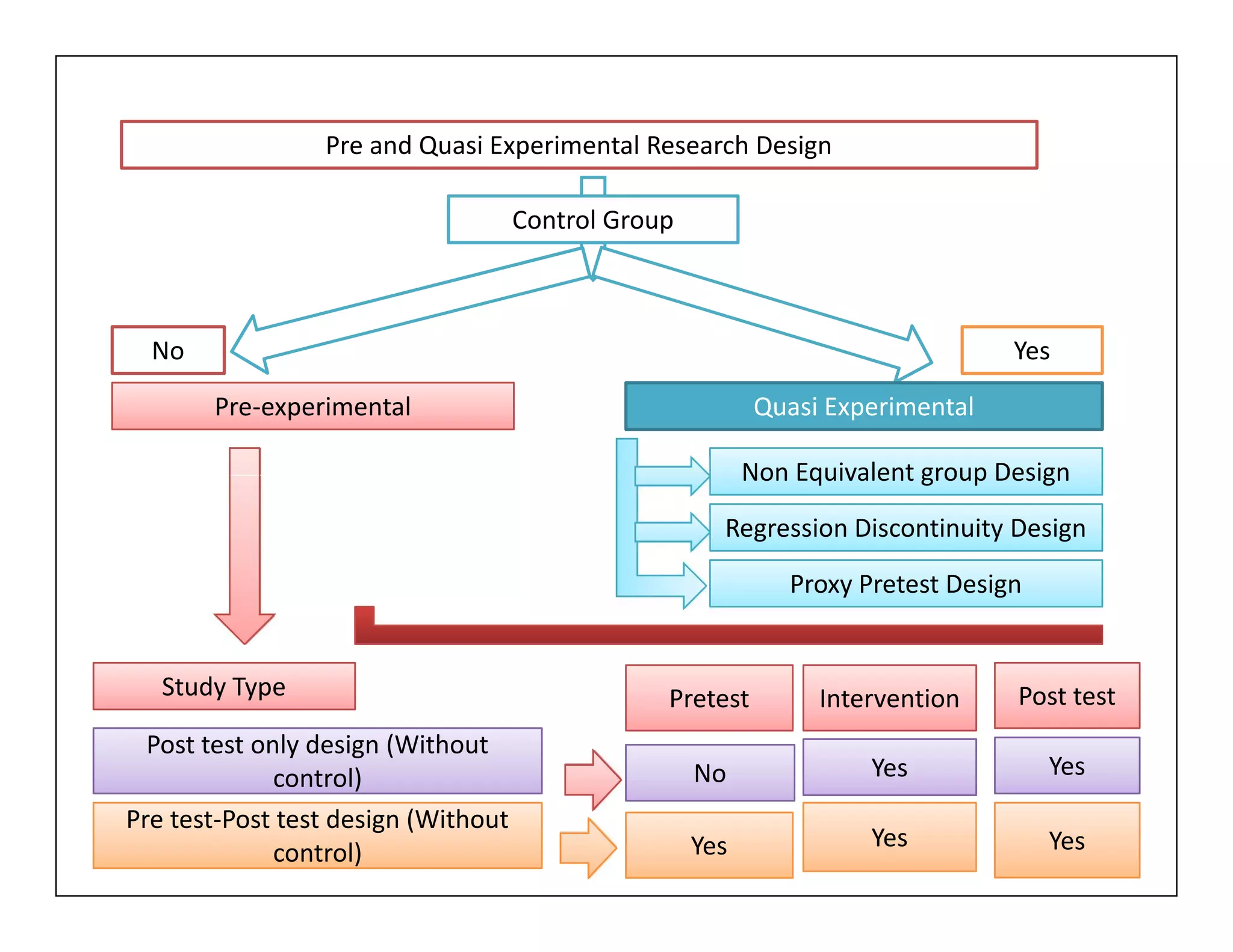
Pre and Quasi Experimental Research Design
Control Group
Pre-experimentalPre-experimental Quasi Experimental
No Yes
Non Equivalent group DesignNon Equivalent group Design
InterventionInterventionStudy TypeStudy Type Post testPost testPretestPretest
Post test only design (Without
control)
Post test only design (Without
control) NoNo YesYes YesYes
Pre test-Post test design (Without
control)
Pre test-Post test design (Without
control) YesYes YesYes YesYes
Non Equivalent group DesignNon Equivalent group Design
Regression Discontinuity DesignRegression Discontinuity Design
Proxy Pretest DesignProxy Pretest Design
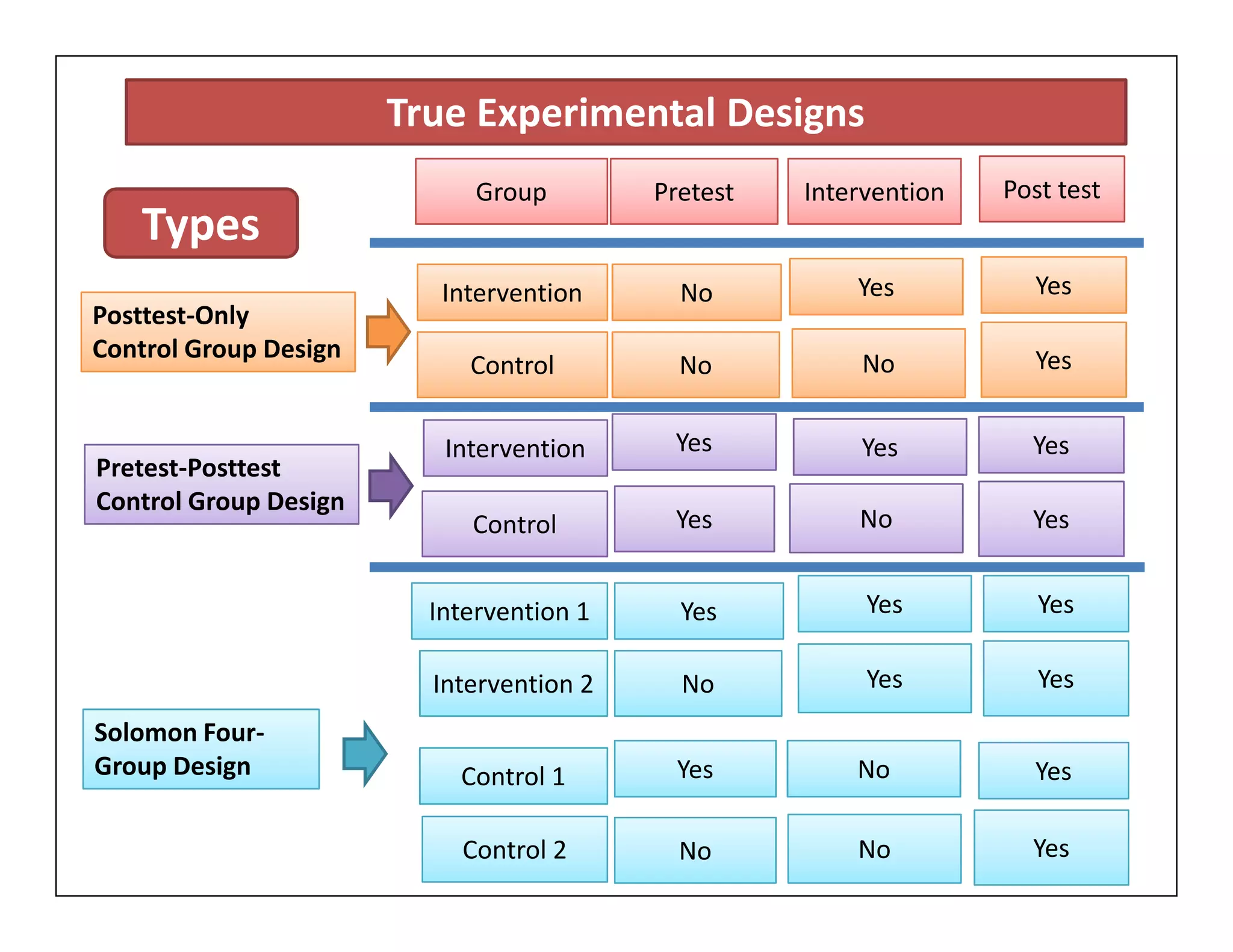
True Experimental Designs
Posttest-Only
Control Group Design
Posttest-Only
Control Group Design
Pretest-Posttest
Control Group Design
Pretest-Posttest
Control Group Design
InterventionIntervention Post testPost testPretestPretest
NoNo YesYes YesYes
NoNo NoNo YesYes
GroupGroup
InterventionIntervention
ControlControl
YesYes YesYes YesYesInterventionIntervention
Types
Pretest-Posttest
Control Group Design
Pretest-Posttest
Control Group Design
Solomon Four-
Group Design
Solomon Four-
Group Design
YesYes NoNo YesYes
Intervention
ControlControl
YesYes YesYes YesYes
NoNo YesYes YesYes
Intervention 1Intervention 1
Intervention 2Intervention 2
YesYes NoNo YesYes
NoNo NoNo YesYes
Control 1Control 1
Control 2Control 2
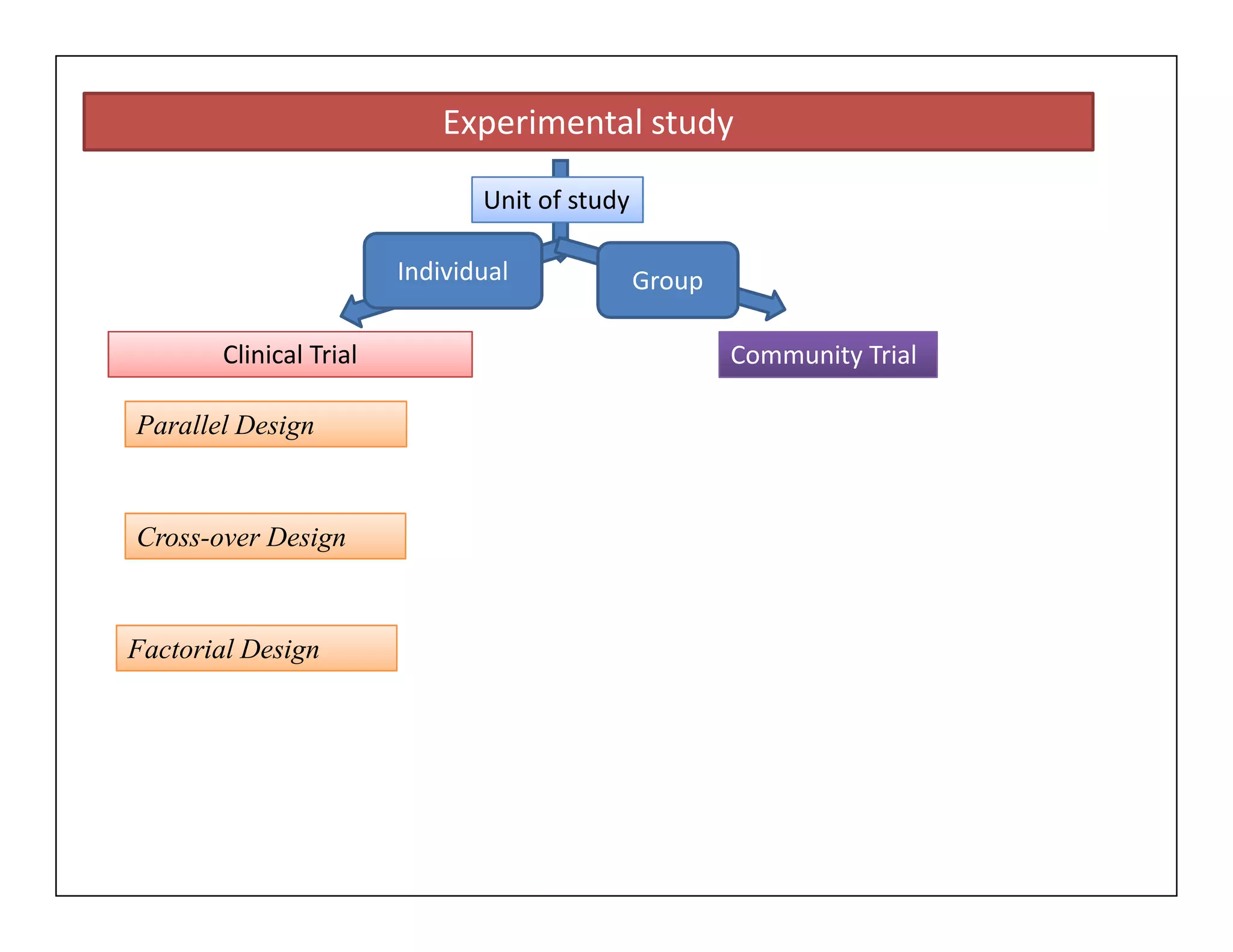
Experimental study
Unit of studyUnit of study
Community TrialCommunity TrialClinical TrialClinical Trial
Parallel DesignParallel Design
GroupIndividual
Cross-over DesignCross-over Design
Factorial DesignFactorial Design
Identifying Research Design for the
Study
Identifying Research Design for the
Study
Factors influencing research design
There is no best type of research design. It
depends on:
• Purpose/area of the study
• Strength of evidence desirable
• Time and resource available
• Ethics
There is no best type of research design. It
depends on:
• Purpose/area of the study
• Strength of evidence desirable
• Time and resource available
• Ethics
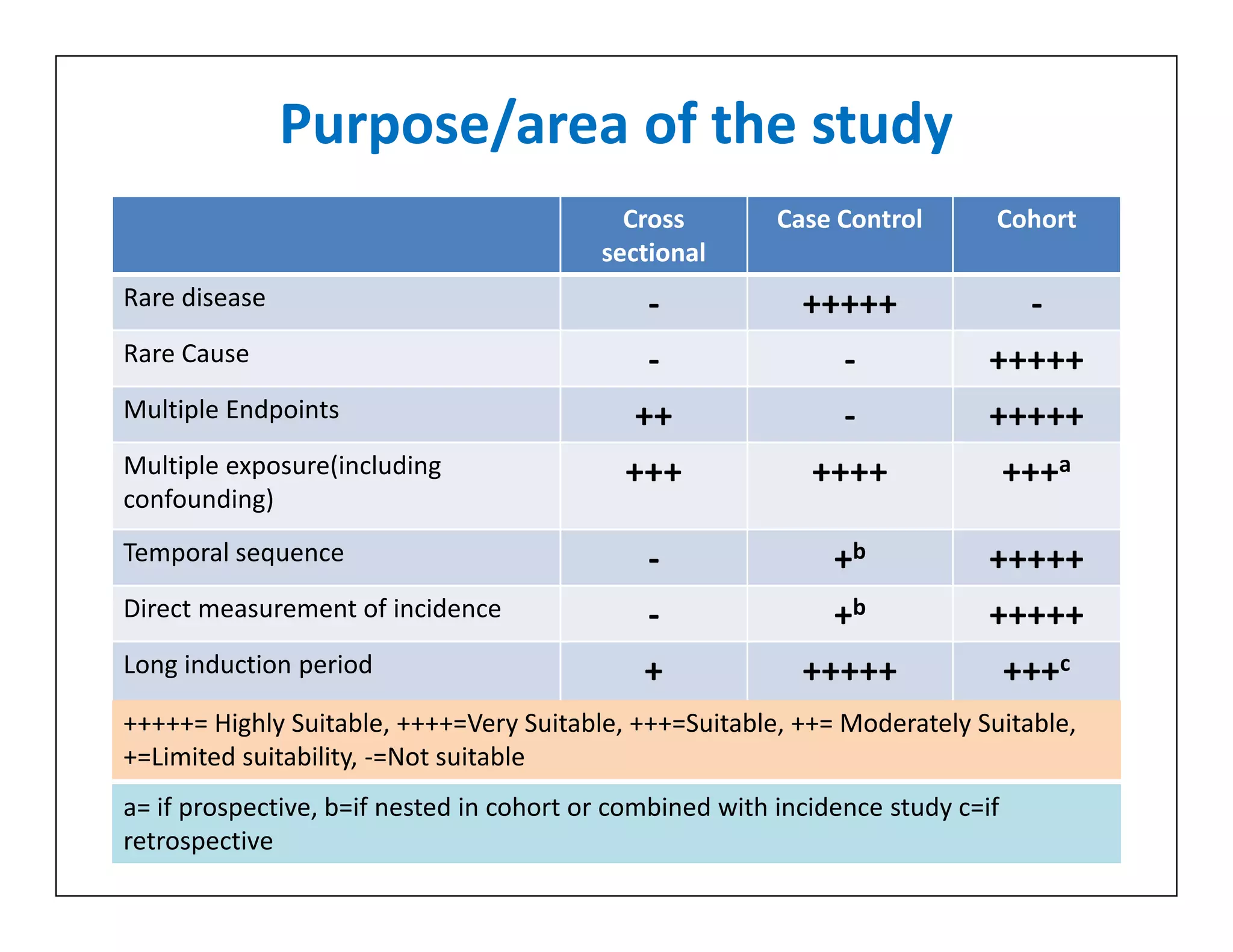
Purpose/area of the study
Cross
sectional
Case Control Cohort
Rare disease - +++++ -
Rare Cause - - +++++
Multiple Endpoints ++ - +++++
Multiple exposure(including
confounding)
+++ ++++ +++aMultiple exposure(including
confounding)
+++ ++++ +++a
Temporal sequence - +b +++++
Direct measurement of incidence - +b +++++
Long induction period + +++++ +++c
+++++= Highly Suitable, ++++=Very Suitable, +++=Suitable, ++= Moderately Suitable,
+=Limited suitability, -=Not suitable
a= if prospective, b=if nested in cohort or combined with incidence study c=if
retrospective
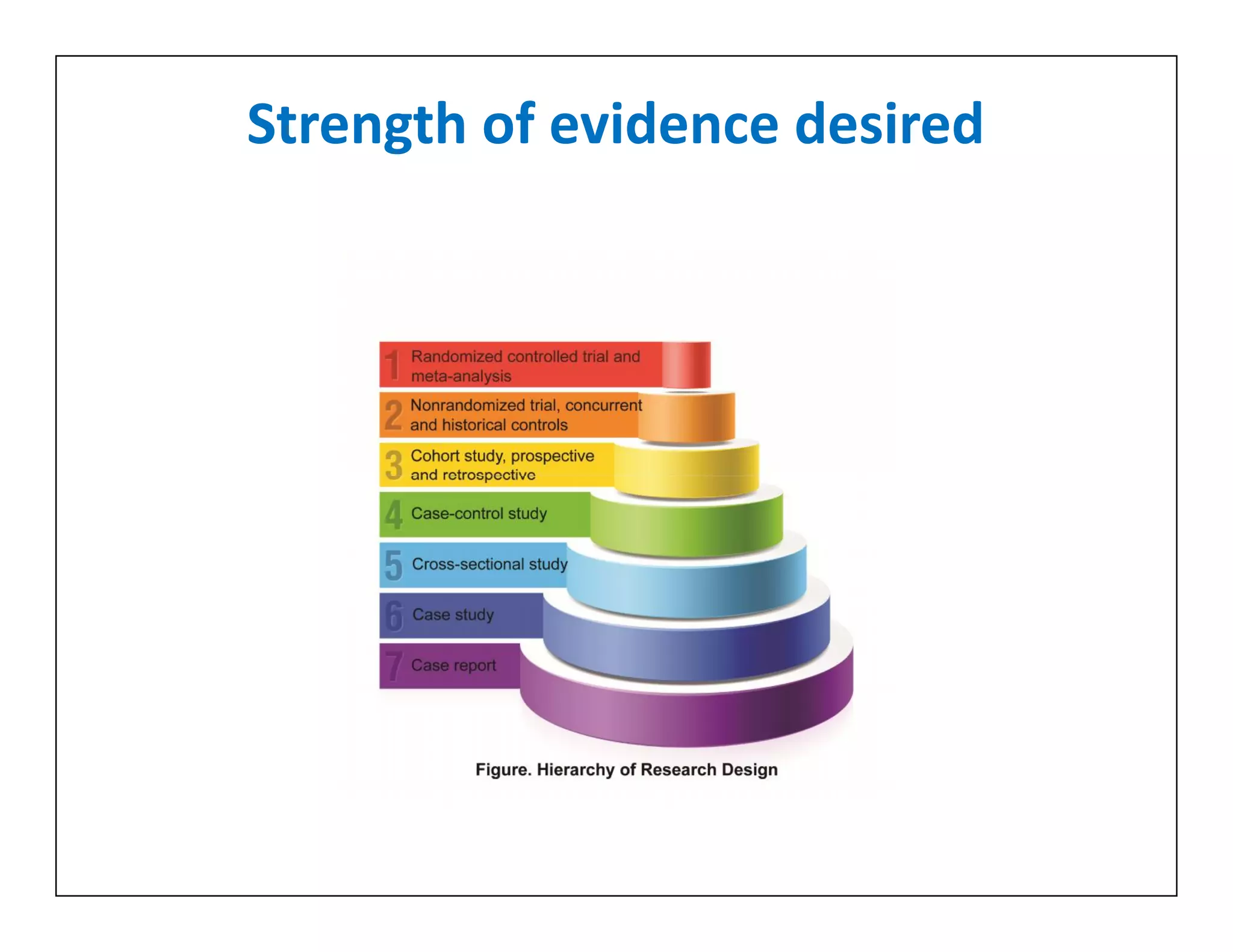
Strength of evidence desired
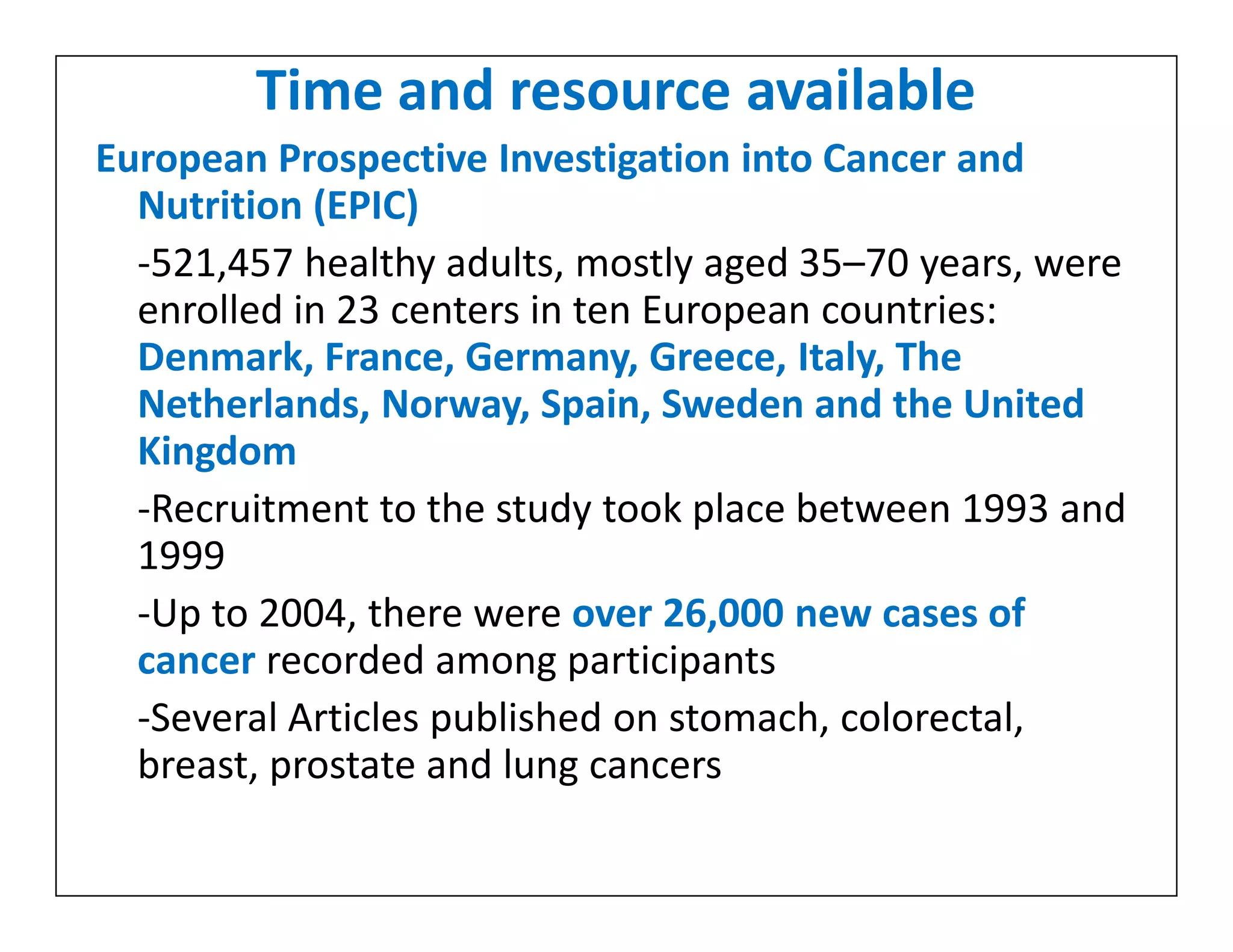
Time and resource available
European Prospective Investigation into Cancer and
Nutrition (EPIC)
-521,457 healthy adults, mostly aged 35–70 years, were
enrolled in 23 centers in ten European countries:
Denmark, France, Germany, Greece, Italy, The
Netherlands, Norway, Spain, Sweden and the United
Kingdom
-Recruitment to the study took place between 1993 and
1999
-Up to 2004, there were over 26,000 new cases of
cancer recorded among participants
-Several Articles published on stomach, colorectal,
breast, prostate and lung cancers
European Prospective Investigation into Cancer and
Nutrition (EPIC)
-521,457 healthy adults, mostly aged 35–70 years, were
enrolled in 23 centers in ten European countries:
Denmark, France, Germany, Greece, Italy, The
Netherlands, Norway, Spain, Sweden and the United
Kingdom
-Recruitment to the study took place between 1993 and
1999
-Up to 2004, there were over 26,000 new cases of
cancer recorded among participants
-Several Articles published on stomach, colorectal,
breast, prostate and lung cancers
Time and resource available
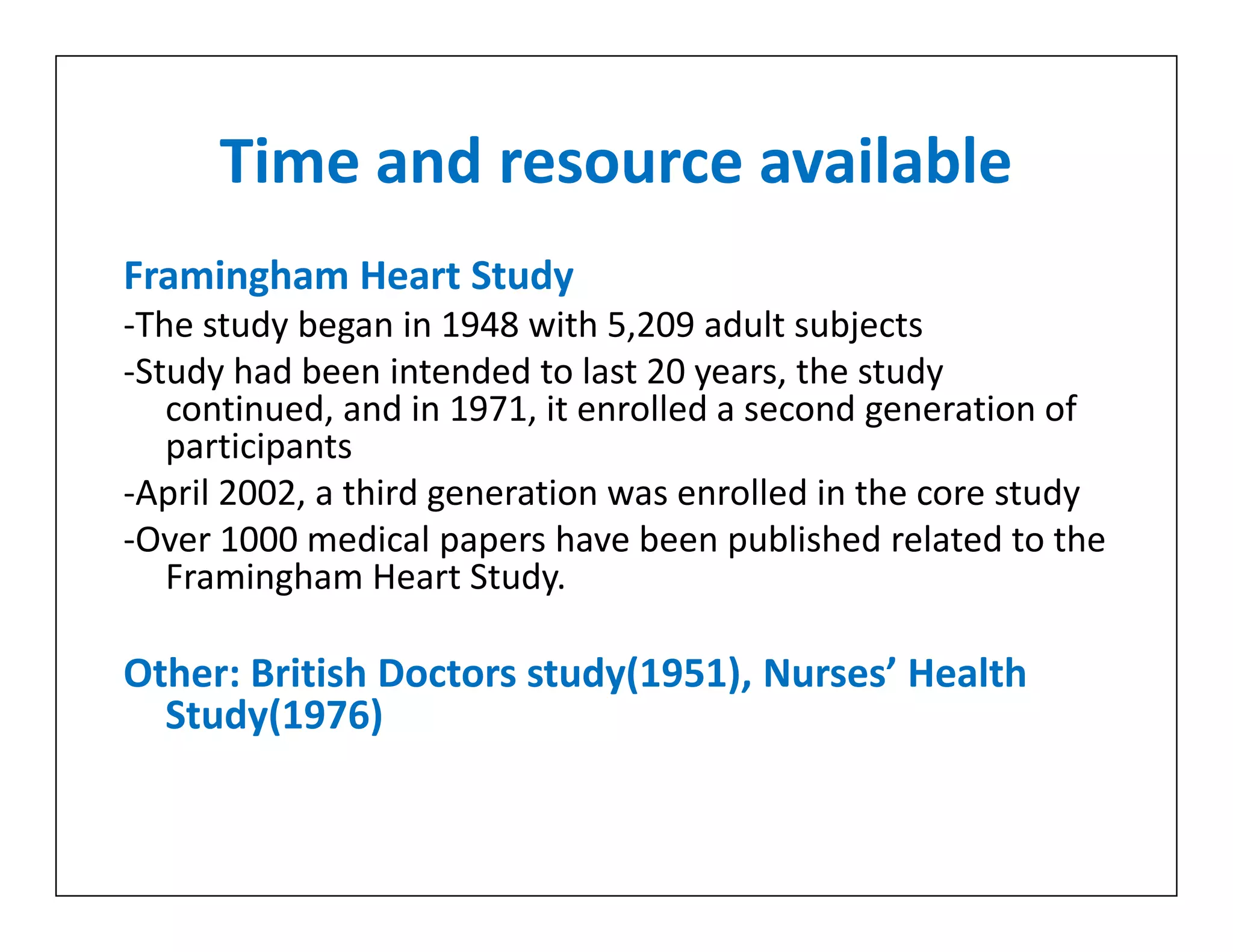
Framingham Heart Study
-The study began in 1948 with 5,209 adult subjects
-Study had been intended to last 20 years, the study
continued, and in 1971, it enrolled a second generation of
participants
-April 2002, a third generation was enrolled in the core study
-Over 1000 medical papers have been published related to the
Framingham Heart Study.
Other: British Doctors study(1951), Nurses’ Health
Study(1976)
Framingham Heart Study
-The study began in 1948 with 5,209 adult subjects
-Study had been intended to last 20 years, the study
continued, and in 1971, it enrolled a second generation of
participants
-April 2002, a third generation was enrolled in the core study
-Over 1000 medical papers have been published related to the
Framingham Heart Study.
Other: British Doctors study(1951), Nurses’ Health
Study(1976)
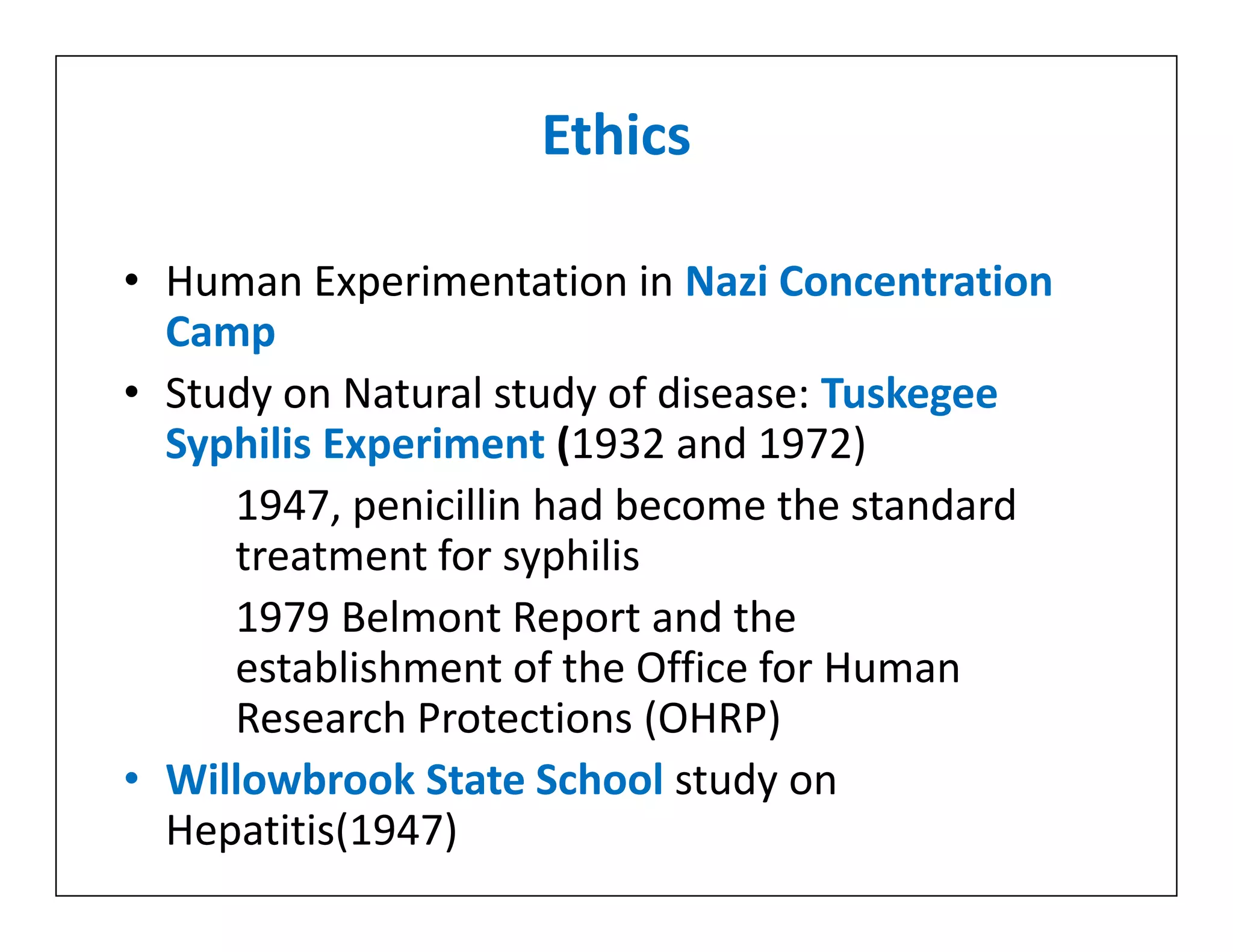
Ethics
• Human Experimentation in Nazi Concentration
Camp
• Study on Natural study of disease: Tuskegee
Syphilis Experiment (1932 and 1972)
1947, penicillin had become the standard
treatment for syphilis
1979 Belmont Report and the
establishment of the Office for Human
Research Protections (OHRP)
• Willowbrook State School study on
Hepatitis(1947)
• Human Experimentation in Nazi Concentration
Camp
• Study on Natural study of disease: Tuskegee
Syphilis Experiment (1932 and 1972)
1947, penicillin had become the standard
treatment for syphilis
1979 Belmont Report and the
establishment of the Office for Human
Research Protections (OHRP)
• Willowbrook State School study on
Hepatitis(1947)
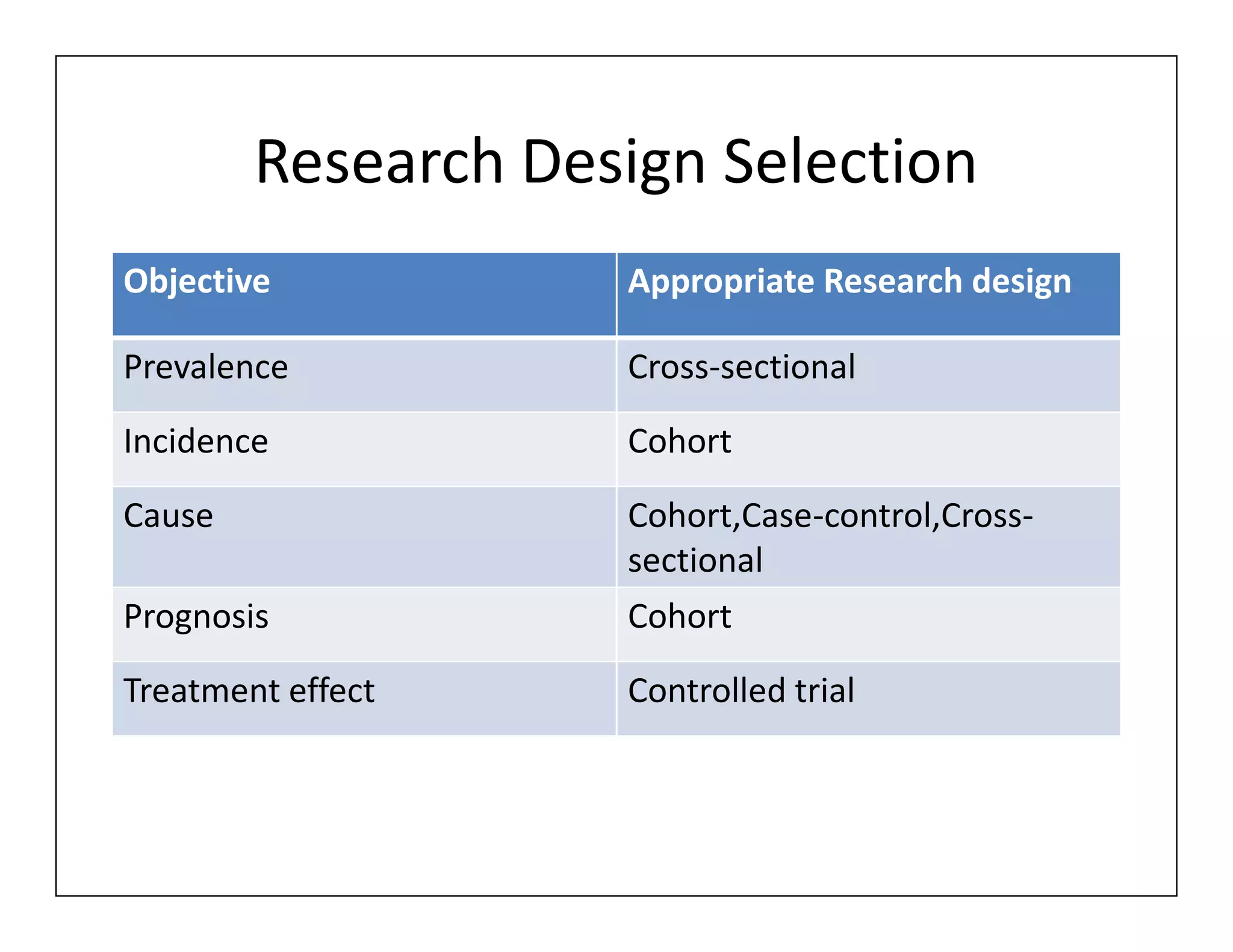
Research Design Selection
Objective Appropriate Research design
Prevalence Cross-sectional
Incidence Cohort
Cause Cohort,Case-control,Cross-
sectional
Prognosis Cohort
Treatment effect Controlled trial
Conceptual FrameworkConceptual Framework
What is a conceptual framework?
A written or visual presentation that:
-explains either graphically, or in narrative
form, the main things to be studied – the
key factors, concepts or variables
-and the presumed relationship among them.
A written or visual presentation that:
-explains either graphically, or in narrative
form, the main things to be studied – the
key factors, concepts or variables
-and the presumed relationship among them.
The conceptualization part of the research
process might well be called the thinking
part of the research while the factual part of
the research process is more related to the
doing aspect.
The conceptualization part of the research
process might well be called the thinking
part of the research while the factual part of
the research process is more related to the
doing aspect.
Conceptual framework should cover
• Establishment of the tentative relationships
between the dependent and independent
variables included in the study.
• Visualizing conceptual causal threads to form
a representation of inter-relatedness among
the identified issues or variables.
• Establishment of the tentative relationships
between the dependent and independent
variables included in the study.
• Visualizing conceptual causal threads to form
a representation of inter-relatedness among
the identified issues or variables.
Conceptual framework should cover
• What are the assumptions? What are the
relationships?
• Identification of possible answers to the
research questions? How are the possible
answers to the question explained and
defended?
• What are the assumptions? What are the
relationships?
• Identification of possible answers to the
research questions? How are the possible
answers to the question explained and
defended?
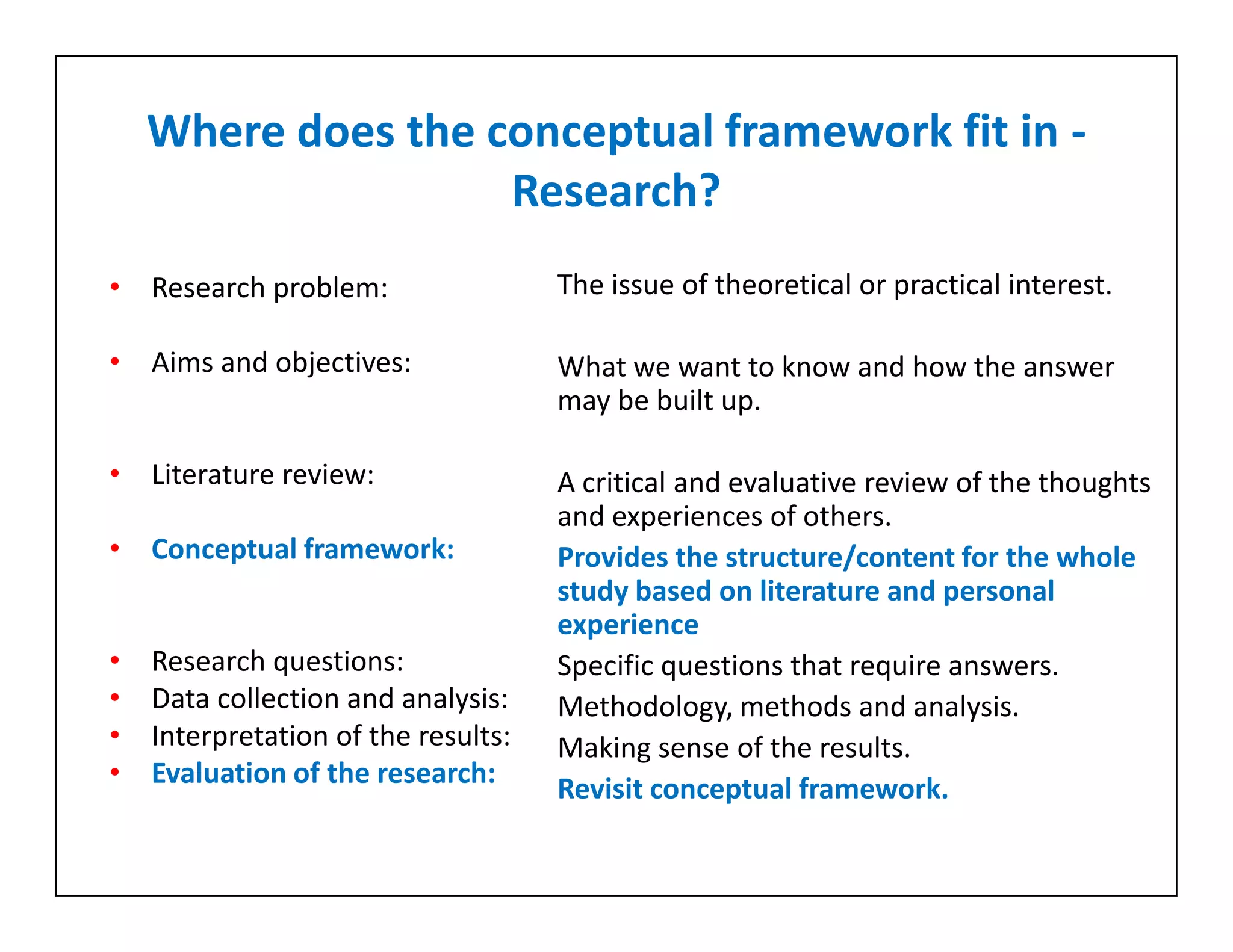
Where does the conceptual framework fit in -
Research?
• Research problem:
• Aims and objectives:
• Literature review:
• Conceptual framework:
• Research questions:
• Data collection and analysis:
• Interpretation of the results:
• Evaluation of the research:
The issue of theoretical or practical interest.
What we want to know and how the answer
may be built up.
A critical and evaluative review of the thoughts
and experiences of others.
Provides the structure/content for the whole
study based on literature and personal
experience
Specific questions that require answers.
Methodology, methods and analysis.
Making sense of the results.
Revisit conceptual framework.
• Research problem:
• Aims and objectives:
• Literature review:
• Conceptual framework:
• Research questions:
• Data collection and analysis:
• Interpretation of the results:
• Evaluation of the research:
The issue of theoretical or practical interest.
What we want to know and how the answer
may be built up.
A critical and evaluative review of the thoughts
and experiences of others.
Provides the structure/content for the whole
study based on literature and personal
experience
Specific questions that require answers.
Methodology, methods and analysis.
Making sense of the results.
Revisit conceptual framework.
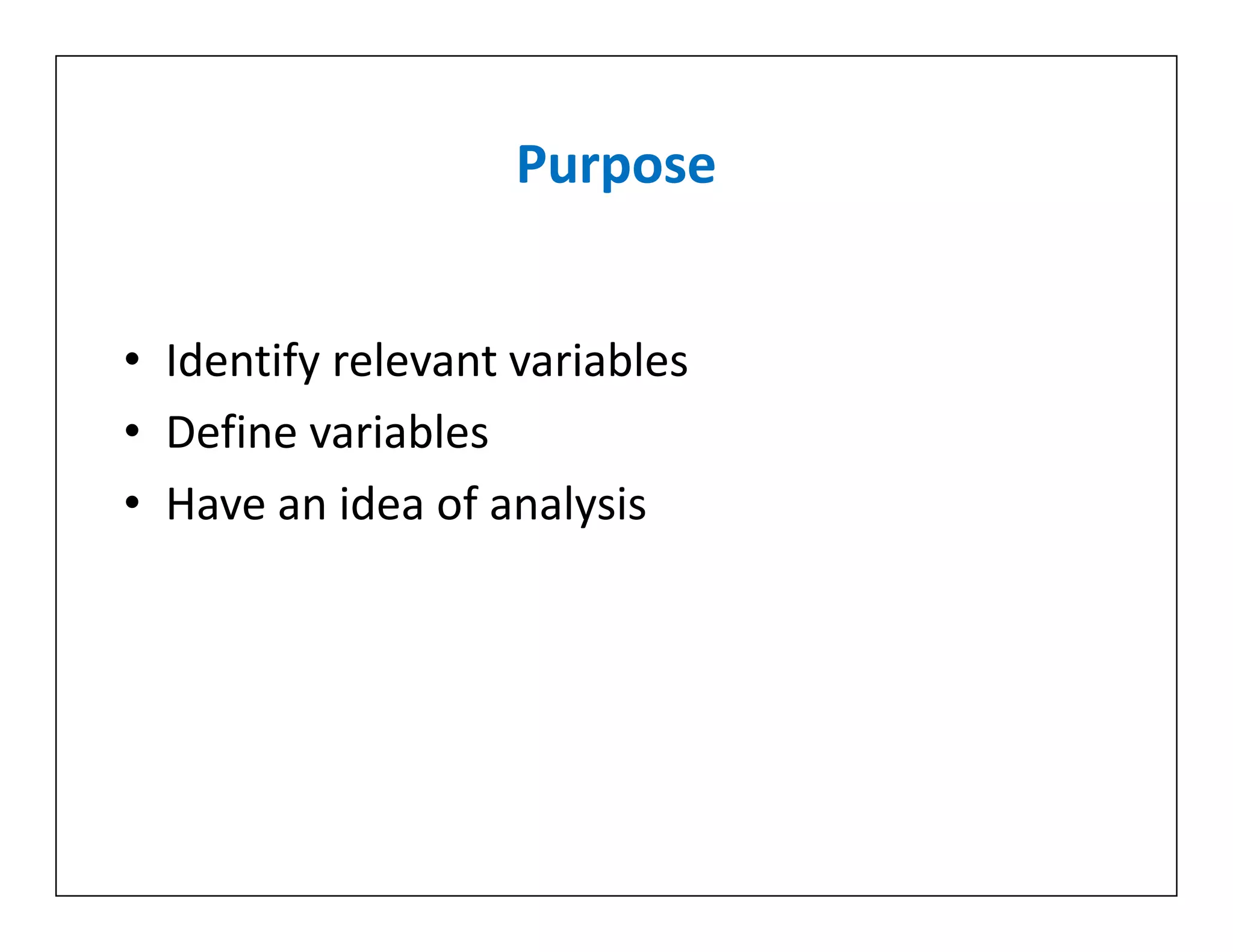
Purpose
• Identify relevant variables
• Define variables
• Have an idea of analysis
• Identify relevant variables
• Define variables
• Have an idea of analysis
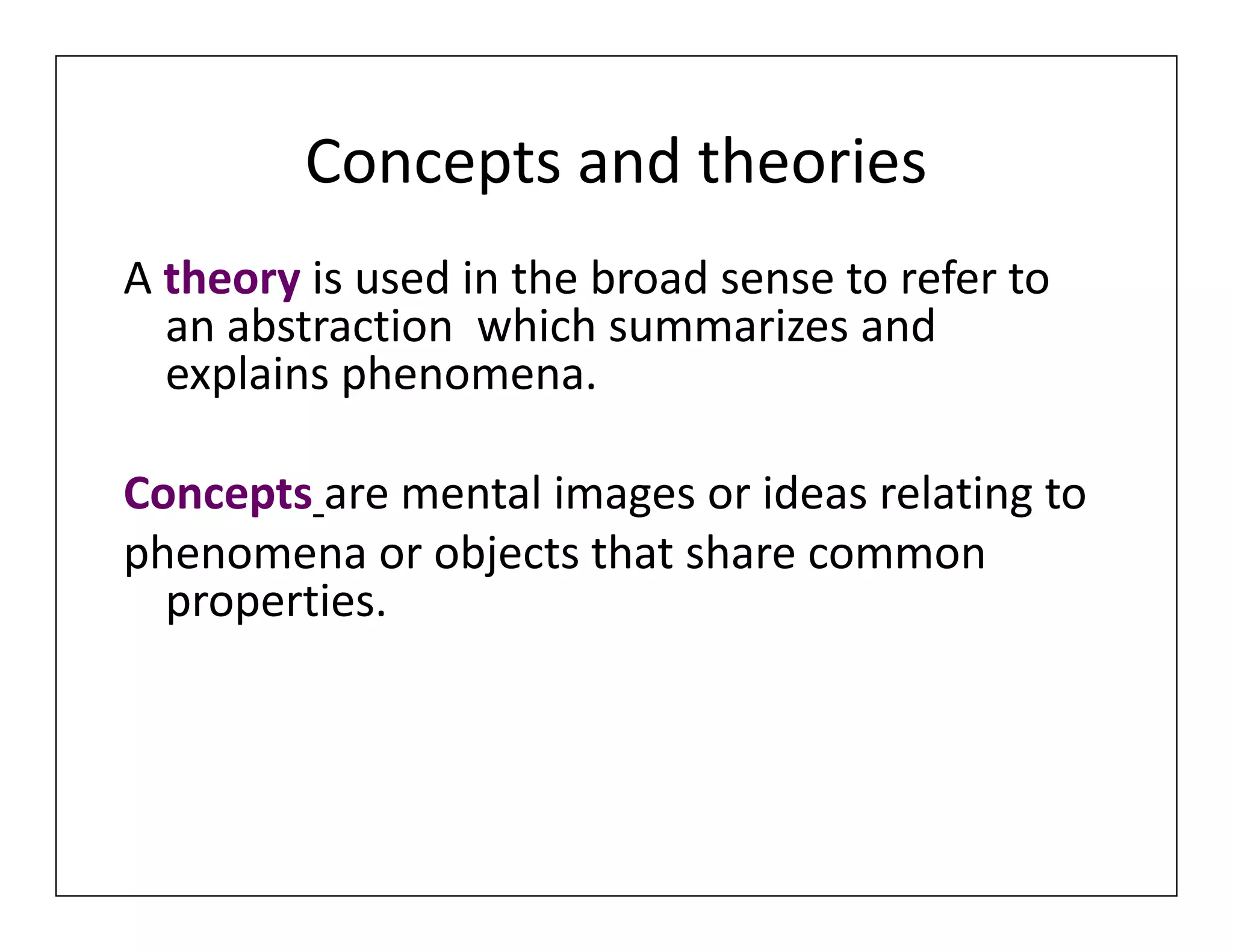
Concepts and theories
A theory is used in the broad sense to refer to
an abstraction which summarizes and
explains phenomena.
Concepts are mental images or ideas relating to
phenomena or objects that share common
properties.
A theory is used in the broad sense to refer to
an abstraction which summarizes and
explains phenomena.
Concepts are mental images or ideas relating to
phenomena or objects that share common
properties.
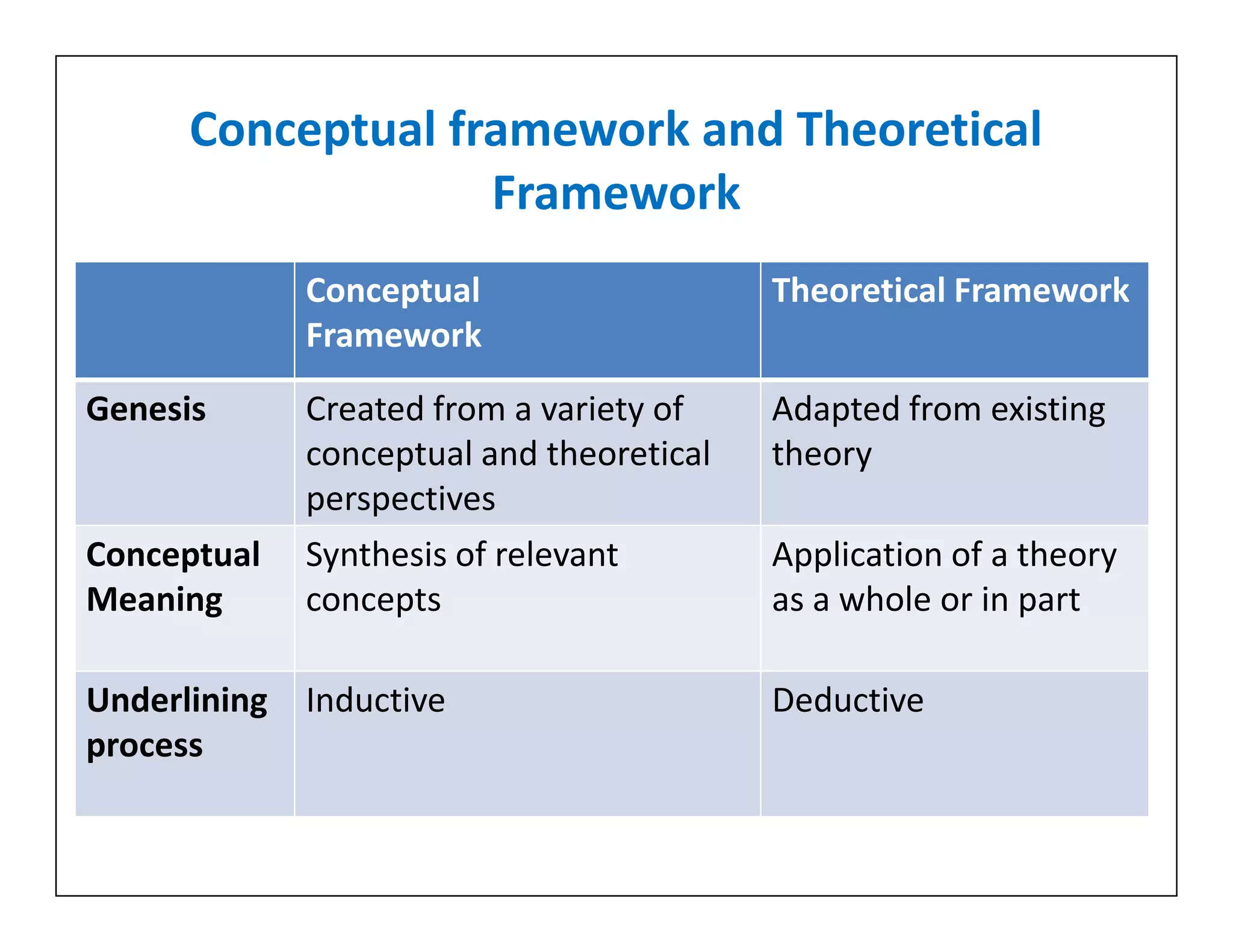
Conceptual framework and Theoretical
Framework
Conceptual
Framework
Theoretical Framework
Genesis Created from a variety of
conceptual and theoretical
perspectives
Adapted from existing
theory
Created from a variety of
conceptual and theoretical
perspectives
Conceptual
Meaning
Synthesis of relevant
concepts
Application of a theory
as a whole or in part
Underlining
process
Inductive Deductive
How to draw a conceptual framework?
• If you drew a picture of your statistical model,
this would be a conceptual framework
because it visualizes the variables and how
they are related.
• Generally Framework may include one
outcome and multiple hypothesized
associated factors
• If you drew a picture of your statistical model,
this would be a conceptual framework
because it visualizes the variables and how
they are related.
• Generally Framework may include one
outcome and multiple hypothesized
associated factors
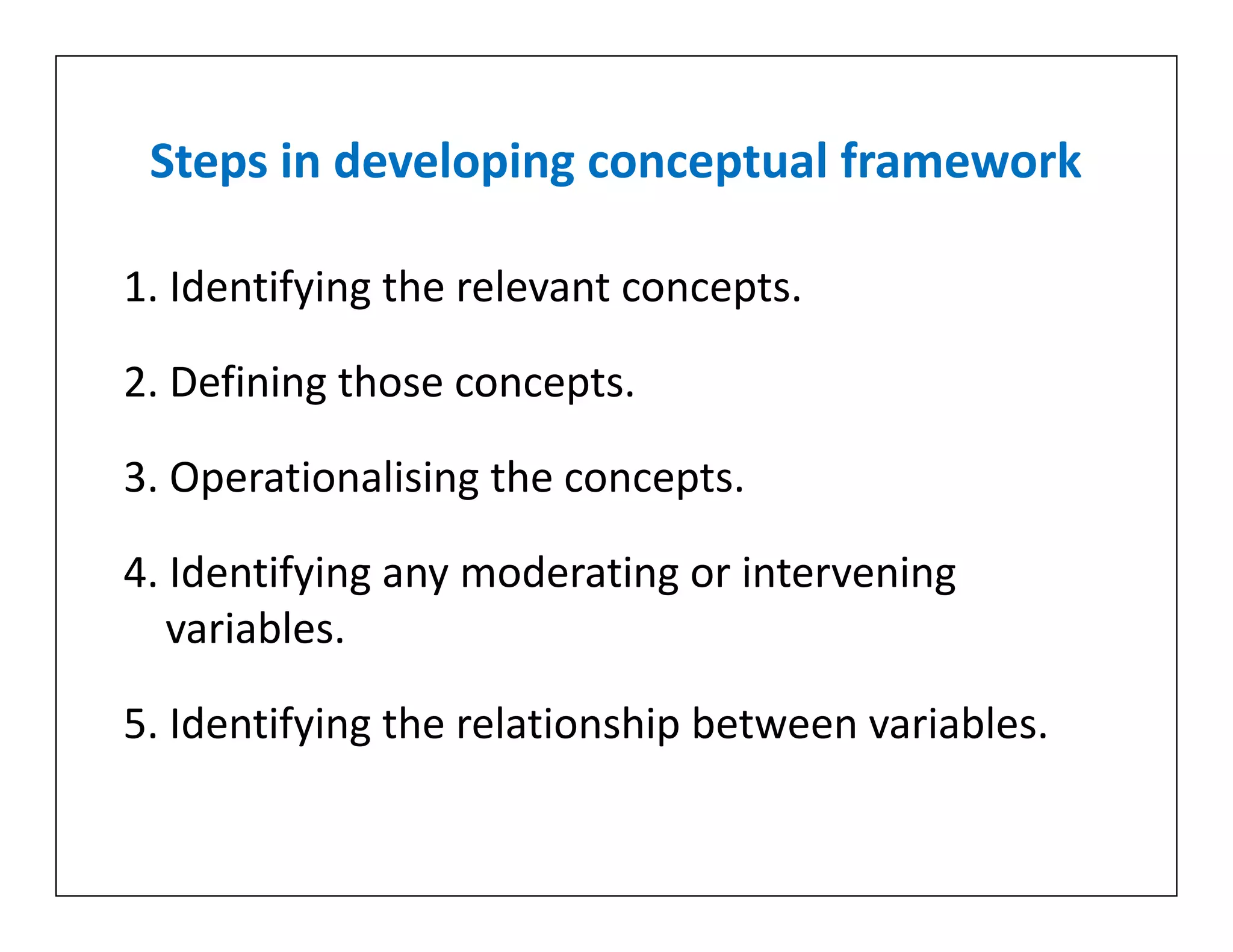
Steps in developing conceptual framework
1. Identifying the relevant concepts.
2. Defining those concepts.
3. Operationalising the concepts.
4. Identifying any moderating or intervening
variables.
5. Identifying the relationship between variables.
1. Identifying the relevant concepts.
2. Defining those concepts.
3. Operationalising the concepts.
4. Identifying any moderating or intervening
variables.
5. Identifying the relationship between variables.
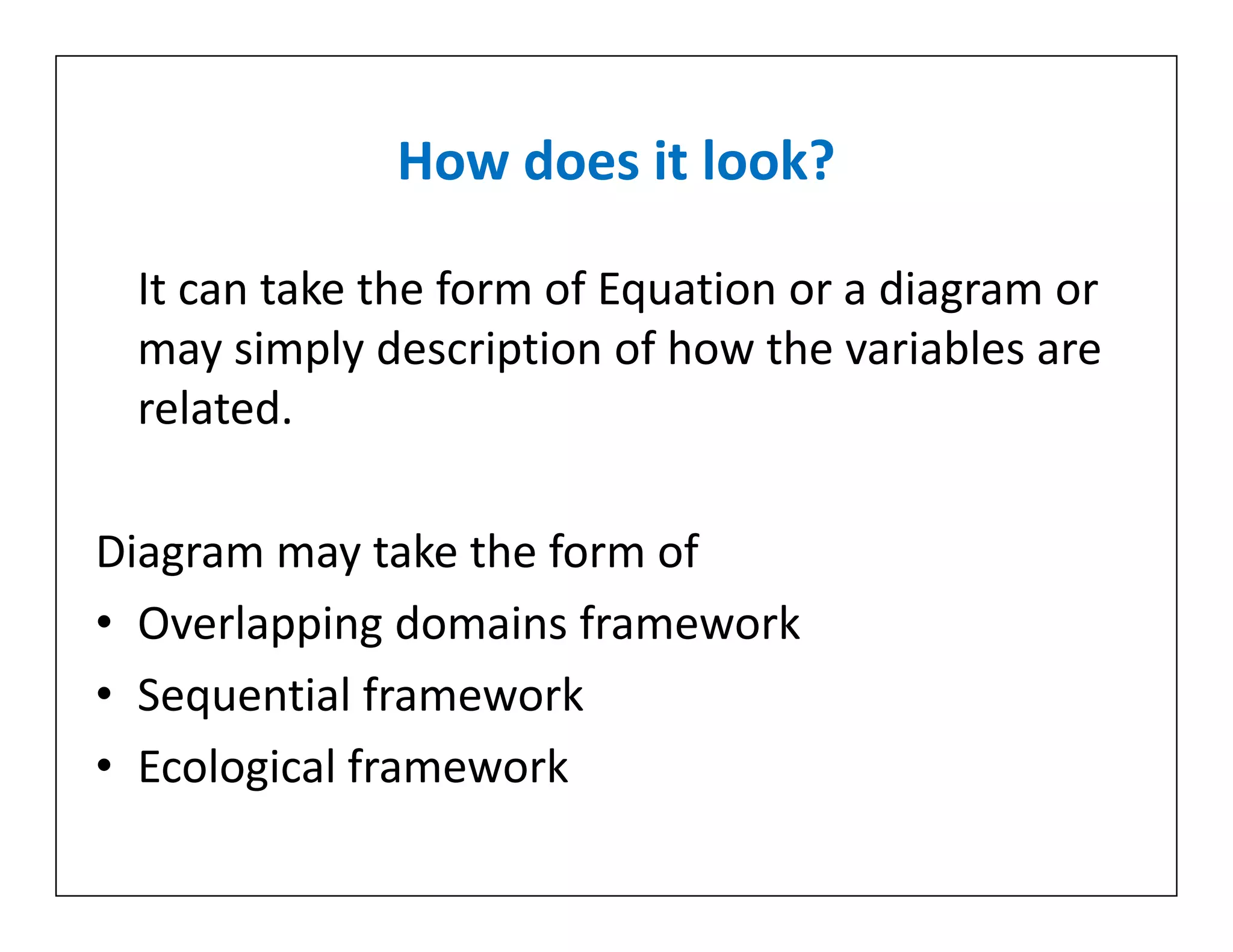
How does it look?
It can take the form of Equation or a diagram or
may simply description of how the variables are
related.
Diagram may take the form of
• Overlapping domains framework
• Sequential framework
• Ecological framework
It can take the form of Equation or a diagram or
may simply description of how the variables are
related.
Diagram may take the form of
• Overlapping domains framework
• Sequential framework
• Ecological framework
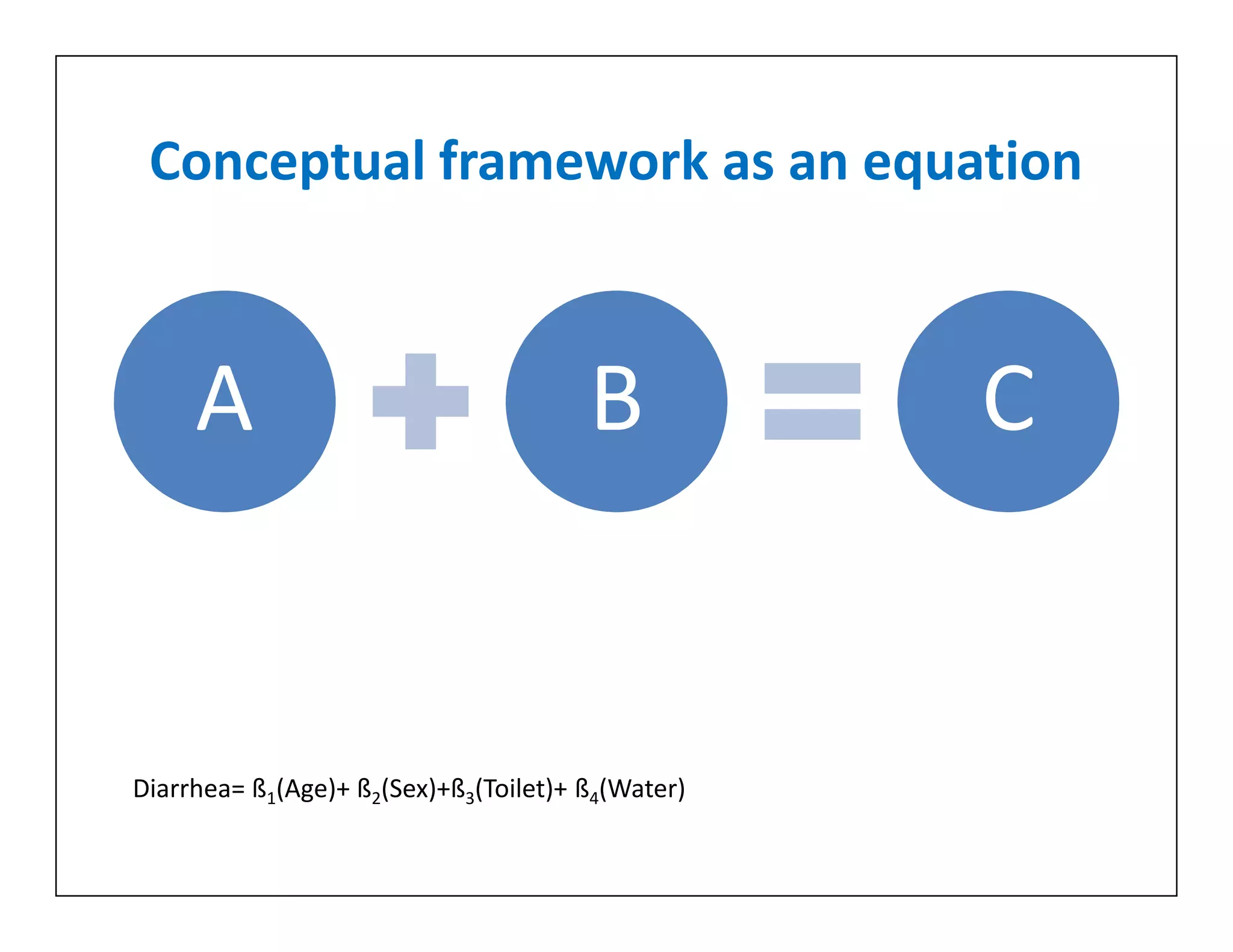
Conceptual framework as an equation
A B C
Diarrhea= ß1(Age)+ ß2(Sex)+ß3(Toilet)+ ß4(Water)
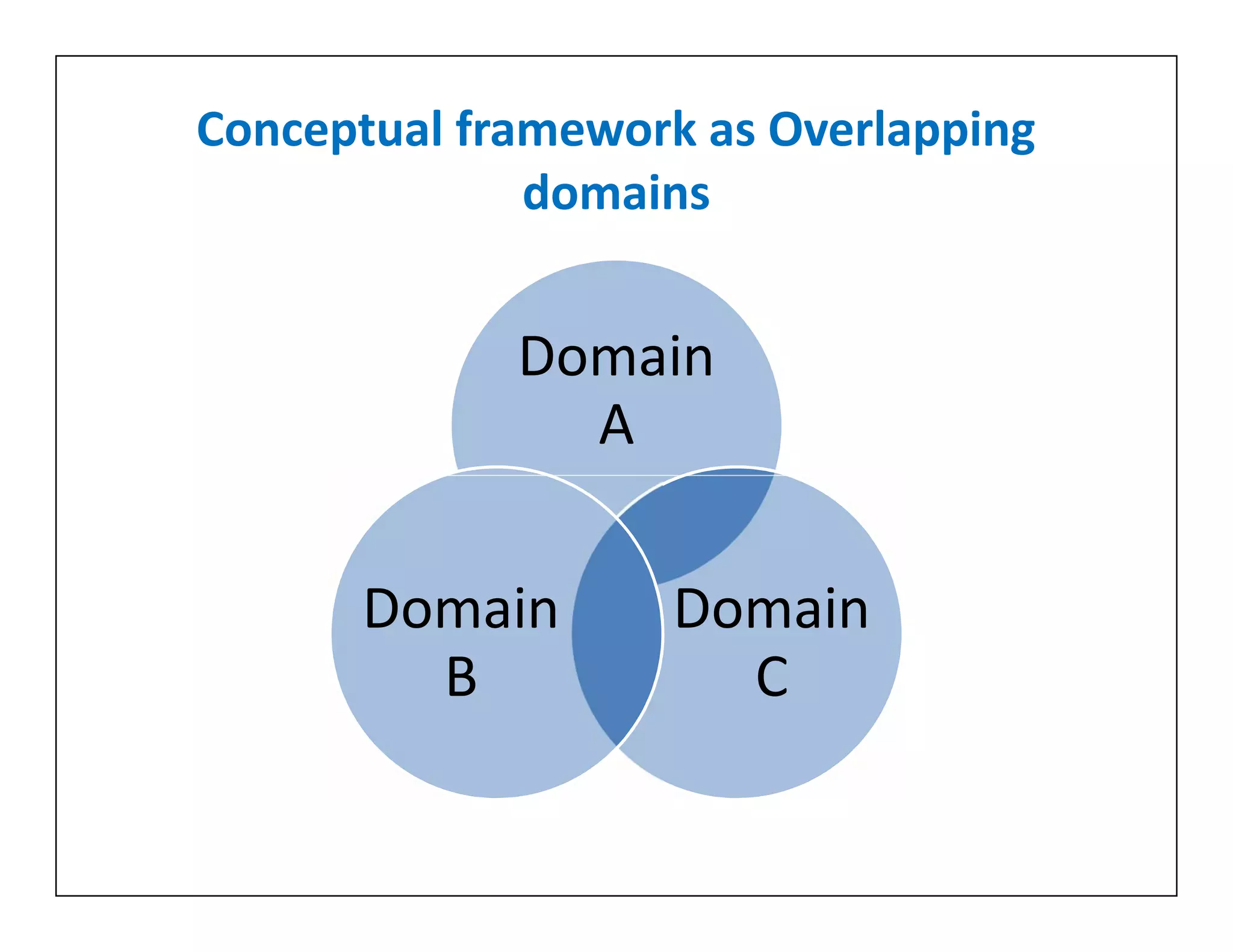
Conceptual framework as Overlapping
domains
Domain
A
Domain
C
Domain
B
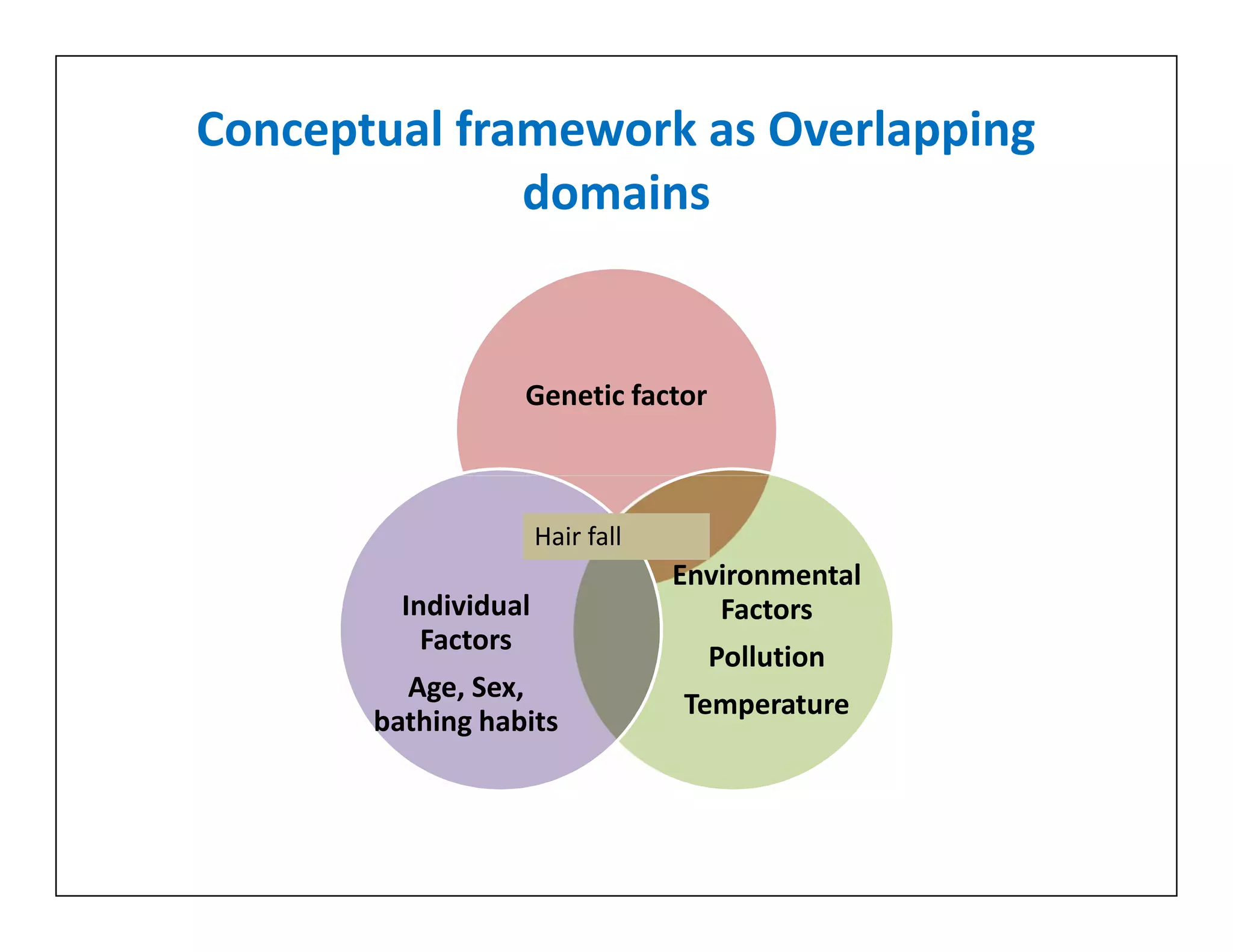
Conceptual framework as Overlapping
domains
Genetic factor
Environmental
Factors
Pollution
Temperature
Individual
Factors
Age, Sex,
bathing habits
Hair fall
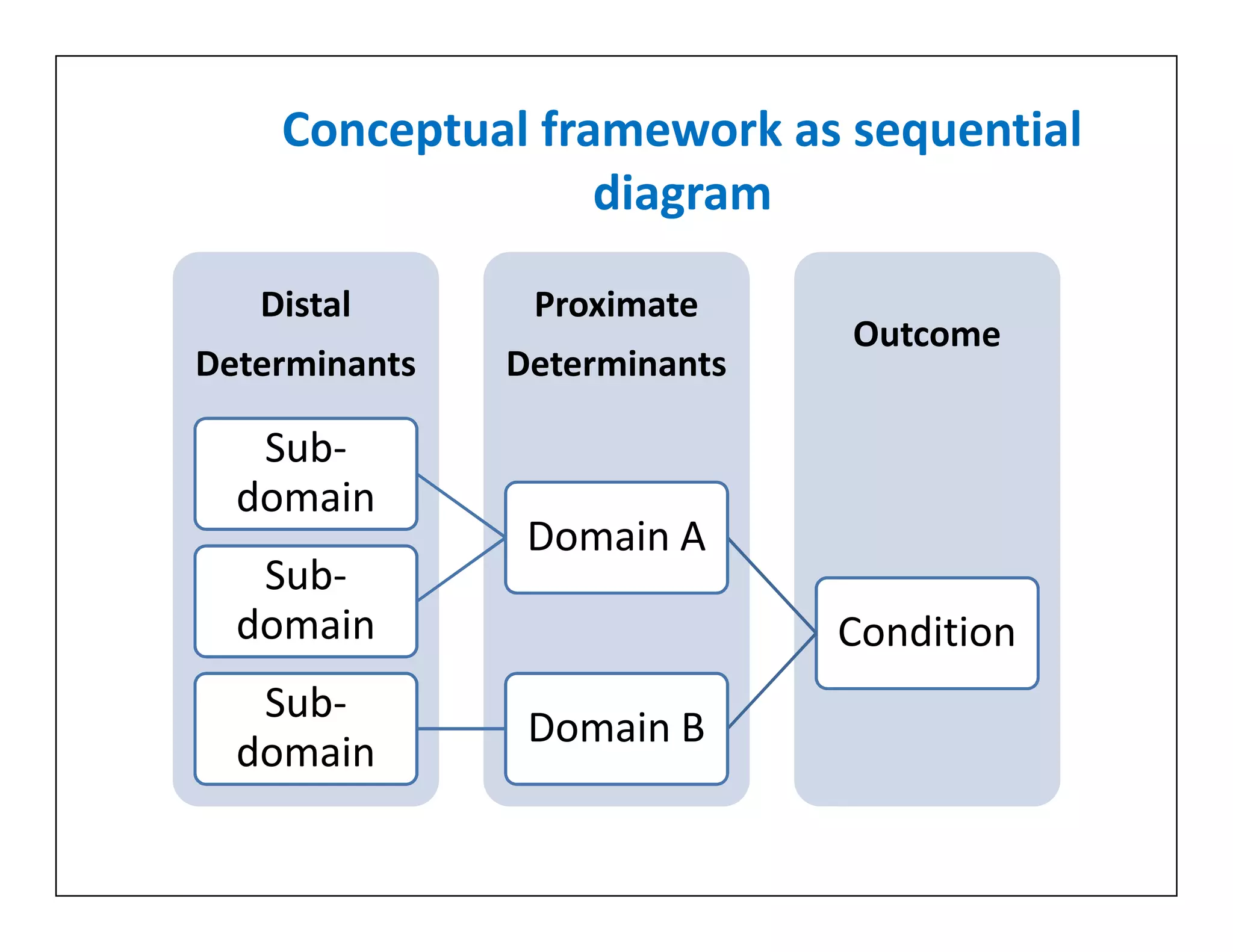
Conceptual framework as sequential
diagram
Distal
Determinants
Proximate
Determinants
Outcome
Sub-
domain
Condition
Domain A
Sub-
domain
Sub-
domain
Domain B
Sub-
domain
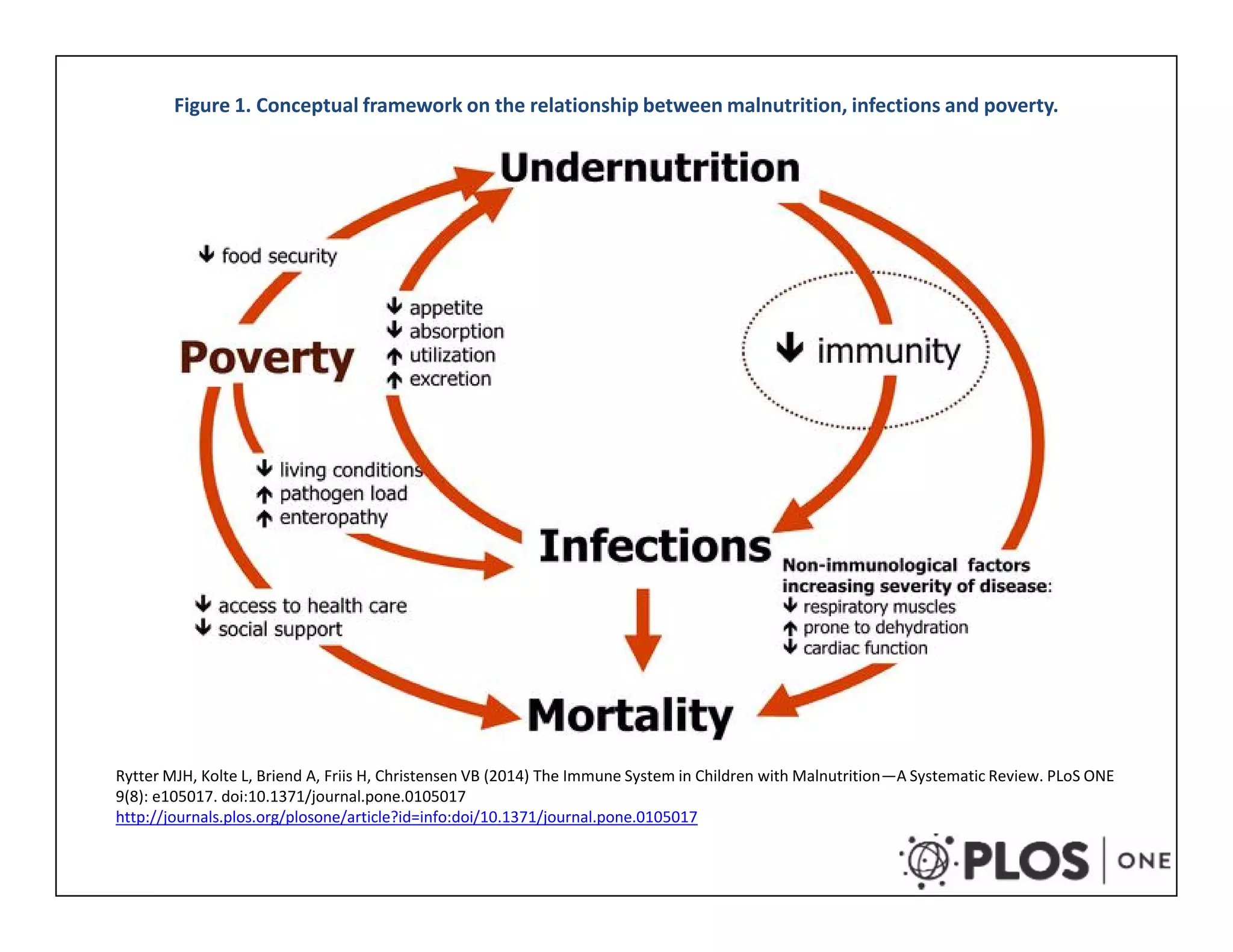
Figure 1. Conceptual framework on the relationship between malnutrition, infections and poverty.
Rytter MJH, Kolte L, Briend A, Friis H, Christensen VB (2014) The Immune System in Children with Malnutrition—A Systematic Review. PLoS ONE
9(8): e105017. doi:10.1371/journal.pone.0105017
http://journals.plos.org/plosone/article?id=info:doi/10.1371/journal.pone.0105017
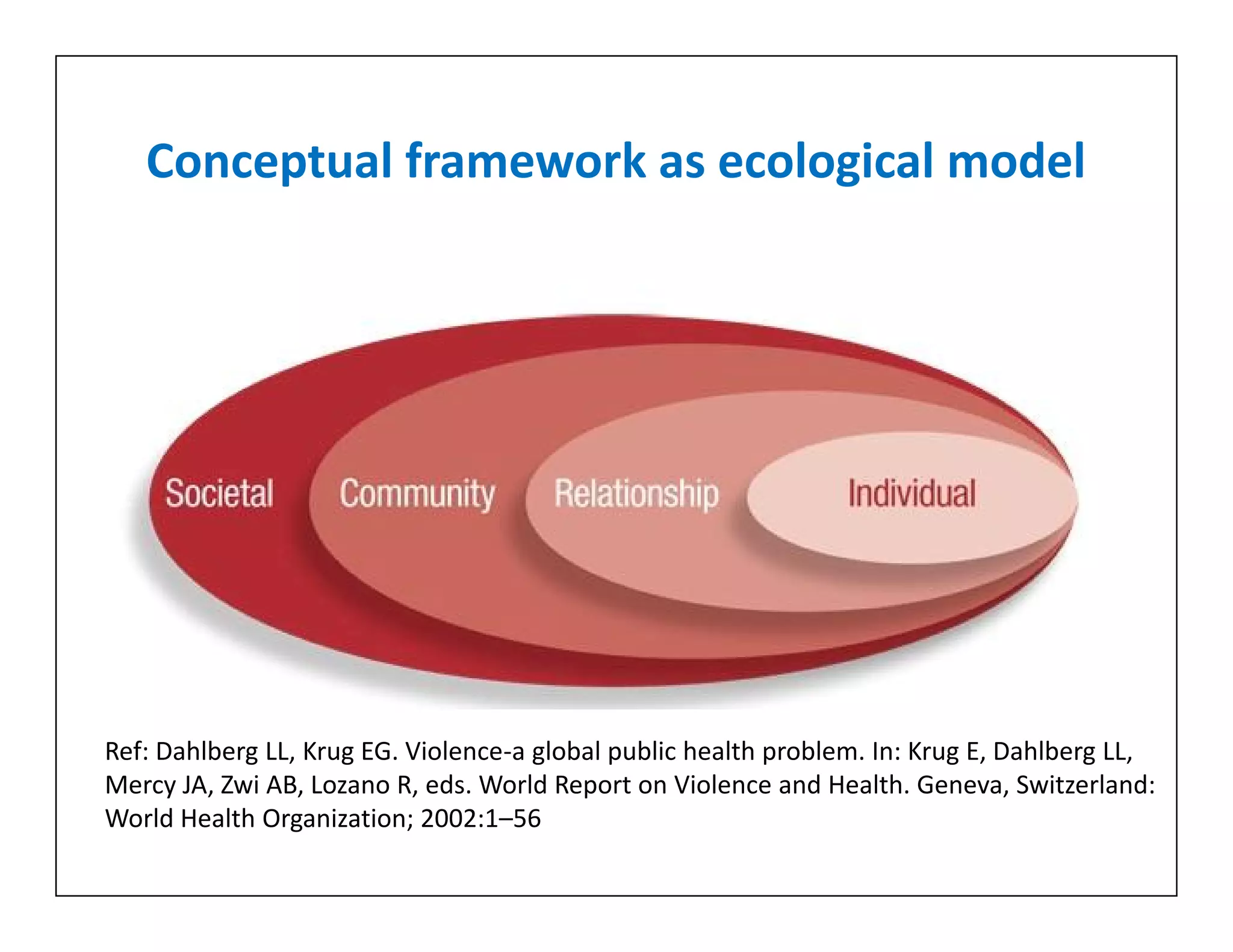
Conceptual framework as ecological model
• Dahlberg LL, Krug EG. Violence-a global public
health problem. In: Krug E, Dahlberg LL, Mercy JA,
Zwi AB, Lozano R, eds. World Report on Violence
and Health. Geneva, Switzerland: World Health
Organization; 2002:1–56
• Dahlberg LL, Krug EG. Violence-a global public
health problem. In: Krug E, Dahlberg LL, Mercy JA,
Zwi AB, Lozano R, eds. World Report on Violence
and Health. Geneva, Switzerland: World Health
Organization; 2002:1–56
Ref: Dahlberg LL, Krug EG. Violence-a global public health problem. In: Krug E, Dahlberg LL,
Mercy JA, Zwi AB, Lozano R, eds. World Report on Violence and Health. Geneva, Switzerland:
World Health Organization; 2002:1–56
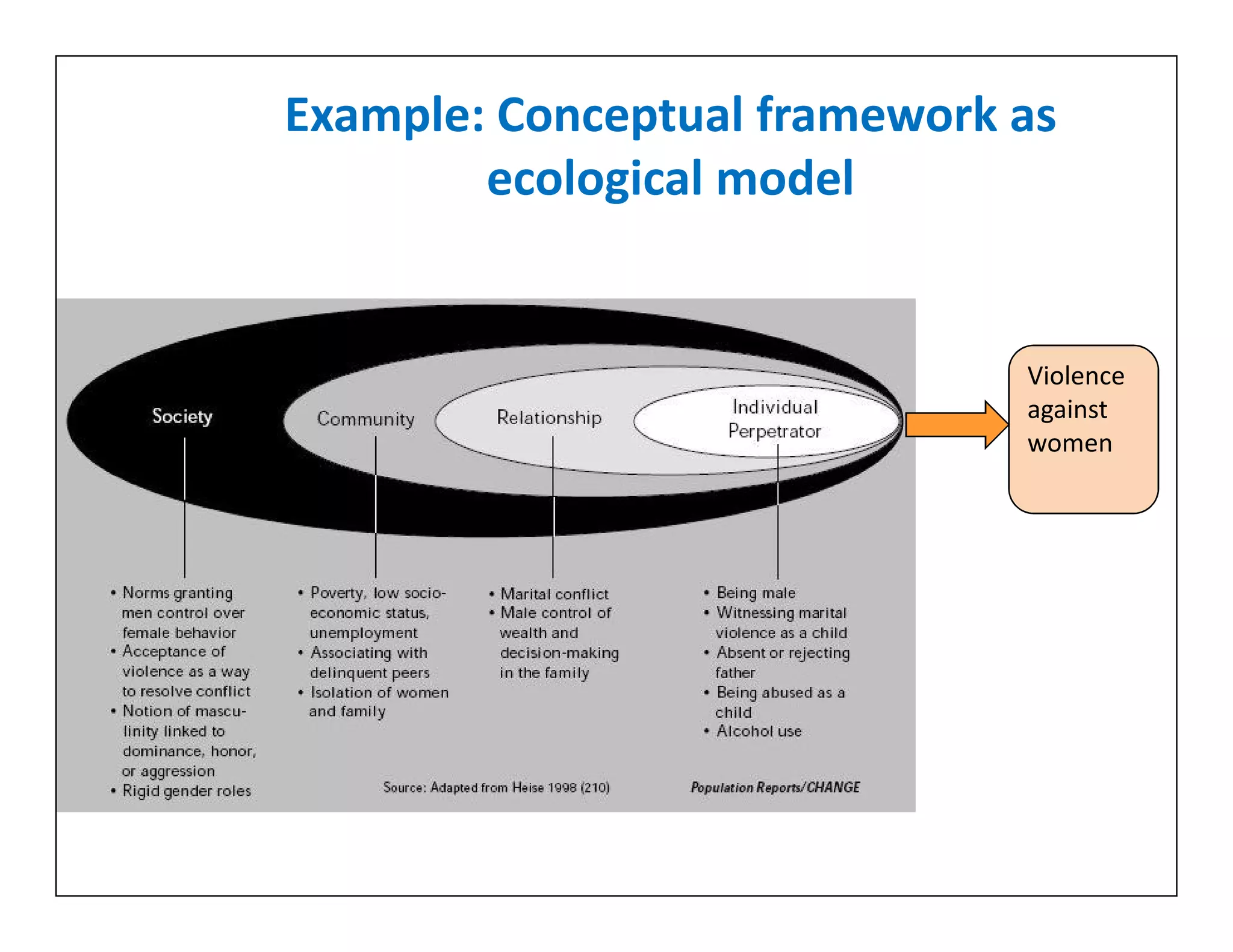
Example: Conceptual framework as
ecological model
Violence
against
women
Development of conceptual framework is an
iterative process, develop once and keep
revising as you move on
Development of conceptual framework is an
iterative process, develop once and keep
revising as you move on
Thank YouThank You

Researh design and conceptual framework

  • 1.
    An Overview ofResearch Design and Conceptual Framework Achyut Raj Pandey Research Officer Nepal Health Research Council1 An Overview of Research Design and Conceptual Framework
  • 2.
  • 3.
    ManipulationManipulation RandomizationRandomization StudyTypeStudy Type ExperimentalExperimental Pre ExperimentalPre Experimental ObservationalObservational YesYes YesYes NoNo NoNo NoNo YesYes Quasi-experimentalQuasi-experimental
  • 4.
    Observational study EcologicalEcologicalCross Sectional,case control or cohort Unit of Study ObservationObservation Ecological Cohort StudyCohort Study ObservationObservation Data on exposure and outcome collected simultaneously Data on exposure and outcome collected simultaneously Outcome determined, data collection retrospectively for exposure Outcome determined, data collection retrospectively for exposure Cross-sectionalCross-sectional Case-ControlCase-Control Prospective Retrospective Ambispective
  • 5.
    Pre and QuasiExperimental Research Design Control Group Pre-experimentalPre-experimental Quasi Experimental No Yes Non Equivalent group DesignNon Equivalent group Design InterventionInterventionStudy TypeStudy Type Post testPost testPretestPretest Post test only design (Without control) Post test only design (Without control) NoNo YesYes YesYes Pre test-Post test design (Without control) Pre test-Post test design (Without control) YesYes YesYes YesYes Non Equivalent group DesignNon Equivalent group Design Regression Discontinuity DesignRegression Discontinuity Design Proxy Pretest DesignProxy Pretest Design
  • 6.
    True Experimental Designs Posttest-Only ControlGroup Design Posttest-Only Control Group Design Pretest-Posttest Control Group Design Pretest-Posttest Control Group Design InterventionIntervention Post testPost testPretestPretest NoNo YesYes YesYes NoNo NoNo YesYes GroupGroup InterventionIntervention ControlControl YesYes YesYes YesYesInterventionIntervention Types Pretest-Posttest Control Group Design Pretest-Posttest Control Group Design Solomon Four- Group Design Solomon Four- Group Design YesYes NoNo YesYes Intervention ControlControl YesYes YesYes YesYes NoNo YesYes YesYes Intervention 1Intervention 1 Intervention 2Intervention 2 YesYes NoNo YesYes NoNo NoNo YesYes Control 1Control 1 Control 2Control 2
  • 7.
    Experimental study Unit ofstudyUnit of study Community TrialCommunity TrialClinical TrialClinical Trial Parallel DesignParallel Design GroupIndividual Cross-over DesignCross-over Design Factorial DesignFactorial Design
  • 8.
    Identifying Research Designfor the Study Identifying Research Design for the Study
  • 9.
    Factors influencing researchdesign There is no best type of research design. It depends on: • Purpose/area of the study • Strength of evidence desirable • Time and resource available • Ethics There is no best type of research design. It depends on: • Purpose/area of the study • Strength of evidence desirable • Time and resource available • Ethics
  • 10.
    Purpose/area of thestudy Cross sectional Case Control Cohort Rare disease - +++++ - Rare Cause - - +++++ Multiple Endpoints ++ - +++++ Multiple exposure(including confounding) +++ ++++ +++aMultiple exposure(including confounding) +++ ++++ +++a Temporal sequence - +b +++++ Direct measurement of incidence - +b +++++ Long induction period + +++++ +++c +++++= Highly Suitable, ++++=Very Suitable, +++=Suitable, ++= Moderately Suitable, +=Limited suitability, -=Not suitable a= if prospective, b=if nested in cohort or combined with incidence study c=if retrospective
  • 11.
  • 12.
    Time and resourceavailable European Prospective Investigation into Cancer and Nutrition (EPIC) -521,457 healthy adults, mostly aged 35–70 years, were enrolled in 23 centers in ten European countries: Denmark, France, Germany, Greece, Italy, The Netherlands, Norway, Spain, Sweden and the United Kingdom -Recruitment to the study took place between 1993 and 1999 -Up to 2004, there were over 26,000 new cases of cancer recorded among participants -Several Articles published on stomach, colorectal, breast, prostate and lung cancers European Prospective Investigation into Cancer and Nutrition (EPIC) -521,457 healthy adults, mostly aged 35–70 years, were enrolled in 23 centers in ten European countries: Denmark, France, Germany, Greece, Italy, The Netherlands, Norway, Spain, Sweden and the United Kingdom -Recruitment to the study took place between 1993 and 1999 -Up to 2004, there were over 26,000 new cases of cancer recorded among participants -Several Articles published on stomach, colorectal, breast, prostate and lung cancers
  • 13.
    Time and resourceavailable Framingham Heart Study -The study began in 1948 with 5,209 adult subjects -Study had been intended to last 20 years, the study continued, and in 1971, it enrolled a second generation of participants -April 2002, a third generation was enrolled in the core study -Over 1000 medical papers have been published related to the Framingham Heart Study. Other: British Doctors study(1951), Nurses’ Health Study(1976) Framingham Heart Study -The study began in 1948 with 5,209 adult subjects -Study had been intended to last 20 years, the study continued, and in 1971, it enrolled a second generation of participants -April 2002, a third generation was enrolled in the core study -Over 1000 medical papers have been published related to the Framingham Heart Study. Other: British Doctors study(1951), Nurses’ Health Study(1976)
  • 14.
    Ethics • Human Experimentationin Nazi Concentration Camp • Study on Natural study of disease: Tuskegee Syphilis Experiment (1932 and 1972) 1947, penicillin had become the standard treatment for syphilis 1979 Belmont Report and the establishment of the Office for Human Research Protections (OHRP) • Willowbrook State School study on Hepatitis(1947) • Human Experimentation in Nazi Concentration Camp • Study on Natural study of disease: Tuskegee Syphilis Experiment (1932 and 1972) 1947, penicillin had become the standard treatment for syphilis 1979 Belmont Report and the establishment of the Office for Human Research Protections (OHRP) • Willowbrook State School study on Hepatitis(1947)
  • 15.
    Research Design Selection ObjectiveAppropriate Research design Prevalence Cross-sectional Incidence Cohort Cause Cohort,Case-control,Cross- sectional Prognosis Cohort Treatment effect Controlled trial
  • 16.
  • 17.
    What is aconceptual framework? A written or visual presentation that: -explains either graphically, or in narrative form, the main things to be studied – the key factors, concepts or variables -and the presumed relationship among them. A written or visual presentation that: -explains either graphically, or in narrative form, the main things to be studied – the key factors, concepts or variables -and the presumed relationship among them.
  • 18.
    The conceptualization partof the research process might well be called the thinking part of the research while the factual part of the research process is more related to the doing aspect. The conceptualization part of the research process might well be called the thinking part of the research while the factual part of the research process is more related to the doing aspect.
  • 19.
    Conceptual framework shouldcover • Establishment of the tentative relationships between the dependent and independent variables included in the study. • Visualizing conceptual causal threads to form a representation of inter-relatedness among the identified issues or variables. • Establishment of the tentative relationships between the dependent and independent variables included in the study. • Visualizing conceptual causal threads to form a representation of inter-relatedness among the identified issues or variables.
  • 20.
    Conceptual framework shouldcover • What are the assumptions? What are the relationships? • Identification of possible answers to the research questions? How are the possible answers to the question explained and defended? • What are the assumptions? What are the relationships? • Identification of possible answers to the research questions? How are the possible answers to the question explained and defended?
  • 21.
    Where does theconceptual framework fit in - Research? • Research problem: • Aims and objectives: • Literature review: • Conceptual framework: • Research questions: • Data collection and analysis: • Interpretation of the results: • Evaluation of the research: The issue of theoretical or practical interest. What we want to know and how the answer may be built up. A critical and evaluative review of the thoughts and experiences of others. Provides the structure/content for the whole study based on literature and personal experience Specific questions that require answers. Methodology, methods and analysis. Making sense of the results. Revisit conceptual framework. • Research problem: • Aims and objectives: • Literature review: • Conceptual framework: • Research questions: • Data collection and analysis: • Interpretation of the results: • Evaluation of the research: The issue of theoretical or practical interest. What we want to know and how the answer may be built up. A critical and evaluative review of the thoughts and experiences of others. Provides the structure/content for the whole study based on literature and personal experience Specific questions that require answers. Methodology, methods and analysis. Making sense of the results. Revisit conceptual framework.
  • 22.
    Purpose • Identify relevantvariables • Define variables • Have an idea of analysis • Identify relevant variables • Define variables • Have an idea of analysis
  • 23.
    Concepts and theories Atheory is used in the broad sense to refer to an abstraction which summarizes and explains phenomena. Concepts are mental images or ideas relating to phenomena or objects that share common properties. A theory is used in the broad sense to refer to an abstraction which summarizes and explains phenomena. Concepts are mental images or ideas relating to phenomena or objects that share common properties.
  • 24.
    Conceptual framework andTheoretical Framework Conceptual Framework Theoretical Framework Genesis Created from a variety of conceptual and theoretical perspectives Adapted from existing theory Created from a variety of conceptual and theoretical perspectives Conceptual Meaning Synthesis of relevant concepts Application of a theory as a whole or in part Underlining process Inductive Deductive
  • 25.
    How to drawa conceptual framework? • If you drew a picture of your statistical model, this would be a conceptual framework because it visualizes the variables and how they are related. • Generally Framework may include one outcome and multiple hypothesized associated factors • If you drew a picture of your statistical model, this would be a conceptual framework because it visualizes the variables and how they are related. • Generally Framework may include one outcome and multiple hypothesized associated factors
  • 26.
    Steps in developingconceptual framework 1. Identifying the relevant concepts. 2. Defining those concepts. 3. Operationalising the concepts. 4. Identifying any moderating or intervening variables. 5. Identifying the relationship between variables. 1. Identifying the relevant concepts. 2. Defining those concepts. 3. Operationalising the concepts. 4. Identifying any moderating or intervening variables. 5. Identifying the relationship between variables.
  • 27.
    How does itlook? It can take the form of Equation or a diagram or may simply description of how the variables are related. Diagram may take the form of • Overlapping domains framework • Sequential framework • Ecological framework It can take the form of Equation or a diagram or may simply description of how the variables are related. Diagram may take the form of • Overlapping domains framework • Sequential framework • Ecological framework
  • 28.
    Conceptual framework asan equation A B C Diarrhea= ß1(Age)+ ß2(Sex)+ß3(Toilet)+ ß4(Water)
  • 29.
    Conceptual framework asOverlapping domains Domain A Domain C Domain B
  • 30.
    Conceptual framework asOverlapping domains Genetic factor Environmental Factors Pollution Temperature Individual Factors Age, Sex, bathing habits Hair fall
  • 31.
    Conceptual framework assequential diagram Distal Determinants Proximate Determinants Outcome Sub- domain Condition Domain A Sub- domain Sub- domain Domain B Sub- domain
  • 33.
    Figure 1. Conceptualframework on the relationship between malnutrition, infections and poverty. Rytter MJH, Kolte L, Briend A, Friis H, Christensen VB (2014) The Immune System in Children with Malnutrition—A Systematic Review. PLoS ONE 9(8): e105017. doi:10.1371/journal.pone.0105017 http://journals.plos.org/plosone/article?id=info:doi/10.1371/journal.pone.0105017
  • 34.
    Conceptual framework asecological model • Dahlberg LL, Krug EG. Violence-a global public health problem. In: Krug E, Dahlberg LL, Mercy JA, Zwi AB, Lozano R, eds. World Report on Violence and Health. Geneva, Switzerland: World Health Organization; 2002:1–56 • Dahlberg LL, Krug EG. Violence-a global public health problem. In: Krug E, Dahlberg LL, Mercy JA, Zwi AB, Lozano R, eds. World Report on Violence and Health. Geneva, Switzerland: World Health Organization; 2002:1–56 Ref: Dahlberg LL, Krug EG. Violence-a global public health problem. In: Krug E, Dahlberg LL, Mercy JA, Zwi AB, Lozano R, eds. World Report on Violence and Health. Geneva, Switzerland: World Health Organization; 2002:1–56
  • 35.
    Example: Conceptual frameworkas ecological model Violence against women
  • 36.
    Development of conceptualframework is an iterative process, develop once and keep revising as you move on Development of conceptual framework is an iterative process, develop once and keep revising as you move on
  • 37.