MODULE 2: PERSPECTIVES OF HUMAN
DEVELOPMENT (2 Credits)
Unit 4: Methods and Approaches of Studying Human
development
a) Methods:
Observation (Participatory And Non- Participatory)
b) Experimental & Clinical.
c) Approaches:
Cross Sectional, Cross Cultural, Longitudinal.
Mrs.Deepali Gaikwad / Borde
INTRODUCTION
Meaning of APPROACHES:
 A way of dealing with a situation or problem.
 An approach in studying child development is important
as it helps to understand the way the child behaves in
different age group.
Approaches
CROSS - SECTIONAL APPROACH
CROSS - CULTURAL APPROACH
LONGITUDINAL APPROACH
Cross sectional approach
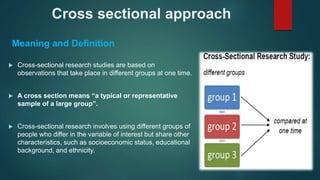
 Cross-sectional research studies are based on
observations that take place in different groups at one time.
 A cross section means “a typical or representative
sample of a large group”.
 Cross-sectional research involves using different groups of
people who differ in the variable of interest but share other
characteristics, such as socioeconomic status, educational
background, and ethnicity.
Meaning and Definition
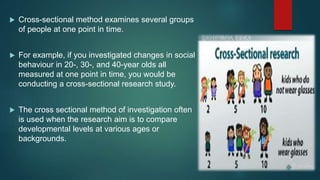
 Cross-sectional method examines several groups
of people at one point in time.
 For example, if you investigated changes in social
behaviour in 20-, 30-, and 40-year olds all
measured at one point in time, you would be
conducting a cross-sectional research study.
 The cross sectional method of investigation often
is used when the research aim is to compare
developmental levels at various ages or
backgrounds.
 Many children at different ages are studied in groups in according to their
age, and the results on the same sets of measures are compared for the
group.
 Example, the approximate age at which an infant can be expected to roll
over, creep, crawl, pull himself up to a standing position, and walk unaided
can be determined by observing the behavior of groups of children from
birth until the age of about 15 months.
 If the investigator, study a group of one month old infants, another group of
two month olds, and a different group of babies at every month of age
thereafter, we will have a cross sectional approach.
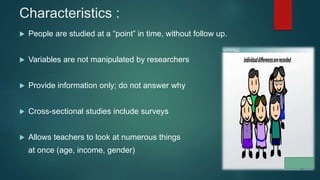
Characteristics :
 People are studied at a “point” in time, without follow up.
 Variables are not manipulated by researchers
 Provide information only; do not answer why
 Cross-sectional studies include surveys
 Allows teachers to look at numerous things
at once (age, income, gender)
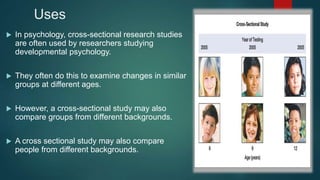
 In psychology, cross-sectional research studies
are often used by researchers studying
developmental psychology.
 They often do this to examine changes in similar
groups at different ages.
 However, a cross-sectional study may also
compare groups from different backgrounds.
 A cross sectional study may also compare
people from different backgrounds.
Uses
Advantages/Merits
 Using a cross-sectional design has one advantage in that a study can be
conducted in a shorter amount of time as opposed to waiting for a group of
5 year olds to reach the age of 15 and observe the changes in social behavior
over the course of 10 years
 A cross-sectional study may also compare people from different backgrounds.
 Cross-sectional studies help us to identify the age-demarcated transitions
during which one or more changes take place, and individual differences in
the ages at which an ability is acquired.
 Efficient, large numbers of subjects
 Can measure attitudes, beliefs, behaviors, personal or family
history, genetic factors, existing or past health conditions, or
anything else that does not require follow-up to assess.
 Easy and quick
 Less expensive
 Can target a larger sample size
Limitations/ Demerits / Disadvantages
 Differences do not necessarily reflect individual’s development
 Differences between age groups reveal just that – differences – and not the process of
developmental change within the child.
 Information on individual change is not available
 Risk of no-response
 Cannot be used to analysed behaviour over a period to time.
 Does not help determine cause and effect.
Cross Cultural Approach
Meaning:
 The study of the relationship between cultural
context and human behaviour.
 This approach comparing two or more cultures and
understanding their values, beliefs and norms.
 Dealing with or offering comparison between two or
more different cultures or cultural areas.
 People differ culturally to the extent that their customs,
roles and other learned behaviours that are passed on
from generation to generation are different.
Merits or advantages
 The advantage of the cross-cultural approach as compared with the single
cultural research approach is that the possibilities for misinterpretation are less
with the former.
 It permits generalization to other societies or cultures or subcultures of the
same nation
 Confirming and exploring the university of some relationship or attribute of
social man
 It maximize the amount or range of variation.
 Natural experiments, in which regions differ In some
environmental factor which can be studied using an
experimental treatment
 Maximum variability studies.
 It helps in inter-cultural awareness.
Limitations/ Demerits / Disadvantages
 Cultural variations
 Order of needs does not always hold true for other cultures
 Biased response/risk of no-response
 Expensive as compared to cross sectional study
 Interpretation may vary from person to person
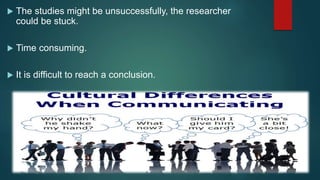
 The studies might be unsuccessfully, the researcher
could be stuck.
 Time consuming.
 It is difficult to reach a conclusion.
Longitudinal Approach
Meaning:
 A longitudinal study is an observational research method in which data is gathered for
the same subjects repeatedly over a period of time. Longitudinal research projects can
extend over years or even decades.
 Is a research in which a researcher measures a particular group of people for a long
period of time.
 In this research method, many observation are being conducted over long periods of
time on the same group or number of people.
 Example –
A group of new-born babies who were available for month-by-month measurements,
one can complete the study with repeated observations.
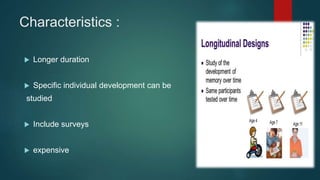
Characteristics :
 Longer duration
 Specific individual development can be
studied
 Include surveys
 expensive
Merits or advantages
 Specific development pattern of individual can be studies and compared .
 Variation in development among individuals within the sample can be studied – since it tracks
the performance of each person over time, research can identify common patterns as well as
individual differences in development.
 This studies permit investigators to examine relationships between early and later events and
behaviours.
 Effective in doing research on developmental trends.
 They are more powerful than cross sectional studies.
 They are highly flexible.
 They can provide high accuracy when observing changes.
Limitations/ Demerits / Disadvantages
 Long period
 Time consuming
 More expensive
 Difficulty in maintaining data
 Risk of sample size reducing due to change in place etc.
 Cannot be repeated because of practical constraints.
Approaches

Approaches

  • 1.
    MODULE 2: PERSPECTIVESOF HUMAN DEVELOPMENT (2 Credits) Unit 4: Methods and Approaches of Studying Human development a) Methods: Observation (Participatory And Non- Participatory) b) Experimental & Clinical. c) Approaches: Cross Sectional, Cross Cultural, Longitudinal. Mrs.Deepali Gaikwad / Borde
  • 2.
    INTRODUCTION Meaning of APPROACHES: A way of dealing with a situation or problem.  An approach in studying child development is important as it helps to understand the way the child behaves in different age group.
  • 3.
    Approaches CROSS - SECTIONALAPPROACH CROSS - CULTURAL APPROACH LONGITUDINAL APPROACH
  • 4.
    Cross sectional approach Cross-sectional research studies are based on observations that take place in different groups at one time.  A cross section means “a typical or representative sample of a large group”.  Cross-sectional research involves using different groups of people who differ in the variable of interest but share other characteristics, such as socioeconomic status, educational background, and ethnicity. Meaning and Definition
  • 5.
     Cross-sectional methodexamines several groups of people at one point in time.  For example, if you investigated changes in social behaviour in 20-, 30-, and 40-year olds all measured at one point in time, you would be conducting a cross-sectional research study.  The cross sectional method of investigation often is used when the research aim is to compare developmental levels at various ages or backgrounds.
  • 6.
     Many childrenat different ages are studied in groups in according to their age, and the results on the same sets of measures are compared for the group.  Example, the approximate age at which an infant can be expected to roll over, creep, crawl, pull himself up to a standing position, and walk unaided can be determined by observing the behavior of groups of children from birth until the age of about 15 months.  If the investigator, study a group of one month old infants, another group of two month olds, and a different group of babies at every month of age thereafter, we will have a cross sectional approach.
  • 7.
    Characteristics :  Peopleare studied at a “point” in time, without follow up.  Variables are not manipulated by researchers  Provide information only; do not answer why  Cross-sectional studies include surveys  Allows teachers to look at numerous things at once (age, income, gender)
  • 8.
     In psychology,cross-sectional research studies are often used by researchers studying developmental psychology.  They often do this to examine changes in similar groups at different ages.  However, a cross-sectional study may also compare groups from different backgrounds.  A cross sectional study may also compare people from different backgrounds. Uses
  • 9.
    Advantages/Merits  Using across-sectional design has one advantage in that a study can be conducted in a shorter amount of time as opposed to waiting for a group of 5 year olds to reach the age of 15 and observe the changes in social behavior over the course of 10 years  A cross-sectional study may also compare people from different backgrounds.  Cross-sectional studies help us to identify the age-demarcated transitions during which one or more changes take place, and individual differences in the ages at which an ability is acquired.
  • 10.
     Efficient, largenumbers of subjects  Can measure attitudes, beliefs, behaviors, personal or family history, genetic factors, existing or past health conditions, or anything else that does not require follow-up to assess.  Easy and quick  Less expensive  Can target a larger sample size
  • 11.
    Limitations/ Demerits /Disadvantages  Differences do not necessarily reflect individual’s development  Differences between age groups reveal just that – differences – and not the process of developmental change within the child.  Information on individual change is not available  Risk of no-response  Cannot be used to analysed behaviour over a period to time.  Does not help determine cause and effect.
  • 12.
  • 13.
    Meaning:  The studyof the relationship between cultural context and human behaviour.  This approach comparing two or more cultures and understanding their values, beliefs and norms.  Dealing with or offering comparison between two or more different cultures or cultural areas.  People differ culturally to the extent that their customs, roles and other learned behaviours that are passed on from generation to generation are different.
  • 14.
    Merits or advantages The advantage of the cross-cultural approach as compared with the single cultural research approach is that the possibilities for misinterpretation are less with the former.  It permits generalization to other societies or cultures or subcultures of the same nation  Confirming and exploring the university of some relationship or attribute of social man  It maximize the amount or range of variation.
  • 15.
     Natural experiments,in which regions differ In some environmental factor which can be studied using an experimental treatment  Maximum variability studies.  It helps in inter-cultural awareness.
  • 16.
    Limitations/ Demerits /Disadvantages  Cultural variations  Order of needs does not always hold true for other cultures  Biased response/risk of no-response  Expensive as compared to cross sectional study  Interpretation may vary from person to person
  • 17.
     The studiesmight be unsuccessfully, the researcher could be stuck.  Time consuming.  It is difficult to reach a conclusion.
  • 18.
  • 19.
    Meaning:  A longitudinalstudy is an observational research method in which data is gathered for the same subjects repeatedly over a period of time. Longitudinal research projects can extend over years or even decades.  Is a research in which a researcher measures a particular group of people for a long period of time.  In this research method, many observation are being conducted over long periods of time on the same group or number of people.  Example – A group of new-born babies who were available for month-by-month measurements, one can complete the study with repeated observations.
  • 20.
    Characteristics :  Longerduration  Specific individual development can be studied  Include surveys  expensive
  • 21.
    Merits or advantages Specific development pattern of individual can be studies and compared .  Variation in development among individuals within the sample can be studied – since it tracks the performance of each person over time, research can identify common patterns as well as individual differences in development.  This studies permit investigators to examine relationships between early and later events and behaviours.  Effective in doing research on developmental trends.  They are more powerful than cross sectional studies.  They are highly flexible.  They can provide high accuracy when observing changes.
  • 22.
    Limitations/ Demerits /Disadvantages  Long period  Time consuming  More expensive  Difficulty in maintaining data  Risk of sample size reducing due to change in place etc.  Cannot be repeated because of practical constraints.