Professor Parveenbanu M. Malek
JG College of Education(PG)
Ahmedabad, Gujarat

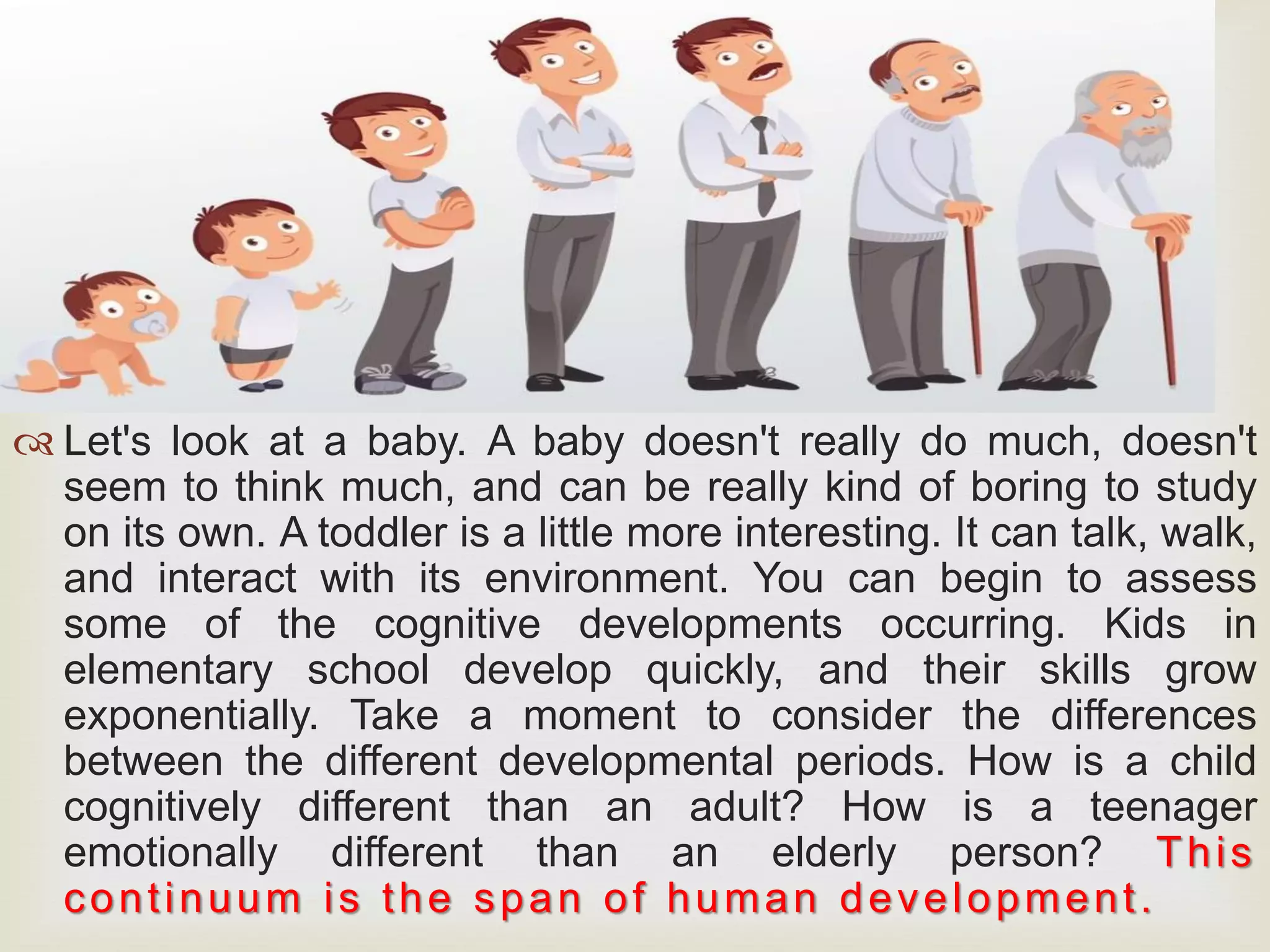
 Let's look at a baby. A baby doesn't really do much, doesn't
seem to think much, and can be really kind of boring to study
on its own. A toddler is a little more interesting. It can talk, walk,
and interact with its environment. You can begin to assess
some of the cognitive developments occurring. Kids in
elementary school develop quickly, and their skills grow
exponentially. Take a moment to consider the differences
between the different developmental periods. How is a child
cognitively different than an adult? How is a teenager
emotionally different than an elderly person? This
continuum is the span of human development.

Darwin’s theory of human evolution is a result of a
research that intended to know the biological
evolution of human being.
Human being has progressed remarkably in every
aspect of life science since Stone Age.

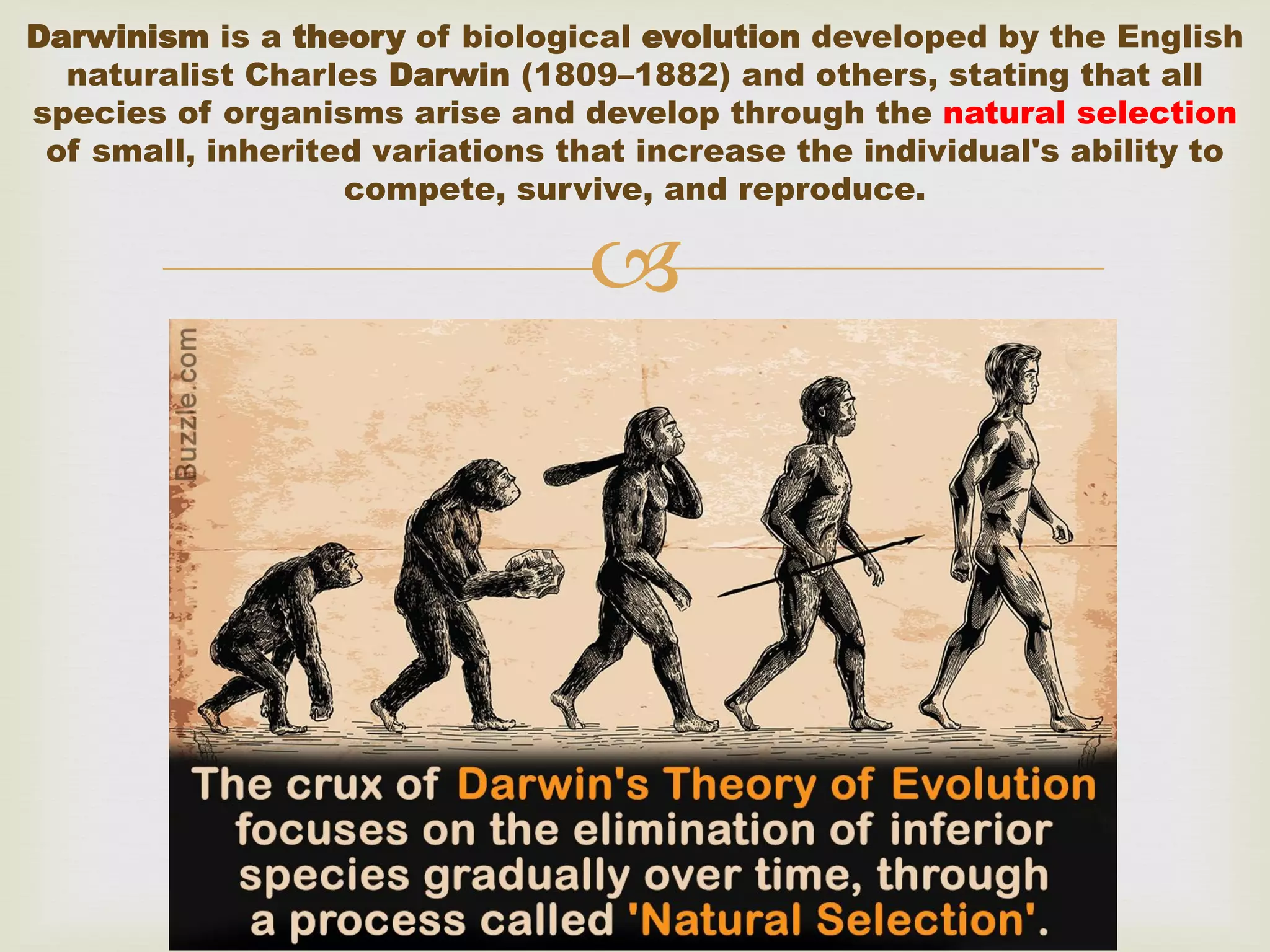
Darwinism is a theory of biological evolution developed by the English
naturalist Charles Darwin (1809–1882) and others, stating that all
species of organisms arise and develop through the natural selection
of small, inherited variations that increase the individual's ability to
compete, survive, and reproduce.

At present, developmental research is conducted in
various fields in order to understand progressive
changes of living being.
Such a research is done in Education, Psychology
and Sociology.
Progressive development of organism, animal and
human being has been a subject of interest for
researcher before the beginning of systematic
approach of research process.

Developmental research is a study focused
on the progressive changes that occur as an
organism develops.
A research method that is used to access
changes over an extended period of time is
called developmental research method.
Definitions of
Developmental Research

There isn't any way to reverse the changes that
happen when you grow up. You can't take an
older person and hit the reset button to revert
them back to childhood to see how raising them
in a different time will change who they are. It'd
be nice, but unfortunately we are stuck
experiencing time in one direction.

 Developmental research intends to study the progressive
changes that occur in an organism with passage of time.
 It studies deeply about such changes that are found in
characteristics, traits and physique of an individual or an
organism in the context of time period.
 It helps in understanding of pattern of development in the
context of certain characteristics of subject.
 Development of an individual remains at the Centre of
educational, psychological and sociological researches.
 So, various developmental studies have been done in these
fields till today.
Meaning of Developmental
Research
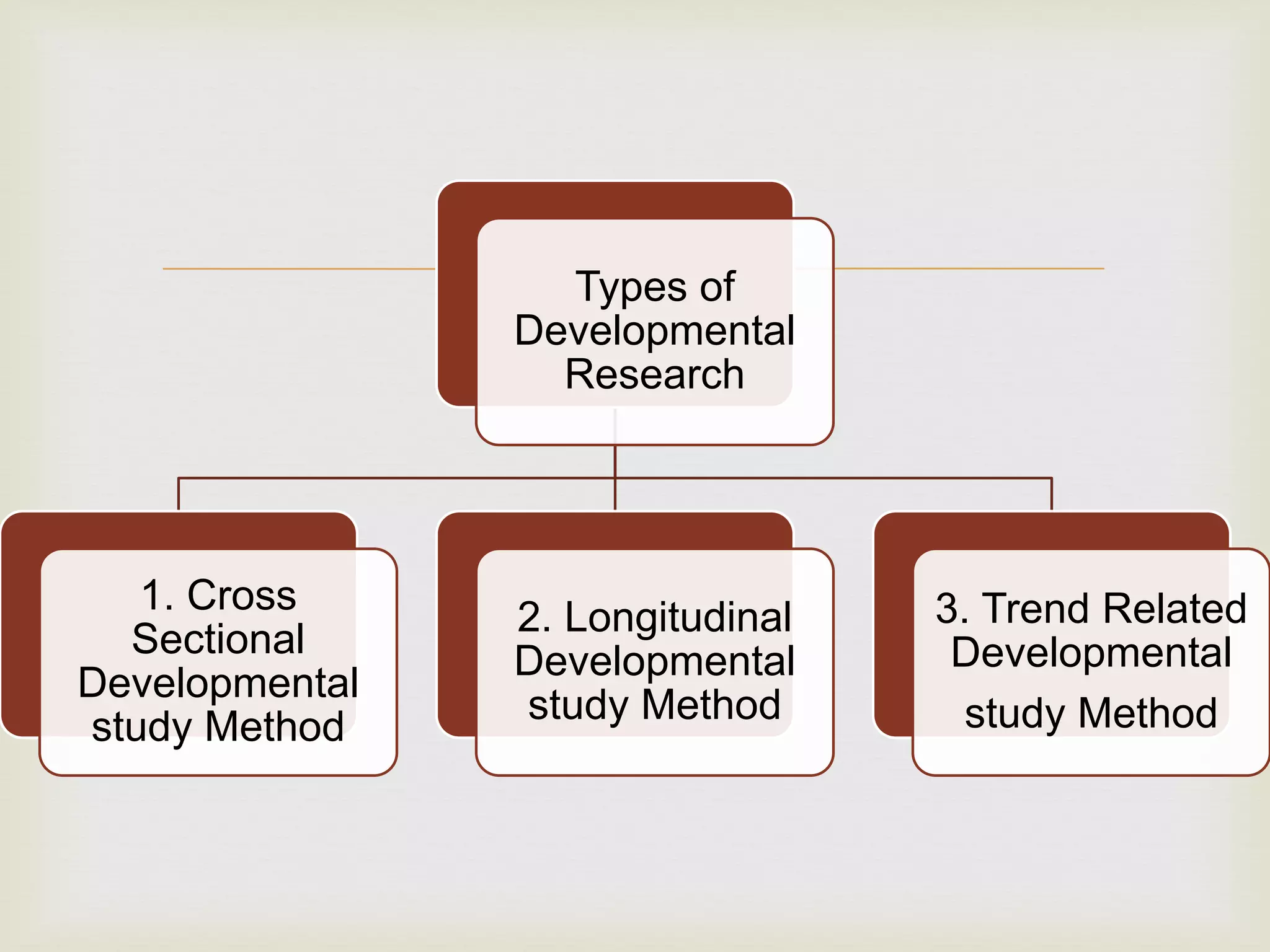
Types of
Developmental
Research
1. Cross
Sectional
Developmental
study Method
2. Longitudinal
Developmental
study Method
3. Trend Related
Developmental
study Method

 Some characteristic of individuals and living being changes
with the passage of time.
 Some natural, social, mental, physical or environmental factors
have been responsible for such changes.
 To know the pattern of such changes, subjects of different age
groups are studied in the same time period in the context of
change in a particular characteristic. For that, the subjects of
different age groups are selected in the same time period.
 The research method used to study a pattern of development in
this way, is called cross sectional research method.
1. Cross Sectional Developmental
study Method

We collect data from the student of 9 to 12 in
the academic year 2018–2019 for research, it
will be called cross-sectional survey because
here data are collected from different groups of
the students in the same time period.
Sometimes instead of studying all groups at the
same time period data are collected from
different groups during different time periods.
Such a study is called longitudinal study.
For example suppose we want to study the
e m o t i o n a l m a t u r i t y of the standards of
grade 9 to 12.

Cross sectional study forms a class of research
methods that involves observation of some
subset of a population of items all at the same
time, in which, groups can be compared at
different ages with respect of independent
variables.
1. Definition Cross Sectional
Developmental study Method

 If subjects of a particular age group are selected ones and
they all are studied at different time period to understand the
pattern of changes that occur in their certain traits, it is called
longitudinal research method.
2. Longitudinal Developmental
study Method

 For example instead of collecting data from the students of
grade 9 to 12 in the same year in the study of their expectations
from the teachers, it is decided to collect the data from the
students of grade 9 in academic year 2017–2018, in 2018–
2019 from the same students when they will come in grade 10,
again data will be collected from the same students in 2019–
2020, when they will come in grade 11 and at last, data will be
collected from them, when they will reach standard 12 in the
academic year 2020–2021.
 If data are collected in this way for research, it is called
longitudinal study.
2. Longitudinal Developmental
study Method

 The most important things to be noted here is, the different
groups for the sample are selected ones and data collected
once during the same time period in cross-sectional study,
 While in longitudinal study, sample is selected ones but data
are collected more than once from each unit of sample.
 Sometimes different sample are selected during different time
periods in longitudinal study for collecting data.
2. Longitudinal Developmental
study Method

 A correlational research study that involves repeated
observations of the same items over long periods of
time
2. Definition of longitudinal
Developmental Study Method
Types of Longitudinal
Developmental study
Method
3. Trend
Research
1. Cohort
Research 2. Panel
Research




The origin of the word ‘chohort’ is an old
French word ‘Chohorte’ or Latin word
‘Choros’.
Out of various meanings of that, one is ‘A
group of persons sharing a particular
statistical or a demographic
characteristic.’
1. Meaning of the term
Cohort

For example a group of persons of a particular
age. Here age is a demographic characteristics.
So this group will be considered as cohort.
In the same way, a group of students having
70% marks in SSC examinations will be
considered as cohort because the students are
grouped here the basis of statistical
characteristics and it is 70% marks.
1. Example of
Cohort Research

In cohort study, population is decided on the basis of
demographic or statistical characteristics and different
samples are selected during different time periods for
survey.
Data are collected from different samples during a
different time periods.
To be more specific, it can be said that type of
population remains the same but units of sample may
change during different time periods.
1. Sample and Population in
Cohort Study

For example if we want to study, for 10 years, the ‘study
habits’ of the students passing the SSC examination with
more than 95%, then population will remain the same and
that is a set of all students, passing SSC with more than
95% marks in respective years.
Here, criterion for deciding the population will remain the
same that is statistical characteristic, which is 95% or
more marks in SSC examinations, but the units of
population and sample will change every year because the
students passing the examinations will be different every
years.
1. Example of Cohort
Research

 In short the definition of population will
remain unchanged during different time
periods of study but the units of population
will keep on changing as the time period
will change and ultimately the units of
sample will also change during different
time period in cohort study.
1. Definition of Cohort
Research

If the sample is selected only once, but data
collected from all the units of the sample during
each time period of study, it is call Panel
longitudinal survey.
In this type of survey, the units of both
population and sample will remain unchanged
during different time periods of study.
2. Sample and Population
in Panel Study

For examples to study the emotional maturity of
the students of 11 to 15 years of age, the
sample will be selected only ones from 11 year
old students. But data will be collected from
them every year till they will complete 15 years
of age. In this way, they will provide the data
five times at the age of 11, 12, 13, 14 and 15
year. Paiget it adopted this method of study
for developing cognitive theory of learning.
2. Example of Panel Study

If the same type of population is defined
during different time periods of study on
the basis of other then demographic or
statistical characteristic of the subjects, it
is called trend survey.
3. Population in Trend
Research

For example, suppose we want to study,
for five years, the opinions of parents of
secondary school students towards
secondary schools. The population will be
decided every year by keeping in mind the
students studying in grade 9 and 10 in
respective years.
3. Example of Trend
Research

The base for deciding sample will not be statistical or
a demographic characteristics but it is grade of the
students, and grade of the students is not a statistical
phenomenon but it is a variable. Every year some new
students will enter the grade 9 and some students will
leave standard 10.
So, some new parents will be added in population and
some parents will be eliminated from the population
every year and the same will happen in the sample
also.
3. Sample in Trend
Research

In short, the definition of population will
remain unchanged in trend survey also, as
it remains the same in cohort survey during
different time periods of study but the units
of population will keep on changing as the
time period will change and ultimately the
units of sample will also change during
different time period in trend study
3. Definition of Population
in Trend Research

Difference between cross-
sectional and longitudinal study
Cross-sectional
studies take place
at a single point in
time
Longitudinal study
involves a series
of measurements
taking over a
period of time

Sample is selected only once in cross-
sectional method but in longitudinal
Method different sample can be selected
during different time period.
Data collected only once from the
subjects in cross-sectional method but in
longitudinal method data are collected
more than one time.
Difference between cross-sectional
and longitudinal study

Less time is consumed in CSM then
LM.
CSM is less expensive than LM.
As time passes, subjects start losing
interest in cooperating with the
researcher in LM but it is not so in CSM.
Difference between cross-
sectional and longitudinal study

Time factor does not affect the responses of
subjects in CSM, as they have to give responses
only once, but in LM the same subject have to give
their responses at different time periods, so due to
maturity, either they do not give true responses or
lose interest in providing fair responses.
Problem of reducing in number of subjects may
occur in LM due to withdrawal, death or migration
of some subjects. Such things do not happen in
CSM.
Difference between cross-sectional and
longitudinal study

If close relationship is established between
subjects and researcher during research in
LM, there sincerity may reduce in terms of
research. It does not happen in CSF.
Researcher has to work with great
understanding, patience and maturity in LM in
order to maintain interest of subjects for the
long time period. He does not have to bother
for such matters in CSM.
Difference between cross-sectional and
longitudinal study

Less subjects are there in LM compared it to
that in CSM.
In trend and cohort approaches of LM, some
or all subjects have to be changed. Every time,
new subjects having similarity in all aspects
with old subjects cannot be selected for the
sample. So reliable information cannot be
gathered. But this problem Does not arise in
CSM as subjects are not changed in it
Difference between cross-sectional and
longitudinal study

Small sample selected in LM compare to CSM. It
may not represent the entire population during
different time periods. CSM works on large sample
so it may represent the population in better way.
While developing a research tool, futuristic
situation has to be considered in LM as the same
tool is to be used at different time periods. Tool is
used only once in CSM so, such consideration is
not required in developing a tool for research.
Difference between cross-sectional and
longitudinal study

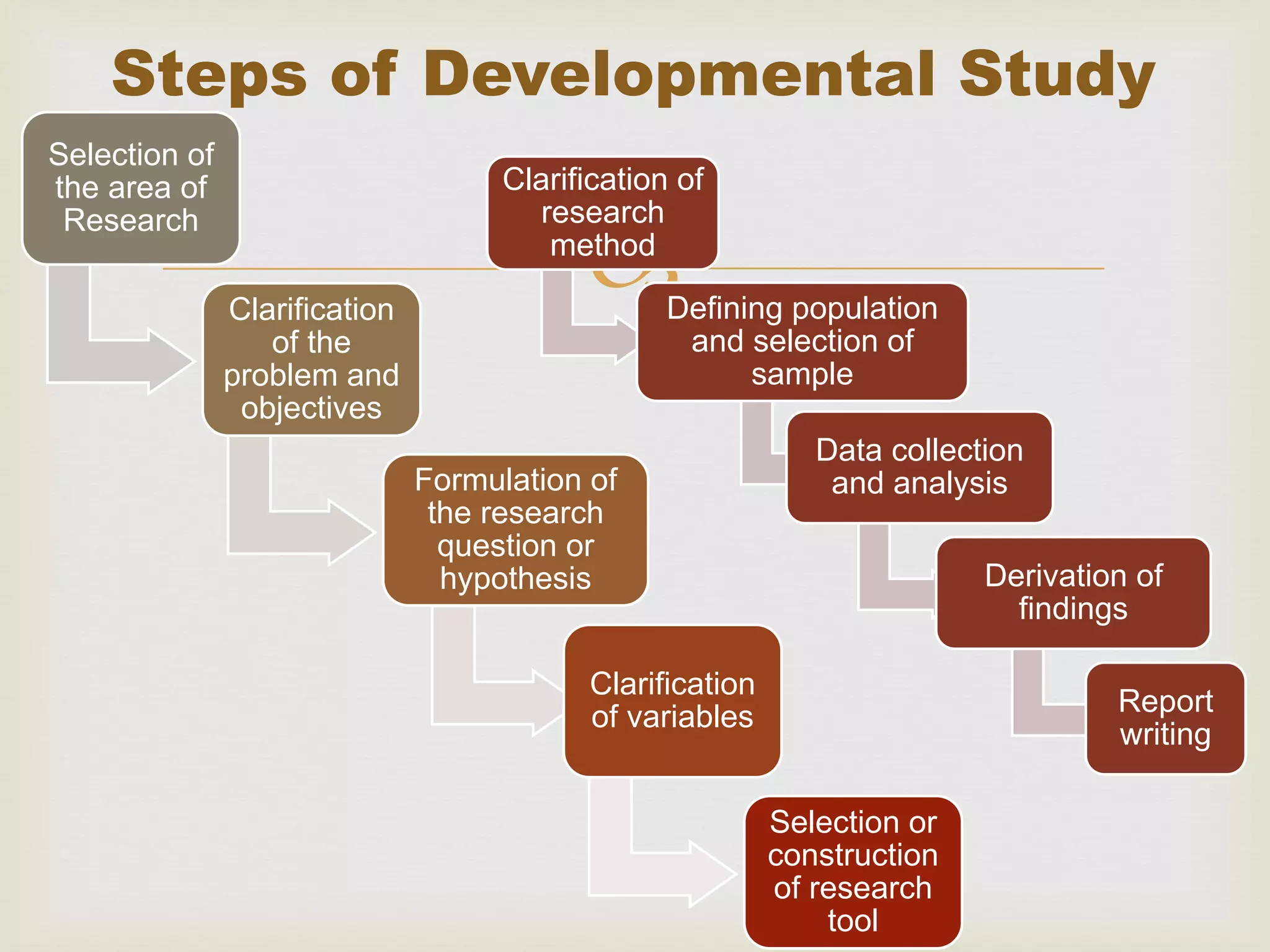
Selection of
the area of
Research
Clarification
of the
problem and
objectives
Formulation of
the research
question or
hypothesis
Clarification
of variables
Selection or
construction
of research
tool
Steps of Developmental Study
Clarification of
research
method
Defining population
and selection of
sample
Data collection
and analysis
Derivation of
findings
Report
writing

1. Trends of individual’s development can be
understood by conducting developmental studies.
Such understanding can be useful in assigning a
particular task to the teacher/employee according to
his developmental trend and abilities.
2. it can be useful in establishing cause and effect
relationship between variables in terms of time period
of development. On the basis of the findings of such
researches conducted in the field of education,
particular decisions regarding teachers and students
can be taken.
Utility of Developmental
Research

3.According to the trend of language
development, textbooks can be written in
proper language for different levels of
education.
4. By knowing the trend of development of
special children, decisions can be taken
regarding their education. They can be guided
also for their progress on the basis of the
findings of such a researches.
Utility of Developmental
Research

5. The teachers can plan their future teaching
strategies according to the developmental trend
of students.
6.The efforts made for development of students
can be judged by this type of research. Proper
steps can be taken for the development of
students on the basis of the findings of search
researchers.
Utility of Developmental
Research

7. Findings of such researches can be
helpful to the government in forming
policies with regards to educational
system
8. The parents can also be guided for
taking proper care of the words in future.
Utility of Developmental
Research

1. The researcher should be very patient and calm
during transacting with subjects in longitudinal
research to maintain their support and interest in
research related activities for a long time period.
2. He should try to establish a good rapport with
subjects.
3.Data should be recorded properly and
maintained precisely for a long time period In
longitudinal studies.
Suggestions to use developmental
research method effectively

4. As the data collected during different time
period, Analysis should be done to compare
present results with the results of previous data
analysis. In this way, progressive trend of
development can be known and understood in
better way. At the end of the process, final data
analysis should be done.
5. Research tool should Be constructed for
longitudinal study by keeping in mind the
futuristic situation.
Suggestions to use developmental
research method effectively

1.The sample is selected only ones in cross-
sectional study, so the effect of changing
environment on the development of subject
cannot be checked.
2. Longitudinal study consumes more time.
3. This method is more expensive than other
descriptive methods.
Limitations of developmental
research

4.Some subjects may start losing interest in longitudinal
research, as the time passes.
5.As the time passes, sincerity of subject may reduce. So,
sometimes, true information cannot be collected from the
subjects. Therefore scope of deriving reliable findings
reduces. This is called ’control effect’ or ’measuring effect.’
6.Due to the long span of time period, Some subjects stop
cooperating, in longitudinal research. That affects the
process of data collection and analysis and ultimately the
findings of research.
Limitations of developmental
research

7.If close relationship is established between the
subject and the researcher during research in LM,
there sincerity may reduce in terms of research.
8.Researcher has to work with great
understanding, patience and maturity in LM in
order to maintain the interest of subjects for a long
time.
9.Large sample cannot be selected in longitudinal
studies.
Limitations of developmental
research

10. In trend and cohort approaches of LM, some or all
subjects have to be changed, but new subjects, having the
similarity in all aspects with old subjects cannot be
selected every time for the sample. So reliable information
cannot be gathered in LM.
11. Small sample is selected in LM compare to CSM. It
may not represent the entire population during different
time period.
12. While developing a research tool futuristic situation
has to be considered in LM as the same tool is used as
different time periods.
Limitations of developmental
research

1. Comparative study of mental abilities/emotional
maturity/speed and precision/numeric ability/computation
ability/physical skills/memory power/reading
comprehension ability/vocabulary/listening comprehension
ability of the student of grade 8 to 12.
2. Comparative study of study habits/exam
anxiety/vocational interest of the students of grade 8 to
grade 12.
3. Study of self-concept/job satisfaction/mental stress of
teachers/employees in the context of their experience.
Some Research Problems for
Developmental Research

4. Study of attitude of great 8 to grade 12
students towers films.
5. Study of attitudes of the students of
grade 8 to 12 towards English/science
subjects.
6. Study of effect of remedial work on the
adjustment of the students of grade 8 to
grade 12.
Some Research Problems for
Developmental Research


Developmental research Method

  • 2.
    Professor Parveenbanu M.Malek JG College of Education(PG) Ahmedabad, Gujarat
  • 3.
      Let's lookat a baby. A baby doesn't really do much, doesn't seem to think much, and can be really kind of boring to study on its own. A toddler is a little more interesting. It can talk, walk, and interact with its environment. You can begin to assess some of the cognitive developments occurring. Kids in elementary school develop quickly, and their skills grow exponentially. Take a moment to consider the differences between the different developmental periods. How is a child cognitively different than an adult? How is a teenager emotionally different than an elderly person? This continuum is the span of human development.
  • 4.
     Darwin’s theory ofhuman evolution is a result of a research that intended to know the biological evolution of human being. Human being has progressed remarkably in every aspect of life science since Stone Age.
  • 5.
     Darwinism is atheory of biological evolution developed by the English naturalist Charles Darwin (1809–1882) and others, stating that all species of organisms arise and develop through the natural selection of small, inherited variations that increase the individual's ability to compete, survive, and reproduce.
  • 6.
     At present, developmentalresearch is conducted in various fields in order to understand progressive changes of living being. Such a research is done in Education, Psychology and Sociology. Progressive development of organism, animal and human being has been a subject of interest for researcher before the beginning of systematic approach of research process.
  • 7.
     Developmental research isa study focused on the progressive changes that occur as an organism develops. A research method that is used to access changes over an extended period of time is called developmental research method. Definitions of Developmental Research
  • 8.
     There isn't anyway to reverse the changes that happen when you grow up. You can't take an older person and hit the reset button to revert them back to childhood to see how raising them in a different time will change who they are. It'd be nice, but unfortunately we are stuck experiencing time in one direction.
  • 9.
      Developmental researchintends to study the progressive changes that occur in an organism with passage of time.  It studies deeply about such changes that are found in characteristics, traits and physique of an individual or an organism in the context of time period.  It helps in understanding of pattern of development in the context of certain characteristics of subject.  Development of an individual remains at the Centre of educational, psychological and sociological researches.  So, various developmental studies have been done in these fields till today. Meaning of Developmental Research
  • 10.
    Types of Developmental Research 1. Cross Sectional Developmental studyMethod 2. Longitudinal Developmental study Method 3. Trend Related Developmental study Method
  • 11.
      Some characteristicof individuals and living being changes with the passage of time.  Some natural, social, mental, physical or environmental factors have been responsible for such changes.  To know the pattern of such changes, subjects of different age groups are studied in the same time period in the context of change in a particular characteristic. For that, the subjects of different age groups are selected in the same time period.  The research method used to study a pattern of development in this way, is called cross sectional research method. 1. Cross Sectional Developmental study Method
  • 12.
     We collect datafrom the student of 9 to 12 in the academic year 2018–2019 for research, it will be called cross-sectional survey because here data are collected from different groups of the students in the same time period. Sometimes instead of studying all groups at the same time period data are collected from different groups during different time periods. Such a study is called longitudinal study. For example suppose we want to study the e m o t i o n a l m a t u r i t y of the standards of grade 9 to 12.
  • 13.
     Cross sectional studyforms a class of research methods that involves observation of some subset of a population of items all at the same time, in which, groups can be compared at different ages with respect of independent variables. 1. Definition Cross Sectional Developmental study Method
  • 14.
      If subjectsof a particular age group are selected ones and they all are studied at different time period to understand the pattern of changes that occur in their certain traits, it is called longitudinal research method. 2. Longitudinal Developmental study Method
  • 15.
      For exampleinstead of collecting data from the students of grade 9 to 12 in the same year in the study of their expectations from the teachers, it is decided to collect the data from the students of grade 9 in academic year 2017–2018, in 2018– 2019 from the same students when they will come in grade 10, again data will be collected from the same students in 2019– 2020, when they will come in grade 11 and at last, data will be collected from them, when they will reach standard 12 in the academic year 2020–2021.  If data are collected in this way for research, it is called longitudinal study. 2. Longitudinal Developmental study Method
  • 16.
      The mostimportant things to be noted here is, the different groups for the sample are selected ones and data collected once during the same time period in cross-sectional study,  While in longitudinal study, sample is selected ones but data are collected more than once from each unit of sample.  Sometimes different sample are selected during different time periods in longitudinal study for collecting data. 2. Longitudinal Developmental study Method
  • 17.
      A correlationalresearch study that involves repeated observations of the same items over long periods of time 2. Definition of longitudinal Developmental Study Method
  • 18.
    Types of Longitudinal Developmentalstudy Method 3. Trend Research 1. Cohort Research 2. Panel Research
  • 19.
  • 20.
  • 21.
  • 22.
     The origin ofthe word ‘chohort’ is an old French word ‘Chohorte’ or Latin word ‘Choros’. Out of various meanings of that, one is ‘A group of persons sharing a particular statistical or a demographic characteristic.’ 1. Meaning of the term Cohort
  • 23.
     For example agroup of persons of a particular age. Here age is a demographic characteristics. So this group will be considered as cohort. In the same way, a group of students having 70% marks in SSC examinations will be considered as cohort because the students are grouped here the basis of statistical characteristics and it is 70% marks. 1. Example of Cohort Research
  • 24.
     In cohort study,population is decided on the basis of demographic or statistical characteristics and different samples are selected during different time periods for survey. Data are collected from different samples during a different time periods. To be more specific, it can be said that type of population remains the same but units of sample may change during different time periods. 1. Sample and Population in Cohort Study
  • 25.
     For example ifwe want to study, for 10 years, the ‘study habits’ of the students passing the SSC examination with more than 95%, then population will remain the same and that is a set of all students, passing SSC with more than 95% marks in respective years. Here, criterion for deciding the population will remain the same that is statistical characteristic, which is 95% or more marks in SSC examinations, but the units of population and sample will change every year because the students passing the examinations will be different every years. 1. Example of Cohort Research
  • 26.
      In shortthe definition of population will remain unchanged during different time periods of study but the units of population will keep on changing as the time period will change and ultimately the units of sample will also change during different time period in cohort study. 1. Definition of Cohort Research
  • 27.
     If the sampleis selected only once, but data collected from all the units of the sample during each time period of study, it is call Panel longitudinal survey. In this type of survey, the units of both population and sample will remain unchanged during different time periods of study. 2. Sample and Population in Panel Study
  • 28.
     For examples tostudy the emotional maturity of the students of 11 to 15 years of age, the sample will be selected only ones from 11 year old students. But data will be collected from them every year till they will complete 15 years of age. In this way, they will provide the data five times at the age of 11, 12, 13, 14 and 15 year. Paiget it adopted this method of study for developing cognitive theory of learning. 2. Example of Panel Study
  • 29.
     If the sametype of population is defined during different time periods of study on the basis of other then demographic or statistical characteristic of the subjects, it is called trend survey. 3. Population in Trend Research
  • 30.
     For example, supposewe want to study, for five years, the opinions of parents of secondary school students towards secondary schools. The population will be decided every year by keeping in mind the students studying in grade 9 and 10 in respective years. 3. Example of Trend Research
  • 31.
     The base fordeciding sample will not be statistical or a demographic characteristics but it is grade of the students, and grade of the students is not a statistical phenomenon but it is a variable. Every year some new students will enter the grade 9 and some students will leave standard 10. So, some new parents will be added in population and some parents will be eliminated from the population every year and the same will happen in the sample also. 3. Sample in Trend Research
  • 32.
     In short, thedefinition of population will remain unchanged in trend survey also, as it remains the same in cohort survey during different time periods of study but the units of population will keep on changing as the time period will change and ultimately the units of sample will also change during different time period in trend study 3. Definition of Population in Trend Research
  • 33.
     Difference between cross- sectionaland longitudinal study Cross-sectional studies take place at a single point in time Longitudinal study involves a series of measurements taking over a period of time
  • 34.
     Sample is selectedonly once in cross- sectional method but in longitudinal Method different sample can be selected during different time period. Data collected only once from the subjects in cross-sectional method but in longitudinal method data are collected more than one time. Difference between cross-sectional and longitudinal study
  • 35.
     Less time isconsumed in CSM then LM. CSM is less expensive than LM. As time passes, subjects start losing interest in cooperating with the researcher in LM but it is not so in CSM. Difference between cross- sectional and longitudinal study
  • 36.
     Time factor doesnot affect the responses of subjects in CSM, as they have to give responses only once, but in LM the same subject have to give their responses at different time periods, so due to maturity, either they do not give true responses or lose interest in providing fair responses. Problem of reducing in number of subjects may occur in LM due to withdrawal, death or migration of some subjects. Such things do not happen in CSM. Difference between cross-sectional and longitudinal study
  • 37.
     If close relationshipis established between subjects and researcher during research in LM, there sincerity may reduce in terms of research. It does not happen in CSF. Researcher has to work with great understanding, patience and maturity in LM in order to maintain interest of subjects for the long time period. He does not have to bother for such matters in CSM. Difference between cross-sectional and longitudinal study
  • 38.
     Less subjects arethere in LM compared it to that in CSM. In trend and cohort approaches of LM, some or all subjects have to be changed. Every time, new subjects having similarity in all aspects with old subjects cannot be selected for the sample. So reliable information cannot be gathered. But this problem Does not arise in CSM as subjects are not changed in it Difference between cross-sectional and longitudinal study
  • 39.
     Small sample selectedin LM compare to CSM. It may not represent the entire population during different time periods. CSM works on large sample so it may represent the population in better way. While developing a research tool, futuristic situation has to be considered in LM as the same tool is to be used at different time periods. Tool is used only once in CSM so, such consideration is not required in developing a tool for research. Difference between cross-sectional and longitudinal study
  • 40.
     Selection of the areaof Research Clarification of the problem and objectives Formulation of the research question or hypothesis Clarification of variables Selection or construction of research tool Steps of Developmental Study Clarification of research method Defining population and selection of sample Data collection and analysis Derivation of findings Report writing
  • 41.
     1. Trends ofindividual’s development can be understood by conducting developmental studies. Such understanding can be useful in assigning a particular task to the teacher/employee according to his developmental trend and abilities. 2. it can be useful in establishing cause and effect relationship between variables in terms of time period of development. On the basis of the findings of such researches conducted in the field of education, particular decisions regarding teachers and students can be taken. Utility of Developmental Research
  • 42.
     3.According to thetrend of language development, textbooks can be written in proper language for different levels of education. 4. By knowing the trend of development of special children, decisions can be taken regarding their education. They can be guided also for their progress on the basis of the findings of such a researches. Utility of Developmental Research
  • 43.
     5. The teacherscan plan their future teaching strategies according to the developmental trend of students. 6.The efforts made for development of students can be judged by this type of research. Proper steps can be taken for the development of students on the basis of the findings of search researchers. Utility of Developmental Research
  • 44.
     7. Findings ofsuch researches can be helpful to the government in forming policies with regards to educational system 8. The parents can also be guided for taking proper care of the words in future. Utility of Developmental Research
  • 45.
     1. The researchershould be very patient and calm during transacting with subjects in longitudinal research to maintain their support and interest in research related activities for a long time period. 2. He should try to establish a good rapport with subjects. 3.Data should be recorded properly and maintained precisely for a long time period In longitudinal studies. Suggestions to use developmental research method effectively
  • 46.
     4. As thedata collected during different time period, Analysis should be done to compare present results with the results of previous data analysis. In this way, progressive trend of development can be known and understood in better way. At the end of the process, final data analysis should be done. 5. Research tool should Be constructed for longitudinal study by keeping in mind the futuristic situation. Suggestions to use developmental research method effectively
  • 47.
     1.The sample isselected only ones in cross- sectional study, so the effect of changing environment on the development of subject cannot be checked. 2. Longitudinal study consumes more time. 3. This method is more expensive than other descriptive methods. Limitations of developmental research
  • 48.
     4.Some subjects maystart losing interest in longitudinal research, as the time passes. 5.As the time passes, sincerity of subject may reduce. So, sometimes, true information cannot be collected from the subjects. Therefore scope of deriving reliable findings reduces. This is called ’control effect’ or ’measuring effect.’ 6.Due to the long span of time period, Some subjects stop cooperating, in longitudinal research. That affects the process of data collection and analysis and ultimately the findings of research. Limitations of developmental research
  • 49.
     7.If close relationshipis established between the subject and the researcher during research in LM, there sincerity may reduce in terms of research. 8.Researcher has to work with great understanding, patience and maturity in LM in order to maintain the interest of subjects for a long time. 9.Large sample cannot be selected in longitudinal studies. Limitations of developmental research
  • 50.
     10. In trendand cohort approaches of LM, some or all subjects have to be changed, but new subjects, having the similarity in all aspects with old subjects cannot be selected every time for the sample. So reliable information cannot be gathered in LM. 11. Small sample is selected in LM compare to CSM. It may not represent the entire population during different time period. 12. While developing a research tool futuristic situation has to be considered in LM as the same tool is used as different time periods. Limitations of developmental research
  • 51.
     1. Comparative studyof mental abilities/emotional maturity/speed and precision/numeric ability/computation ability/physical skills/memory power/reading comprehension ability/vocabulary/listening comprehension ability of the student of grade 8 to 12. 2. Comparative study of study habits/exam anxiety/vocational interest of the students of grade 8 to grade 12. 3. Study of self-concept/job satisfaction/mental stress of teachers/employees in the context of their experience. Some Research Problems for Developmental Research
  • 52.
     4. Study ofattitude of great 8 to grade 12 students towers films. 5. Study of attitudes of the students of grade 8 to 12 towards English/science subjects. 6. Study of effect of remedial work on the adjustment of the students of grade 8 to grade 12. Some Research Problems for Developmental Research
  • 53.