Types of genomics
Group
Hina zamir (04)
Mahnoor khan (02)
Rameen Nadeem (25)
Syeda iqra Hussain
(?05)
Maleeha Inayat (06)
Overview
• Genomics overview
• Goal of genomics
• Types of genomics overview
• Structural genomics
• Functional genomics
• Mutational genomics
• Comparative genomics
Genomics overview
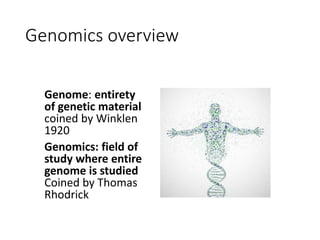
Genome: entirety
of genetic material
coined by Winklen
1920
Genomics: field of
study where entire
genome is studied
Coined by Thomas
Rhodrick
als of genomics
Compile the genomic sequences of organisms
Search out the location of the genes for
analyzing spatial relationships and annotate the
gene set in a genome
Learn the function of genes and their influence
Establish how gene expression profiles of a
cell vary under different conditions.
Compare gene and protein profiles among
different organisms to learn about evalutionary
relationships.
Structural
genomics:
• Aims to determine
structure of every
protein encoded by
the genome.
• Identify novel
protein folds and 3-
D structures for
better
understanding the
functions of
proteins.
Functional genomics:
• Aims to collect and use
data from sequencing
for decribing gene and
protein functions
• functions of genes and
non-gene sequences in
genomes
• Gena and protein
interactions
• Genotype- phenotypes
Comparative Genomics
• Aims to compare
genomic features
between different species
• e,.g. for better
understanding the
evaloutionary
relationships.
• to determine the function
of each genome E.g
studying genes in model
organisms
• Yeast and human
Mutational Genomics:
• The study of genome in
terms of mutations that
occur in an individual’s
DNA or genome
• One of the aspect of
functional genomics
• Also referred as gene
function determination
• Aim to determine
function of gene
• Or anonymous
sequence
Structural genomics
Definition
• Structural genomics helps to describe the 3-
dimensional structure of every protein encoded by
a particular genome.
• The principal difference between structural
genomics and traditional structural prediction is
that structural genomics attempts to determine the
structure of every protein encoded by the genome,
rather than focusing on oneparticular protein.
• It involves taking a large number of approaches to
structure determination, including
• experimental methods using genomic sequences or
• modeling-based approaches ....
• based on sequence or structural homology of a
protein of known structure or
• based on chemical and physical principles for a
protein with no homology to any known structure.
Goals
• Structural genomics has role in determination of
function of a protein.
• Used in drug discovery and
• in protein engineering On a large scale
• Interpretation of protein structure:
• The gene sequence of the target protein can also
be compared to a known sequence and structural
information can then be inferred from the known
protein’s structure.
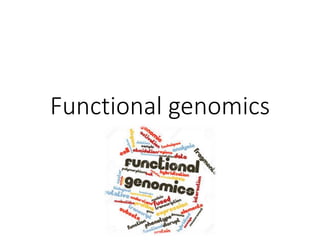
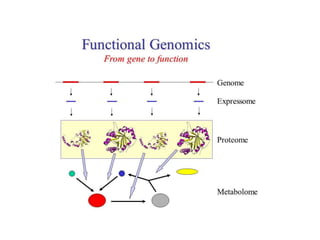
Functional genomics
Functional genomics:
• Branch of genomics that determines biological
functions of genes and their products.
• Functional genomics (transcriptomics and
proteomics) is a global, systematic and
comprehensive approach for identification and
description of the processes and pathways
involved in the normal and abnormal state of
genes.
Why we need to study?
• It is estimated that approximately 30% of the open
reading frames in a fully sequenced organism have
unknown function at the biochemical level and are
unrelated to any known gene. This is why recently
the interest of researchers has shifted from
genome mapping and sequencing to determination
of genome function by using the functional
genomics approach.
Example:
• A single gene can give rise to multiple gene
products. RNA can be alternatively spliced or edited
to form mature mRNA. Besides, proteins are
regulated by additional mechanisms such as
posttranslational modifications,
compartmentalization and proteolysis. Finally,
biological function is determined by the complexity
of these processes.
Techniques of functional genomics:
• At the DNA level(Genetic interaction mapping, the
ENCODE project)
• Gene expression profiling at the transcript level
(differential display, expressed sequence tags, serial
analysis of gene expression and DNA microarrays)
• Proteome analysis (Protein microarray, 2D-PAGE)
Mutational genomics
Mutational genomics
• Mutational genomics is the field of genomics that
characterizes mutation associated genes.
• In this we basically focuses on genomic, epigenomic and
transcript alterations in cancer.
• Mutational genomics bears similarity to genetical
genomics, linking genotype to transcriptional state.
• In mutational genomics the difficult task is the finding of
genes that underlying transcriptional changes
Mutational genomics strategy
• There are three basic types of mutational genomics strategy
• First, the systematic approach of deliberately mutating every gene
in the genome, one at a time, and generating banks of specific
mutant strains.
• Second, the random approach in which genes are mutated
indiscriminately. Individual mutation are then catalogued by
obtaining flanking sequence tags, and genes are annotated by
matching the tags to entries in sequence databases.
• The third approach encompasses a group of techniques which
generate functional phenocopies of mutant allelles. i.e, the likeness
of a mutation without actually altering the DNA sequence of an
organism.
Oncogenomics
• Oncogenomics is a sub-field of mutational genomics that
characterizes cancer-associated genes.
• It focuses on genomic, epigenomic and transcript alterations in
cancer.
• Cancer is a genetic disease caused by accumulation of DNA
mutations and epigenetic alterations leading to unrestrained cell
proliferation and neoplasm formation.
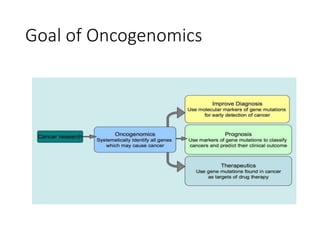
• The goal of oncogenomics is to identify new oncogenes or tumor
suppressor genes that may provide new insights into cancer
diagnosis, predicting clinical outcome of cancers and new targets for
cancer therapies.
Goal of Oncogenomics
Comparative
genomics
Defination
• field of biological research in which the genomic
features of different organisms are compared The
genomic features may include the DNA sequence
genes gene order regulatory sequences
Purpose
• In this branch of genomics, whole or large parts of
genomes resulting from genome projects are
compared TO STUDY basic biological similarities
differences evolutionary relationships between
organisms The major principle of comparative
genomics is that common features of two
organisms will often be encoded within the DNA
that is evolutionarily conserved between them.
•
By comparing the sequences of genomes of
different organisms, researchers can understand
what, at the molecular level, distinguishes
different life forms from each other.
• Comparative genomics also provides a powerful
tool for
• 1: Studying evolutionary changes
• 2: Helping to identify genes that are conserved
or common among species
• 3: Genes that give each organism its unique
characteristics.
How are genomes compared?
• A simple comparison of the general features of
genomes such as genome size, number of genes,
and chromosome number presents an entry point
into comparative genomic analysis. The
comparisons highlight some striking findings. Finer-
resolution comparisons are possible by direct DNA
sequence comparisons between species.
Comparison of discrete segments of genomes is
also possible by aligning homologous DNA from
different species.
Tools
• Computational tools for analyzing sequences and
complete genomes are developed quickly due to
the availability of large amount of genomic data. At
the same time, comparative analysis tools are
progressed and improved.
Applications
•
Applying a comparative genomics approach by
analyzing the genomes of several related pathogens
can lead to the development of vaccines that are
multiprotective Identifying the loci of advantageous
genes is a key step in breeding crops that are
optimized for greater yield, cost-efficiency, quality,
and disease resistance.
Types of genomics ppt

Types of genomics ppt

  • 1.
    Types of genomics Group Hinazamir (04) Mahnoor khan (02) Rameen Nadeem (25) Syeda iqra Hussain (?05) Maleeha Inayat (06)
  • 2.
    Overview • Genomics overview •Goal of genomics • Types of genomics overview • Structural genomics • Functional genomics • Mutational genomics • Comparative genomics
  • 3.
    Genomics overview Genome: entirety ofgenetic material coined by Winklen 1920 Genomics: field of study where entire genome is studied Coined by Thomas Rhodrick
  • 4.
    als of genomics Compilethe genomic sequences of organisms Search out the location of the genes for analyzing spatial relationships and annotate the gene set in a genome Learn the function of genes and their influence Establish how gene expression profiles of a cell vary under different conditions. Compare gene and protein profiles among different organisms to learn about evalutionary relationships.
  • 5.
    Structural genomics: • Aims todetermine structure of every protein encoded by the genome. • Identify novel protein folds and 3- D structures for better understanding the functions of proteins. Functional genomics: • Aims to collect and use data from sequencing for decribing gene and protein functions • functions of genes and non-gene sequences in genomes • Gena and protein interactions • Genotype- phenotypes
  • 6.
    Comparative Genomics • Aimsto compare genomic features between different species • e,.g. for better understanding the evaloutionary relationships. • to determine the function of each genome E.g studying genes in model organisms • Yeast and human Mutational Genomics: • The study of genome in terms of mutations that occur in an individual’s DNA or genome • One of the aspect of functional genomics • Also referred as gene function determination • Aim to determine function of gene • Or anonymous sequence
  • 7.
  • 8.
    Definition • Structural genomicshelps to describe the 3- dimensional structure of every protein encoded by a particular genome. • The principal difference between structural genomics and traditional structural prediction is that structural genomics attempts to determine the structure of every protein encoded by the genome, rather than focusing on oneparticular protein.
  • 9.
    • It involvestaking a large number of approaches to structure determination, including • experimental methods using genomic sequences or • modeling-based approaches .... • based on sequence or structural homology of a protein of known structure or • based on chemical and physical principles for a protein with no homology to any known structure.
  • 10.
    Goals • Structural genomicshas role in determination of function of a protein. • Used in drug discovery and • in protein engineering On a large scale • Interpretation of protein structure: • The gene sequence of the target protein can also be compared to a known sequence and structural information can then be inferred from the known protein’s structure.
  • 11.
  • 12.
    Functional genomics: • Branchof genomics that determines biological functions of genes and their products. • Functional genomics (transcriptomics and proteomics) is a global, systematic and comprehensive approach for identification and description of the processes and pathways involved in the normal and abnormal state of genes.
  • 13.
    Why we needto study? • It is estimated that approximately 30% of the open reading frames in a fully sequenced organism have unknown function at the biochemical level and are unrelated to any known gene. This is why recently the interest of researchers has shifted from genome mapping and sequencing to determination of genome function by using the functional genomics approach.
  • 14.
    Example: • A singlegene can give rise to multiple gene products. RNA can be alternatively spliced or edited to form mature mRNA. Besides, proteins are regulated by additional mechanisms such as posttranslational modifications, compartmentalization and proteolysis. Finally, biological function is determined by the complexity of these processes.
  • 15.
    Techniques of functionalgenomics: • At the DNA level(Genetic interaction mapping, the ENCODE project) • Gene expression profiling at the transcript level (differential display, expressed sequence tags, serial analysis of gene expression and DNA microarrays) • Proteome analysis (Protein microarray, 2D-PAGE)
  • 17.
  • 18.
    Mutational genomics • Mutationalgenomics is the field of genomics that characterizes mutation associated genes. • In this we basically focuses on genomic, epigenomic and transcript alterations in cancer. • Mutational genomics bears similarity to genetical genomics, linking genotype to transcriptional state. • In mutational genomics the difficult task is the finding of genes that underlying transcriptional changes
  • 19.
    Mutational genomics strategy •There are three basic types of mutational genomics strategy • First, the systematic approach of deliberately mutating every gene in the genome, one at a time, and generating banks of specific mutant strains. • Second, the random approach in which genes are mutated indiscriminately. Individual mutation are then catalogued by obtaining flanking sequence tags, and genes are annotated by matching the tags to entries in sequence databases. • The third approach encompasses a group of techniques which generate functional phenocopies of mutant allelles. i.e, the likeness of a mutation without actually altering the DNA sequence of an organism.
  • 20.
    Oncogenomics • Oncogenomics isa sub-field of mutational genomics that characterizes cancer-associated genes. • It focuses on genomic, epigenomic and transcript alterations in cancer. • Cancer is a genetic disease caused by accumulation of DNA mutations and epigenetic alterations leading to unrestrained cell proliferation and neoplasm formation. • The goal of oncogenomics is to identify new oncogenes or tumor suppressor genes that may provide new insights into cancer diagnosis, predicting clinical outcome of cancers and new targets for cancer therapies.
  • 21.
  • 22.
  • 23.
    Defination • field ofbiological research in which the genomic features of different organisms are compared The genomic features may include the DNA sequence genes gene order regulatory sequences
  • 24.
    Purpose • In thisbranch of genomics, whole or large parts of genomes resulting from genome projects are compared TO STUDY basic biological similarities differences evolutionary relationships between organisms The major principle of comparative genomics is that common features of two organisms will often be encoded within the DNA that is evolutionarily conserved between them.
  • 25.
    • By comparing thesequences of genomes of different organisms, researchers can understand what, at the molecular level, distinguishes different life forms from each other. • Comparative genomics also provides a powerful tool for • 1: Studying evolutionary changes • 2: Helping to identify genes that are conserved or common among species • 3: Genes that give each organism its unique characteristics.
  • 26.
    How are genomescompared? • A simple comparison of the general features of genomes such as genome size, number of genes, and chromosome number presents an entry point into comparative genomic analysis. The comparisons highlight some striking findings. Finer- resolution comparisons are possible by direct DNA sequence comparisons between species. Comparison of discrete segments of genomes is also possible by aligning homologous DNA from different species.
  • 27.
    Tools • Computational toolsfor analyzing sequences and complete genomes are developed quickly due to the availability of large amount of genomic data. At the same time, comparative analysis tools are progressed and improved.
  • 28.
    Applications • Applying a comparativegenomics approach by analyzing the genomes of several related pathogens can lead to the development of vaccines that are multiprotective Identifying the loci of advantageous genes is a key step in breeding crops that are optimized for greater yield, cost-efficiency, quality, and disease resistance.

Editor's Notes

  • #5 In the field of molecular biology, gene expression profiling is the measurement of the activity (the expression) of thousands of genes at once, to create a global picture of cellular function