Medical database
and
networking
Group members
Hina zamir 04
Maryam wahab 16
Mashal mukhtiyar 53
What is
database &
Medical
database :
Database :
A database is a collection of information that is
organized so that it can easily be accessed, managed,
and updated.
Sometimes called “data bank “ as it collect, store, use,
exchange and distribute data like money banks
Medical database:
it is collection of information related to medical sciences.
Which can be accessed, managed and updated
Origin of
medical
database:
 The Medical Database provides access to over 1,400
essential publications in full text covering topics across
all areas of the medical sciences.
 The content is diverse enough to support the needs of
medical students, faculty, and clinicians.
 medical records were paper-based
 Development of computers
 Databases
 Databases management system (system software for
creating and managing databases.The DBMS provides
users and programmers with a systematic way to
create, retrieve, update and manage data.)

Classification
of medical
database
 Medical databases collect, integrate, and store data from various
sources;
 Medical databases are classified in accordance with their
objectives
 Primary database:
 when the data were initially collected and used to serve the direct
purposes of the user
 secondary databases
 when data derived from primary databases were stored in other
databases and used for other objectives
Medical
databases
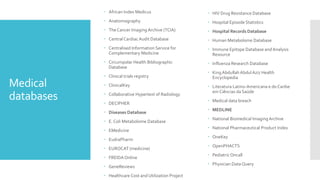
 African Index Medicus
 Anatomography
 The Cancer ImagingArchive (TCIA)
 Central Cardiac Audit Database
 Centralised Information Service for
Complementary Medicine
 Circumpolar Health Bibliographic
Database
 Clinical trials registry
 ClinicalKey
 Collaborative Hypertext of Radiology
 DECIPHER
 Diseases Database
 E. Coli Metabolome Database
 EMedicine
 EudraPharm
 EUROCAT (medicine)
 FREIDAOnline
 GeneReviews
 Healthcare Cost and Utilization Project
 HIV Drug Resistance Database
 Hospital Episode Statistics
 Hospital Records Database
 Human Metabolome Database
 Immune Epitope Database andAnalysis
Resource
 Influenza Research Database
 KingAbdullahAbdulAziz Health
Encyclopedia
 Literatura Latino-Americana e do Caribe
em Ciências da Saúde
 Medical data breach
 MEDLINE
 National Biomedical ImagingArchive
 National Pharmaceutical Product Index
 OneKey
 OpenPHACTS
 Pediatric Oncall
 Physician Data Query
Medical
databases
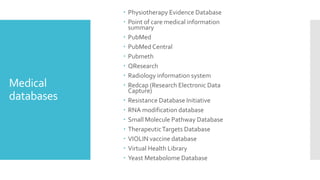
 Physiotherapy Evidence Database
 Point of care medical information
summary
 PubMed
 PubMed Central
 Pubmeth
 QResearch
 Radiology information system
 Redcap (Research Electronic Data
Capture)
 Resistance Database Initiative
 RNA modification database
 Small Molecule Pathway Database
 TherapeuticTargets Database
 VIOLIN vaccine database
 Virtual Health Library
 Yeast Metabolome Database
Disease
database
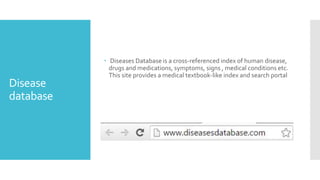
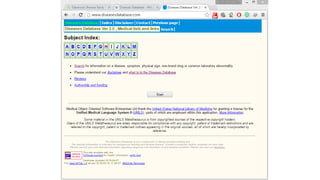
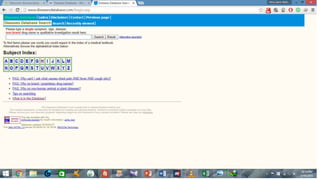
 Diseases Database is a cross-referenced index of human disease,
drugs and medications, symptoms, signs , medical conditions etc.
This site provides a medical textbook-like index and search portal
NLM search &
retrieval
programs
 The NLM developed a variety of programs to help
standardize medical terms ; & to support electronic access,
search ,retrieval & links to its large number of databases.
 The United States National Library of Medicine (NLM),
operated by the United States federal government, is the
world's largest medical library
 Its collections include more than seven million books,
journals, technical reports, manuscripts, microfilms,
photographs, and images on medicine and related sciences,
including some of the world's oldest and rarest works.
 Medical subject headings(MeSH) vocabulary file was initiated
in 1960 by NLM to facilitate the use of its search programs.
 www.nlm.nih.gov
MEDLINE :
 MEDLINE is an online searchable index medicus from
1966 forward.
 MEDLINE was inaugurated in 1970 by the NLM as an
experimental online retrieval service.
 Itis a bibliographic database of life sciences and
biomedical information.
 It includes bibliographic information for articles from
academic journals covering medicine, nursing, pharmacy,
dentistry, veterinary medicine, and health care.
 The database contains more than 21.6 million records
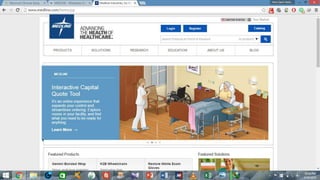
 http://www.medline.com
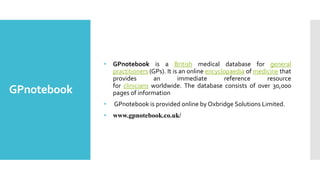
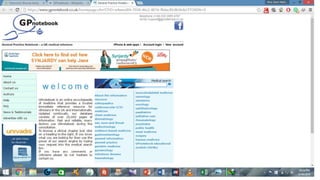
GPnotebook
• GPnotebook is a British medical database for general
practitioners (GPs). It is an online encyclopaedia of medicine that
provides an immediate reference resource
for clinicians worldwide. The database consists of over 30,000
pages of information
• GPnotebook is provided online by Oxbridge Solutions Limited.
• www.gpnotebook.co.uk/
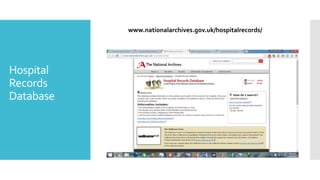
Hospital
Records
Database
www.nationalarchives.gov.uk/hospitalrecords/
Relation
between
networking
and database
 Distributed database systems evolved in the 1970s with
the introduction of low-costminicomputers and effi
cient communication networks that brought
computers closer to the users.
 In a distributed database system with a cluster of
specialized subsystem databases, each subsystem
collected and stored in its separate database
 the data it generated; and a communications network
provided linkages for data
 entry to, and retrieval from, an integrating central
database, and also to other subsystem databases as
needed.
Networking
and medical
data base
 As each specialized clinical service developed its
individual database to satisfy its own specifi c
functional and technical requirements,
 This usually resulted in the need for an overall
integrating database-management system that could
better service the very complex organizational
structure of a large hospital.
 This allowed physicians to use clinical workstations
connected to client– server minicomputers connected
in a local-area-network that linked the entire hospital.
 Patient data could be generated and used at the local
sites, and collected from all of the distributed
subsystem databases, and integrated in a central,
computerbased patient record (Friedman et al. 1990 ;
Collen 1995 ) .
Problems give
rise to
development
 However, since the computers were often made by
different manufacturers that used different software,
this introduced a major problem when interchanging
data between differently designed computer-database
systems.
 This stimulated the evolution of specialized
communications computers and networks for the
distribution of data.
 Computers began to be linked together, usually
connected to a central mainframe computer from
which
 data could be downloaded to the smaller computers;
and this changed the requirements and the designs of
database-management systems.
Developments
 New software like mumps
 Communication links like lan
 Help of ethernet technology
 Fiber area local network
Importance
 Communications s tandards for both the communications
networks and for their
 transmission of data became essential requirements
for the exchange of data between different computer
systems.
 In the late 1970s the International Standards
Organization (ISO) developed an important model and
reference base for network systems that specifi ed
seven layers for the exchange of data between
computers, with each layer corresponding to the same
layer in the other computers
Continued….
 Time division multiplexed (TDM) systems that allowed several lower-
speed digital communication channels to interleave onto a higher-
speed channel
 The evolution of Integrated Services Digital Network (ISDN) that
 developed international standards to satisfy the needs for medical
database systems; and to provide users with universal, digital inter-
connectivity regardless ofmodality, including natural-language text,
voice, and three-dimensional images;
 The increasing use of broadband fi ber-optics for digital data
communication and the evolving global use of wireless
communications.
 Health Level 7 (HL7), an international organization made up of computer
vendors, hospital users, and healthcare consultants, was formed in 1987
to develop
standards for transmitting data between medical applications that
used different computers within hospital information systems, with the
goal of creating a common language to share clinical data (Simborg
1987 ) . HL7 communicates

Medical database

  • 1.
    Medical database and networking Group members Hinazamir 04 Maryam wahab 16 Mashal mukhtiyar 53
  • 2.
    What is database & Medical database: Database : A database is a collection of information that is organized so that it can easily be accessed, managed, and updated. Sometimes called “data bank “ as it collect, store, use, exchange and distribute data like money banks Medical database: it is collection of information related to medical sciences. Which can be accessed, managed and updated
  • 3.
    Origin of medical database:  TheMedical Database provides access to over 1,400 essential publications in full text covering topics across all areas of the medical sciences.  The content is diverse enough to support the needs of medical students, faculty, and clinicians.  medical records were paper-based  Development of computers  Databases  Databases management system (system software for creating and managing databases.The DBMS provides users and programmers with a systematic way to create, retrieve, update and manage data.) 
  • 4.
    Classification of medical database  Medicaldatabases collect, integrate, and store data from various sources;  Medical databases are classified in accordance with their objectives  Primary database:  when the data were initially collected and used to serve the direct purposes of the user  secondary databases  when data derived from primary databases were stored in other databases and used for other objectives
  • 5.
    Medical databases  African IndexMedicus  Anatomography  The Cancer ImagingArchive (TCIA)  Central Cardiac Audit Database  Centralised Information Service for Complementary Medicine  Circumpolar Health Bibliographic Database  Clinical trials registry  ClinicalKey  Collaborative Hypertext of Radiology  DECIPHER  Diseases Database  E. Coli Metabolome Database  EMedicine  EudraPharm  EUROCAT (medicine)  FREIDAOnline  GeneReviews  Healthcare Cost and Utilization Project  HIV Drug Resistance Database  Hospital Episode Statistics  Hospital Records Database  Human Metabolome Database  Immune Epitope Database andAnalysis Resource  Influenza Research Database  KingAbdullahAbdulAziz Health Encyclopedia  Literatura Latino-Americana e do Caribe em Ciências da Saúde  Medical data breach  MEDLINE  National Biomedical ImagingArchive  National Pharmaceutical Product Index  OneKey  OpenPHACTS  Pediatric Oncall  Physician Data Query
  • 6.
    Medical databases  Physiotherapy EvidenceDatabase  Point of care medical information summary  PubMed  PubMed Central  Pubmeth  QResearch  Radiology information system  Redcap (Research Electronic Data Capture)  Resistance Database Initiative  RNA modification database  Small Molecule Pathway Database  TherapeuticTargets Database  VIOLIN vaccine database  Virtual Health Library  Yeast Metabolome Database
  • 7.
    Disease database  Diseases Databaseis a cross-referenced index of human disease, drugs and medications, symptoms, signs , medical conditions etc. This site provides a medical textbook-like index and search portal
  • 10.
    NLM search & retrieval programs The NLM developed a variety of programs to help standardize medical terms ; & to support electronic access, search ,retrieval & links to its large number of databases.  The United States National Library of Medicine (NLM), operated by the United States federal government, is the world's largest medical library  Its collections include more than seven million books, journals, technical reports, manuscripts, microfilms, photographs, and images on medicine and related sciences, including some of the world's oldest and rarest works.  Medical subject headings(MeSH) vocabulary file was initiated in 1960 by NLM to facilitate the use of its search programs.  www.nlm.nih.gov
  • 12.
    MEDLINE :  MEDLINEis an online searchable index medicus from 1966 forward.  MEDLINE was inaugurated in 1970 by the NLM as an experimental online retrieval service.  Itis a bibliographic database of life sciences and biomedical information.  It includes bibliographic information for articles from academic journals covering medicine, nursing, pharmacy, dentistry, veterinary medicine, and health care.  The database contains more than 21.6 million records  http://www.medline.com
  • 14.
    GPnotebook • GPnotebook isa British medical database for general practitioners (GPs). It is an online encyclopaedia of medicine that provides an immediate reference resource for clinicians worldwide. The database consists of over 30,000 pages of information • GPnotebook is provided online by Oxbridge Solutions Limited. • www.gpnotebook.co.uk/
  • 16.
  • 18.
    Relation between networking and database  Distributeddatabase systems evolved in the 1970s with the introduction of low-costminicomputers and effi cient communication networks that brought computers closer to the users.  In a distributed database system with a cluster of specialized subsystem databases, each subsystem collected and stored in its separate database  the data it generated; and a communications network provided linkages for data  entry to, and retrieval from, an integrating central database, and also to other subsystem databases as needed.
  • 19.
    Networking and medical data base As each specialized clinical service developed its individual database to satisfy its own specifi c functional and technical requirements,  This usually resulted in the need for an overall integrating database-management system that could better service the very complex organizational structure of a large hospital.  This allowed physicians to use clinical workstations connected to client– server minicomputers connected in a local-area-network that linked the entire hospital.  Patient data could be generated and used at the local sites, and collected from all of the distributed subsystem databases, and integrated in a central, computerbased patient record (Friedman et al. 1990 ; Collen 1995 ) .
  • 20.
    Problems give rise to development However, since the computers were often made by different manufacturers that used different software, this introduced a major problem when interchanging data between differently designed computer-database systems.  This stimulated the evolution of specialized communications computers and networks for the distribution of data.  Computers began to be linked together, usually connected to a central mainframe computer from which  data could be downloaded to the smaller computers; and this changed the requirements and the designs of database-management systems.
  • 21.
    Developments  New softwarelike mumps  Communication links like lan  Help of ethernet technology  Fiber area local network
  • 22.
    Importance  Communications standards for both the communications networks and for their  transmission of data became essential requirements for the exchange of data between different computer systems.  In the late 1970s the International Standards Organization (ISO) developed an important model and reference base for network systems that specifi ed seven layers for the exchange of data between computers, with each layer corresponding to the same layer in the other computers
  • 23.
    Continued….  Time divisionmultiplexed (TDM) systems that allowed several lower- speed digital communication channels to interleave onto a higher- speed channel  The evolution of Integrated Services Digital Network (ISDN) that  developed international standards to satisfy the needs for medical database systems; and to provide users with universal, digital inter- connectivity regardless ofmodality, including natural-language text, voice, and three-dimensional images;  The increasing use of broadband fi ber-optics for digital data communication and the evolving global use of wireless communications.  Health Level 7 (HL7), an international organization made up of computer vendors, hospital users, and healthcare consultants, was formed in 1987 to develop standards for transmitting data between medical applications that used different computers within hospital information systems, with the goal of creating a common language to share clinical data (Simborg 1987 ) . HL7 communicates