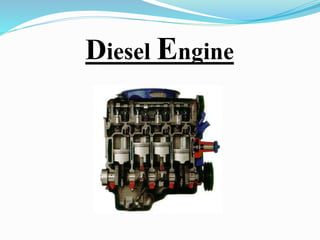
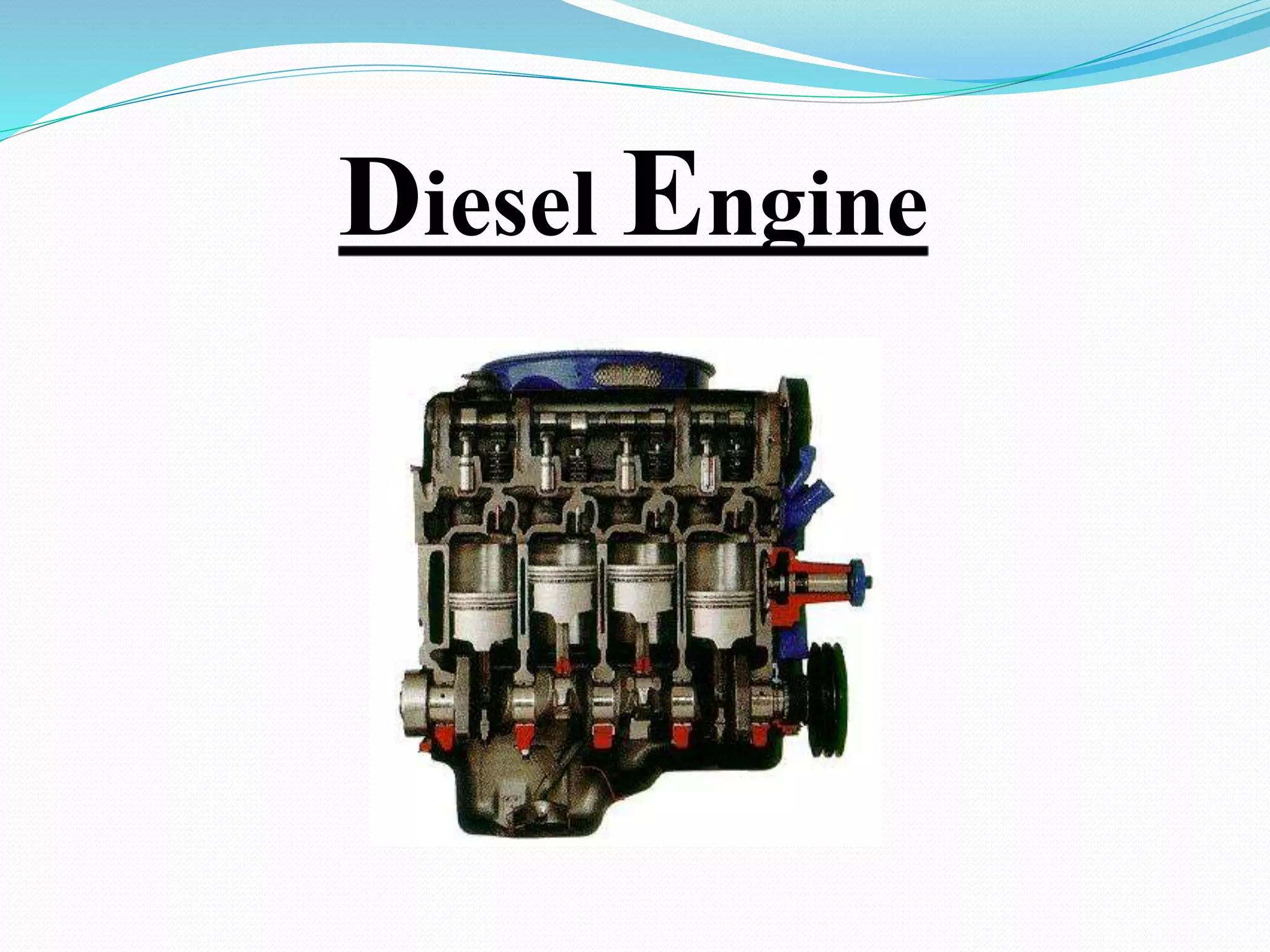
Diesel Engine
Made By:- 
Vedant Dave(140120119247) 
Vivek Verma(140120119248) 
Guided By:- 
Mr. Aditya Singh
History 
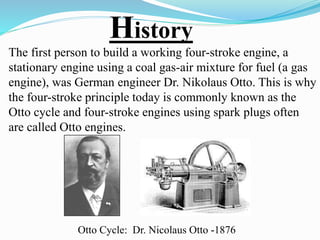
The first person to build a working four-stroke engine, a 
stationary engine using a coal gas-air mixture for fuel (a gas 
engine), was German engineer Dr. Nikolaus Otto. This is why 
the four-stroke principle today is commonly known as the 
Otto cycle and four-stroke engines using spark plugs often 
are called Otto engines. 
Otto Cycle: Dr. Nicolaus Otto -1876
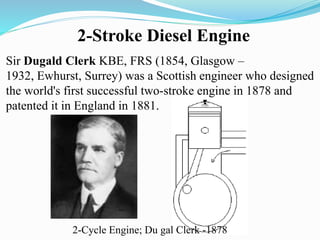
2-Stroke Diesel Engine 
Sir Dugald Clerk KBE, FRS (1854, Glasgow – 
1932, Ewhurst, Surrey) was a Scottish engineer who designed 
the world's first successful two-stroke engine in 1878 and 
patented it in England in 1881. 
2-Cycle Engine; Du gal Clerk -1878
4-Stroke Diesel Engine 
Rudolf Christian Karl Diesel (March 18, 1858 – September 
29, 1913) was a German inventor and mechanical engineer, 
famous for the invention of the 4-stroke diesel engine. 
Diesel Engine - Dr. Rudolph Diesel -1895
Four Stroke Diesel Engine 
Four stroke engine was first demonstrate by Nikolaus Otto in 
1876,hence it is also known as Otto cycle. It consist of 4 
stroke ,one cycle operation is completed in 4 stroke of the 
piston, That is one cycle is completed in every 2 revolutions of 
the crankshaft. Each stroke consist of 180°,of crankshaft 
rotation and hence a cycle consist of 720°,of crankshaft 
rotation.
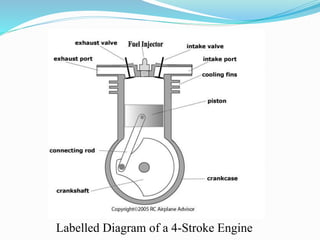
Labelled Diagram of a 4-Stroke Engine
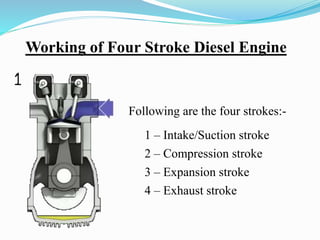
Working of Four Stroke Diesel Engine 
Following are the four strokes:- 
1 – Intake/Suction stroke 
2 – Compression stroke 
3 – Expansion stroke 
4 – Exhaust stroke
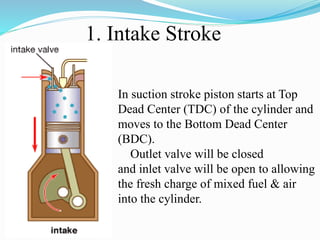
1. Intake Stroke 
In suction stroke piston starts at Top 
Dead Center (TDC) of the cylinder and 
moves to the Bottom Dead Center 
(BDC). 
Outlet valve will be closed 
and inlet valve will be open to allowing 
the fresh charge of mixed fuel & air 
into the cylinder.
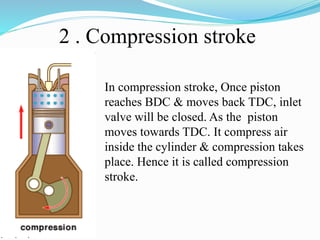
2 . Compression stroke 
In compression stroke, Once piston 
reaches BDC & moves back TDC, inlet 
valve will be closed. As the piston 
moves towards TDC. It compress air 
inside the cylinder & compression takes 
place. Hence it is called compression 
stroke.
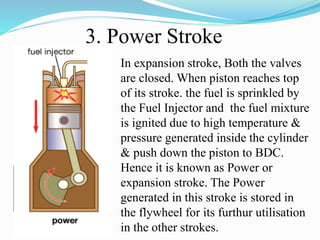
3. Power Stroke 
In expansion stroke, Both the valves 
are closed. When piston reaches top 
of its stroke. the fuel is sprinkled by 
the Fuel Injector and the fuel mixture 
is ignited due to high temperature & 
pressure generated inside the cylinder 
& push down the piston to BDC. 
Hence it is known as Power or 
expansion stroke. The Power 
generated in this stroke is stored in 
the flywheel for its furthur utilisation 
in the other strokes.
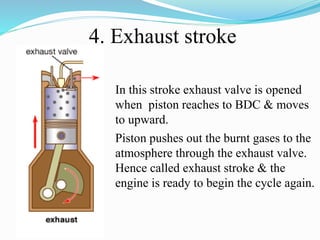
4. Exhaust stroke 
In this stroke exhaust valve is opened 
when piston reaches to BDC & moves 
to upward. 
Piston pushes out the burnt gases to the 
atmosphere through the exhaust valve. 
Hence called exhaust stroke & the 
engine is ready to begin the cycle again.
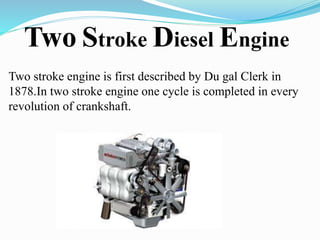
Two Stroke Diesel Engine 
Two stroke engine is first described by Du gal Clerk in 
1878.In two stroke engine one cycle is completed in every 
revolution of crankshaft.
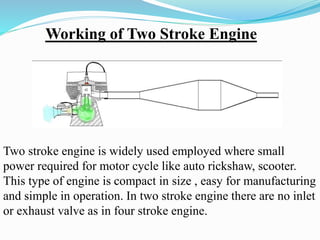
Working of Two Stroke Engine 
Two stroke engine is widely used employed where small 
power required for motor cycle like auto rickshaw, scooter. 
This type of engine is compact in size , easy for manufacturing 
and simple in operation. In two stroke engine there are no inlet 
or exhaust valve as in four stroke engine.
A two-stroke, or two-cycle, engine is a type of internal 
combustion engine which completes a power cycle in 
only one crankshaft revolution and with two strokes, or 
up and down movements, of the piston in comparison to a 
"four-stroke engine", which uses four strokes. This is 
accomplished by the end of the combustion stroke and the 
beginning of the compression stroke happening 
simultaneously and performing the intake and exhaust (or 
scavenging) functions at the same time. 
Two-stroke engines often provide high power-to-weight 
ratio, usually in a narrow range of rotational speeds called 
the "power band". Compared to 4-stroke engines, they 
have a greatly reduced number of moving parts, are more 
compact and significantly lighter.
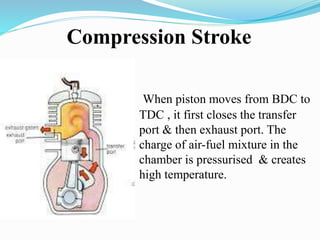
Compression Stroke 
When piston moves from BDC to 
TDC , it first closes the transfer 
port & then exhaust port. The 
charge of air-fuel mixture in the 
chamber is pressurised & creates 
high temperature.
At the same time a vacuum is developing in the crankcase, 
so the fresh charge is being drawn into the. As the piston 
moves towards TDC ,the diesel is added to the pressurised 
and high tempratured gas which in turn ignites the whole 
mixture inside the cylinder and forces the piston to move 
downwards.
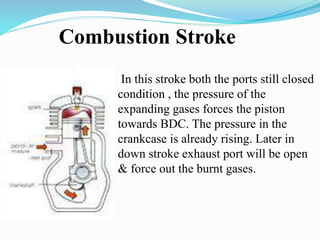
Combustion Stroke 
In this stroke both the ports still closed 
condition , the pressure of the 
expanding gases forces the piston 
towards BDC. The pressure in the 
crankcase is already rising. Later in 
down stroke exhaust port will be open 
& force out the burnt gases.
Very shortly after that the Inlet / Transfer port will 
also open to intake the fresh charge of fuel mixture 
and engine is ready to start of the cycle.
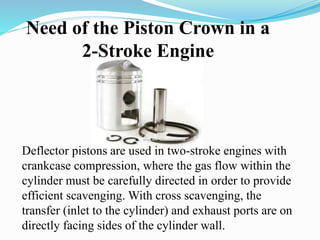
Need of the Piston Crown in a 
2-Stroke Engine 
Deflector pistons are used in two-stroke engines with 
crankcase compression, where the gas flow within the 
cylinder must be carefully directed in order to provide 
efficient scavenging. With cross scavenging, the 
transfer (inlet to the cylinder) and exhaust ports are on 
directly facing sides of the cylinder wall.
To prevent the incoming mixture passing straight across 
from one port to the other, the piston has a raised rib on its 
crown. This is intended to deflect the incoming mixture 
upwards, around the combustion chamber. Much effort, and 
many different designs of piston crown, went into 
developing improved scavenging. The crowns developed 
from a simple rib to a large asymmetric bulge, usually with a 
steep face on the inlet side and a gentle curve on the exhaust. 
Despite this, cross scavenging was never as effective as 
hoped. This places a pair of transfer ports in the sides of the 
cylinder and encourages gas flow to rotate around a vertical 
axis, rather than a horizontal axis.
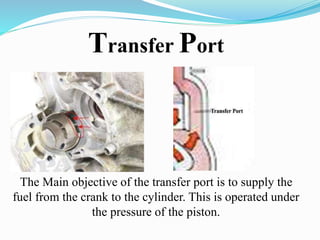
Transfer Port 
The Main objective of the transfer port is to supply the 
fuel from the crank to the cylinder. This is operated under 
the pressure of the piston.
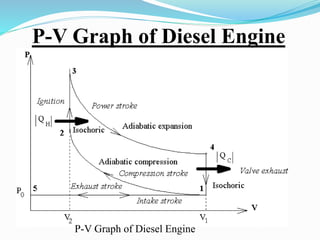
P-V Graph of Diesel Engine 
P-V Graph of Diesel Engine
Advantages & Disadvantages of 
Two Stroke Engine 
Advantages :- 
• One cycle completed in every revolution of crankshaft. 
• It is more compact , required less space and lighter in 
weight than four stroke engine. 
• The design & construction is much simpler than four 
stroke engine. 
• Easy to manufacture & low cost.
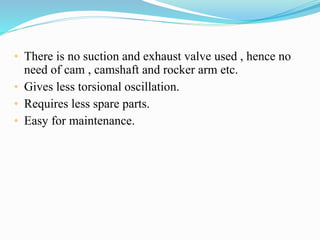
• There is no suction and exhaust valve used , hence no 
need of cam , camshaft and rocker arm etc. 
• Gives less torsional oscillation. 
• Requires less spare parts. 
• Easy for maintenance.
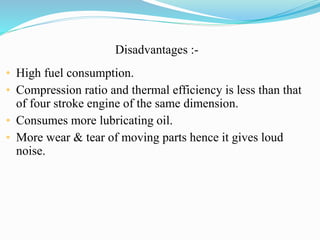
Disadvantages :- 
• High fuel consumption. 
• Compression ratio and thermal efficiency is less than that 
of four stroke engine of the same dimension. 
• Consumes more lubricating oil. 
• More wear & tear of moving parts hence it gives loud 
noise.
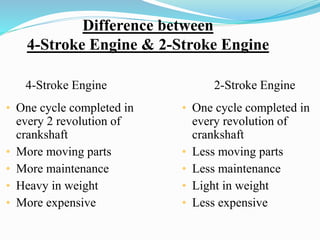
Difference between 
4-Stroke Engine & 2-Stroke Engine 
4-Stroke Engine 2-Stroke Engine 
• One cycle completed in 
every 2 revolution of 
crankshaft 
• More moving parts 
• More maintenance 
• Heavy in weight 
• More expensive 
• One cycle completed in 
every revolution of 
crankshaft 
• Less moving parts 
• Less maintenance 
• Light in weight 
• Less expensive
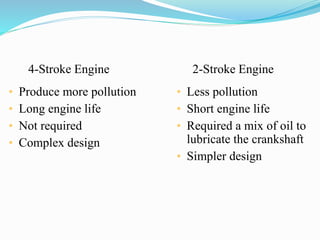
4-Stroke Engine 2-Stroke Engine 
• Produce more pollution 
• Long engine life 
• Not required 
• Complex design 
• Less pollution 
• Short engine life 
• Required a mix of oil to 
lubricate the crankshaft 
• Simpler design
Diesel engine Powerpoint

Diesel engine Powerpoint

  • 1.
  • 2.
    Made By:- VedantDave(140120119247) Vivek Verma(140120119248) Guided By:- Mr. Aditya Singh
  • 3.
    History The firstperson to build a working four-stroke engine, a stationary engine using a coal gas-air mixture for fuel (a gas engine), was German engineer Dr. Nikolaus Otto. This is why the four-stroke principle today is commonly known as the Otto cycle and four-stroke engines using spark plugs often are called Otto engines. Otto Cycle: Dr. Nicolaus Otto -1876
  • 4.
    2-Stroke Diesel Engine Sir Dugald Clerk KBE, FRS (1854, Glasgow – 1932, Ewhurst, Surrey) was a Scottish engineer who designed the world's first successful two-stroke engine in 1878 and patented it in England in 1881. 2-Cycle Engine; Du gal Clerk -1878
  • 5.
    4-Stroke Diesel Engine Rudolf Christian Karl Diesel (March 18, 1858 – September 29, 1913) was a German inventor and mechanical engineer, famous for the invention of the 4-stroke diesel engine. Diesel Engine - Dr. Rudolph Diesel -1895
  • 6.
    Four Stroke DieselEngine Four stroke engine was first demonstrate by Nikolaus Otto in 1876,hence it is also known as Otto cycle. It consist of 4 stroke ,one cycle operation is completed in 4 stroke of the piston, That is one cycle is completed in every 2 revolutions of the crankshaft. Each stroke consist of 180°,of crankshaft rotation and hence a cycle consist of 720°,of crankshaft rotation.
  • 7.
    Labelled Diagram ofa 4-Stroke Engine
  • 8.
    Working of FourStroke Diesel Engine Following are the four strokes:- 1 – Intake/Suction stroke 2 – Compression stroke 3 – Expansion stroke 4 – Exhaust stroke
  • 9.
    1. Intake Stroke In suction stroke piston starts at Top Dead Center (TDC) of the cylinder and moves to the Bottom Dead Center (BDC). Outlet valve will be closed and inlet valve will be open to allowing the fresh charge of mixed fuel & air into the cylinder.
  • 10.
    2 . Compressionstroke In compression stroke, Once piston reaches BDC & moves back TDC, inlet valve will be closed. As the piston moves towards TDC. It compress air inside the cylinder & compression takes place. Hence it is called compression stroke.
  • 11.
    3. Power Stroke In expansion stroke, Both the valves are closed. When piston reaches top of its stroke. the fuel is sprinkled by the Fuel Injector and the fuel mixture is ignited due to high temperature & pressure generated inside the cylinder & push down the piston to BDC. Hence it is known as Power or expansion stroke. The Power generated in this stroke is stored in the flywheel for its furthur utilisation in the other strokes.
  • 12.
    4. Exhaust stroke In this stroke exhaust valve is opened when piston reaches to BDC & moves to upward. Piston pushes out the burnt gases to the atmosphere through the exhaust valve. Hence called exhaust stroke & the engine is ready to begin the cycle again.
  • 13.
    Two Stroke DieselEngine Two stroke engine is first described by Du gal Clerk in 1878.In two stroke engine one cycle is completed in every revolution of crankshaft.
  • 14.
    Working of TwoStroke Engine Two stroke engine is widely used employed where small power required for motor cycle like auto rickshaw, scooter. This type of engine is compact in size , easy for manufacturing and simple in operation. In two stroke engine there are no inlet or exhaust valve as in four stroke engine.
  • 15.
    A two-stroke, ortwo-cycle, engine is a type of internal combustion engine which completes a power cycle in only one crankshaft revolution and with two strokes, or up and down movements, of the piston in comparison to a "four-stroke engine", which uses four strokes. This is accomplished by the end of the combustion stroke and the beginning of the compression stroke happening simultaneously and performing the intake and exhaust (or scavenging) functions at the same time. Two-stroke engines often provide high power-to-weight ratio, usually in a narrow range of rotational speeds called the "power band". Compared to 4-stroke engines, they have a greatly reduced number of moving parts, are more compact and significantly lighter.
  • 16.
    Compression Stroke Whenpiston moves from BDC to TDC , it first closes the transfer port & then exhaust port. The charge of air-fuel mixture in the chamber is pressurised & creates high temperature.
  • 17.
    At the sametime a vacuum is developing in the crankcase, so the fresh charge is being drawn into the. As the piston moves towards TDC ,the diesel is added to the pressurised and high tempratured gas which in turn ignites the whole mixture inside the cylinder and forces the piston to move downwards.
  • 18.
    Combustion Stroke Inthis stroke both the ports still closed condition , the pressure of the expanding gases forces the piston towards BDC. The pressure in the crankcase is already rising. Later in down stroke exhaust port will be open & force out the burnt gases.
  • 19.
    Very shortly afterthat the Inlet / Transfer port will also open to intake the fresh charge of fuel mixture and engine is ready to start of the cycle.
  • 20.
    Need of thePiston Crown in a 2-Stroke Engine Deflector pistons are used in two-stroke engines with crankcase compression, where the gas flow within the cylinder must be carefully directed in order to provide efficient scavenging. With cross scavenging, the transfer (inlet to the cylinder) and exhaust ports are on directly facing sides of the cylinder wall.
  • 21.
    To prevent theincoming mixture passing straight across from one port to the other, the piston has a raised rib on its crown. This is intended to deflect the incoming mixture upwards, around the combustion chamber. Much effort, and many different designs of piston crown, went into developing improved scavenging. The crowns developed from a simple rib to a large asymmetric bulge, usually with a steep face on the inlet side and a gentle curve on the exhaust. Despite this, cross scavenging was never as effective as hoped. This places a pair of transfer ports in the sides of the cylinder and encourages gas flow to rotate around a vertical axis, rather than a horizontal axis.
  • 22.
    Transfer Port TheMain objective of the transfer port is to supply the fuel from the crank to the cylinder. This is operated under the pressure of the piston.
  • 23.
    P-V Graph ofDiesel Engine P-V Graph of Diesel Engine
  • 24.
    Advantages & Disadvantagesof Two Stroke Engine Advantages :- • One cycle completed in every revolution of crankshaft. • It is more compact , required less space and lighter in weight than four stroke engine. • The design & construction is much simpler than four stroke engine. • Easy to manufacture & low cost.
  • 25.
    • There isno suction and exhaust valve used , hence no need of cam , camshaft and rocker arm etc. • Gives less torsional oscillation. • Requires less spare parts. • Easy for maintenance.
  • 26.
    Disadvantages :- •High fuel consumption. • Compression ratio and thermal efficiency is less than that of four stroke engine of the same dimension. • Consumes more lubricating oil. • More wear & tear of moving parts hence it gives loud noise.
  • 27.
    Difference between 4-StrokeEngine & 2-Stroke Engine 4-Stroke Engine 2-Stroke Engine • One cycle completed in every 2 revolution of crankshaft • More moving parts • More maintenance • Heavy in weight • More expensive • One cycle completed in every revolution of crankshaft • Less moving parts • Less maintenance • Light in weight • Less expensive
  • 28.
    4-Stroke Engine 2-StrokeEngine • Produce more pollution • Long engine life • Not required • Complex design • Less pollution • Short engine life • Required a mix of oil to lubricate the crankshaft • Simpler design