

THERMO
STRUCTURAL
DESIGN OF A FOUR
STROKE IC ENGINE
JJ Technical Solutions
www.mechieprojects.com
Presentation Outline
 Introduction
 Aim
 Literature Review
 Problem Formulation
 Scheme of Implementation
 Progress Made
 References
www.mechieprojects.co
m
www.mechieprojects.com
AIM
The aim of the study is to understand the effect of the shape of an IC Engine
Piston on its structural strength and the fins parameters effect viz. shape,
material, heat transfer coefficient etc. on the rate of heat transfer from the fins,
using FEA package Ansys 14.0.
An existing 4 stroke, Spark Ignition, air cooled IC engine (Bajaj Pulsar 150cc)
is modeled and optimize its piston design & fin geometry by varying the
following design parameters:
 Effect of piston shape and material on the stresses developed in the piston.
 Optimization of piston crown design and comparison with analytical results.
 Study the effect of fin geometry, pitch and shape on the rate of heat transfer.
 Optimize the fin design for rate of heat transfer and weight of fin.
www.mechieprojects.co
www.mechieprojects.com
LITERATURE REVIEW
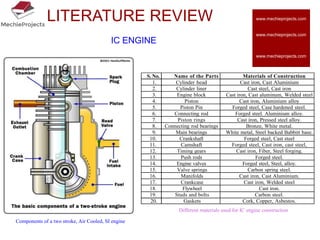
S. No. Name of the Parts Materials of Construction
1. Cylinder head Cast iron, Cast Aluminium
2. Cylinder liner Cast steel, Cast iron
3. Engine block Cast iron, Cast aluminum, Welded steel
4. Piston Cast iron, Aluminium alloy
5. Piston Pin Forged steel, Case hardened steel.
6. Connecting rod Forged steel. Aluminium alloy.
7. Piston rings Cast iron, Pressed steel alloy.
8. Connecting rod bearings Bronze, White metal.
9. Main bearings White metal, Steel backed Babbitt base.
10. Crankshaft Forged steel, Cast steel
11. Camshaft Forged steel, Cast iron, cast steel,
12. Timing gears Cast iron, Fiber, Steel forging.
13. Push rods Forged steel.
14. Engine valves Forged steel, Steel, alloy.
15. Valve springs Carbon spring steel.
16. Manifolds Cast iron, Cast Aluminium.
17. Crankcase Cast iron, Welded steel
18. Flywheel Cast iron.
19. Studs and bolts Carbon steel.
20. Gaskets Cork, Copper, Asbestos.
Different materials used for IC engine construction
Components of a two stroke, Air Cooled, SI engine
IC ENGINE
www.mechieprojects.com
LITERATURE REVIEW….
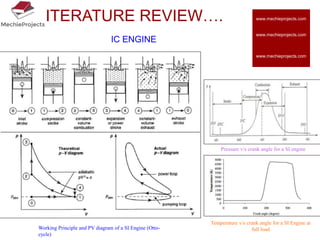
Pressure v/s crank angle for a SI engine
Temperature v/s crank angle for a SI Engine at
full loadWorking Principle and PV diagram of a SI Engine (Otto-
cycle)
IC ENGINE
www.mechieprojects.com
Piston in an IC engine must possess the following
characteristics:
1. Strength to resist gas pressure and inertia forces.
2. Must have minimum weight to minimize the inertia
forces.
3. Must be able to reciprocate with minimum noise.
4. Must have sufficient bearing area to prevent wear.
5. Must seal the gas from top and oil from the bottom.
6. Must disperse the heat generated during
combustion.
7. Must have good resistance to distortion under heavy
forces and heavy temperature.
LITERATURE REVIEW….
The piston assembly consists of the head or crown, piston rings, skirt and Piston Pins.
Piston cross sectional view
PISTON
www.mechieprojects.com
LITERATURE REVIEW….
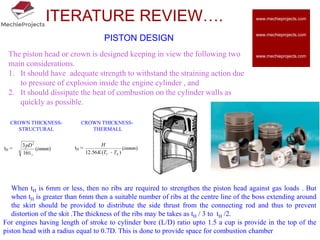
PISTON DESIGN
The piston head or crown is designed keeping in view the following two
main considerations.
1. It should have adequate strength to withstand the straining action due
to pressure of explosion inside the engine cylinder , and
2. It should dissipate the heat of combustion on the cylinder walls as
quickly as possible.
tH = )(
16
3 2
inmm
pD
ts
tH = )(
)(56.12
inmm
TTK
H
EC -
When tH is 6mm or less, then no ribs are required to strengthen the piston head against gas loads . But
when tH is greater than 6mm then a suitable number of ribs at the centre line of the boss extending around
the skirt should be provided to distribute the side thrust from the connecting rod and thus to prevent
distortion of the skit .The thickness of the ribs may be takes as tH / 3 to tH /2.
For engines having length of stroke to cylinder bore (L/D) ratio upto 1.5 a cup is provide in the top of the
piston head with a radius equal to 0.7D. This is done to provide space for combustion chamber
CROWN THICKNESS-
STRUCTURAL
CROWN THICKNESS-
THERMALL
www.mechieprojects.com
LITERATURE REVIEW….
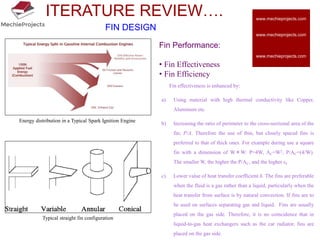
FIN DESIGN
Energy distribution in a Typical Spark Ignition Engine
Typical straight fin configuration
Fin Performance:
• Fin Effectiveness
• Fin Efficiency
Fin effectiveness is enhanced by:
a) Using material with high thermal conductivity like Copper,
Aluminum etc.
b) Increasing the ratio of perimeter to the cross-sectional area of the
fin; P/A. Therefore the use of thin, but closely spaced fins is
preferred to that of thick ones. For example during use a square
fin with a dimension of W×W: P=4W, AC=W2, P/AC=(4/W).
The smaller W, the higher the P/AC, and the higher f.
c) Lower value of heat transfer coefficient h. The fins are preferable
when the fluid is a gas rather than a liquid, particularly when the
heat transfer from surface is by natural convection. If fins are to
be used on surfaces separating gas and liquid. Fins are usually
placed on the gas side. Therefore, it is no coincidence that in
liquid-to-gas heat exchangers such as the car radiator, fins are
placed on the gas side.
www.mechieprojects.com
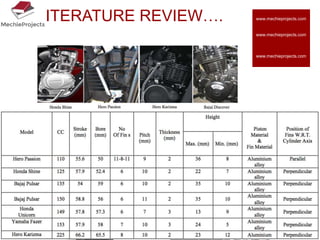
LITERATURE REVIEW…. www.mechieprojects.com
www.mechieprojects.com
PROBLEM
FORMULATION
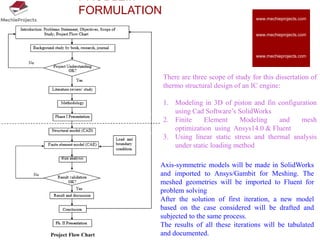
There are three scope of study for this dissertation of
thermo structural design of an IC engine:
1. Modeling in 3D of piston and fin configuration
using Cad Software’s SolidWorks
2. Finite Element Modeling and mesh
optimization using Ansys14.0 & Fluent
3. Using linear static stress and thermal analysis
under static loading method
Axis-symmetric models will be made in SolidWorks
and imported to Ansys/Gambit for Meshing. The
meshed geometries will be imported to Fluent for
problem solving
After the solution of first iteration, a new model
based on the case considered will be drafted and
subjected to the same process.
The results of all these iterations will be tabulated
and documented.Project Flow Chart
www.mechieprojects.com
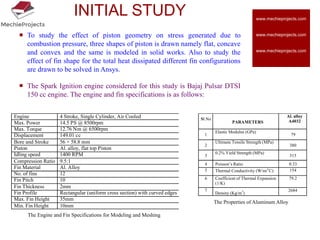
INITIAL STUDY
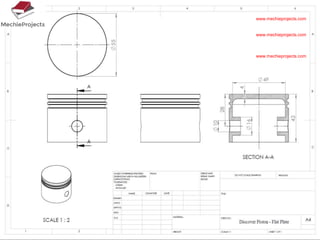
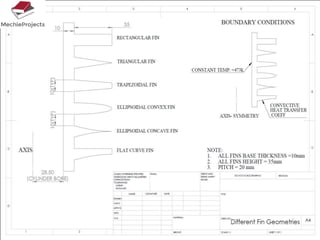
 To study the effect of piston geometry on stress generated due to
combustion pressure, three shapes of piston is drawn namely flat, concave
and convex and the same is modeled in solid works. Also to study the
effect of fin shape for the total heat dissipated different fin configurations
are drawn to be solved in Ansys.
 The Spark Ignition engine considered for this study is Bajaj Pulsar DTSI
150 cc engine. The engine and fin specifications is as follows:
Engine 4 Stroke, Single Cylinder, Air Cooled
Max. Power 14.5 PS @ 8500rpm
Max. Torque 12.76 Nm @ 6500rpm
Displacement 149.01 cc
Bore and Stroke 56 × 58.8 mm
Piston Al. alloy, flat top Piston
Idling speed 1400 RPM
Compression Ratio 9.5:1
Fin Material Al. Alloy
No. of fins 12
Fin Pitch 10
Fin Thickness 2mm
Fin Profile Rectangular (uniform cross section) with curved edges
Max. Fin Height 35mm
Min. Fin Height 10mm
Sl.No
PARAMETERS
Al. alloy
A4032
1
Elastic Modulus (GPa)
79
2
Ultimate Tensile Strength (MPa)
380
3
0.2% Yield Strength (MPa)
315
4 Poisson’s Ratio 0.33
5 Thermal Conductivity (W/m/
o
C) 154
6 Coefficient of Thermal Expansion
(1/K)
79.2
7
Density (Kg/m3
)
2684
The Properties of Aluminum Alloy
The Engine and Fin Specifications for Modeling and Meshing
www.mechieprojects.com
REFERENCES
[1] Heat and Mass Transfer by R.K. Rajput (2007)
[2] Isam Jasim Jaber and Ajeet Kumar Rai, “Design and Analysis of IC
Engine Piston and Piston-Ring Using CATIA and ANSYS Software”,
IJMET, Vol.5, 2014.
[3] J.C.Sanders, et al. (1942). Cooling test of an air-cooled engine cylinder
with copper fins on the barrel, NACA Report E-103
[4] Thermal Engineering by Rudramoorthy.
[5] P. Agarwal, et al. (2011). Heat Transfer Simulation by CFD from Fins of
an Air Cooled Motorcycle Engine under Varying Climatic Conditions.
Proceedings of the World Congress on Engineering.
[6] J.A. Paul, et al. (2012). "Experimental and Parametric Study of Extended
Fins in the Optimization of Internal Combustion Engine Cooling Using
CFD." International Journal of Applied Research in Mechanical
Engineering (IJARME) 2(1).
[7] Heat Transfer by PK Nag.
[8] D.G.Kumbhar, et al. (2009). Finite Element Analysis and Experimental
Study of Convective Heat Transfer Augmentation from Horizontal
Rectangular Fin by Triangular Perforations. Proc. of the International
Conference on Advances in Mechanical Engineering.
[9] Denpong Soodphakdee, et al. (2001). "A Comparison of Fin Geometries for
Heatsinks in Laminar Forced Convection Part 1 - Round, Elliptical, and
Plate Fins in Staggered and In-Line Configurations." The International
Journal of Microcircuits and Electronic Packaging 24(1).
[10] Biermann, A. E. and B. Pinkel (1934). Heat Transfer from finned metal
cylinders in an air stream, NACA Report No.488
[11] Shigley, Mechanical Engineering Design, 9
th
editions, McGraw-Hill.
[12] Ajay Raj Singh et al. (2014) “ Design Analysis and Optimisation of three
Aluminium piston alloy using FEA”. IJERA Vol. 4, Issue 1, 2014.
[13] Aditya Kumar Gupta et. al. (2014) “ Design Analysis and Optimisation of IC
engine piston using CAE tool ANSYS”. IJERA, Vol4, Issue 11, 2014.
www.mechieprojects.com

IC Engine Piston Design

  • 1.
    THERMO STRUCTURAL DESIGN OF AFOUR STROKE IC ENGINE JJ Technical Solutions www.mechieprojects.com
  • 2.
    Presentation Outline  Introduction Aim  Literature Review  Problem Formulation  Scheme of Implementation  Progress Made  References www.mechieprojects.co m www.mechieprojects.com www.mechieprojects.com www.mechieprojects.com
  • 3.
    AIM The aim ofthe study is to understand the effect of the shape of an IC Engine Piston on its structural strength and the fins parameters effect viz. shape, material, heat transfer coefficient etc. on the rate of heat transfer from the fins, using FEA package Ansys 14.0. An existing 4 stroke, Spark Ignition, air cooled IC engine (Bajaj Pulsar 150cc) is modeled and optimize its piston design & fin geometry by varying the following design parameters:  Effect of piston shape and material on the stresses developed in the piston.  Optimization of piston crown design and comparison with analytical results.  Study the effect of fin geometry, pitch and shape on the rate of heat transfer.  Optimize the fin design for rate of heat transfer and weight of fin. www.mechieprojects.co www.mechieprojects.com www.mechieprojects.com www.mechieprojects.com
  • 4.
    LITERATURE REVIEW S. No.Name of the Parts Materials of Construction 1. Cylinder head Cast iron, Cast Aluminium 2. Cylinder liner Cast steel, Cast iron 3. Engine block Cast iron, Cast aluminum, Welded steel 4. Piston Cast iron, Aluminium alloy 5. Piston Pin Forged steel, Case hardened steel. 6. Connecting rod Forged steel. Aluminium alloy. 7. Piston rings Cast iron, Pressed steel alloy. 8. Connecting rod bearings Bronze, White metal. 9. Main bearings White metal, Steel backed Babbitt base. 10. Crankshaft Forged steel, Cast steel 11. Camshaft Forged steel, Cast iron, cast steel, 12. Timing gears Cast iron, Fiber, Steel forging. 13. Push rods Forged steel. 14. Engine valves Forged steel, Steel, alloy. 15. Valve springs Carbon spring steel. 16. Manifolds Cast iron, Cast Aluminium. 17. Crankcase Cast iron, Welded steel 18. Flywheel Cast iron. 19. Studs and bolts Carbon steel. 20. Gaskets Cork, Copper, Asbestos. Different materials used for IC engine construction Components of a two stroke, Air Cooled, SI engine IC ENGINE www.mechieprojects.com www.mechieprojects.com www.mechieprojects.com
  • 5.
    LITERATURE REVIEW…. Pressure v/scrank angle for a SI engine Temperature v/s crank angle for a SI Engine at full loadWorking Principle and PV diagram of a SI Engine (Otto- cycle) IC ENGINE www.mechieprojects.com www.mechieprojects.com www.mechieprojects.com
  • 6.
    Piston in anIC engine must possess the following characteristics: 1. Strength to resist gas pressure and inertia forces. 2. Must have minimum weight to minimize the inertia forces. 3. Must be able to reciprocate with minimum noise. 4. Must have sufficient bearing area to prevent wear. 5. Must seal the gas from top and oil from the bottom. 6. Must disperse the heat generated during combustion. 7. Must have good resistance to distortion under heavy forces and heavy temperature. LITERATURE REVIEW…. The piston assembly consists of the head or crown, piston rings, skirt and Piston Pins. Piston cross sectional view PISTON www.mechieprojects.com www.mechieprojects.com www.mechieprojects.com
  • 7.
    LITERATURE REVIEW…. PISTON DESIGN Thepiston head or crown is designed keeping in view the following two main considerations. 1. It should have adequate strength to withstand the straining action due to pressure of explosion inside the engine cylinder , and 2. It should dissipate the heat of combustion on the cylinder walls as quickly as possible. tH = )( 16 3 2 inmm pD ts tH = )( )(56.12 inmm TTK H EC - When tH is 6mm or less, then no ribs are required to strengthen the piston head against gas loads . But when tH is greater than 6mm then a suitable number of ribs at the centre line of the boss extending around the skirt should be provided to distribute the side thrust from the connecting rod and thus to prevent distortion of the skit .The thickness of the ribs may be takes as tH / 3 to tH /2. For engines having length of stroke to cylinder bore (L/D) ratio upto 1.5 a cup is provide in the top of the piston head with a radius equal to 0.7D. This is done to provide space for combustion chamber CROWN THICKNESS- STRUCTURAL CROWN THICKNESS- THERMALL www.mechieprojects.com www.mechieprojects.com www.mechieprojects.com
  • 8.
    LITERATURE REVIEW…. FIN DESIGN Energydistribution in a Typical Spark Ignition Engine Typical straight fin configuration Fin Performance: • Fin Effectiveness • Fin Efficiency Fin effectiveness is enhanced by: a) Using material with high thermal conductivity like Copper, Aluminum etc. b) Increasing the ratio of perimeter to the cross-sectional area of the fin; P/A. Therefore the use of thin, but closely spaced fins is preferred to that of thick ones. For example during use a square fin with a dimension of W×W: P=4W, AC=W2, P/AC=(4/W). The smaller W, the higher the P/AC, and the higher f. c) Lower value of heat transfer coefficient h. The fins are preferable when the fluid is a gas rather than a liquid, particularly when the heat transfer from surface is by natural convection. If fins are to be used on surfaces separating gas and liquid. Fins are usually placed on the gas side. Therefore, it is no coincidence that in liquid-to-gas heat exchangers such as the car radiator, fins are placed on the gas side. www.mechieprojects.com www.mechieprojects.com www.mechieprojects.com
  • 9.
  • 10.
    PROBLEM FORMULATION There are threescope of study for this dissertation of thermo structural design of an IC engine: 1. Modeling in 3D of piston and fin configuration using Cad Software’s SolidWorks 2. Finite Element Modeling and mesh optimization using Ansys14.0 & Fluent 3. Using linear static stress and thermal analysis under static loading method Axis-symmetric models will be made in SolidWorks and imported to Ansys/Gambit for Meshing. The meshed geometries will be imported to Fluent for problem solving After the solution of first iteration, a new model based on the case considered will be drafted and subjected to the same process. The results of all these iterations will be tabulated and documented.Project Flow Chart www.mechieprojects.com www.mechieprojects.com www.mechieprojects.com
  • 11.
    INITIAL STUDY  Tostudy the effect of piston geometry on stress generated due to combustion pressure, three shapes of piston is drawn namely flat, concave and convex and the same is modeled in solid works. Also to study the effect of fin shape for the total heat dissipated different fin configurations are drawn to be solved in Ansys.  The Spark Ignition engine considered for this study is Bajaj Pulsar DTSI 150 cc engine. The engine and fin specifications is as follows: Engine 4 Stroke, Single Cylinder, Air Cooled Max. Power 14.5 PS @ 8500rpm Max. Torque 12.76 Nm @ 6500rpm Displacement 149.01 cc Bore and Stroke 56 × 58.8 mm Piston Al. alloy, flat top Piston Idling speed 1400 RPM Compression Ratio 9.5:1 Fin Material Al. Alloy No. of fins 12 Fin Pitch 10 Fin Thickness 2mm Fin Profile Rectangular (uniform cross section) with curved edges Max. Fin Height 35mm Min. Fin Height 10mm Sl.No PARAMETERS Al. alloy A4032 1 Elastic Modulus (GPa) 79 2 Ultimate Tensile Strength (MPa) 380 3 0.2% Yield Strength (MPa) 315 4 Poisson’s Ratio 0.33 5 Thermal Conductivity (W/m/ o C) 154 6 Coefficient of Thermal Expansion (1/K) 79.2 7 Density (Kg/m3 ) 2684 The Properties of Aluminum Alloy The Engine and Fin Specifications for Modeling and Meshing www.mechieprojects.com www.mechieprojects.com www.mechieprojects.com
  • 12.
  • 14.
    REFERENCES [1] Heat andMass Transfer by R.K. Rajput (2007) [2] Isam Jasim Jaber and Ajeet Kumar Rai, “Design and Analysis of IC Engine Piston and Piston-Ring Using CATIA and ANSYS Software”, IJMET, Vol.5, 2014. [3] J.C.Sanders, et al. (1942). Cooling test of an air-cooled engine cylinder with copper fins on the barrel, NACA Report E-103 [4] Thermal Engineering by Rudramoorthy. [5] P. Agarwal, et al. (2011). Heat Transfer Simulation by CFD from Fins of an Air Cooled Motorcycle Engine under Varying Climatic Conditions. Proceedings of the World Congress on Engineering. [6] J.A. Paul, et al. (2012). "Experimental and Parametric Study of Extended Fins in the Optimization of Internal Combustion Engine Cooling Using CFD." International Journal of Applied Research in Mechanical Engineering (IJARME) 2(1). [7] Heat Transfer by PK Nag. [8] D.G.Kumbhar, et al. (2009). Finite Element Analysis and Experimental Study of Convective Heat Transfer Augmentation from Horizontal Rectangular Fin by Triangular Perforations. Proc. of the International Conference on Advances in Mechanical Engineering. [9] Denpong Soodphakdee, et al. (2001). "A Comparison of Fin Geometries for Heatsinks in Laminar Forced Convection Part 1 - Round, Elliptical, and Plate Fins in Staggered and In-Line Configurations." The International Journal of Microcircuits and Electronic Packaging 24(1). [10] Biermann, A. E. and B. Pinkel (1934). Heat Transfer from finned metal cylinders in an air stream, NACA Report No.488 [11] Shigley, Mechanical Engineering Design, 9 th editions, McGraw-Hill. [12] Ajay Raj Singh et al. (2014) “ Design Analysis and Optimisation of three Aluminium piston alloy using FEA”. IJERA Vol. 4, Issue 1, 2014. [13] Aditya Kumar Gupta et. al. (2014) “ Design Analysis and Optimisation of IC engine piston using CAE tool ANSYS”. IJERA, Vol4, Issue 11, 2014. www.mechieprojects.com www.mechieprojects.com www.mechieprojects.com