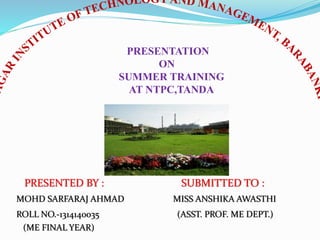
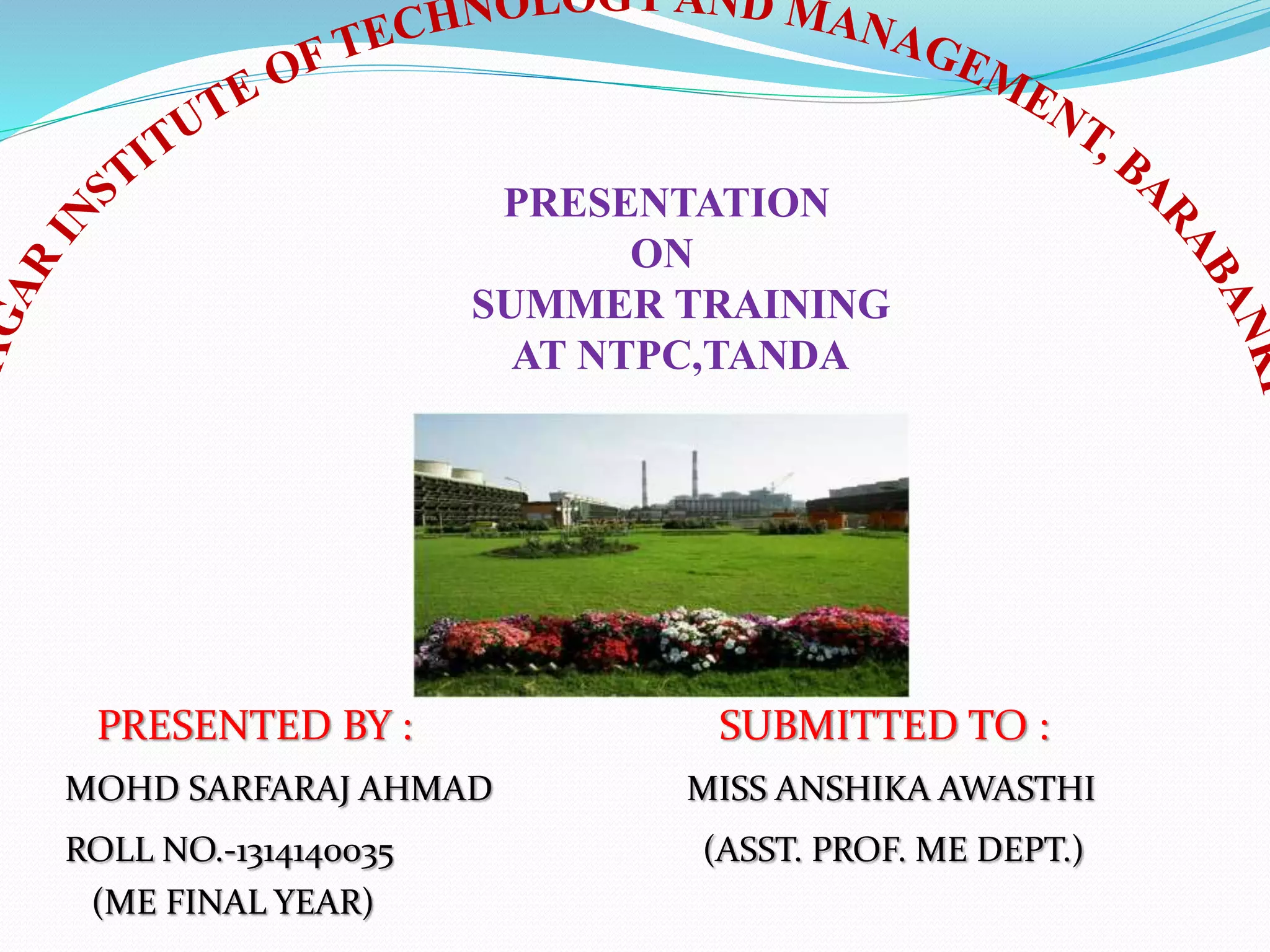
The document provides details about a presentation on summer training at NTPC Tanda power plant. It discusses that NTPC is the largest power company in India. It then summarizes information about NTPC Tanda power plant including its capacity, sources, main departments like coal handling plant, boiler, turbine, and generator. It also mentions advantages like low cost of fuel and disadvantages like atmospheric pollution of thermal power plants.
ABOUT NTPC
• NTPCis the largest power generating company in india, was set up
in 1975 to accelerate power development in the country.
• NTPC has installed capacity of (43803 MW).
• NTPC has 16 coal based power stations (31182 MW).
• NTPC has 7 gas based power stations (4017 MW).
• NTPC has 7 power stations in joint ventures (8604 MW).
• In 1997 , Government of india granted NTPC status of ‘Navratna’.
3.
CONTENT
About NTPCTanda
Capacity of Plant
Sources of Plant
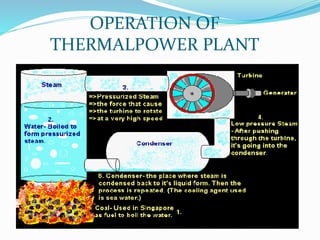
Operation of Thermo Power Plant
Main Department of Plant
Coal Handling Plant
Boiler
Super Heater
Turbine Generator
Condenser
Cooling Tower
Utilization of Secondary Raw Material
Advantages
Disadvantages
4.
ABOUT NTPC, TANDA
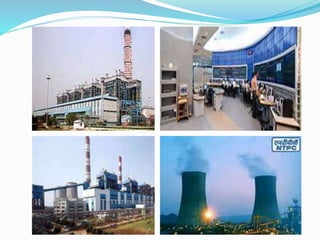
•Tanda Thermal Power Station is located in Ambedkar Nagar district
in the Indian state of Uttar Pradesh. The power plant is one of the
coal based power plants of NTPC.
• In the year 2000, Uttar Pradesh State Electricity Board (U.P.S.E.B.)
transferred Tanda Thermal Power Plant to NTPC Limited against
payment overdue.
• After that this plant, because of the better maintenance by NTPC
Limited, this power plant has crossed its Plant Load Factor (P.L.F.) to
more than 100%.
6.
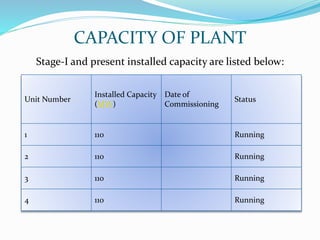
CAPACITY OF PLANT
Stage-Iand present installed capacity are listed below:
Unit Number
Installed Capacity
(MW)
Date of
Commissioning
Status
1 110 Running
2 110 Running
3 110 Running
4 110 Running
7.
CPACITY OF PLANT
ForStage-II, NTPC Limited has started
construction/installation of two new units of 660 MWs each
Unit Number
Commissioned
Capacity (MW)
Date of
Commissioning
Status
5 660
Under
Construction
6 660
Under
Construction
Stage-I : 4x110 MWs = 440 MWs (Current Power Generation)
Stage-II : 660 MW + 660 MW = 1320 MW
Total Power Generation (After completion of Stage-II): 1720 MWs
8.
COAL SOURCE
NorthKarnpura Coal Fields
• WATER SOURCE
Saryu River
SOURCES OF
PLANT
COAL HANDLING PLANT
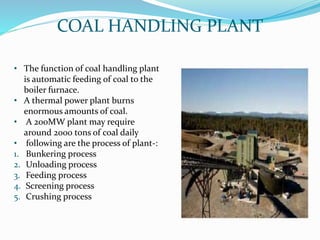
•The function of coal handling plant
is automatic feeding of coal to the
boiler furnace.
• A thermal power plant burns
enormous amounts of coal.
• A 200MW plant may require
around 2000 tons of coal daily
• following are the process of plant-:
1. Bunkering process
2. Unloading process
3. Feeding process
4. Screening process
5. Crushing process
12.
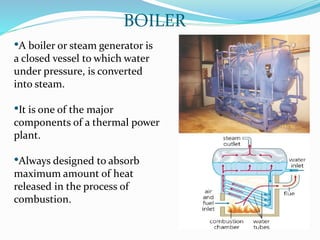
•A boiler orsteam generator is
a closed vessel to which water
under pressure, is converted
into steam.
•It is one of the major
components of a thermal power
plant.
•Always designed to absorb
maximum amount of heat
released in the process of
combustion.
BOILER
13.
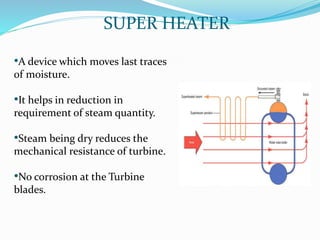
SUPER HEATER
•A devicewhich moves last traces
of moisture.
•It helps in reduction in
requirement of steam quantity.
•Steam being dry reduces the
mechanical resistance of turbine.
•No corrosion at the Turbine
blades.
14.
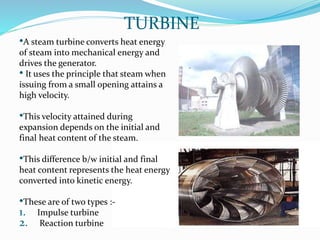
TURBINE
•A steam turbineconverts heat energy
of steam into mechanical energy and
drives the generator.
• It uses the principle that steam when
issuing from a small opening attains a
high velocity.
•This velocity attained during
expansion depends on the initial and
final heat content of the steam.
•This difference b/w initial and final
heat content represents the heat energy
converted into kinetic energy.
•These are of two types :-
1. Impulse turbine
2. Reaction turbine
15.
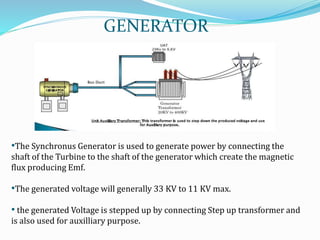
GENERATOR
•The Synchronus Generatoris used to generate power by connecting the
shaft of the Turbine to the shaft of the generator which create the magnetic
flux producing Emf.
•The generated voltage will generally 33 KV to 11 KV max.
• the generated Voltage is stepped up by connecting Step up transformer and
is also used for auxilliary purpose.
16.
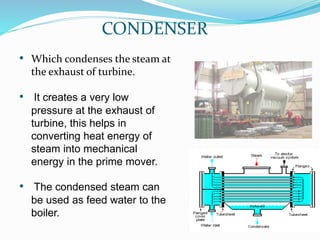
CONDENSER
• Which condensesthe steam at
the exhaust of turbine.
• It creates a very low
pressure at the exhaust of
turbine, this helps in
converting heat energy of
steam into mechanical
energy in the prime mover.
• The condensed steam can
be used as feed water to the
boiler.
17.
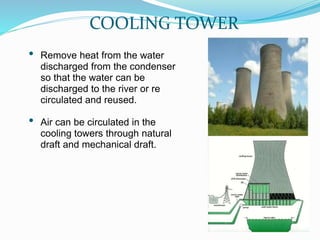
COOLING TOWER
• Removeheat from the water
discharged from the condenser
so that the water can be
discharged to the river or re
circulated and reused.
• Air can be circulated in the
cooling towers through natural
draft and mechanical draft.
18.
UTILISATION OF SECONDARY
RAWMATERIAL (ASH)
• Construction of embankments and fills
• Construction of road in sub-base
• Manufacture of cement
• Manufacture of bricks/blocks
• Filling as flowable fill material
• Agriculture as soil amendment/source of essential plant
nutrients
19.
ADVANTAGES
•The fuel usedis quite cheap.
•Less initial cost as compared to other generating plants.
•It can be installed at any place irrespective of the existence
of coal.
•The coal can be easily transported to the site
•It require less space as compared to Hydro power plants.
•Cost of generation is less than that of diesel power plants.
20.
DISADVANTAGES
•It pollutes theatmosphere due to production of large amount of
smoke and fumes.
•It is costlier in running cost as compared to Hydro electric
plants.
•Maintenance cost is more.