COOLING SYSTEM
Yo u c a n f i n d m e a t
ka u s h a l g a d a r i y a @ g m a i l . c o m
CONTENTS
 Introduction
 Effects of high temperature in the engine
 Purpose of cooling
 Types of cooling system
 Air cooling system & its components (merits & Demerits)
 Liquid cooling system & its components (merits &
Demerits)
 Coolant/Anti-freeze
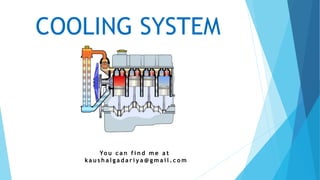
COOLING SYSTEM
 An automobile's cooling system is the collection of parts
and substances (coolants) that work together to maintain
the engine's temperature at optimal levels.
 Comprising many different components such as water pump,
coolant, a thermostat etc.
 The system enables smooth and efficient functioning of the
engine at the same time protecting it from damage
 The temperature produced on the power stroke of an
engine can be as high as 1600 degree and this is greater
than melting point of engine parts.
TRANSFORMATION OF FUEL ENERGY
35%
Exhaust
&
Cooling
35 %
Heat Dissipation
25-30 %
Mechanica
l
Work
4
Effects of high temperature in
the engine
 Due to high temperature, the piston would seized in
cylinder and stop the engine.
 Lubricating quality of the oil inside the cylinder would be
destroyed.
 Preignition of fuel mixture which cause engine knocking as
well as loss of power.
PURPOSE OF COOLING
 To maintain optimum temperature of an engine for
efficient operation under all conditions.
 To dissipate surplus heat for protection of engine
components like cylinder, cylinder head, piston, piston
ring and valves.
 To maintain the lubricating property of the oil inside the
engine cylinder for normal functioning of the engine.
TYPES OF COOLING
 In order to cool the engine a cooling medium is required.
On the basis of medium ,in general use for cooling I.C.
engine ,types of cooling system are:-
Air cooling system
Liquid or water cooling system
AIR COOLING SYSTEM
AIR COOLING SYSTEM
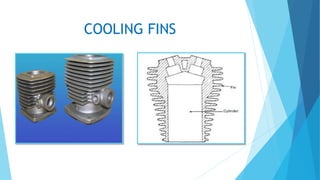
 Air cooled engines are those engines, in which heat is
conducted from the working components of the engine to
the atmosphere directly.
 The cylinder of an air cooled engine has fins to increase
the area of contact of air for speedy cooling.
 The amount of heat dissipated to air depends upon :
Amount of air flowing through the fins.
Fin surface area.
Thermal conductivity of metal used for fins.
COOLING FINS
MERITS & DEMERITS OF AIR
COOLING SYSTEM
 MERITS:
 It is more simple in design and construction
 Water jackets, radiators, water pumps, thermostat,
pipes, hoses etc. are not needed
 It is more compact
 It is comparatively lighter in weight
 DEMERITS:
 There is uneven cooling of engine parts
 Engine temperature is generally high during working
period
LIQUID COOLING SYSTEM
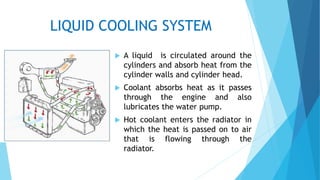
 A liquid is circulated around the
cylinders and absorb heat from the
cylinder walls and cylinder head.
 Coolant absorbs heat as it passes
through the engine and also
lubricates the water pump.
 Hot coolant enters the radiator in
which the heat is passed on to air
that is flowing through the
radiator.
Working principle of water-
cooled system.
MERITS AND DEMERITS OF LIQUID
COOLING SYSTEM
 MERITS:
 Uniform cooling of cylinder, cylinder head and valves
 Specific fuel consumption of engine improves by using water cooling
system
 If we employ water cooling system, then engine need may not be
provided at the front end of moving vehicle.
 Engine is less noisy as compared with air cooled engines, as it has water
for damping noise
 DEMERITS:
 It depends upon the supply of water
 If the water cooling system fails then it will result in severe damage of
engine
 The water cooling system is costlier as it has more number of parts
TYPES OF WATER COOLED SYSTEM
Open Jacket
System
Thermo syphon
Cooling System
Forced
Circulation
Cooling System
OPEN JACKET SYSTEM
This system is used where plenty of water is available.
The water is supplied from large tank or river through
the inlet valve of cooling water jacket.
The main specification of this system is that Hot water
is not cooled but simply discharged.
THERMOSYPHON COOLING SYSTEM
 The basic principle of this system is based upon the
relative density of the water.
 The main advantage of this system is it’s simplicity and
automatic circulation of cooling water.
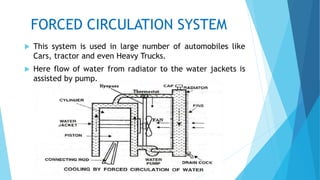
FORCED CIRCULATION SYSTEM
 This system is used in large number of automobiles like
Cars, tractor and even Heavy Trucks.
 Here flow of water from radiator to the water jackets is
assisted by pump.
• To supply the water forcely into the systemWATER PUMP
• To dissipates the heat from coolantRADIATOR
• To provide strong draft of air through the radiatorFAN
• Designed to keep engine block and cylinder head
cool.WATER JACKETS
• To control the flow of coolant, it opens at 70
degree and fully open at 82 degreeTHERMOSTAT VALVE
• To store the coolantSTORAGE TANK
COMPONENTS OF LIQUID COOLING
SYSTEM
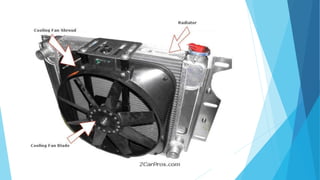
RADIATOR
 Radiators are heat
exchangers used to
transfer thermal
energy from one medium
to another for the purpose
of cooling and heating.
21
THERMOSTAT
VALVE
 Its job is to block the
flow of coolant to the
radiator until the engine
has warmed up.
Thermostat Closed Thermostat Open
When engine is cold When engine reaches the
specified temperature
WATER JACKETS
 Cooling water jackets are
provided around the
cylinder, cylinder head,
valve seats, and any hot
part which are to be
cooled. Heat generated in
the cylinder is conducted to
the Jacket.
ANTIFREEZE MIXTURE
 To prevent the freezing of cooling water in western
countries antifreeze mixture are added to the cooling
water
 There are the following type of antifreeze mixtures :-
Ethylene glycol
Propylene glycol
Organic acid technology (OAT)
Hybrid organic acid technology (HOAT)
Coolant/Anti-freeze
 Engine coolant is a mixture of water and
antifreeze/coolant.
 Water alone has a boiling point of 100°C and a freezing
point of 0°C at sea level.
 Engine coolant has a higher boiling temperature and a
lower freezing point than water.
 The exact boiling or freezing temperatures depend on
the mixture.
 The typical recommended mixture is a 50/50 solution of
water and antifreeze/coolant.
Engine Cooling system

Engine Cooling system

  • 1.
    COOLING SYSTEM Yo uc a n f i n d m e a t ka u s h a l g a d a r i y a @ g m a i l . c o m
  • 2.
    CONTENTS  Introduction  Effectsof high temperature in the engine  Purpose of cooling  Types of cooling system  Air cooling system & its components (merits & Demerits)  Liquid cooling system & its components (merits & Demerits)  Coolant/Anti-freeze
  • 3.
    COOLING SYSTEM  Anautomobile's cooling system is the collection of parts and substances (coolants) that work together to maintain the engine's temperature at optimal levels.  Comprising many different components such as water pump, coolant, a thermostat etc.  The system enables smooth and efficient functioning of the engine at the same time protecting it from damage  The temperature produced on the power stroke of an engine can be as high as 1600 degree and this is greater than melting point of engine parts.
  • 4.
    TRANSFORMATION OF FUELENERGY 35% Exhaust & Cooling 35 % Heat Dissipation 25-30 % Mechanica l Work 4
  • 5.
    Effects of hightemperature in the engine  Due to high temperature, the piston would seized in cylinder and stop the engine.  Lubricating quality of the oil inside the cylinder would be destroyed.  Preignition of fuel mixture which cause engine knocking as well as loss of power.
  • 6.
    PURPOSE OF COOLING To maintain optimum temperature of an engine for efficient operation under all conditions.  To dissipate surplus heat for protection of engine components like cylinder, cylinder head, piston, piston ring and valves.  To maintain the lubricating property of the oil inside the engine cylinder for normal functioning of the engine.
  • 7.
    TYPES OF COOLING In order to cool the engine a cooling medium is required. On the basis of medium ,in general use for cooling I.C. engine ,types of cooling system are:- Air cooling system Liquid or water cooling system
  • 8.
  • 9.
    AIR COOLING SYSTEM Air cooled engines are those engines, in which heat is conducted from the working components of the engine to the atmosphere directly.  The cylinder of an air cooled engine has fins to increase the area of contact of air for speedy cooling.  The amount of heat dissipated to air depends upon : Amount of air flowing through the fins. Fin surface area. Thermal conductivity of metal used for fins.
  • 10.
  • 11.
    MERITS & DEMERITSOF AIR COOLING SYSTEM  MERITS:  It is more simple in design and construction  Water jackets, radiators, water pumps, thermostat, pipes, hoses etc. are not needed  It is more compact  It is comparatively lighter in weight  DEMERITS:  There is uneven cooling of engine parts  Engine temperature is generally high during working period
  • 12.
  • 13.
    LIQUID COOLING SYSTEM A liquid is circulated around the cylinders and absorb heat from the cylinder walls and cylinder head.  Coolant absorbs heat as it passes through the engine and also lubricates the water pump.  Hot coolant enters the radiator in which the heat is passed on to air that is flowing through the radiator.
  • 14.
    Working principle ofwater- cooled system.
  • 15.
    MERITS AND DEMERITSOF LIQUID COOLING SYSTEM  MERITS:  Uniform cooling of cylinder, cylinder head and valves  Specific fuel consumption of engine improves by using water cooling system  If we employ water cooling system, then engine need may not be provided at the front end of moving vehicle.  Engine is less noisy as compared with air cooled engines, as it has water for damping noise  DEMERITS:  It depends upon the supply of water  If the water cooling system fails then it will result in severe damage of engine  The water cooling system is costlier as it has more number of parts
  • 16.
    TYPES OF WATERCOOLED SYSTEM Open Jacket System Thermo syphon Cooling System Forced Circulation Cooling System
  • 17.
    OPEN JACKET SYSTEM Thissystem is used where plenty of water is available. The water is supplied from large tank or river through the inlet valve of cooling water jacket. The main specification of this system is that Hot water is not cooled but simply discharged.
  • 18.
    THERMOSYPHON COOLING SYSTEM The basic principle of this system is based upon the relative density of the water.  The main advantage of this system is it’s simplicity and automatic circulation of cooling water.
  • 19.
    FORCED CIRCULATION SYSTEM This system is used in large number of automobiles like Cars, tractor and even Heavy Trucks.  Here flow of water from radiator to the water jackets is assisted by pump.
  • 20.
    • To supplythe water forcely into the systemWATER PUMP • To dissipates the heat from coolantRADIATOR • To provide strong draft of air through the radiatorFAN • Designed to keep engine block and cylinder head cool.WATER JACKETS • To control the flow of coolant, it opens at 70 degree and fully open at 82 degreeTHERMOSTAT VALVE • To store the coolantSTORAGE TANK COMPONENTS OF LIQUID COOLING SYSTEM
  • 21.
    RADIATOR  Radiators areheat exchangers used to transfer thermal energy from one medium to another for the purpose of cooling and heating. 21
  • 23.
    THERMOSTAT VALVE  Its jobis to block the flow of coolant to the radiator until the engine has warmed up.
  • 24.
    Thermostat Closed ThermostatOpen When engine is cold When engine reaches the specified temperature
  • 25.
    WATER JACKETS  Coolingwater jackets are provided around the cylinder, cylinder head, valve seats, and any hot part which are to be cooled. Heat generated in the cylinder is conducted to the Jacket.
  • 26.
    ANTIFREEZE MIXTURE  Toprevent the freezing of cooling water in western countries antifreeze mixture are added to the cooling water  There are the following type of antifreeze mixtures :- Ethylene glycol Propylene glycol Organic acid technology (OAT) Hybrid organic acid technology (HOAT)
  • 27.
    Coolant/Anti-freeze  Engine coolantis a mixture of water and antifreeze/coolant.  Water alone has a boiling point of 100°C and a freezing point of 0°C at sea level.  Engine coolant has a higher boiling temperature and a lower freezing point than water.  The exact boiling or freezing temperatures depend on the mixture.  The typical recommended mixture is a 50/50 solution of water and antifreeze/coolant.