Presented by
NIGHTFOX
Today my presentation on..
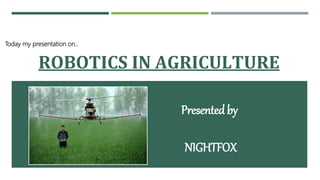
ROBOTICS IN AGRICULTURE
Robots
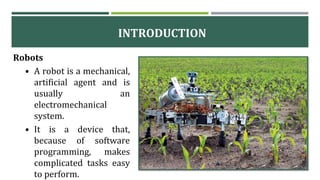
• A robot is a mechanical,
artificial agent and is
usually an
electromechanical
system.
• It is a device that,
because of software
programming, makes
complicated tasks easy
to perform.
INTRODUCTION
AGRICULTURAL ROBOTICS
 Applying automation to agriculture has helped create several
advancements to the industry while helping farmers save money
and time.
 Agricultural robotics is the use of automation in bio systems such
as agriculture, forestry, and fisheries.
 It is replacing the conventional techniques to perform the same
tasks, with efficiency.
DIFFERENCE BETWEEN AUTOMIZED AND
CONVENTIONAL TECHNIQUES
Conventional techniques depend on human power and old techniques
Robots can work non stop, humans need rest
Human may not be able to work in hazardous environments
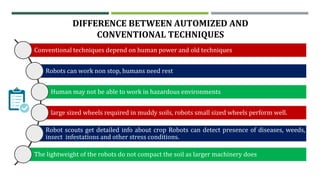
large sized wheels required in muddy soils, robots small sized wheels perform well.
Robot scouts get detailed info about crop Robots can detect presence of diseases, weeds,
insect infestations and other stress conditions.
The lightweight of the robots do not compact the soil as larger machinery does
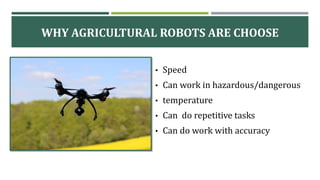
WHY AGRICULTURAL ROBOTS ARE CHOOSE
• Speed
• Can work in hazardous/dangerous
• temperature
• Can do repetitive tasks
• Can do work with accuracy
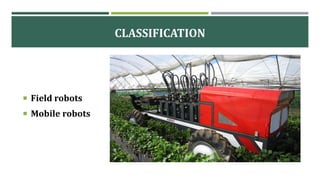
CLASSIFICATION
 Field robots
 Mobile robots
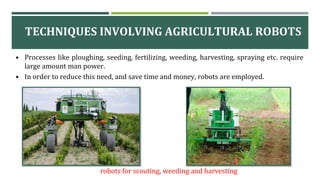
TECHNIQUES INVOLVING AGRICULTURAL ROBOTS
robots for scouting, weeding and harvesting
• Processes like ploughing, seeding, fertilizing, weeding, harvesting, spraying etc. require
large amount man power.
• In order to reduce this need, and save time and money, robots are employed.
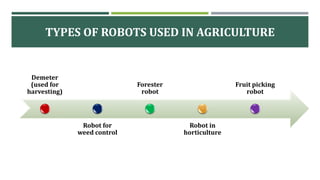
TYPES OF ROBOTS USED IN AGRICULTURE
Demeter
(used for
harvesting)
Robot for
weed control
Forester
robot
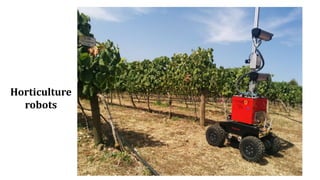
Robot in
horticulture
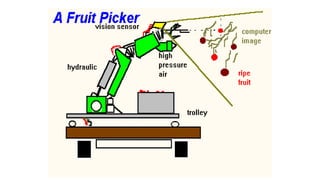
Fruit picking
robot
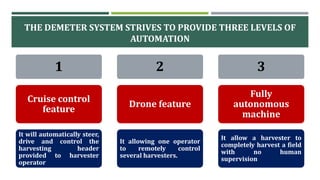
THE DEMETER SYSTEM STRIVES TO PROVIDE THREE LEVELS OF
AUTOMATION
1
Cruise control
feature
It will automatically steer,
drive and control the
harvesting header
provided to harvester
operator
2
Drone feature
It allowing one operator
to remotely control
several harvesters.
3
Fully
autonomous
machine
It allow a harvester to
completely harvest a field
with no human
supervision
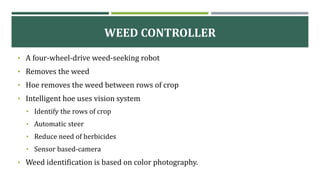
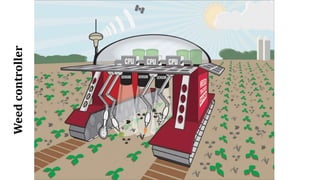
WEED CONTROLLER
• A four-wheel-drive weed-seeking robot
• Removes the weed
• Hoe removes the weed between rows of crop
• Intelligent hoe uses vision system
• Identify the rows of crop
• Automatic steer
• Reduce need of herbicides
• Sensor based-camera
• Weed identification is based on color photography.
Weedcontroller
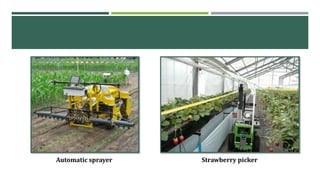
Automatic sprayer Strawberry picker
Horticulture
robots
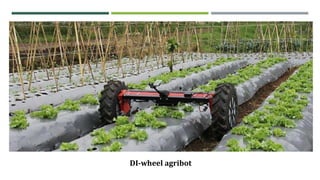
DI-wheel agribot
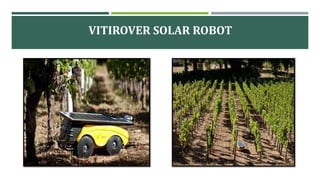
VITIROVER SOLAR ROBOT
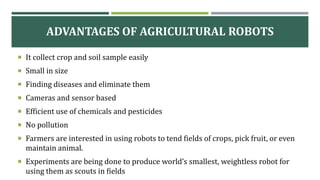
ADVANTAGES OF AGRICULTURAL ROBOTS
 It collect crop and soil sample easily
 Small in size
 Finding diseases and eliminate them
 Cameras and sensor based
 Efficient use of chemicals and pesticides
 No pollution
 Farmers are interested in using robots to tend fields of crops, pick fruit, or even
maintain animal.
 Experiments are being done to produce world’s smallest, weightless robot for
using them as scouts in fields
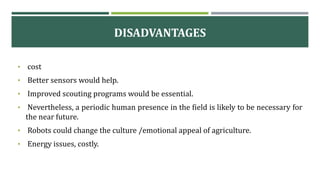
DISADVANTAGES
• cost
• Better sensors would help.
• Improved scouting programs would be essential.
• Nevertheless, a periodic human presence in the field is likely to be necessary for
the near future.
• Robots could change the culture /emotional appeal of agriculture.
• Energy issues, costly.
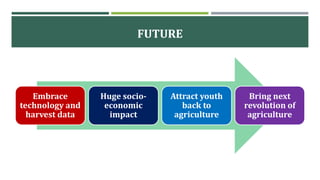
FUTURE
Embrace
technology and
harvest data
Huge socio-
economic
impact
Attract youth
back to
agriculture
Bring next
revolution of
agriculture
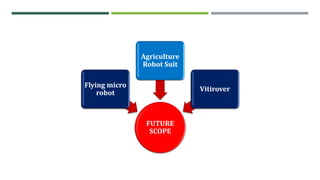
FUTURE
SCOPE
Flying micro
robot
Agriculture
Robot Suit
Vitirover
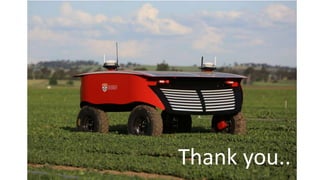
Thank you..

Robotics in agriculture kvg

  • 2.
    Presented by NIGHTFOX Today mypresentation on.. ROBOTICS IN AGRICULTURE
  • 3.
    Robots • A robotis a mechanical, artificial agent and is usually an electromechanical system. • It is a device that, because of software programming, makes complicated tasks easy to perform. INTRODUCTION
  • 4.
    AGRICULTURAL ROBOTICS  Applyingautomation to agriculture has helped create several advancements to the industry while helping farmers save money and time.  Agricultural robotics is the use of automation in bio systems such as agriculture, forestry, and fisheries.  It is replacing the conventional techniques to perform the same tasks, with efficiency.
  • 5.
    DIFFERENCE BETWEEN AUTOMIZEDAND CONVENTIONAL TECHNIQUES Conventional techniques depend on human power and old techniques Robots can work non stop, humans need rest Human may not be able to work in hazardous environments large sized wheels required in muddy soils, robots small sized wheels perform well. Robot scouts get detailed info about crop Robots can detect presence of diseases, weeds, insect infestations and other stress conditions. The lightweight of the robots do not compact the soil as larger machinery does
  • 6.
    WHY AGRICULTURAL ROBOTSARE CHOOSE • Speed • Can work in hazardous/dangerous • temperature • Can do repetitive tasks • Can do work with accuracy
  • 7.
  • 8.
    TECHNIQUES INVOLVING AGRICULTURALROBOTS robots for scouting, weeding and harvesting • Processes like ploughing, seeding, fertilizing, weeding, harvesting, spraying etc. require large amount man power. • In order to reduce this need, and save time and money, robots are employed.
  • 9.
    TYPES OF ROBOTSUSED IN AGRICULTURE Demeter (used for harvesting) Robot for weed control Forester robot Robot in horticulture Fruit picking robot
  • 10.
    THE DEMETER SYSTEMSTRIVES TO PROVIDE THREE LEVELS OF AUTOMATION 1 Cruise control feature It will automatically steer, drive and control the harvesting header provided to harvester operator 2 Drone feature It allowing one operator to remotely control several harvesters. 3 Fully autonomous machine It allow a harvester to completely harvest a field with no human supervision
  • 11.
    WEED CONTROLLER • Afour-wheel-drive weed-seeking robot • Removes the weed • Hoe removes the weed between rows of crop • Intelligent hoe uses vision system • Identify the rows of crop • Automatic steer • Reduce need of herbicides • Sensor based-camera • Weed identification is based on color photography.
  • 12.
  • 13.
  • 15.
  • 16.
  • 17.
  • 18.
    ADVANTAGES OF AGRICULTURALROBOTS  It collect crop and soil sample easily  Small in size  Finding diseases and eliminate them  Cameras and sensor based  Efficient use of chemicals and pesticides  No pollution  Farmers are interested in using robots to tend fields of crops, pick fruit, or even maintain animal.  Experiments are being done to produce world’s smallest, weightless robot for using them as scouts in fields
  • 19.
    DISADVANTAGES • cost • Bettersensors would help. • Improved scouting programs would be essential. • Nevertheless, a periodic human presence in the field is likely to be necessary for the near future. • Robots could change the culture /emotional appeal of agriculture. • Energy issues, costly.
  • 20.
    FUTURE Embrace technology and harvest data Hugesocio- economic impact Attract youth back to agriculture Bring next revolution of agriculture
  • 21.
  • 22.

Editor's Notes

  • #8 Field robots work with respect to environment and medium. They change themselves according to the required condition. Mobile robots are those which posses mobility with respect to a medium. The entire system moves with respect to environment.