welcome
AUTOMATION IN
MICROIRRIGATION
presentation on :-
Subject: -
Micro irrigation system design
Presented by: -
BARIA DIPAK ( PAGEN-091-2012 )
KAUSHAL .V. GADARIYA (PAGEN-097-2012)
CHETAN CHAUHAN (PAGEN-092-2012)
Contents
 Introduction
 System components of automated irrigation system
 Preparation of programming schedule
 Various types of automation system
 Benefits of automized irrigation
 Limitations of automized irrigation system
Introduction
 Automation is the godsend of farming.
 In developed countries a large area has been
covered under automated micro irrigation system.
 It is relatively new; but getting popularity day-
by-day.
What is automation?
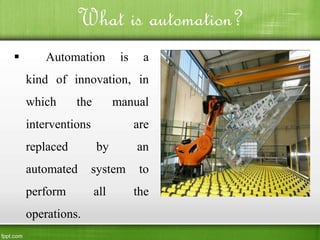
 Automation is a
kind of innovation, in
which the manual
interventions are
replaced by an
automated system to
perform all the
operations.
What is automation in micro irrigation?
 It is a system by which all the operations
related to the supply of irrigation water or
fertilizer to the crop are carried out, automatically
with no or minimum manual interventions.
Scope of automation in micro irrigation
 The scope of automation has become a new
development in micro irrigation sector.
 In India, the pressurized irrigation has created a
great awareness among the farmers.
 From government side several initiatives have
been taken for popularization.
System components of
automated irrigation
system
 An automized micro-irrigation consists of
following three components
1.Sensors
2.Controllers
3.Monitoring software / decision
support system
Sensors
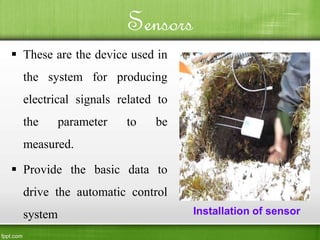
 These are the device used in
the system for producing
electrical signals related to
the parameter to be
measured.
 Provide the basic data to
drive the automatic control
system Installation of sensor
Types of sensors
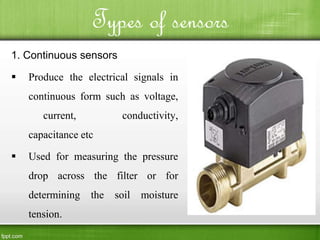
1. Continuous sensors
 Produce the electrical signals in
continuous form such as voltage,
current, conductivity,
capacitance etc
 Used for measuring the pressure
drop across the filter or for
determining the soil moisture
tension.
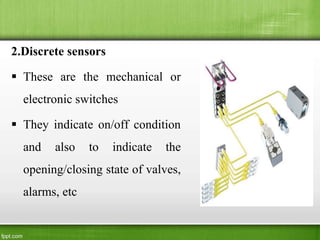
2.Discrete sensors
 These are the mechanical or
electronic switches
 They indicate on/off condition
and also to indicate the
opening/closing state of valves,
alarms, etc
Different types of sensors
 Analog tensiometer.
 Contact tensiometer.
 Electrical resistance sensors.
 Dielectric sensors.
 Thermal soil matric potential sensor.
 Gypsum block soil moisture sensor.
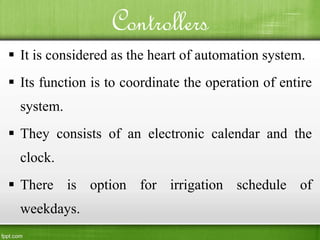
Controllers
 It is considered as the heart of automation system.
 Its function is to coordinate the operation of entire
system.
 They consists of an electronic calendar and the
clock.
 There is option for irrigation schedule of
weekdays.
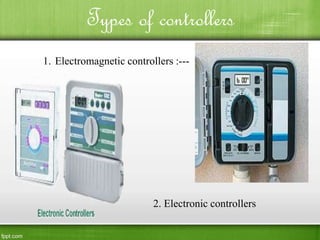
Types of controllers
1. Electromagnetic controllers :---
2. Electronic controllers
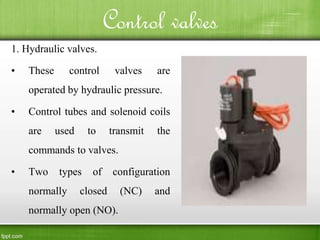
Control valves
1. Hydraulic valves.
• These control valves are
operated by hydraulic pressure.
• Control tubes and solenoid coils
are used to transmit the
commands to valves.
• Two types of configuration
normally closed (NC) and
normally open (NO).
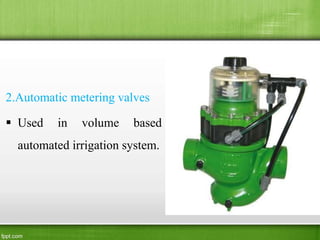
2.Automatic metering valves
 Used in volume based
automated irrigation system.
Preparation of programming schedule
 Programmed the irrigation system to determine
the duration of irrigation for the given crop, and
for each section.
 Feed the duration of individual valves in the
controller along with system start time.
 Set the controller clock in respect of current day
and time.
Working procedure
 As the clock of controller gets matched with the start
time of programme.
 The controller starts sending 24V AC current to the
first solenoid valve in the programme sequencer.
 At the same time the current reaches the master
relay to start the pump.
Various types of automation
system
 Time based system
 Volume based system
 Open Loop Systems
 Closed Loop Systems
 Real Time Feedback System
 Computer-based Irrigation Control Systems
 Sensor Controlled Micro Irrigation
Types of automation system
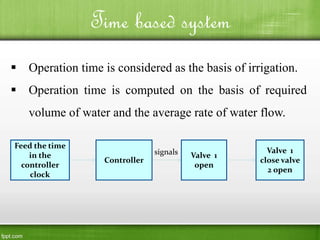
 Operation time is considered as the basis of irrigation.
 Operation time is computed on the basis of required
volume of water and the average rate of water flow.
Time based system
Feed the time
in the
controller
clock
Controller
Valve 1
open
Valve 1
close valve
2 open
signals
Volume based system
 Provided with volume controlled metering valve by
which a preset amount of water is applied to the field.
 It consists of 2 systems
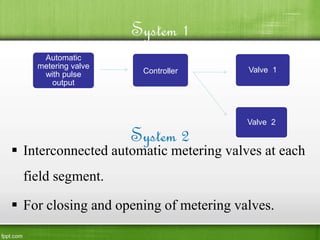
System 2
 Interconnected automatic metering valves at each
field segment.
 For closing and opening of metering valves.
System 1
Automatic
metering valve
with pulse
output
Controller Valve 1
Valve 2
Open loop system
 In this system information about irrigation duration
or required volume of water is feed to the control
unit.
 These information were programmed in he system
controller.
 Advantage - low cost.
 Disadvantage – system does not respond to the
environmental conditions.
Closed loop system
 In this system one or more sensors are equipped.
 Operator based on operator’s control strategy.
 System takes the decision on he basis of sensors
data.
Real time feed back system
 The system works on the basis of real feed back data
regarding demand of the crop at a given time.
 Various sensors like tensiometer, relative humidity
sensors, rain sensors, temperature sensors etc, used to feed
the crop data to control unit.
Computer based irrigation control system
 In this system, a hardware and software is equipped to
supervise the irrigation and other associated works like
fertigation, maintenance.
 This control system used in MIS is divided into following
two categories:
1)Interactive system
2)Fully automatic system
1. Interactive system : -
 This system use a micro computer.
 The data is transmitted to control unit from sensors and
then to central computer.
 In system, the field devices like valves, regulators, pumps
etc., are fitted with electrically operated servo-device, which
operates them.
Operator has provision to control the flow from the central
computer by changing the parameters like pressure etc.
2. Automatic system : -
 In this system person is completely avoided.
 Computer is programmed to perform automatic
functions.
 With the help of control devices corrections can be
done.
 In this system there is a facility to stop the
function when there is a rainfall etc.
Benefits of automized irrigation
 Conservation of water, labour and energy.
 Flexibility in operation.
 Precision and ease in operation.
 Adoption possibilities of advanced cropping and new
technologies.
 Feasibility of water use from different sources.
 Control on entire irrigation system.
 Enhancement in crop yield with better quality.
 Better water and nutrient use efficiency.
Limitations of automized irrigation system
 High system cost.
 Sensor sensitivity.
 Improper functioning of control valves.
 Frequent maintenance.
Reference
 Abraham, N.,Hema, P.S.,Saritha, E.K. & Subramannaiah,
S. (2000). Irrigation automation based on soil electrical
conductivity & leaf temperature. Agricultural water
management 45:145-157
 R. Suresh, “ Micro irrigation theory and practice “
THANK YOU

Automation in micro irrigation kvg

  • 1.
  • 2.
    AUTOMATION IN MICROIRRIGATION presentation on:- Subject: - Micro irrigation system design Presented by: - BARIA DIPAK ( PAGEN-091-2012 ) KAUSHAL .V. GADARIYA (PAGEN-097-2012) CHETAN CHAUHAN (PAGEN-092-2012)
  • 3.
    Contents  Introduction  Systemcomponents of automated irrigation system  Preparation of programming schedule  Various types of automation system  Benefits of automized irrigation  Limitations of automized irrigation system
  • 4.
    Introduction  Automation isthe godsend of farming.  In developed countries a large area has been covered under automated micro irrigation system.  It is relatively new; but getting popularity day- by-day.
  • 5.
    What is automation? Automation is a kind of innovation, in which the manual interventions are replaced by an automated system to perform all the operations.
  • 6.
    What is automationin micro irrigation?  It is a system by which all the operations related to the supply of irrigation water or fertilizer to the crop are carried out, automatically with no or minimum manual interventions.
  • 7.
    Scope of automationin micro irrigation  The scope of automation has become a new development in micro irrigation sector.  In India, the pressurized irrigation has created a great awareness among the farmers.  From government side several initiatives have been taken for popularization.
  • 8.
  • 9.
     An automizedmicro-irrigation consists of following three components 1.Sensors 2.Controllers 3.Monitoring software / decision support system
  • 10.
    Sensors  These arethe device used in the system for producing electrical signals related to the parameter to be measured.  Provide the basic data to drive the automatic control system Installation of sensor
  • 11.
    Types of sensors 1.Continuous sensors  Produce the electrical signals in continuous form such as voltage, current, conductivity, capacitance etc  Used for measuring the pressure drop across the filter or for determining the soil moisture tension.
  • 12.
    2.Discrete sensors  Theseare the mechanical or electronic switches  They indicate on/off condition and also to indicate the opening/closing state of valves, alarms, etc
  • 13.
    Different types ofsensors  Analog tensiometer.  Contact tensiometer.  Electrical resistance sensors.  Dielectric sensors.  Thermal soil matric potential sensor.  Gypsum block soil moisture sensor.
  • 14.
    Controllers  It isconsidered as the heart of automation system.  Its function is to coordinate the operation of entire system.  They consists of an electronic calendar and the clock.  There is option for irrigation schedule of weekdays.
  • 15.
    Types of controllers 1.Electromagnetic controllers :--- 2. Electronic controllers
  • 16.
    Control valves 1. Hydraulicvalves. • These control valves are operated by hydraulic pressure. • Control tubes and solenoid coils are used to transmit the commands to valves. • Two types of configuration normally closed (NC) and normally open (NO).
  • 17.
    2.Automatic metering valves Used in volume based automated irrigation system.
  • 18.
    Preparation of programmingschedule  Programmed the irrigation system to determine the duration of irrigation for the given crop, and for each section.  Feed the duration of individual valves in the controller along with system start time.  Set the controller clock in respect of current day and time.
  • 19.
    Working procedure  Asthe clock of controller gets matched with the start time of programme.  The controller starts sending 24V AC current to the first solenoid valve in the programme sequencer.  At the same time the current reaches the master relay to start the pump.
  • 20.
    Various types ofautomation system
  • 21.
     Time basedsystem  Volume based system  Open Loop Systems  Closed Loop Systems  Real Time Feedback System  Computer-based Irrigation Control Systems  Sensor Controlled Micro Irrigation Types of automation system
  • 22.
     Operation timeis considered as the basis of irrigation.  Operation time is computed on the basis of required volume of water and the average rate of water flow. Time based system Feed the time in the controller clock Controller Valve 1 open Valve 1 close valve 2 open signals
  • 23.
    Volume based system Provided with volume controlled metering valve by which a preset amount of water is applied to the field.  It consists of 2 systems
  • 24.
    System 2  Interconnectedautomatic metering valves at each field segment.  For closing and opening of metering valves. System 1 Automatic metering valve with pulse output Controller Valve 1 Valve 2
  • 25.
    Open loop system In this system information about irrigation duration or required volume of water is feed to the control unit.  These information were programmed in he system controller.  Advantage - low cost.  Disadvantage – system does not respond to the environmental conditions.
  • 26.
    Closed loop system In this system one or more sensors are equipped.  Operator based on operator’s control strategy.  System takes the decision on he basis of sensors data.
  • 27.
    Real time feedback system  The system works on the basis of real feed back data regarding demand of the crop at a given time.  Various sensors like tensiometer, relative humidity sensors, rain sensors, temperature sensors etc, used to feed the crop data to control unit.
  • 28.
    Computer based irrigationcontrol system  In this system, a hardware and software is equipped to supervise the irrigation and other associated works like fertigation, maintenance.  This control system used in MIS is divided into following two categories: 1)Interactive system 2)Fully automatic system
  • 29.
    1. Interactive system: -  This system use a micro computer.  The data is transmitted to control unit from sensors and then to central computer.  In system, the field devices like valves, regulators, pumps etc., are fitted with electrically operated servo-device, which operates them. Operator has provision to control the flow from the central computer by changing the parameters like pressure etc.
  • 30.
    2. Automatic system: -  In this system person is completely avoided.  Computer is programmed to perform automatic functions.  With the help of control devices corrections can be done.  In this system there is a facility to stop the function when there is a rainfall etc.
  • 31.
    Benefits of automizedirrigation  Conservation of water, labour and energy.  Flexibility in operation.  Precision and ease in operation.  Adoption possibilities of advanced cropping and new technologies.  Feasibility of water use from different sources.  Control on entire irrigation system.  Enhancement in crop yield with better quality.  Better water and nutrient use efficiency.
  • 32.
    Limitations of automizedirrigation system  High system cost.  Sensor sensitivity.  Improper functioning of control valves.  Frequent maintenance.
  • 33.
    Reference  Abraham, N.,Hema,P.S.,Saritha, E.K. & Subramannaiah, S. (2000). Irrigation automation based on soil electrical conductivity & leaf temperature. Agricultural water management 45:145-157  R. Suresh, “ Micro irrigation theory and practice “
  • 34.