KALYAN ACHARJYA
kalyan5.blogspot.in
Fundamental of Electronics (FOE)
UNIT-5
ELECTRON MICROSCOPY
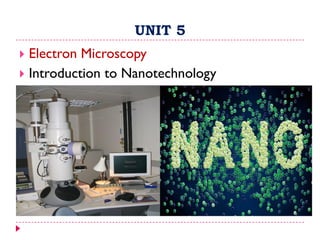
UNIT 5
 Electron Microscopy
 Introduction to Nanotechnology
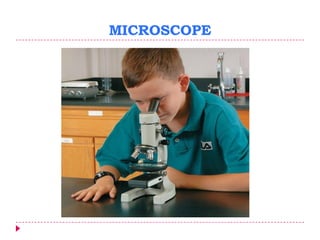
MICROSCOPE
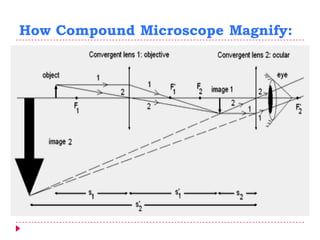
How Compound Microscope Magnify:
Microscopy
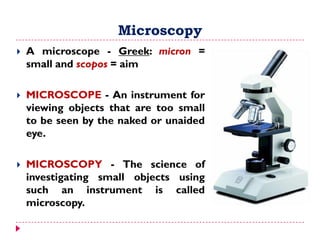
 A microscope - Greek: micron =
small and scopos = aim
 MICROSCOPE - An instrument for
viewing objects that are too small
to be seen by the naked or unaided
eye.
 MICROSCOPY - The science of
investigating small objects using
such an instrument is called
microscopy.
Historical Background
 1590 - Hans Janssen and his son Zacharias Janssen, developed
first microscope.
 1609 - Galileo Galilei - occhiolino or compound microscope.
 1620 - Christian Huygens, another Dutchman, developed a
simple 2-lens ocular system that was chromatically corrected.
Microscopy History
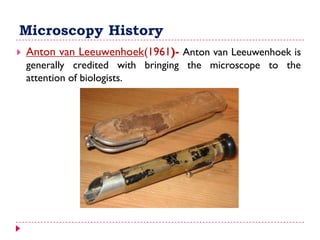
 Anton van Leeuwenhoek(1961)- Anton van Leeuwenhoek is
generally credited with bringing the microscope to the
attention of biologists.
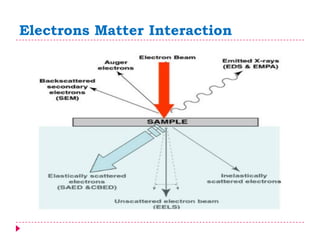
Electrons Matter Interaction
References (Contents)
 Dr SANTOSH KARADE Slides (SlideShare.net)
 Wikipedia (For Images)
 Researchgate.net (SEM & TEM Difference)
Disclosure
Only Use for Academic Purpose Only
Thank you for all Original owner of
Images and some contents
When we see the any objects?
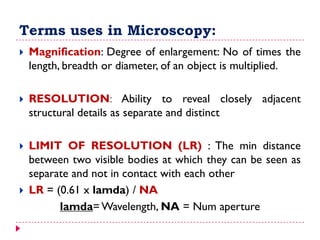
Terms uses in Microscopy:
 Magnification: Degree of enlargement: No of times the
length, breadth or diameter, of an object is multiplied.
 RESOLUTION: Ability to reveal closely adjacent
structural details as separate and distinct
 LIMIT OF RESOLUTION (LR) : The min distance
between two visible bodies at which they can be seen as
separate and not in contact with each other
 LR = (0.61 x lamda) / NA
lamda= Wavelength, NA = Num aperture
12
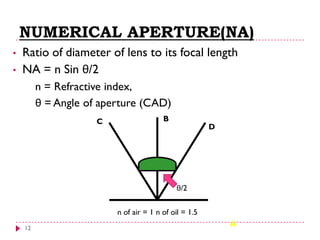
NUMERICAL APERTURE(NA)
• Ratio of diameter of lens to its focal length
• NA = n Sin θ/2
n = Refractive index,
θ = Angle of aperture (CAD)
θ/2
A
B
D
C
n of air = 1 n of oil = 1.5
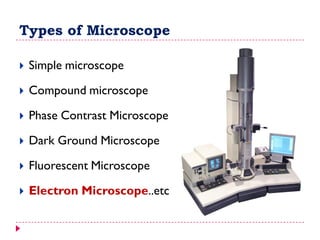
Types of Microscope
 Simple microscope
 Compound microscope
 Phase Contrast Microscope
 Dark Ground Microscope
 Fluorescent Microscope
 Electron Microscope..etc
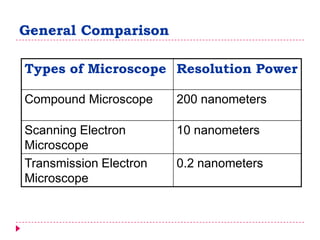
General Comparison
Types of Microscope Resolution Power
Compound Microscope 200 nanometers
Scanning Electron
Microscope
10 nanometers
Transmission Electron
Microscope
0.2 nanometers
15
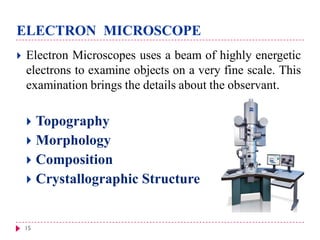
ELECTRON MICROSCOPE
 Electron Microscopes uses a beam of highly energetic
electrons to examine objects on a very fine scale. This
examination brings the details about the observant.
 Topography
 Morphology
 Composition
 Crystallographic Structure
16
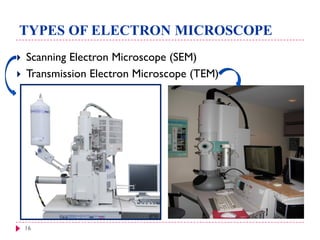
TYPES OF ELECTRON MICROSCOPE
 Scanning Electron Microscope (SEM)
 Transmission Electron Microscope (TEM)
17
 SEM focuses on the sample’s surface and its composition
 Scan a gold-plated specimen to give a 3-D view of the
surface of an object which is black and white.
 Used to study surface features of materials, cells and
viruses.
 Scanning Electron microscope has resolution 1000 times
better than Light microscope.
SCANNING ELECTRO MICROSCOPE
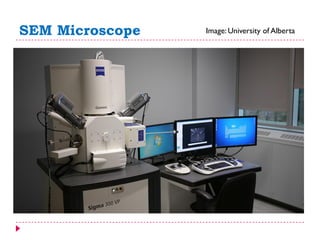
SEM Microscope Image: University of Alberta
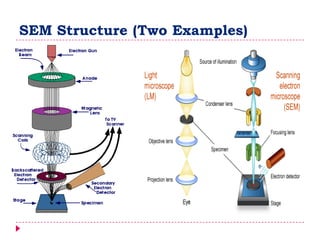
SEM Structure (Two Examples)
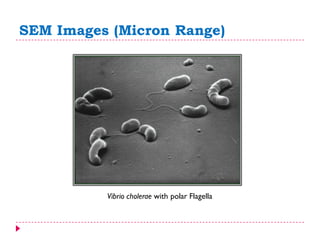
SEM Images (Micron Range)
Vibrio cholerae with polar Flagella
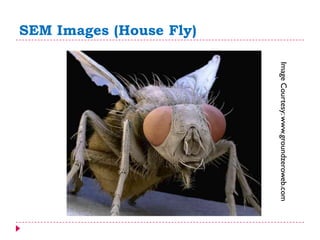
SEM Images (House Fly)
ImageCourtesy:www.groundzeroweb.com
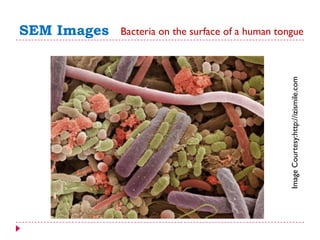
SEM Images Bacteria on the surface of a human tongue
ImageCourtesy:http://izismile.com
SEM Images
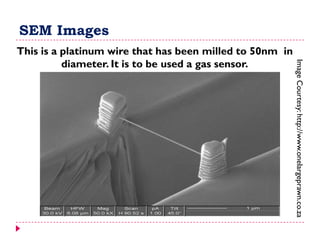
This is a platinum wire that has been milled to 50nm in
diameter. It is to be used a gas sensor.
ImageCourtesy:http://www.onelargeprawn.co.za
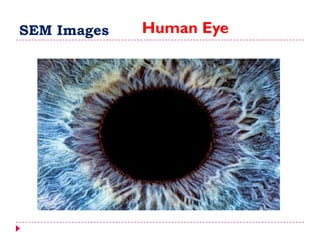
SEM Images Human Eye
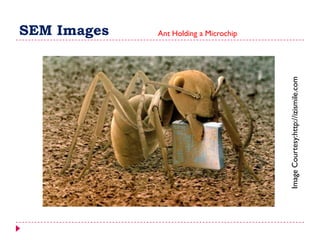
SEM Images Ant Holding a Microchip
ImageCourtesy:http://izismile.com
26
TRANSMISSION ELECTRON MICROSCOPE
(TEM)-STEM-Scanning TEM
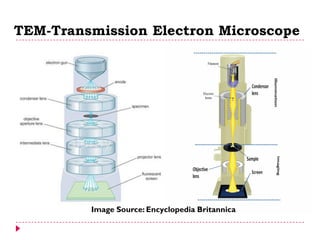
 Stream of electrons is formed.
 Accelerated using a positive electrical potential
 Focused by metallic aperture and Electro magnets
 Interactions occur inside the irradiated sample which are
detected and transformed into an image .
 Scanning electron microscopy allows for higher magnification and
better resolution than standard light microscopy.
 Since the sample is bombarded with electrons rather than light,
the level of detail in a smaller area is much greater than a light
microscope
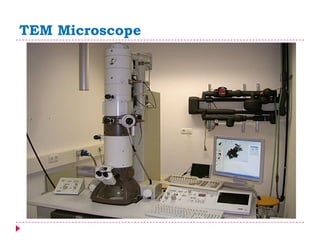
TEM Microscope
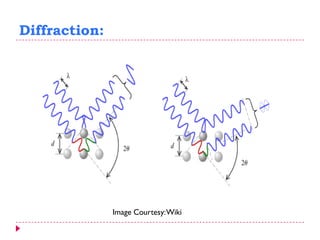
Diffraction:
Image Courtesy:Wiki
TEM-Transmission Electron Microscope
Image Source: Encyclopedia Britannica
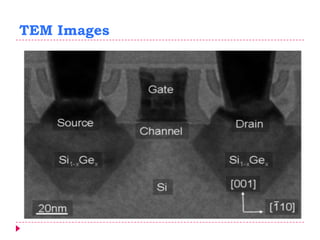
TEM Images
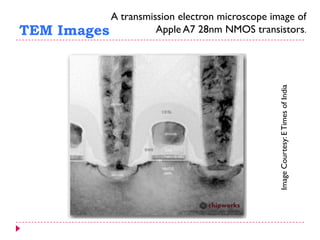
TEM Images
A transmission electron microscope image of
Apple A7 28nm NMOS transistors.
ImageCourtesy:ETimesofIndia
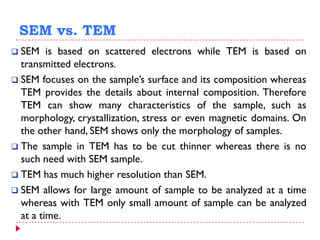
SEM vs. TEM
 SEM is based on scattered electrons while TEM is based on
transmitted electrons.
 SEM focuses on the sample’s surface and its composition whereas
TEM provides the details about internal composition. Therefore
TEM can show many characteristics of the sample, such as
morphology, crystallization, stress or even magnetic domains. On
the other hand, SEM shows only the morphology of samples.
 The sample in TEM has to be cut thinner whereas there is no
such need with SEM sample.
 TEM has much higher resolution than SEM.
 SEM allows for large amount of sample to be analyzed at a time
whereas with TEM only small amount of sample can be analyzed
at a time.
SEM vs. TEM
 SEM is used for surfaces, powders, polished & etched
microstructures, IC chips, chemical segregation whereas
TEM is used for imaging of dislocations, tiny precipitates,
grain boundaries and other defect structures in solids
 In TEM, pictures are shown on fluorescent screens whereas
in SEM, picture is shown on monitor.
 SEM also provides a 3-dimensional image while TEM
provides a 2-dimensional picture.
 TEM requires extensive sample preparation. The thickness
of the specimens to be examined under TEM should be less
that 100nm.
34
Advanced MICROSCOPES
SCANNING PROBE MICROSCOPE -Class of
Microscope that measures surface features by
moving a sharp probe over object surface.
Used to visualize atoms and molecules in
more distinctly.
 ScanningTunneling Microscope (STM)
 Atomic Force Microscope (AFM)
TAHNK YOU 4 UR Kind Attention..!
You all are awesome
kalyan.acharjya@gmail.com
kalyan5.blogspot.in

Electron Microscopy (SEM & TEM)

  • 1.
    KALYAN ACHARJYA kalyan5.blogspot.in Fundamental ofElectronics (FOE) UNIT-5 ELECTRON MICROSCOPY
  • 2.
    UNIT 5  ElectronMicroscopy  Introduction to Nanotechnology
  • 3.
  • 4.
  • 5.
    Microscopy  A microscope- Greek: micron = small and scopos = aim  MICROSCOPE - An instrument for viewing objects that are too small to be seen by the naked or unaided eye.  MICROSCOPY - The science of investigating small objects using such an instrument is called microscopy.
  • 6.
    Historical Background  1590- Hans Janssen and his son Zacharias Janssen, developed first microscope.  1609 - Galileo Galilei - occhiolino or compound microscope.  1620 - Christian Huygens, another Dutchman, developed a simple 2-lens ocular system that was chromatically corrected.
  • 7.
    Microscopy History  Antonvan Leeuwenhoek(1961)- Anton van Leeuwenhoek is generally credited with bringing the microscope to the attention of biologists.
  • 8.
  • 9.
    References (Contents)  DrSANTOSH KARADE Slides (SlideShare.net)  Wikipedia (For Images)  Researchgate.net (SEM & TEM Difference) Disclosure Only Use for Academic Purpose Only Thank you for all Original owner of Images and some contents
  • 10.
    When we seethe any objects?
  • 11.
    Terms uses inMicroscopy:  Magnification: Degree of enlargement: No of times the length, breadth or diameter, of an object is multiplied.  RESOLUTION: Ability to reveal closely adjacent structural details as separate and distinct  LIMIT OF RESOLUTION (LR) : The min distance between two visible bodies at which they can be seen as separate and not in contact with each other  LR = (0.61 x lamda) / NA lamda= Wavelength, NA = Num aperture
  • 12.
    12 NUMERICAL APERTURE(NA) • Ratioof diameter of lens to its focal length • NA = n Sin θ/2 n = Refractive index, θ = Angle of aperture (CAD) θ/2 A B D C n of air = 1 n of oil = 1.5
  • 13.
    Types of Microscope Simple microscope  Compound microscope  Phase Contrast Microscope  Dark Ground Microscope  Fluorescent Microscope  Electron Microscope..etc
  • 14.
    General Comparison Types ofMicroscope Resolution Power Compound Microscope 200 nanometers Scanning Electron Microscope 10 nanometers Transmission Electron Microscope 0.2 nanometers
  • 15.
    15 ELECTRON MICROSCOPE  ElectronMicroscopes uses a beam of highly energetic electrons to examine objects on a very fine scale. This examination brings the details about the observant.  Topography  Morphology  Composition  Crystallographic Structure
  • 16.
    16 TYPES OF ELECTRONMICROSCOPE  Scanning Electron Microscope (SEM)  Transmission Electron Microscope (TEM)
  • 17.
    17  SEM focuseson the sample’s surface and its composition  Scan a gold-plated specimen to give a 3-D view of the surface of an object which is black and white.  Used to study surface features of materials, cells and viruses.  Scanning Electron microscope has resolution 1000 times better than Light microscope. SCANNING ELECTRO MICROSCOPE
  • 18.
    SEM Microscope Image:University of Alberta
  • 19.
  • 20.
    SEM Images (MicronRange) Vibrio cholerae with polar Flagella
  • 21.
    SEM Images (HouseFly) ImageCourtesy:www.groundzeroweb.com
  • 22.
    SEM Images Bacteriaon the surface of a human tongue ImageCourtesy:http://izismile.com
  • 23.
    SEM Images This isa platinum wire that has been milled to 50nm in diameter. It is to be used a gas sensor. ImageCourtesy:http://www.onelargeprawn.co.za
  • 24.
  • 25.
    SEM Images AntHolding a Microchip ImageCourtesy:http://izismile.com
  • 26.
    26 TRANSMISSION ELECTRON MICROSCOPE (TEM)-STEM-ScanningTEM  Stream of electrons is formed.  Accelerated using a positive electrical potential  Focused by metallic aperture and Electro magnets  Interactions occur inside the irradiated sample which are detected and transformed into an image .  Scanning electron microscopy allows for higher magnification and better resolution than standard light microscopy.  Since the sample is bombarded with electrons rather than light, the level of detail in a smaller area is much greater than a light microscope
  • 27.
  • 28.
  • 29.
    TEM-Transmission Electron Microscope ImageSource: Encyclopedia Britannica
  • 30.
  • 31.
    TEM Images A transmissionelectron microscope image of Apple A7 28nm NMOS transistors. ImageCourtesy:ETimesofIndia
  • 32.
    SEM vs. TEM SEM is based on scattered electrons while TEM is based on transmitted electrons.  SEM focuses on the sample’s surface and its composition whereas TEM provides the details about internal composition. Therefore TEM can show many characteristics of the sample, such as morphology, crystallization, stress or even magnetic domains. On the other hand, SEM shows only the morphology of samples.  The sample in TEM has to be cut thinner whereas there is no such need with SEM sample.  TEM has much higher resolution than SEM.  SEM allows for large amount of sample to be analyzed at a time whereas with TEM only small amount of sample can be analyzed at a time.
  • 33.
    SEM vs. TEM SEM is used for surfaces, powders, polished & etched microstructures, IC chips, chemical segregation whereas TEM is used for imaging of dislocations, tiny precipitates, grain boundaries and other defect structures in solids  In TEM, pictures are shown on fluorescent screens whereas in SEM, picture is shown on monitor.  SEM also provides a 3-dimensional image while TEM provides a 2-dimensional picture.  TEM requires extensive sample preparation. The thickness of the specimens to be examined under TEM should be less that 100nm.
  • 34.
    34 Advanced MICROSCOPES SCANNING PROBEMICROSCOPE -Class of Microscope that measures surface features by moving a sharp probe over object surface. Used to visualize atoms and molecules in more distinctly.  ScanningTunneling Microscope (STM)  Atomic Force Microscope (AFM)
  • 35.
    TAHNK YOU 4UR Kind Attention..! You all are awesome kalyan.acharjya@gmail.com kalyan5.blogspot.in