RNA INTERFERENCE
TECHNOLOGY- GENE
SLIENCING
(Shooting down mRNA)
By-Somanath Baral
Roll No.-BY3416
M.Sc part I
sb000333@gmail.com
BackgroundBackground
What is it and its discovery?What is it and its discovery?
The mechanism and processThe mechanism and process
Advantages of RNAi mechanismAdvantages of RNAi mechanism
in cellin cell
ConclusionConclusion
RNAiRNAi
Transcription
Translation
Shooting mRNA means RNA interference
What is RNA interference?
--Gene “knockdown”
--A cellular mechanism that degrades
unwanted RNAs in the cytoplasm but not
in the nucleus.
--A way for the cell to defend itself.
Jorgensen 1990
van der Krol 1990
Gene injection (pigmentation
Enzyme-petunias)
Expectation: more red color
Co-suppression of transgene
and endogenous gene.
First discovered in plants
(R. Jorgensen, 1990)
RNAi discovered in C. elegans (first animal) while
attempting to use antisense RNA in vivo
Craig Mello Andrew Fire (2006 Nobel Prize in
Physiology & Medicine)
Control “sense” RNAs also produced suppression of
target gene!
sense RNAs were contaminated with dsRNA.
dsRNA was the suppressing agent.
RNA interference:
--A type of gene regulation
--Involve small RNA molecules
--Induce a double stranded RNA
The RNAi process
The mechanism of
small interfering RNAs (siRNAs)
What happens?
dsRNA is processed into shorter units
(siRNAs) that guide the targeted cleavage
of homologous RNA.
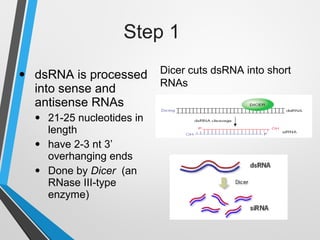
Step 1
• dsRNA is processed
into sense and
antisense RNAs
• 21-25 nucleotides in
length
• have 2-3 nt 3’
overhanging ends
• Done by Dicer (an
RNase III-type
enzyme)
Dicer cuts dsRNA into short
RNAs
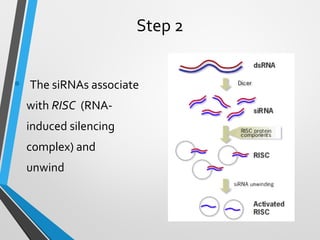
Step 2
• The siRNAs associate
with RISC (RNA-
induced silencing
complex) and
unwind
Step 3
• the antisense siRNAs
act as guides for RISC
to associate with
complimentary single-
stranded mRNAs.
Step 4
• RISC cuts the mRNA
approximately in the
middle of the region
paired with the siRNA
• The mRNA is degraded
further
Advantages of RNAi
1. The most powerful way to inhibit
unwanted gene expression and
acquire info about the gene’s
function fast
2. Works in any cell/organism
3. Uses conserved endogenous
machinery
4. Potent at low concentrations
5. Highly specific.
conclusion
RNAi is a valuable research tool,both in self culture and
in living organism.
Most widely held view is that RNAi evolved to protect the
genome virus.
The genetic modifications of plant by different
approaches have a millstone among RNAi shows the
greater potentiality to for crop improvement to sustain
the production and productivity.
References
1. Textbook of Genetics by Ajoy Paul
2. Genetics by P.K.Gupta
3. Images from Google
THANK YOUTHANK YOU

RNA Interference technology

  • 1.
    RNA INTERFERENCE TECHNOLOGY- GENE SLIENCING (Shootingdown mRNA) By-Somanath Baral Roll No.-BY3416 M.Sc part I sb000333@gmail.com
  • 2.
    BackgroundBackground What is itand its discovery?What is it and its discovery? The mechanism and processThe mechanism and process Advantages of RNAi mechanismAdvantages of RNAi mechanism in cellin cell ConclusionConclusion RNAiRNAi
  • 3.
  • 4.
    Shooting mRNA meansRNA interference What is RNA interference?
  • 5.
    --Gene “knockdown” --A cellularmechanism that degrades unwanted RNAs in the cytoplasm but not in the nucleus. --A way for the cell to defend itself.
  • 7.
    Jorgensen 1990 van derKrol 1990 Gene injection (pigmentation Enzyme-petunias) Expectation: more red color Co-suppression of transgene and endogenous gene. First discovered in plants (R. Jorgensen, 1990)
  • 8.
    RNAi discovered inC. elegans (first animal) while attempting to use antisense RNA in vivo Craig Mello Andrew Fire (2006 Nobel Prize in Physiology & Medicine) Control “sense” RNAs also produced suppression of target gene! sense RNAs were contaminated with dsRNA. dsRNA was the suppressing agent.
  • 9.
    RNA interference: --A typeof gene regulation --Involve small RNA molecules --Induce a double stranded RNA The RNAi process
  • 10.
    The mechanism of smallinterfering RNAs (siRNAs) What happens? dsRNA is processed into shorter units (siRNAs) that guide the targeted cleavage of homologous RNA.
  • 11.
    Step 1 • dsRNAis processed into sense and antisense RNAs • 21-25 nucleotides in length • have 2-3 nt 3’ overhanging ends • Done by Dicer (an RNase III-type enzyme) Dicer cuts dsRNA into short RNAs
  • 12.
    Step 2 • ThesiRNAs associate with RISC (RNA- induced silencing complex) and unwind
  • 13.
    Step 3 • theantisense siRNAs act as guides for RISC to associate with complimentary single- stranded mRNAs.
  • 14.
    Step 4 • RISCcuts the mRNA approximately in the middle of the region paired with the siRNA • The mRNA is degraded further
  • 15.
    Advantages of RNAi 1.The most powerful way to inhibit unwanted gene expression and acquire info about the gene’s function fast 2. Works in any cell/organism 3. Uses conserved endogenous machinery 4. Potent at low concentrations 5. Highly specific.
  • 17.
    conclusion RNAi is avaluable research tool,both in self culture and in living organism. Most widely held view is that RNAi evolved to protect the genome virus. The genetic modifications of plant by different approaches have a millstone among RNAi shows the greater potentiality to for crop improvement to sustain the production and productivity.
  • 18.
    References 1. Textbook ofGenetics by Ajoy Paul 2. Genetics by P.K.Gupta 3. Images from Google
  • 19.