WELCOME
RNA INTERFERENCE
AND
ITS APPLICATIONS IN
CROP IMPROVEMENT
PRESENTED BY S.NAGALAKSHMI
RAD/10-28
DEPARTMENT OF AGRICULTURAL
BIOTECHNOLOGY
1.RNA Interference(RNAi)
-Introduction
-History
-Mechanism
2.Transforming methods
-Direct method
-Indirect method
3.Significance
4.Applications in crop improvement
5.Conclusion
6.References
3
What is RNAiWhat is RNAi
• RNA interference (RNAi) is a process by
which double-stranded RNA (dsRNA)
homologous to the target locus can
specifically inactivate gene function in
plants, invertebrates, and mammalian
systems (Sharp 1999;Hammond et al.
2001).
RNAi was first discovered in 1998 byRNAi was first discovered in 1998 by
Andrew Fire and Craig Mello in theAndrew Fire and Craig Mello in the
nematode wormnematode worm Caenorhabditis elegans.Caenorhabditis elegans.
This technique has proven effective in
Drosophila, plants, and recently, in
mammalian cell culture.
History
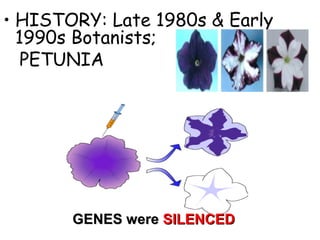
• Post-transcriptional gene silencing (PTGS)
was observed first in Petunia.
• RNA interference was first observed in
petunias, when Napoli et al. (1990)
discovered that introduction of a pigment-
producing gene under control of a powerful
promoter suppressed expression of both the
introduced gene and the homologous
endogenous gene.
• The phenomenon they called cosuppression.”
• HISTORY: Late 1980s & Early
1990s Botanists;
PETUNIA
GENES wereGENES were SILENCEDSILENCED
Final Discovery
Andrew Fire , Craig Mello 1998 announced RNAi
discovery.
The crucial 1998 discovery by Fire et al., that injection
of dsRNA—a mixture of both sense and antisense
strands of the target mRNA, rather than either strand
alone—into gonads of the nematode Caenorhabditis
elegans resulted in extremely potent silencing
unequivocably identified dsRNA as the inducer of
RNA interference
Awarded Nobel Prize 2006 for this Path-breaking
concept.
In 2006, Andrew Z. Fire and Craig C. Mello shared the Nobel
Prize in Physiology or Medicine for their work on RNA
interference in the nematode worm Caenorhabditis elegans.
Andrew Z. Fire Craig C.Mello
w
Craig Mello at the 2006 Nobel Prize
lecture.
What are the
components
of RNAi machinery?
Components of RNA InterferenceComponents of RNA Interference
• DicerDicer
• RNA-Induced Silencing Complex (RISC)RNA-Induced Silencing Complex (RISC)
• DroshaDrosha
• siRNAsiRNA
• miRNAmiRNA
DicerDicer
Enzyme involved in the initiation of RNAi.
Rnase-III-like dsRNA-specific ribonuclease (200
KDa)
ATP-dependent nucleases.
Dicer homologs exist in many organisms including
C.elegans, Drosphila, yeast and humans.
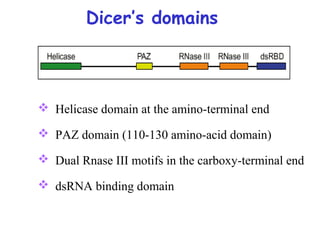
Dicer’s domains
 Helicase domain at the amino-terminal end
 PAZ domain (110-130 amino-acid domain)
 Dual Rnase III motifs in the carboxy-terminal end
 dsRNA binding domain
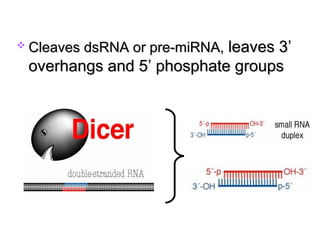
 Cleaves dsRNA or pre-miRNA,Cleaves dsRNA or pre-miRNA, leaves 3’leaves 3’
overhangs and 5’ phosphate groupsoverhangs and 5’ phosphate groups
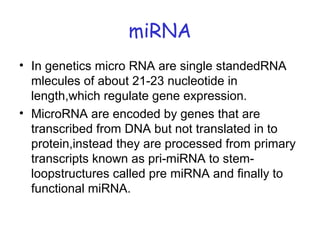
miRNA
• In genetics micro RNA are single standedRNA
mlecules of about 21-23 nucleotide in
length,which regulate gene expression.
• MicroRNA are encoded by genes that are
transcribed from DNA but not translated in to
protein,instead they are processed from primary
transcripts known as pri-miRNA to stem-
loopstructures called pre miRNA and finally to
functional miRNA.
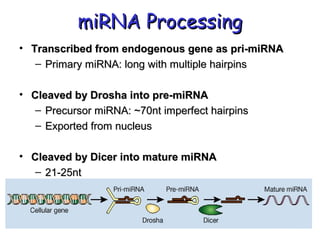
miRNA ProcessingmiRNA Processing
• Transcribed from endogenous gene as pri-miRNATranscribed from endogenous gene as pri-miRNA
– Primary miRNA: long with multiple hairpinsPrimary miRNA: long with multiple hairpins
• Cleaved by Drosha into pre-miRNACleaved by Drosha into pre-miRNA
– Precursor miRNA: ~70nt imperfect hairpinsPrecursor miRNA: ~70nt imperfect hairpins
– Exported from nucleusExported from nucleus
• Cleaved by Dicer into mature miRNACleaved by Dicer into mature miRNA
– 21-25nt21-25nt
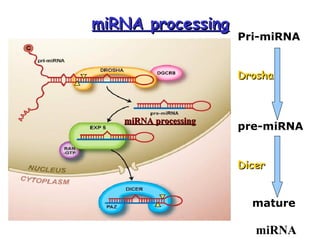
miRNA processingmiRNA processingmiRNA processingmiRNA processingmiRNA processingmiRNA processing
miRNA processingmiRNA processing
Pri-miRNA
DroshaDrosha
pre-miRNA
DicerDicer
mature
miRNA
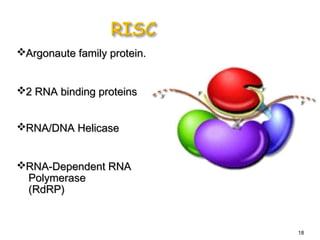
Argonaute family protein.Argonaute family protein.
2 RNA binding proteins2 RNA binding proteins
RNA/DNA HelicaseRNA/DNA Helicase
RNA-Dependent RNARNA-Dependent RNA
PolymerasePolymerase
(RdRP)(RdRP)
18
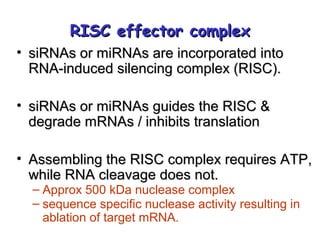
RISC effector complexRISC effector complex
• siRNAs or miRNAs are incorporated intosiRNAs or miRNAs are incorporated into
RNA-induced silencing complex (RISC).RNA-induced silencing complex (RISC).
• siRNAs or miRNAs guides the RISC &siRNAs or miRNAs guides the RISC &
degrade mRNAs / inhibits translationdegrade mRNAs / inhibits translation
• Assembling the RISC complex requires ATP,Assembling the RISC complex requires ATP,
while RNA cleavage does not.while RNA cleavage does not.
– Approx 500 kDa nuclease complex
– sequence specific nuclease activity resulting in
ablation of target mRNA.
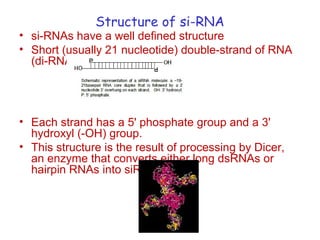
Structure of si-RNA
• si-RNAs have a well defined structure
• Short (usually 21 nucleotide) double-strand of RNA
(di-RNA)
• Each strand has a 5' phosphate group and a 3'
hydroxyl (-OH) group.
• This structure is the result of processing by Dicer,
an enzyme that converts either long dsRNAs or
hairpin RNAs into siRNAs.
Mechanism of RNAi
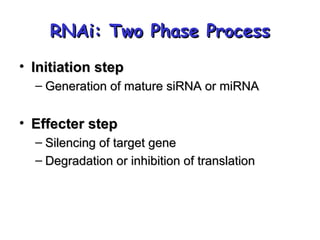
RNAi: Two Phase ProcessRNAi: Two Phase Process
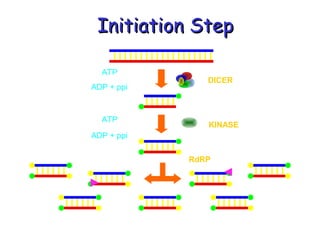
• Initiation stepInitiation step
– Generation of mature siRNA or miRNAGeneration of mature siRNA or miRNA
• Effecter stepEffecter step
– Silencing of target geneSilencing of target gene
– Degradation or inhibition of translationDegradation or inhibition of translation
Initiation StepInitiation Step
ATP
ATP
ADP + ppi
ADP + ppi
DICER
KINASE
RdRP
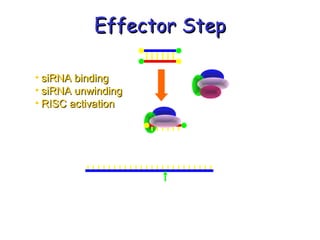
Effector StepEffector Step
• siRNA bindingsiRNA binding
• siRNA unwindingsiRNA unwinding
• RISC activationRISC activation
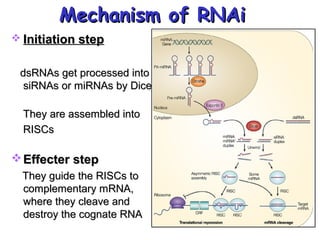
 Initiation stepInitiation step
dsRNAs get processed intodsRNAs get processed into
siRNAs or miRNAs by DicersiRNAs or miRNAs by Dicer
They are assembled intoThey are assembled into
RISCsRISCs
Effecter stepEffecter step
They guide the RISCs toThey guide the RISCs to
complementary mRNA,complementary mRNA,
where they cleave andwhere they cleave and
destroy the cognate RNAdestroy the cognate RNA
Mechanism of RNAiMechanism of RNAi
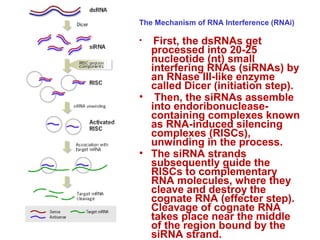
The Mechanism of RNA Interference (RNAi)
• First, the dsRNAs get
processed into 20-25
nucleotide (nt) small
interfering RNAs (siRNAs) by
an RNase III-like enzyme
called Dicer (initiation step).
• Then, the siRNAs assemble
into endoribonuclease-
containing complexes known
as RNA-induced silencing
complexes (RISCs),
unwinding in the process.
• The siRNA strands
subsequently guide the
RISCs to complementary
RNA molecules, where they
cleave and destroy the
cognate RNA (effecter step).
Cleavage of cognate RNA
takes place near the middle
of the region bound by the
siRNA strand.
Transforming methods
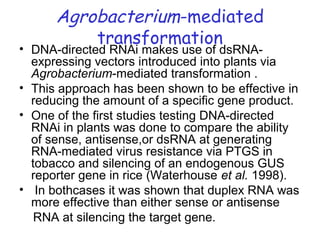
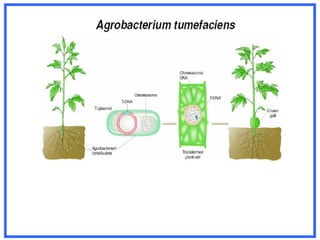
Agrobacterium-mediated
transformation
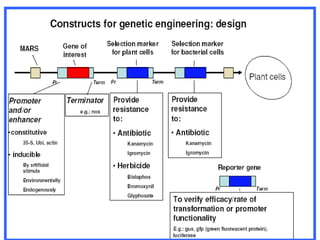
• DNA-directed RNAi makes use of dsRNA-
expressing vectors introduced into plants via
Agrobacterium-mediated transformation .
• This approach has been shown to be effective in
reducing the amount of a specific gene product.
• One of the first studies testing DNA-directed
RNAi in plants was done to compare the ability
of sense, antisense,or dsRNA at generating
RNA-mediated virus resistance via PTGS in
tobacco and silencing of an endogenous GUS
reporter gene in rice (Waterhouse et al. 1998).
• In bothcases it was shown that duplex RNA was
more effective than either sense or antisense
RNA at silencing the target gene.
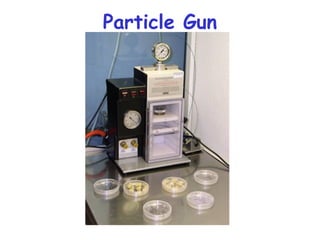
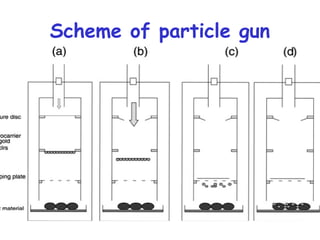
Particle Gun
• some applications of RNAi in plants have relied
on non-Agrobacterium-mediated methods of
introduction of dsRNA into the cells.
• For example, particle bombardment was used
to show that RNAi worked at the single cell level
in cereals (Schweizer et al. 2000).
• while Klink & Wolniak (2000) and Stout et al.
(2003) demonstrated that there is a direct
uptake of dsRNA by fern spores during
imbibition.
Particle Gun
Scheme of particle gun
• Most of these methods utilize an RNAi vector to
produce stable or transient dsRNA in vivo.
• Unnamalai et al. (2004), have recently devised a
way of introducing dsRNA without transforming
the plant with an RNAi vector.
• They used cationic oligopeptides for delivering
dsRNA into plant cells.
• Specifically, the scientists introduced dsRNA
into tobacco cells using cationic oligopeptide 12-
mer.
• Their results showed efficient silencing of the
target genes.
Vectors expressing siRNAsVectors expressing siRNAs
• Plasmid-based vectorsPlasmid-based vectors
– Low and variable transfection efficiencyLow and variable transfection efficiency
• Viral-based vectorsViral-based vectors
– Highly efficientHighly efficient
– Better than plasmid-basedBetter than plasmid-based
• Pol II promoter-based plasmid vectorsPol II promoter-based plasmid vectors
– Tissue specificTissue specific
Significance of RNA interferenceSignificance of RNA interference
 Protects against viral infections.
. Secures genome stability by keeping
mobile elements silent.
• Important role during development in
plants,C. elegans and mammals.
• Used to determine the function of a specific
gene by silencing its expression.
• Silencing of over-expressed or aberrantly
expressed disease causing genes.
Applications in crop improvement
RICE
• Kusaba and his team (Kusaba et al., 2003) have
made significant contribution by applying RNAi
to improve rice plants.
• They were able to reduce the level of glutenin
and produced a rice variety called LGC-1 (low
glutenin content 1).
• The low glutenin content was a relief to the
kidney patients unable to digest glutenin. The
trait was stable and was transmitted for a
number of generations.
• They showed that the procedure may apply to
both monogenic and polygenic agronomic
characters (Williams et al., 2004).
MAIZE
• In another study, RNAi has been
successfully used to generate a dominant
high-lysine maize variant by knocking out
the expression of the 22-kD maize zein
storage protein,a protein that is poor in
Lysine content (Segal et al., 2003).
• RNAi generates quality and normal maize
seeds with high levels of lysine-rich
proteins (Tang et al., 2004).
BARLEY
• Bayer Crop Science has acquired an exclusive
worldwide license to develop, market, and sell
selected crop plant varieties in which the RNAi
technology has been successfully applied.
• Using this technique this group has developed
varieties of barley that are resistant to BYDV (barley
yellow dwarf virus) (Wang et al., 2000).
• Their results showed that the barley plants
developed through RNAi technology are resistant to
viral infection while the control plants became
infected with the yellow dwarf virus.
COTTON
• Another nutritionally important crop is cotton.
• Cotton is mainly used for fiber production, and is an
important crop not only in developed ountries, but
also in many developing countries where
malnutrition and starvation are widespread
(Sunilkumar et al., 2006).
• In these developing areas, the cottonseeds that
remain after fiber extraction could be extensively
used as sources of protein and calories.
• But they are largely underutilized because they
contain a toxic gossypol terpenoid.
• Indeed, transgenic cotton plants expressing a
RNAi construct of the d-cadinene synthase
gene of gossypol synthesis fused to a seed-
specific promoter caused seed specific
reduction of this metabolite.
• These cotton plants are thus expected to
have similar insect and pathogen resistance
to that of wild type cotton, but to produce
seeds with higher nutritional value (Tang et
al., 2007).
JUTE
• A possible application of RNAi involves
the down regulation of a key enzyme in
the biosynthetic pathway of lignin in the
two economically important Corchorus
species, namely, C. capsularis and C.
olitorius.
• The enzyme 4-coumarate: CoA ligase (4-
Cl) is one of the key enzymes in the early
stages of lignin biosynthesis.
• With the availability of the sequence of the 4-Cl
gene, it would be possible to create a transgenic
jute variety expressing the RNAi construct to
down regulate the quantity of 4-Cl mRNA
thereby reducing the lignin production.
• Thus RNAi technology may prove to be a
powerful molecular tool by generating jute
varieties with low lignin content and production
of various economically important commodities
such as high quality paper and cloth (Williams et
al., 2004).
TOMATO
• Among the vegetables, tomato fruits are
relatively rich in a number of vitamins including
the strong antioxidant carotenoid, or lycopene,
which provides the tomato fruit with its typical
red color.
• Carotenoids are synthesized by the same
biosynthetic pathway that synthesizes
chlorophyll, and it has been shown that genes
controlling the light-mediated regulation of the
photosynthetic machinery also influence tomato
fruit quality by altering the levels of carotenoids
and flavonoids (Adams-Phillips et al., 2004).
• The tomato high pigment (hp-2) phenotype,
which accumulates elevated levels of
carotenoids and flavonoids, is due to mutations
in the regulatory gene DE-ETHIOLATED1
(DET1)
• which represses several light-dependent
signaling pathways (Levin et al., 2003; Mustilli et
al., 1999).
• Yet, RNAi-mediated suppression of DET1
expression under fruit-specific promoters has
shown to improve carotenoid and flavonoid
levels in tomato fruits with minimal effects on
plant growth and other fruit quality parameters
(Davuluri et al., 2005) .
Latyrus sativus
• In Ethiopia, Bangladesh and India, the
people in the lower socioeconomic class
use a leafy vegetable known as Lathyrus
sativus.
• It is a leguminous crop and contains a
neurotoxin called β-oxalylaminoalanine-L-
alanine (BOAA) (Spencer et al., 1986).
• People consuming this vegetable suffer
from a paralytic disease called, lathyrism.
• Paralysis in the limbs is a known symptom of
BOAA, yet people still consume this vegetable in
times of famine.
• This is an instance where RNAi technology can be
used to silence the gene(s) responsible for
production of BOAA.
• There may be one difficulty; in that the BOAA
genes may be linked to genes, which confer
immunity to this unique crop or impart drought and
flood tolerance.
• Bringing down the levels of BOAA to a safe
concentration, rather than totally silencing the
concerned genes, may overcome this obstacle
(Williams et al., 2004).
COFFEE
• 10% of the coffee on the world market is shared
by decaffeinate coffee (DECAF). Decaf is
wanted by buyers which are sensitive to
caffeine.
• Decaf is obtained from natural coffee by several
ways: by using water or solvent extraction.
• RNAi technology has enabled the creation of
varieties of Coffee that produces natural coffee
with low or very low caffeine content, thus by-
pass the need of extraction (Van Uyen, 2006).
BANANA
• Another instance where RNAi may be fruitfully
applied is in the production of banana varieties
resistant to the Banana Bract Mosaic Virus
(BBrMV), currently devastating the banana
population in Southeast Asia and India (Rodoni et
al., 1999).
• The BBrMV infects banana plants destroying the
fruit producing bract region, rendering them
useless to farmers. By designing an RNAi vector
aimed at silencing the Coat Protein (CP) region of
the virus.
APPLE
• Fruit quality has also been addressed by
silencing experiments.
• Several characteristics are involved in fruit
quality.
• Transgenic apple fruits silencing key
enzymes involved in autocatalytic ethylene
production were significantly firmer and
displayed an increased shelf-life
(Dandekar et al., 2004).
CITRUS
• In Citrus, the down regulation of putative
thermostable pectin methylesterase genes
is projected as a possible solution for the
undesirable separation of juice into clear
serum and particulate phase (Guo et al.,
2005).
• In this case, RNAi could be used to
achieve this goal (Amancio et al., 2007).
Healthier oil
• An application of RNAi in plants that is much
closer to agricultural use is the silencing of
genes involved with seedoil production.
• The best oil for heat stability and with no
negative effects on cholesterol levels is one
which is high in oleic acid.
• Used RNAi to silence the gene in cotton which
codes for the enzyme that converts oleic acid
into a different fatty acid. This has altered the
seed-oil from being around 10% to an
impressive 75% oleic acid.
Pest control
• dsRNA designed to suppress specific genes in
some pests,can be provided in the diet to
suppress or kill those pests.
• The sequence specificity of RNAi presents the
opportunity to selectively target some pest
species while sparing desirable species.
• All transgenic-plant-mediated insect control
technology is based on the plants producing
proteins derived from a specific type of bacteria,
Bacillus thuringiensis or Bt.
Flower color modification of plants by
RNAi-mediated gene silencing
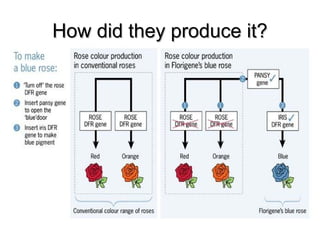
Blue Rose
• The cyanidin gene is responsible for a synthethic
pathway that leads to formation of red pigment
and a correspondent Delphinidin gene is the key
gene for formation of blue color.
• Scientists at Florigene (Australia) and Suntory
(Japan) have been successful in knock -downing
the cyanidin genes in rose and carnation by
RNAi technology and introduce delphinidin
genes,
How did they produce it?How did they produce it?
The First Blue RoseThe First Blue Rose
RNAi and Flowering time
• One of the important aspects of crop
production is flowering time .
• So, being able to control flowering time in
plants could be a very useful tool in
horticulture and agriculture.
• In Arabidopsis, there is a gene called FLC
which represses flowering and used RNAi
to switch it off and bring on flowering.
• This clearly shows that the technology has
the potential to regulate flowering time in
crops (Waterhouse et al., 1998).
RNAi Assay
• RT-PCR
• Western blot
• Histological, physiological, structural,
biochemical assay of transgenic cells or
animals.
Conclusion
• Current agricultural technology needs
more and more molecular tools to
reduce current crop loss and feed extra
mouths,which according to a recent
estimate by the FAO will increase by
two billion over the next 30 years.
• An important gene regulation pathway.An important gene regulation pathway.
• A small world with mighty biologicalA small world with mighty biological
functions.functions.
• The technology is well developed and
can be applied directly to evolve a crop
resistant to stresses caused by
virus,bacteria,fungi,insects or natural
disasters.
• Since this technology offers great
potential in understanding gene
functions and utilize them to improve
crop quality and production.
• It is a matter of time before we see
the products of this RNAi research in
the farmer’s fields around the world.
References
• Wang M, Abbott D, Waterhouse P M (2000) A single copy of
a virus derived transgene encoding hairpin RNA gives
immunity to barley yellow dwarf virus. Molecular Plant
Pathology 1: 401-410.
• Kusaba M, Miyahara K, Lida S, Fukuoka H, Takario T, Sassa
H, Nishimura M, Nishio T (2003) Low glutenin content 1 : a
dominant mutation that suppresses the glutenin multigene
family via RNA silencing in rice. Plant Cell 15: 1455-1467.
• Williams M, Clark G, Sathasivan K, Islam AS (2004) RNA
Interference and its Application in Crop Improvement. Plant
tissue culture and Biotechnology 1-18.
• Tang G, Galili G (2004) Using RNAi to improve plant
nutritional value: from mechanism to application. TRENDS in
Biotechnology 22(9) 463-469.
The web
sites containing such RNAi related software applications
are listed here.
.
Silencing RNA Target Finder from Ambion
• http://www.ambion.com/techlib/misc/siRNA_finder.html
RNAi Design Tool from Integrated DNA Technologies
• http://biotools.idtdna.com/rnai/
Gene Specific siRNA Selector
• http://hydra1.wistar.upenn.edu/Projects/siRNA/siRNAindex.htm
RNAi Designer from Invitrogen
• https://rnaidesigner.invitrogen.com/sirna/
siRNA Selection Program, Whitehead Institute for Biomedical
Research.
• http://jura.wi.mit.edu/siRNAext/register.php
Summary of siRNA Design Rules and Tools
• http://www.protocol-online.org/prot/Molecular_Biology/
• RNA/RNA_Interference/siRNA_Design_Rules/
General Resources on RNAi in Ambion
• http://www.ambion.com/techlib/resources/RNAi/
THANK YOU

Micro RNARNA INTERFERENCE AND ITS APPLICATIONS IN CROP IMPROVEMENT

  • 1.
  • 2.
    RNA INTERFERENCE AND ITS APPLICATIONSIN CROP IMPROVEMENT PRESENTED BY S.NAGALAKSHMI RAD/10-28 DEPARTMENT OF AGRICULTURAL BIOTECHNOLOGY
  • 3.
    1.RNA Interference(RNAi) -Introduction -History -Mechanism 2.Transforming methods -Directmethod -Indirect method 3.Significance 4.Applications in crop improvement 5.Conclusion 6.References 3
  • 4.
    What is RNAiWhatis RNAi • RNA interference (RNAi) is a process by which double-stranded RNA (dsRNA) homologous to the target locus can specifically inactivate gene function in plants, invertebrates, and mammalian systems (Sharp 1999;Hammond et al. 2001).
  • 5.
    RNAi was firstdiscovered in 1998 byRNAi was first discovered in 1998 by Andrew Fire and Craig Mello in theAndrew Fire and Craig Mello in the nematode wormnematode worm Caenorhabditis elegans.Caenorhabditis elegans. This technique has proven effective in Drosophila, plants, and recently, in mammalian cell culture.
  • 6.
    History • Post-transcriptional genesilencing (PTGS) was observed first in Petunia. • RNA interference was first observed in petunias, when Napoli et al. (1990) discovered that introduction of a pigment- producing gene under control of a powerful promoter suppressed expression of both the introduced gene and the homologous endogenous gene. • The phenomenon they called cosuppression.”
  • 7.
    • HISTORY: Late1980s & Early 1990s Botanists; PETUNIA GENES wereGENES were SILENCEDSILENCED
  • 8.
    Final Discovery Andrew Fire, Craig Mello 1998 announced RNAi discovery. The crucial 1998 discovery by Fire et al., that injection of dsRNA—a mixture of both sense and antisense strands of the target mRNA, rather than either strand alone—into gonads of the nematode Caenorhabditis elegans resulted in extremely potent silencing unequivocably identified dsRNA as the inducer of RNA interference Awarded Nobel Prize 2006 for this Path-breaking concept.
  • 9.
    In 2006, AndrewZ. Fire and Craig C. Mello shared the Nobel Prize in Physiology or Medicine for their work on RNA interference in the nematode worm Caenorhabditis elegans. Andrew Z. Fire Craig C.Mello w Craig Mello at the 2006 Nobel Prize lecture.
  • 10.
  • 11.
    Components of RNAInterferenceComponents of RNA Interference • DicerDicer • RNA-Induced Silencing Complex (RISC)RNA-Induced Silencing Complex (RISC) • DroshaDrosha • siRNAsiRNA • miRNAmiRNA
  • 12.
    DicerDicer Enzyme involved inthe initiation of RNAi. Rnase-III-like dsRNA-specific ribonuclease (200 KDa) ATP-dependent nucleases. Dicer homologs exist in many organisms including C.elegans, Drosphila, yeast and humans.
  • 13.
    Dicer’s domains  Helicasedomain at the amino-terminal end  PAZ domain (110-130 amino-acid domain)  Dual Rnase III motifs in the carboxy-terminal end  dsRNA binding domain
  • 14.
     Cleaves dsRNAor pre-miRNA,Cleaves dsRNA or pre-miRNA, leaves 3’leaves 3’ overhangs and 5’ phosphate groupsoverhangs and 5’ phosphate groups
  • 15.
    miRNA • In geneticsmicro RNA are single standedRNA mlecules of about 21-23 nucleotide in length,which regulate gene expression. • MicroRNA are encoded by genes that are transcribed from DNA but not translated in to protein,instead they are processed from primary transcripts known as pri-miRNA to stem- loopstructures called pre miRNA and finally to functional miRNA.
  • 16.
    miRNA ProcessingmiRNA Processing •Transcribed from endogenous gene as pri-miRNATranscribed from endogenous gene as pri-miRNA – Primary miRNA: long with multiple hairpinsPrimary miRNA: long with multiple hairpins • Cleaved by Drosha into pre-miRNACleaved by Drosha into pre-miRNA – Precursor miRNA: ~70nt imperfect hairpinsPrecursor miRNA: ~70nt imperfect hairpins – Exported from nucleusExported from nucleus • Cleaved by Dicer into mature miRNACleaved by Dicer into mature miRNA – 21-25nt21-25nt
  • 17.
    miRNA processingmiRNA processingmiRNAprocessingmiRNA processingmiRNA processingmiRNA processing miRNA processingmiRNA processing Pri-miRNA DroshaDrosha pre-miRNA DicerDicer mature miRNA
  • 18.
    Argonaute family protein.Argonautefamily protein. 2 RNA binding proteins2 RNA binding proteins RNA/DNA HelicaseRNA/DNA Helicase RNA-Dependent RNARNA-Dependent RNA PolymerasePolymerase (RdRP)(RdRP) 18
  • 19.
    RISC effector complexRISCeffector complex • siRNAs or miRNAs are incorporated intosiRNAs or miRNAs are incorporated into RNA-induced silencing complex (RISC).RNA-induced silencing complex (RISC). • siRNAs or miRNAs guides the RISC &siRNAs or miRNAs guides the RISC & degrade mRNAs / inhibits translationdegrade mRNAs / inhibits translation • Assembling the RISC complex requires ATP,Assembling the RISC complex requires ATP, while RNA cleavage does not.while RNA cleavage does not. – Approx 500 kDa nuclease complex – sequence specific nuclease activity resulting in ablation of target mRNA.
  • 20.
    Structure of si-RNA •si-RNAs have a well defined structure • Short (usually 21 nucleotide) double-strand of RNA (di-RNA) • Each strand has a 5' phosphate group and a 3' hydroxyl (-OH) group. • This structure is the result of processing by Dicer, an enzyme that converts either long dsRNAs or hairpin RNAs into siRNAs.
  • 21.
  • 22.
    RNAi: Two PhaseProcessRNAi: Two Phase Process • Initiation stepInitiation step – Generation of mature siRNA or miRNAGeneration of mature siRNA or miRNA • Effecter stepEffecter step – Silencing of target geneSilencing of target gene – Degradation or inhibition of translationDegradation or inhibition of translation
  • 23.
    Initiation StepInitiation Step ATP ATP ADP+ ppi ADP + ppi DICER KINASE RdRP
  • 24.
    Effector StepEffector Step •siRNA bindingsiRNA binding • siRNA unwindingsiRNA unwinding • RISC activationRISC activation
  • 25.
     Initiation stepInitiationstep dsRNAs get processed intodsRNAs get processed into siRNAs or miRNAs by DicersiRNAs or miRNAs by Dicer They are assembled intoThey are assembled into RISCsRISCs Effecter stepEffecter step They guide the RISCs toThey guide the RISCs to complementary mRNA,complementary mRNA, where they cleave andwhere they cleave and destroy the cognate RNAdestroy the cognate RNA Mechanism of RNAiMechanism of RNAi
  • 26.
    The Mechanism ofRNA Interference (RNAi) • First, the dsRNAs get processed into 20-25 nucleotide (nt) small interfering RNAs (siRNAs) by an RNase III-like enzyme called Dicer (initiation step). • Then, the siRNAs assemble into endoribonuclease- containing complexes known as RNA-induced silencing complexes (RISCs), unwinding in the process. • The siRNA strands subsequently guide the RISCs to complementary RNA molecules, where they cleave and destroy the cognate RNA (effecter step). Cleavage of cognate RNA takes place near the middle of the region bound by the siRNA strand.
  • 27.
  • 28.
    Agrobacterium-mediated transformation • DNA-directed RNAimakes use of dsRNA- expressing vectors introduced into plants via Agrobacterium-mediated transformation . • This approach has been shown to be effective in reducing the amount of a specific gene product. • One of the first studies testing DNA-directed RNAi in plants was done to compare the ability of sense, antisense,or dsRNA at generating RNA-mediated virus resistance via PTGS in tobacco and silencing of an endogenous GUS reporter gene in rice (Waterhouse et al. 1998). • In bothcases it was shown that duplex RNA was more effective than either sense or antisense RNA at silencing the target gene.
  • 31.
    Particle Gun • someapplications of RNAi in plants have relied on non-Agrobacterium-mediated methods of introduction of dsRNA into the cells. • For example, particle bombardment was used to show that RNAi worked at the single cell level in cereals (Schweizer et al. 2000). • while Klink & Wolniak (2000) and Stout et al. (2003) demonstrated that there is a direct uptake of dsRNA by fern spores during imbibition.
  • 32.
  • 33.
  • 34.
    • Most ofthese methods utilize an RNAi vector to produce stable or transient dsRNA in vivo. • Unnamalai et al. (2004), have recently devised a way of introducing dsRNA without transforming the plant with an RNAi vector. • They used cationic oligopeptides for delivering dsRNA into plant cells. • Specifically, the scientists introduced dsRNA into tobacco cells using cationic oligopeptide 12- mer. • Their results showed efficient silencing of the target genes.
  • 35.
    Vectors expressing siRNAsVectorsexpressing siRNAs • Plasmid-based vectorsPlasmid-based vectors – Low and variable transfection efficiencyLow and variable transfection efficiency • Viral-based vectorsViral-based vectors – Highly efficientHighly efficient – Better than plasmid-basedBetter than plasmid-based • Pol II promoter-based plasmid vectorsPol II promoter-based plasmid vectors – Tissue specificTissue specific
  • 36.
    Significance of RNAinterferenceSignificance of RNA interference  Protects against viral infections. . Secures genome stability by keeping mobile elements silent. • Important role during development in plants,C. elegans and mammals.
  • 37.
    • Used todetermine the function of a specific gene by silencing its expression. • Silencing of over-expressed or aberrantly expressed disease causing genes.
  • 38.
  • 39.
    RICE • Kusaba andhis team (Kusaba et al., 2003) have made significant contribution by applying RNAi to improve rice plants. • They were able to reduce the level of glutenin and produced a rice variety called LGC-1 (low glutenin content 1). • The low glutenin content was a relief to the kidney patients unable to digest glutenin. The trait was stable and was transmitted for a number of generations. • They showed that the procedure may apply to both monogenic and polygenic agronomic characters (Williams et al., 2004).
  • 40.
    MAIZE • In anotherstudy, RNAi has been successfully used to generate a dominant high-lysine maize variant by knocking out the expression of the 22-kD maize zein storage protein,a protein that is poor in Lysine content (Segal et al., 2003). • RNAi generates quality and normal maize seeds with high levels of lysine-rich proteins (Tang et al., 2004).
  • 41.
    BARLEY • Bayer CropScience has acquired an exclusive worldwide license to develop, market, and sell selected crop plant varieties in which the RNAi technology has been successfully applied. • Using this technique this group has developed varieties of barley that are resistant to BYDV (barley yellow dwarf virus) (Wang et al., 2000). • Their results showed that the barley plants developed through RNAi technology are resistant to viral infection while the control plants became infected with the yellow dwarf virus.
  • 42.
    COTTON • Another nutritionallyimportant crop is cotton. • Cotton is mainly used for fiber production, and is an important crop not only in developed ountries, but also in many developing countries where malnutrition and starvation are widespread (Sunilkumar et al., 2006). • In these developing areas, the cottonseeds that remain after fiber extraction could be extensively used as sources of protein and calories. • But they are largely underutilized because they contain a toxic gossypol terpenoid.
  • 43.
    • Indeed, transgeniccotton plants expressing a RNAi construct of the d-cadinene synthase gene of gossypol synthesis fused to a seed- specific promoter caused seed specific reduction of this metabolite. • These cotton plants are thus expected to have similar insect and pathogen resistance to that of wild type cotton, but to produce seeds with higher nutritional value (Tang et al., 2007).
  • 44.
    JUTE • A possibleapplication of RNAi involves the down regulation of a key enzyme in the biosynthetic pathway of lignin in the two economically important Corchorus species, namely, C. capsularis and C. olitorius. • The enzyme 4-coumarate: CoA ligase (4- Cl) is one of the key enzymes in the early stages of lignin biosynthesis.
  • 45.
    • With theavailability of the sequence of the 4-Cl gene, it would be possible to create a transgenic jute variety expressing the RNAi construct to down regulate the quantity of 4-Cl mRNA thereby reducing the lignin production. • Thus RNAi technology may prove to be a powerful molecular tool by generating jute varieties with low lignin content and production of various economically important commodities such as high quality paper and cloth (Williams et al., 2004).
  • 46.
    TOMATO • Among thevegetables, tomato fruits are relatively rich in a number of vitamins including the strong antioxidant carotenoid, or lycopene, which provides the tomato fruit with its typical red color. • Carotenoids are synthesized by the same biosynthetic pathway that synthesizes chlorophyll, and it has been shown that genes controlling the light-mediated regulation of the photosynthetic machinery also influence tomato fruit quality by altering the levels of carotenoids and flavonoids (Adams-Phillips et al., 2004).
  • 47.
    • The tomatohigh pigment (hp-2) phenotype, which accumulates elevated levels of carotenoids and flavonoids, is due to mutations in the regulatory gene DE-ETHIOLATED1 (DET1) • which represses several light-dependent signaling pathways (Levin et al., 2003; Mustilli et al., 1999). • Yet, RNAi-mediated suppression of DET1 expression under fruit-specific promoters has shown to improve carotenoid and flavonoid levels in tomato fruits with minimal effects on plant growth and other fruit quality parameters (Davuluri et al., 2005) .
  • 48.
    Latyrus sativus • InEthiopia, Bangladesh and India, the people in the lower socioeconomic class use a leafy vegetable known as Lathyrus sativus. • It is a leguminous crop and contains a neurotoxin called β-oxalylaminoalanine-L- alanine (BOAA) (Spencer et al., 1986). • People consuming this vegetable suffer from a paralytic disease called, lathyrism.
  • 49.
    • Paralysis inthe limbs is a known symptom of BOAA, yet people still consume this vegetable in times of famine. • This is an instance where RNAi technology can be used to silence the gene(s) responsible for production of BOAA. • There may be one difficulty; in that the BOAA genes may be linked to genes, which confer immunity to this unique crop or impart drought and flood tolerance. • Bringing down the levels of BOAA to a safe concentration, rather than totally silencing the concerned genes, may overcome this obstacle (Williams et al., 2004).
  • 50.
    COFFEE • 10% ofthe coffee on the world market is shared by decaffeinate coffee (DECAF). Decaf is wanted by buyers which are sensitive to caffeine. • Decaf is obtained from natural coffee by several ways: by using water or solvent extraction. • RNAi technology has enabled the creation of varieties of Coffee that produces natural coffee with low or very low caffeine content, thus by- pass the need of extraction (Van Uyen, 2006).
  • 51.
    BANANA • Another instancewhere RNAi may be fruitfully applied is in the production of banana varieties resistant to the Banana Bract Mosaic Virus (BBrMV), currently devastating the banana population in Southeast Asia and India (Rodoni et al., 1999). • The BBrMV infects banana plants destroying the fruit producing bract region, rendering them useless to farmers. By designing an RNAi vector aimed at silencing the Coat Protein (CP) region of the virus.
  • 52.
    APPLE • Fruit qualityhas also been addressed by silencing experiments. • Several characteristics are involved in fruit quality. • Transgenic apple fruits silencing key enzymes involved in autocatalytic ethylene production were significantly firmer and displayed an increased shelf-life (Dandekar et al., 2004).
  • 53.
    CITRUS • In Citrus,the down regulation of putative thermostable pectin methylesterase genes is projected as a possible solution for the undesirable separation of juice into clear serum and particulate phase (Guo et al., 2005). • In this case, RNAi could be used to achieve this goal (Amancio et al., 2007).
  • 54.
    Healthier oil • Anapplication of RNAi in plants that is much closer to agricultural use is the silencing of genes involved with seedoil production. • The best oil for heat stability and with no negative effects on cholesterol levels is one which is high in oleic acid. • Used RNAi to silence the gene in cotton which codes for the enzyme that converts oleic acid into a different fatty acid. This has altered the seed-oil from being around 10% to an impressive 75% oleic acid.
  • 55.
    Pest control • dsRNAdesigned to suppress specific genes in some pests,can be provided in the diet to suppress or kill those pests. • The sequence specificity of RNAi presents the opportunity to selectively target some pest species while sparing desirable species. • All transgenic-plant-mediated insect control technology is based on the plants producing proteins derived from a specific type of bacteria, Bacillus thuringiensis or Bt.
  • 56.
    Flower color modificationof plants by RNAi-mediated gene silencing
  • 57.
    Blue Rose • Thecyanidin gene is responsible for a synthethic pathway that leads to formation of red pigment and a correspondent Delphinidin gene is the key gene for formation of blue color. • Scientists at Florigene (Australia) and Suntory (Japan) have been successful in knock -downing the cyanidin genes in rose and carnation by RNAi technology and introduce delphinidin genes,
  • 58.
    How did theyproduce it?How did they produce it?
  • 59.
    The First BlueRoseThe First Blue Rose
  • 60.
    RNAi and Floweringtime • One of the important aspects of crop production is flowering time . • So, being able to control flowering time in plants could be a very useful tool in horticulture and agriculture.
  • 61.
    • In Arabidopsis,there is a gene called FLC which represses flowering and used RNAi to switch it off and bring on flowering. • This clearly shows that the technology has the potential to regulate flowering time in crops (Waterhouse et al., 1998).
  • 62.
    RNAi Assay • RT-PCR •Western blot • Histological, physiological, structural, biochemical assay of transgenic cells or animals.
  • 63.
    Conclusion • Current agriculturaltechnology needs more and more molecular tools to reduce current crop loss and feed extra mouths,which according to a recent estimate by the FAO will increase by two billion over the next 30 years. • An important gene regulation pathway.An important gene regulation pathway. • A small world with mighty biologicalA small world with mighty biological functions.functions.
  • 64.
    • The technologyis well developed and can be applied directly to evolve a crop resistant to stresses caused by virus,bacteria,fungi,insects or natural disasters. • Since this technology offers great potential in understanding gene functions and utilize them to improve crop quality and production. • It is a matter of time before we see the products of this RNAi research in the farmer’s fields around the world.
  • 65.
    References • Wang M,Abbott D, Waterhouse P M (2000) A single copy of a virus derived transgene encoding hairpin RNA gives immunity to barley yellow dwarf virus. Molecular Plant Pathology 1: 401-410. • Kusaba M, Miyahara K, Lida S, Fukuoka H, Takario T, Sassa H, Nishimura M, Nishio T (2003) Low glutenin content 1 : a dominant mutation that suppresses the glutenin multigene family via RNA silencing in rice. Plant Cell 15: 1455-1467. • Williams M, Clark G, Sathasivan K, Islam AS (2004) RNA Interference and its Application in Crop Improvement. Plant tissue culture and Biotechnology 1-18. • Tang G, Galili G (2004) Using RNAi to improve plant nutritional value: from mechanism to application. TRENDS in Biotechnology 22(9) 463-469.
  • 66.
    The web sites containingsuch RNAi related software applications are listed here. . Silencing RNA Target Finder from Ambion • http://www.ambion.com/techlib/misc/siRNA_finder.html RNAi Design Tool from Integrated DNA Technologies • http://biotools.idtdna.com/rnai/ Gene Specific siRNA Selector • http://hydra1.wistar.upenn.edu/Projects/siRNA/siRNAindex.htm RNAi Designer from Invitrogen • https://rnaidesigner.invitrogen.com/sirna/ siRNA Selection Program, Whitehead Institute for Biomedical Research. • http://jura.wi.mit.edu/siRNAext/register.php Summary of siRNA Design Rules and Tools • http://www.protocol-online.org/prot/Molecular_Biology/ • RNA/RNA_Interference/siRNA_Design_Rules/ General Resources on RNAi in Ambion • http://www.ambion.com/techlib/resources/RNAi/
  • 67.

Editor's Notes

  • #19 RISC – RNA-induced silencing complex Components of RISC are still unknown… but what’s is known so far 2 RNA binding proteins – bind the siRNA RNA/DNA Helicase – unwinding of the siRNA Translation Initiation Factor – mutations of this component affect the initiation step RNA-Dependent RNA Pol – may be a part of the RISC complex – may not – but it plays a role in the triggering and amplification of the silencing effect Transmembrane Protein – seems to be the protein involved in the systemic spread of the RNAi… found in plants and so far in animals it’s only found in c.elegans (the only animal that shows systemic spread of RNAi – talk about later
  • #24 dsRNA Cleaved by Dicer Phosphorylated by putative Kinase RNA-dependent RNA Polymerase (potentially part of the RISC) can amplify the siRNA
  • #25 siRNA binds to RISC siRNA is unwound and activated RISC siRNA/RISC complex binds to target mRNA Endonuclease activity of RISC cleaves target sequence Exonuclease activity of RISC (potentially) cleaves the rest
  • #36 Problem with viral – dangerous (death of a patient injected with adeno virus) While most vectors available on the market use Pol III promoters regions, Pol II promoter-based plasmid vectors is a new trend Pol III is active in all cells in the body Pol II isn’t – so to have tissue specific gene silencing, a plasmid with a Pol-II promoter can be used