Nuclear Chemistry
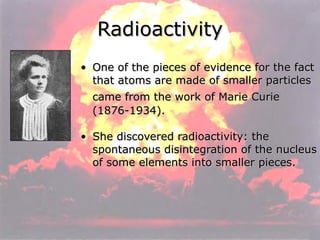
Radioactivity One of the pieces of evidence for the fact that atoms are made of smaller particles came from the work of Marie Curie  (1876-1934).  She discovered radioactivity: the spontaneous disintegration of the nucleus of some elements into smaller pieces.
Nuclear Reactions vs. Normal Chemical Changes Nuclear reactions involve the nucleus The nucleus loses particles, and protons and neutrons are rearranged The disintegration of the nucleus releases a tremendous amount of energy that holds the nucleus together – called binding energy “ Normal” Chemical Reactions involve electrons, not protons and neutrons
 
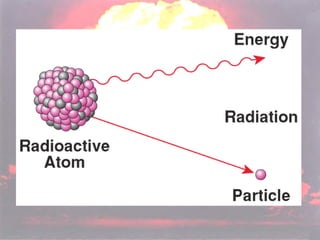
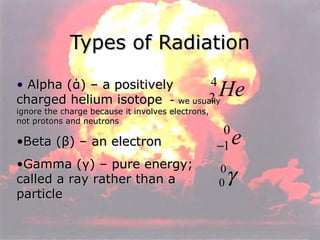
Types of Radiation Alpha ( ά ) – a positively charged helium isotope   -  we usually ignore the charge because it involves electrons, not protons and neutrons Beta ( β ) – an electron Gamma ( γ ) – pure energy; called a ray rather than a particle
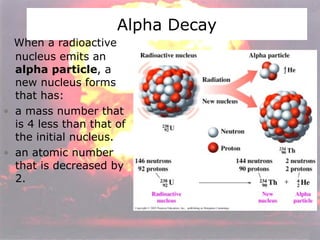
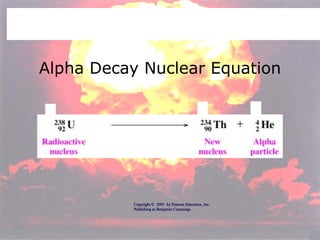
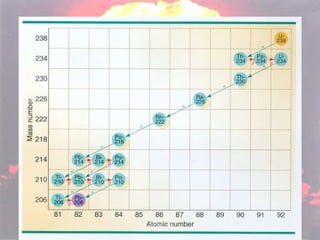
Alpha Decay When a radioactive nucleus emits an  alpha particle , a new nucleus forms that has: a mass number that is 4 less than that of the initial nucleus.  an atomic number that is decreased by 2.
Alpha Decay Nuclear Equation Copyright ©  2005  by Pearson Education, Inc. Publishing as Benjamin Cummings
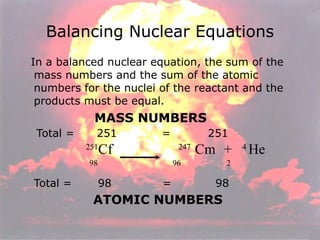
In a balanced nuclear equation, the sum of the mass numbers and the sum of the atomic numbers for the nuclei of the reactant and the products must be equal. MASS NUMBERS Total =  251  =  251 251 Cf     247  Cm   +   4  He   98  96  2  Total =  98   =   98   ATOMIC NUMBERS Balancing Nuclear Equations
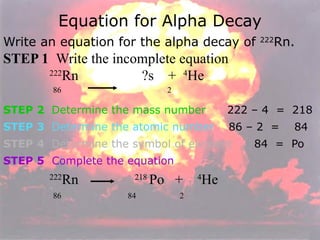
Equation for Alpha Decay Write an equation for the alpha decay of  222 Rn. STEP 1   Write the incomplete equation   222 Rn    ?s  +  4 He     86  2 STEP 2   Determine the mass number   222 – 4  =  218 STEP 3   Determine the atomic number   86 – 2  =  84 STEP 4   Determine the symbol of element   84  =  Po STEP 5   Complete the equation     222 Rn    218  Po  +  4 He      86  84  2
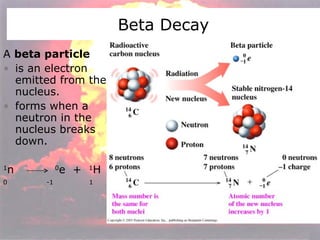
Beta Decay A  beta particle is an electron emitted from the nucleus. forms when a neutron in the nucleus breaks down. 1 n  0 e  +  1 H 0  -1   1
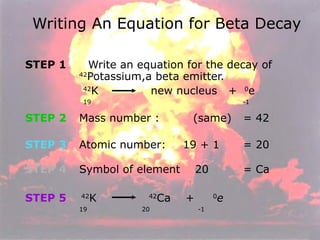
STEP 1   Write an equation for the decay of 42 Potassium,a beta emitter. 42 K  new nucleus  +  0 e 19     -1 STEP 2   Mass number :  (same)  = 42 STEP 3   Atomic number:  19 + 1  = 20 STEP 4   Symbol of element  20 = Ca STEP 5   42 K  42 Ca  +  0 e 19  20  -1 Writing An Equation for Beta Decay
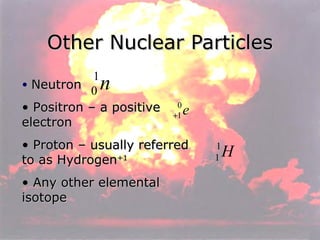
Other Nuclear Particles Neutron Positron – a positive electron Proton – usually referred to as Hydrogen +1 Any other elemental  isotope
 
 
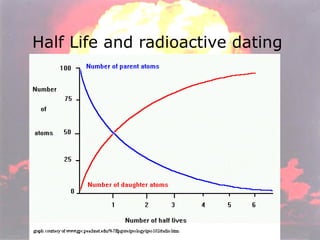
Half Life The time required for half of the nuclei in a sample of a specific isotope to undergo radioactive decay.
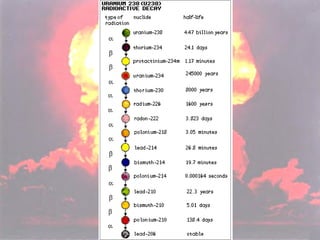
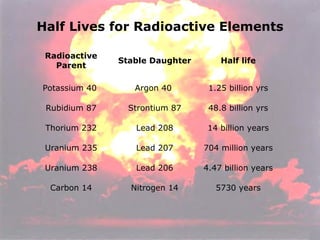
Half Lives for Radioactive Elements Radioactive Parent Stable Daughter Half life Potassium 40  Argon 40  1.25 billion yrs Rubidium 87 Strontium 87 48.8 billion yrs Thorium 232 Lead 208 14 billion years Uranium 235 Lead 207 704 million years Uranium 238 Lead 206 4.47 billion years Carbon 14 Nitrogen 14 5730 years
Half Life and radioactive dating
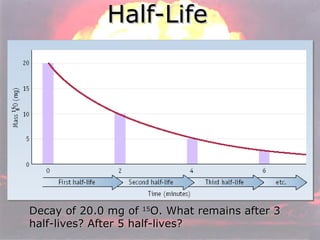
Half-Life Decay of 20.0 mg of  15 O. What remains after 3 half-lives? After 5 half-lives?
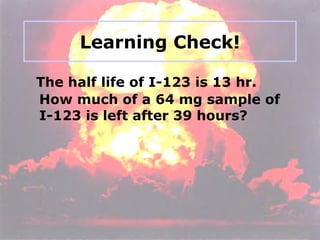
Learning Check! The half life of I-123 is 13 hr.  How much of a 64 mg sample of I-123 is left after 39 hours?
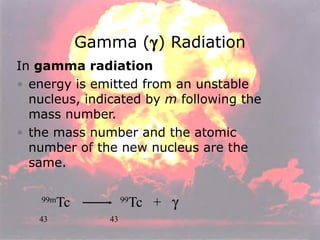
In  gamma radiation energy is emitted from an unstable nucleus, indicated by  m  following the mass number. the mass number and the atomic number of the new nucleus are the same. 99m Tc  99 Tc  +   43  43 Gamma (  ) Radiation
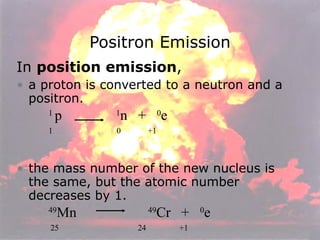
In  position emission , a proton is converted to a neutron and a positron.   1  p    1 n  +  0 e 1    0  +1 the mass number of the new nucleus is the same, but the atomic number decreases by 1. 49 Mn    49 Cr  +  0 e   25  24  +1 Positron Emission
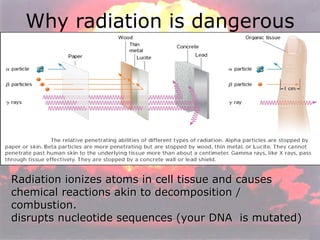
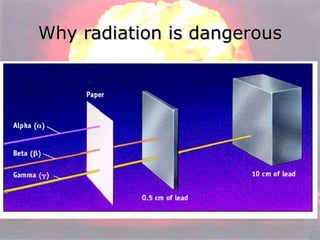
Why radiation is dangerous Radiation ionizes atoms in cell tissue and causes chemical reactions akin to decomposition / combustion.  disrupts nucleotide sequences (your DNA  is mutated)
Why radiation is dangerous
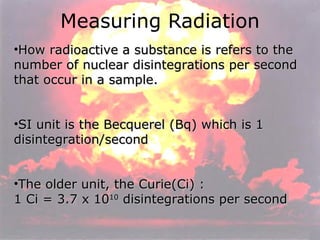
Measuring Radiation How radioactive a substance is refers to the number of nuclear disintegrations per second that occur in a sample.  SI unit is the Becquerel (Bq) which is 1 disintegration/second The older unit, the Curie(Ci) : 1 Ci = 3.7 x 10 10  disintegrations per second
Measuring Radiation The  'rad ' is used to describe the energy quantity or dose of radiation absorbed.  rad  (rd)  stands for “radiation absorbed dose”  One  rad  defined as 10 -5  J/g of material.
Measuring Radiation Damage The rad does not account for the kind of damage done, only for how much radiation goes in. To take into account this fact the REM was derived To find the dose in REMS the dosage in rads is multiplied by a conversion factor that reflects the effectiveness of the  kind  of radiation causing the damage
Dosage in REMS Biological Effect : 25    notable change in blood cell components  100  radiation sickness - nausea, vomiting, decrease in white blood cell count, diarrhea, dehydration, prostration, hemorrhaging and loss of hair  200  the same as above but more pronounced in a shorter period of time    400  ½ of any population exposed to this dosage will be dead in 60 days    600  all exposed to this level will be dead in one week 
 
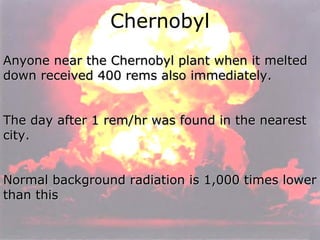
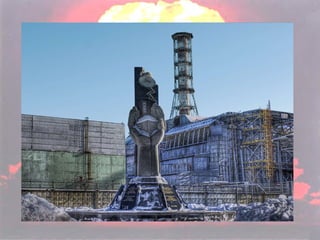
Chernobyl Anyone near the Chernobyl plant when it melted down received 400 rems also immediately.  The day after 1 rem/hr was found in the nearest city.  Normal background radiation is 1,000 times lower than this
 
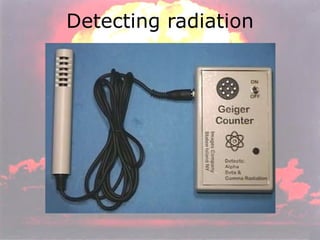
Detecting radiation
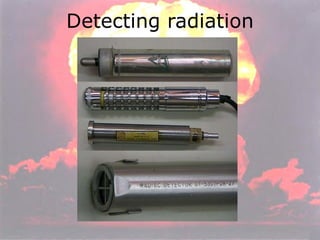
Detecting radiation
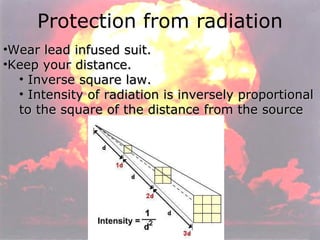
Protection from radiation Wear lead infused suit. Keep your distance. Inverse square law. Intensity of radiation is inversely proportional to the square of the distance from the source
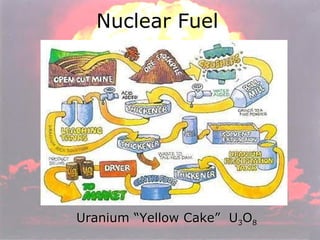
Nuclear Fuel Uranium “Yellow Cake”  U 3 O 8
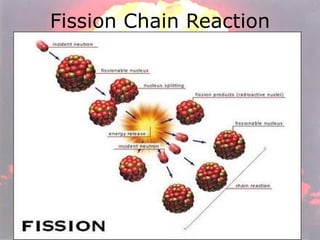
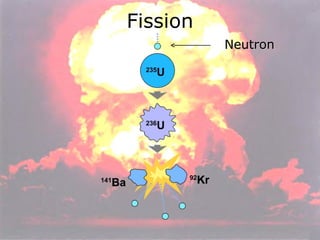
Fission Neutron
Fission Chain Reaction
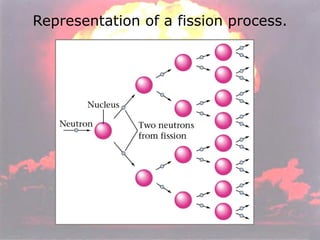
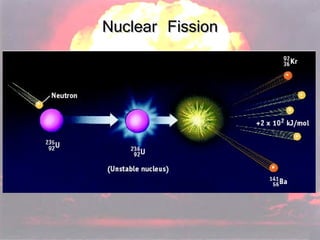
Representation of a fission process.
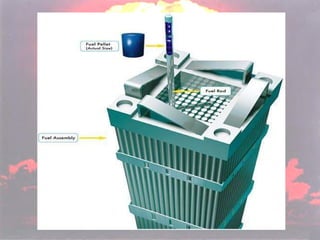
Nuclear Fission
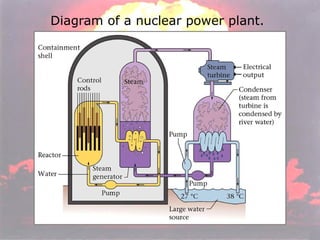
Diagram of a nuclear power plant.
 
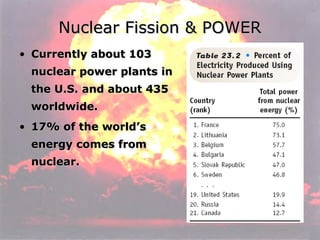
Nuclear Fission & POWER Currently about 103 nuclear power plants in the U.S. and about 435 worldwide. 17% of the world’s energy comes from nuclear.
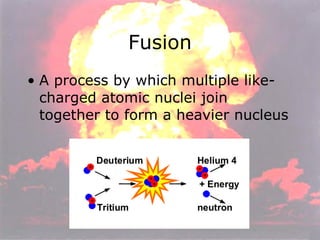
Fusion A process by which multiple like-charged atomic nuclei join together to form a heavier nucleus
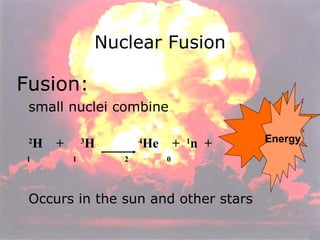
Nuclear Fusion Fusion:  small nuclei combine 2 H  +  3 H  4 He  +  1 n  + 1  1  2  0 Occurs in the sun and other stars Energy
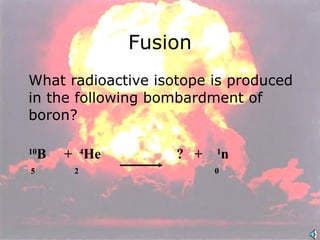
What radioactive isotope is produced in the following bombardment of boron? 10 B  +  4 He    ?  +  1 n  5  2      0  Fusion
Nuclear Fusion Fusion  Excessive heat can not be contained Attempts at “cold” fusion have FAILED. “ Hot” fusion is difficult to contain
Artificial Nuclear Reactions New elements or new isotopes of known elements are produced by bombarding an atom with a subatomic particle such as a proton or neutron -- or even a much heavier particle such as  4 He and  11 B. Reactions using neutrons are called     reactions   because a    ray is usually emitted. Radioisotopes used in medicine are often made by     reactions .
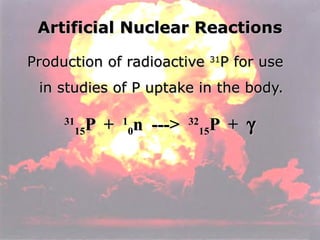
Artificial Nuclear Reactions Production of radioactive  31 P for use in studies of P uptake in the body. 31 15 P  +  1 0 n  --->  32 15 P  +  
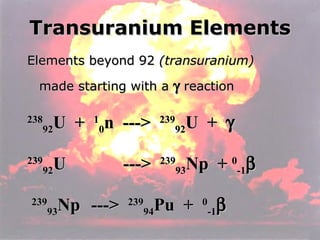
Transuranium Elements Elements beyond 92  (transuranium)  made starting with a     reaction   238 92 U  +  1 0 n  --->  239 92 U  +   239 92 U  --->  239 93 Np  +  0 -1  239 93 Np  --->  239 94 Pu  +  0 -1 
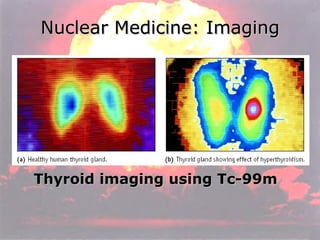
Nuclear Medicine: Imaging Thyroid imaging using Tc-99m
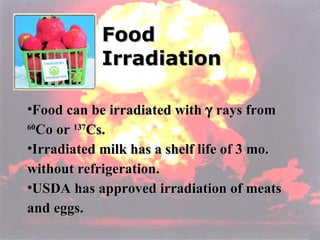
Food Irradiation Food can be irradiated with    rays from  60 Co or  137 Cs. Irradiated milk has a shelf life of 3 mo. without refrigeration. USDA has approved irradiation of meats and eggs.

Nuclear chemistry

  • 1.
  • 2.
    Radioactivity One ofthe pieces of evidence for the fact that atoms are made of smaller particles came from the work of Marie Curie (1876-1934). She discovered radioactivity: the spontaneous disintegration of the nucleus of some elements into smaller pieces.
  • 3.
    Nuclear Reactions vs.Normal Chemical Changes Nuclear reactions involve the nucleus The nucleus loses particles, and protons and neutrons are rearranged The disintegration of the nucleus releases a tremendous amount of energy that holds the nucleus together – called binding energy “ Normal” Chemical Reactions involve electrons, not protons and neutrons
  • 4.
  • 5.
    Types of RadiationAlpha ( ά ) – a positively charged helium isotope - we usually ignore the charge because it involves electrons, not protons and neutrons Beta ( β ) – an electron Gamma ( γ ) – pure energy; called a ray rather than a particle
  • 6.
    Alpha Decay Whena radioactive nucleus emits an alpha particle , a new nucleus forms that has: a mass number that is 4 less than that of the initial nucleus. an atomic number that is decreased by 2.
  • 7.
    Alpha Decay NuclearEquation Copyright © 2005 by Pearson Education, Inc. Publishing as Benjamin Cummings
  • 8.
    In a balancednuclear equation, the sum of the mass numbers and the sum of the atomic numbers for the nuclei of the reactant and the products must be equal. MASS NUMBERS Total = 251 = 251 251 Cf 247 Cm + 4 He 98 96 2 Total = 98 = 98 ATOMIC NUMBERS Balancing Nuclear Equations
  • 9.
    Equation for AlphaDecay Write an equation for the alpha decay of 222 Rn. STEP 1 Write the incomplete equation 222 Rn ?s + 4 He 86 2 STEP 2 Determine the mass number 222 – 4 = 218 STEP 3 Determine the atomic number 86 – 2 = 84 STEP 4 Determine the symbol of element 84 = Po STEP 5 Complete the equation 222 Rn 218 Po + 4 He 86 84 2
  • 10.
    Beta Decay A beta particle is an electron emitted from the nucleus. forms when a neutron in the nucleus breaks down. 1 n 0 e + 1 H 0 -1 1
  • 11.
    STEP 1 Write an equation for the decay of 42 Potassium,a beta emitter. 42 K new nucleus + 0 e 19 -1 STEP 2 Mass number : (same) = 42 STEP 3 Atomic number: 19 + 1 = 20 STEP 4 Symbol of element 20 = Ca STEP 5 42 K 42 Ca + 0 e 19 20 -1 Writing An Equation for Beta Decay
  • 12.
    Other Nuclear ParticlesNeutron Positron – a positive electron Proton – usually referred to as Hydrogen +1 Any other elemental isotope
  • 13.
  • 14.
  • 15.
    Half Life Thetime required for half of the nuclei in a sample of a specific isotope to undergo radioactive decay.
  • 16.
    Half Lives forRadioactive Elements Radioactive Parent Stable Daughter Half life Potassium 40 Argon 40 1.25 billion yrs Rubidium 87 Strontium 87 48.8 billion yrs Thorium 232 Lead 208 14 billion years Uranium 235 Lead 207 704 million years Uranium 238 Lead 206 4.47 billion years Carbon 14 Nitrogen 14 5730 years
  • 17.
    Half Life andradioactive dating
  • 18.
    Half-Life Decay of20.0 mg of 15 O. What remains after 3 half-lives? After 5 half-lives?
  • 19.
    Learning Check! Thehalf life of I-123 is 13 hr. How much of a 64 mg sample of I-123 is left after 39 hours?
  • 20.
    In gammaradiation energy is emitted from an unstable nucleus, indicated by m following the mass number. the mass number and the atomic number of the new nucleus are the same. 99m Tc 99 Tc +  43 43 Gamma (  ) Radiation
  • 21.
    In positionemission , a proton is converted to a neutron and a positron. 1 p 1 n + 0 e 1 0 +1 the mass number of the new nucleus is the same, but the atomic number decreases by 1. 49 Mn 49 Cr + 0 e 25 24 +1 Positron Emission
  • 22.
    Why radiation isdangerous Radiation ionizes atoms in cell tissue and causes chemical reactions akin to decomposition / combustion. disrupts nucleotide sequences (your DNA is mutated)
  • 23.
  • 24.
    Measuring Radiation Howradioactive a substance is refers to the number of nuclear disintegrations per second that occur in a sample. SI unit is the Becquerel (Bq) which is 1 disintegration/second The older unit, the Curie(Ci) : 1 Ci = 3.7 x 10 10 disintegrations per second
  • 25.
    Measuring Radiation The 'rad ' is used to describe the energy quantity or dose of radiation absorbed. rad (rd) stands for “radiation absorbed dose” One rad defined as 10 -5 J/g of material.
  • 26.
    Measuring Radiation DamageThe rad does not account for the kind of damage done, only for how much radiation goes in. To take into account this fact the REM was derived To find the dose in REMS the dosage in rads is multiplied by a conversion factor that reflects the effectiveness of the kind of radiation causing the damage
  • 27.
    Dosage in REMSBiological Effect : 25    notable change in blood cell components  100  radiation sickness - nausea, vomiting, decrease in white blood cell count, diarrhea, dehydration, prostration, hemorrhaging and loss of hair  200  the same as above but more pronounced in a shorter period of time  400  ½ of any population exposed to this dosage will be dead in 60 days  600  all exposed to this level will be dead in one week 
  • 28.
  • 29.
    Chernobyl Anyone nearthe Chernobyl plant when it melted down received 400 rems also immediately. The day after 1 rem/hr was found in the nearest city. Normal background radiation is 1,000 times lower than this
  • 30.
  • 31.
  • 32.
  • 33.
    Protection from radiationWear lead infused suit. Keep your distance. Inverse square law. Intensity of radiation is inversely proportional to the square of the distance from the source
  • 34.
    Nuclear Fuel Uranium“Yellow Cake” U 3 O 8
  • 35.
  • 36.
  • 37.
    Representation of afission process.
  • 38.
  • 39.
    Diagram of anuclear power plant.
  • 40.
  • 41.
    Nuclear Fission &POWER Currently about 103 nuclear power plants in the U.S. and about 435 worldwide. 17% of the world’s energy comes from nuclear.
  • 42.
    Fusion A processby which multiple like-charged atomic nuclei join together to form a heavier nucleus
  • 43.
    Nuclear Fusion Fusion: small nuclei combine 2 H + 3 H 4 He + 1 n + 1 1 2 0 Occurs in the sun and other stars Energy
  • 44.
    What radioactive isotopeis produced in the following bombardment of boron? 10 B + 4 He ? + 1 n 5 2 0 Fusion
  • 45.
    Nuclear Fusion Fusion Excessive heat can not be contained Attempts at “cold” fusion have FAILED. “ Hot” fusion is difficult to contain
  • 46.
    Artificial Nuclear ReactionsNew elements or new isotopes of known elements are produced by bombarding an atom with a subatomic particle such as a proton or neutron -- or even a much heavier particle such as 4 He and 11 B. Reactions using neutrons are called  reactions because a  ray is usually emitted. Radioisotopes used in medicine are often made by  reactions .
  • 47.
    Artificial Nuclear ReactionsProduction of radioactive 31 P for use in studies of P uptake in the body. 31 15 P + 1 0 n ---> 32 15 P + 
  • 48.
    Transuranium Elements Elementsbeyond 92 (transuranium) made starting with a  reaction 238 92 U + 1 0 n ---> 239 92 U +  239 92 U ---> 239 93 Np + 0 -1  239 93 Np ---> 239 94 Pu + 0 -1 
  • 49.
    Nuclear Medicine: ImagingThyroid imaging using Tc-99m
  • 50.
    Food Irradiation Foodcan be irradiated with  rays from 60 Co or 137 Cs. Irradiated milk has a shelf life of 3 mo. without refrigeration. USDA has approved irradiation of meats and eggs.