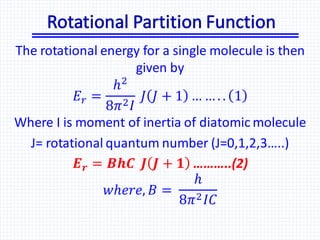
The rotational energy for a single molecule is then
given by
𝐸𝑟 =
ℎ2
8𝜋2 𝐼
𝐽 𝐽 + 1 … … . . 1
Where I is moment of inertia of diatomic molecule
J= rotational quantum number (J=0,1,2,3…..)
𝑬 𝒓 = 𝑩𝒉𝑪 𝑱 𝑱 + 𝟏 ………..(2)
𝑤ℎ𝑒𝑟𝑒, 𝐵 =
ℎ
8𝜋2 𝐼𝐶
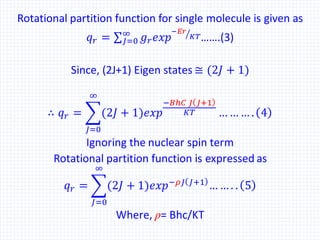
Rotational partition function for single molecule is given as
𝑞 𝑟 = 𝑔 𝑟 𝑒𝑥𝑝
−𝐸𝑟
𝐾𝑇∞
𝐽<0 …….(3)
Since, (2J+1) Eigen states ≅ (2𝐽 + 1)
∴ 𝑞 𝑟 = (2𝐽 + 1)𝑒𝑥𝑝
;𝐵ℎ𝐶 𝐽 𝐽:1
𝐾𝑇
∞
𝐽<0
… … … . 4
Ignoring the nuclear spin term
Rotational partition function is expressed as
𝑞 𝑟 = (2𝐽 + 1)𝑒𝑥𝑝;𝜌𝐽 𝐽:1 … … . . 5
∞
𝐽<0
Where, = Bhc/KT
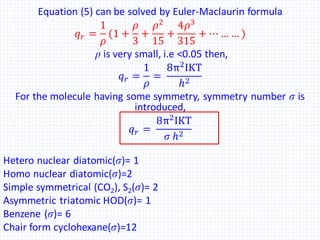
Equation (5) can be solved by Euler-Maclaurin formula
𝑞 𝑟 =
1
𝜌
(1 +
𝜌
3
+
𝜌2
15
+
4𝜌3
315
+ ⋯ … … )
 is very small, i.e <0.05 then,
𝑞 𝑟 =
1
𝜌
=
8π2
IKT
ℎ2
For the molecule having some symmetry, symmetry number  is
introduced,
𝑞 𝑟 =
8π2IKT
 ℎ2
Hetero nuclear diatomic()= 1
Homo nuclear diatomic()=2
Simple symmetrical (CO2), S2()= 2
Asymmetric triatomic HOD()= 1
Benzene ()= 6
Chair form cyclohexane()=12
𝐸𝑟 = 𝐾𝑇2
𝜕𝑙𝑛𝑄
𝜕𝑇 𝑉
Since, 𝑄 𝑟 = 𝑞 𝑟
𝑁
Or, 𝑙𝑛𝑄 𝑟 = 𝑁𝑙𝑛
8π2IKT
 ℎ2
Or,
𝜕𝑙𝑛𝑄
𝜕𝑇 𝑉
=
1
𝑇
× 𝑁
Substituting this rotational energy is found to be
𝐸𝑟 = 𝐾𝑇2
×
1
𝑇
× 𝑁
Er= NKT
Er= nRT
𝐶 𝑉 =
𝜕
𝜕𝑇
𝐾𝑇2
𝜕𝑙𝑛𝑄
𝜕𝑇
𝑉
𝐶 𝑉 =
𝜕
𝜕𝑇
𝐾𝑇2
×
1
𝑇
× 𝑁
𝐶 𝑉 = 𝑁𝑇
= 𝑛𝑅
Similarly,
entropy, free energy and enthalpy is related as
∴ 𝑆𝑟 = 𝑛𝑅[1 + 𝑙𝑛
8π2
IKT
 ℎ2 ]
∴ 𝐺𝑟 = −𝑛𝑅𝑇𝑙𝑛
8π2
IKT
 ℎ2
Hr= nRT
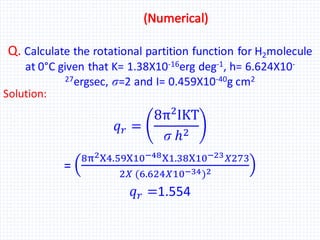
Q. Calculate the rotational partition function for H2molecule
at 0°C given that K= 1.38X10⁻¹⁶erg deg-1, h= 6.624X10-
27ergsec, =2 and I= 0.459X10-40g cm2
Solution:
𝑞 𝑟 =
8π2
IKT
 ℎ2
=
8π2X4.59X10−48X1.38X10−23 𝑋273
2𝑋 (6.624𝑋10−34)2
𝑞 𝑟 =1.554
Thank You

Rotational partition function

  • 2.
    The rotational energyfor a single molecule is then given by 𝐸𝑟 = ℎ2 8𝜋2 𝐼 𝐽 𝐽 + 1 … … . . 1 Where I is moment of inertia of diatomic molecule J= rotational quantum number (J=0,1,2,3…..) 𝑬 𝒓 = 𝑩𝒉𝑪 𝑱 𝑱 + 𝟏 ………..(2) 𝑤ℎ𝑒𝑟𝑒, 𝐵 = ℎ 8𝜋2 𝐼𝐶
  • 3.
    Rotational partition functionfor single molecule is given as 𝑞 𝑟 = 𝑔 𝑟 𝑒𝑥𝑝 −𝐸𝑟 𝐾𝑇∞ 𝐽<0 …….(3) Since, (2J+1) Eigen states ≅ (2𝐽 + 1) ∴ 𝑞 𝑟 = (2𝐽 + 1)𝑒𝑥𝑝 ;𝐵ℎ𝐶 𝐽 𝐽:1 𝐾𝑇 ∞ 𝐽<0 … … … . 4 Ignoring the nuclear spin term Rotational partition function is expressed as 𝑞 𝑟 = (2𝐽 + 1)𝑒𝑥𝑝;𝜌𝐽 𝐽:1 … … . . 5 ∞ 𝐽<0 Where, = Bhc/KT
  • 4.
    Equation (5) canbe solved by Euler-Maclaurin formula 𝑞 𝑟 = 1 𝜌 (1 + 𝜌 3 + 𝜌2 15 + 4𝜌3 315 + ⋯ … … )  is very small, i.e <0.05 then, 𝑞 𝑟 = 1 𝜌 = 8π2 IKT ℎ2 For the molecule having some symmetry, symmetry number  is introduced, 𝑞 𝑟 = 8π2IKT  ℎ2 Hetero nuclear diatomic()= 1 Homo nuclear diatomic()=2 Simple symmetrical (CO2), S2()= 2 Asymmetric triatomic HOD()= 1 Benzene ()= 6 Chair form cyclohexane()=12
  • 5.
    𝐸𝑟 = 𝐾𝑇2 𝜕𝑙𝑛𝑄 𝜕𝑇𝑉 Since, 𝑄 𝑟 = 𝑞 𝑟 𝑁 Or, 𝑙𝑛𝑄 𝑟 = 𝑁𝑙𝑛 8π2IKT  ℎ2 Or, 𝜕𝑙𝑛𝑄 𝜕𝑇 𝑉 = 1 𝑇 × 𝑁 Substituting this rotational energy is found to be 𝐸𝑟 = 𝐾𝑇2 × 1 𝑇 × 𝑁 Er= NKT Er= nRT
  • 6.
    𝐶 𝑉 = 𝜕 𝜕𝑇 𝐾𝑇2 𝜕𝑙𝑛𝑄 𝜕𝑇 𝑉 𝐶𝑉 = 𝜕 𝜕𝑇 𝐾𝑇2 × 1 𝑇 × 𝑁 𝐶 𝑉 = 𝑁𝑇 = 𝑛𝑅 Similarly, entropy, free energy and enthalpy is related as ∴ 𝑆𝑟 = 𝑛𝑅[1 + 𝑙𝑛 8π2 IKT  ℎ2 ] ∴ 𝐺𝑟 = −𝑛𝑅𝑇𝑙𝑛 8π2 IKT  ℎ2 Hr= nRT
  • 7.
    Q. Calculate therotational partition function for H2molecule at 0°C given that K= 1.38X10⁻¹⁶erg deg-1, h= 6.624X10- 27ergsec, =2 and I= 0.459X10-40g cm2 Solution: 𝑞 𝑟 = 8π2 IKT  ℎ2 = 8π2X4.59X10−48X1.38X10−23 𝑋273 2𝑋 (6.624𝑋10−34)2 𝑞 𝑟 =1.554
  • 8.