Managing Pneumothorax
Dan Stevens
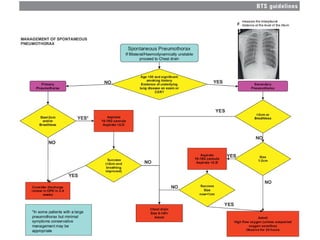
Pneumothorax
• Spontaneous or Traumatic
• Primary or Secondary
• Old or Young (patient)
• Breathless or Not
• Big or Small
• Admit or Discharge
• Aspirate or Drain (big or small)
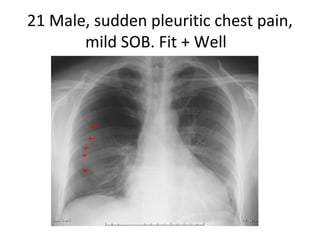
21 Male, sudden pleuritic chest pain,
mild SOB. Fit + Well
Spontaneous Pneumothorax
• Why is secondary important
– Increased mortality
– Increased morbidity
• Why size matters
– 2cm cut off has been chosen as compromise between risks of
intervention and length of time to resolution
– 2cm estimated to mean loss of 50% volume of hemithorax
– Rate of resolution = 2% hemithorax in 24 hrs
– Therefore 2cm = 25 days (without leak)
ED Treatment Options
• Oxygen
– Decreases time to resolution 4 fold
• Simple aspiration
– 2nd
intercostal space midclavicular line?
• Chest drain
– Small bores recommended (F10-14)
• Better tolerated and no evidence larger is better
– Triangle of safety
– 2nd
intercostal space mid clavicular line in apical
Discharge Advice
• Return if SOB
• No flying until complete resolution
– Airlines arbitrarily say at least 6 weeks
– Some say at least 1 week after complete resolution
– Risk of recurrence reduces significantly after 1 year
• Avoid sports until complete resolution
• No scuba diving
– Unless cleared to do so
– Undergone bilateral surgical pleurectomy, has normal lung
function and chest CT
• Stop smoking
– Increased risk of recurrence
Follow Up
• All patients should be followed up by a
respiratory physician
• 2 – 4 weeks to ensure complete resolution
• Failure to re-expand within 24 hours with drain
suggests air leak  referral to respiratory
physician
– Suction
– Drain repositioning
• Failure to re-expand at 3-5 days suggests
persistant air leak  Thoracic surgeons
1am, 25 male. L sided chest pain, x1
previous pneumothorax
68 Female. SOB and chest pain. COPD
26 female, 19 weeks pregnant, chest
pain, slight SOB
When Else to Involve Specialist Early
• Recurrent pneumothorax (2nd ipsalateral or 1st
contralateral pneumothorax)
• Bilateral pneumothorax
• Professions at risk (Diving, Pilots)
• Pregnancy
– Involvement of obstetrics and thoracic surgeons
early
– High risk recurrence therefore aim to avoid chest
drain
25 male. Fallen off bike. L chest Pain
Traumatic Pneumothorax
• Often require treatment with chest drain
• Management of occult pneumothorax
– No lung edge seen on chest x-ray
• Supine
• Small
– Often picked up on CT chest
• Require intervention (drain) if intubation is
required or patient symptomatic
• Can be treated with observation and oxygen
Definitive Treatment Options
• Open thoracotomy
• VATS (Video-assisted thoracoscopic surgery)
• Surgical chemical pleurodesis
• Medical pleurodesis
– Less effective
Summary
• Spontaneous and traumatic can be treated
similarly
• Patients age, medical state, level of
breathlessness and size of pneumothorax are
main deciding factors
• There are several treatment options
– Can we just leave it to the patient to decide what
they want?

Managing pneumothorax

  • 1.
  • 2.
    Pneumothorax • Spontaneous orTraumatic • Primary or Secondary • Old or Young (patient) • Breathless or Not • Big or Small • Admit or Discharge • Aspirate or Drain (big or small)
  • 3.
    21 Male, suddenpleuritic chest pain, mild SOB. Fit + Well
  • 5.
    Spontaneous Pneumothorax • Whyis secondary important – Increased mortality – Increased morbidity • Why size matters – 2cm cut off has been chosen as compromise between risks of intervention and length of time to resolution – 2cm estimated to mean loss of 50% volume of hemithorax – Rate of resolution = 2% hemithorax in 24 hrs – Therefore 2cm = 25 days (without leak)
  • 6.
    ED Treatment Options •Oxygen – Decreases time to resolution 4 fold • Simple aspiration – 2nd intercostal space midclavicular line? • Chest drain – Small bores recommended (F10-14) • Better tolerated and no evidence larger is better – Triangle of safety – 2nd intercostal space mid clavicular line in apical
  • 7.
    Discharge Advice • Returnif SOB • No flying until complete resolution – Airlines arbitrarily say at least 6 weeks – Some say at least 1 week after complete resolution – Risk of recurrence reduces significantly after 1 year • Avoid sports until complete resolution • No scuba diving – Unless cleared to do so – Undergone bilateral surgical pleurectomy, has normal lung function and chest CT • Stop smoking – Increased risk of recurrence
  • 8.
    Follow Up • Allpatients should be followed up by a respiratory physician • 2 – 4 weeks to ensure complete resolution • Failure to re-expand within 24 hours with drain suggests air leak  referral to respiratory physician – Suction – Drain repositioning • Failure to re-expand at 3-5 days suggests persistant air leak  Thoracic surgeons
  • 9.
    1am, 25 male.L sided chest pain, x1 previous pneumothorax
  • 11.
    68 Female. SOBand chest pain. COPD
  • 13.
    26 female, 19weeks pregnant, chest pain, slight SOB
  • 15.
    When Else toInvolve Specialist Early • Recurrent pneumothorax (2nd ipsalateral or 1st contralateral pneumothorax) • Bilateral pneumothorax • Professions at risk (Diving, Pilots) • Pregnancy – Involvement of obstetrics and thoracic surgeons early – High risk recurrence therefore aim to avoid chest drain
  • 16.
    25 male. Fallenoff bike. L chest Pain
  • 17.
    Traumatic Pneumothorax • Oftenrequire treatment with chest drain • Management of occult pneumothorax – No lung edge seen on chest x-ray • Supine • Small – Often picked up on CT chest • Require intervention (drain) if intubation is required or patient symptomatic • Can be treated with observation and oxygen
  • 18.
    Definitive Treatment Options •Open thoracotomy • VATS (Video-assisted thoracoscopic surgery) • Surgical chemical pleurodesis • Medical pleurodesis – Less effective
  • 19.
    Summary • Spontaneous andtraumatic can be treated similarly • Patients age, medical state, level of breathlessness and size of pneumothorax are main deciding factors • There are several treatment options – Can we just leave it to the patient to decide what they want?